
Again looking at my travel ,history books in my library I came upon this time that we visited several times while in living in the area you know where. I am glad to have found couple pictures in my cd rom vault to tell you more of Le Vésinet for you and me. Therefore, let me tell you about curiosities of Le Vésinet !!! Hope you enjoy the story as I.
The town of Le Vésinet is renowned for attracting the bourgeoisie of the last century. To stay close to the splendors of Paris but enjoy a unique and stately green setting, there was nothing better than here. The town is in my former Yvelines dept 78 of the Île de France region of my belle France, It is 15 km from Paris ,4 km from Saint-Germain-en-Laye, 12 km from Versailles, and 442 km from my current home. The neighboring towns all known and many if not all in my blog are Chatou, Croissy-sur-Seine, Le Pecq, and ,Montesson. The town has four main axes radiating from the Place de la République located on the site of the forest star: the Sartrouville road D 121 , the Montesson road D 311, the Boulevard Carnot D 186 ,and the Route de Croissy D 121. The boulevard Carnot connects the Pecq bridge to the Chatou bridge and constitutes the main artery of the town. The town, is ,also, connected to the A86 via the Chatou bridge and to the A13, Rocquencourt interchange via Saint-Germain-en-Laye N13.
The Palais Rose is located at 12, rue Diderot. The main façade, which faces the Lac des Ibis, is rectangular and comprising only one floor, it has two wings and a wide staircase accessed by the same number of steps as the Grand Trianon, decorated with nine arched doors separated by Ionic-style pilasters in pink marble. We also find the same entablature bordered by a balustrade. This ground floor consists of a series of state rooms (living rooms, dining room, library). Finally, to the north is the private apartment of the master of the house (bedroom, boudoir or antechamber and bathroom). The rear façade, for its part, has nothing in common with the Grand Trianon. It rests on a base. Here we find the service rooms (kitchens, linen room, boiler room and servants’ rooms). To connect the upper and lower parts, two mezzanines have been created in the wings of the building. They overlook the garden.
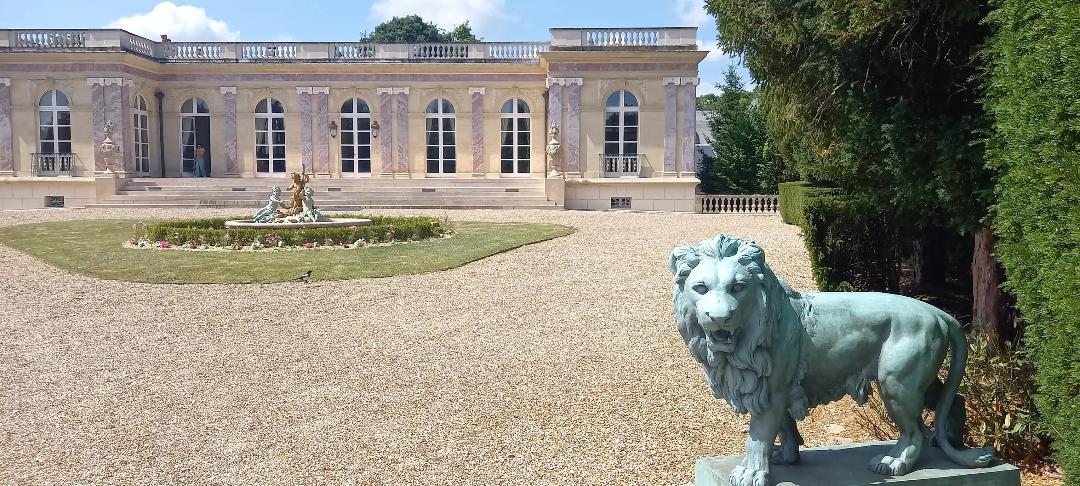
It was built for the shipowner Arthur Schweitzer, he acquired two adjacent plots of land overlooking the Lac des Ibis between 1899 and 1900 and had a private mansion built there, following the main architectural lines of the Grand Trianon in Versailles. It subsequently had around ten owners, some of whom were illustrious, such as Count Robert de Montesquiou which the sale was signed on October 29, 1908. He occupied the premises until 1921, the year of his death. However, there were illustrious visitors, friends of the time, or not yet so illustrious, young people for whom the aging poet was establishing himself as a mentor. We can thus name Gabriele d’Annunzio, Ida Rubinstein, Claude Debussy, Colette, Rodin, Sarah Bernhardt, Maurice Rostand, Jean Cocteau or Cécile Sorel.etc. At the beginning of the Battle of France in WWII, General de Gaulle, having just taken command of the 4th Armored Division, accepted the hospitality of Mr. Scrive, and stayed from May 12 to 15, 1940 at the Hermitage of the Palais Rose, as evidenced by the commemorative plaque sealed to the building itself and visible from rue Diderot. The Palais Rose was bought at the end of the 1990s by the SCI Palais Rose, worked was started during which Emad Khashoggi, at the head of his company, COGEMAD, would completely undertake the renovation and enlarge the Palais Rose, while preserving all the noble levels.
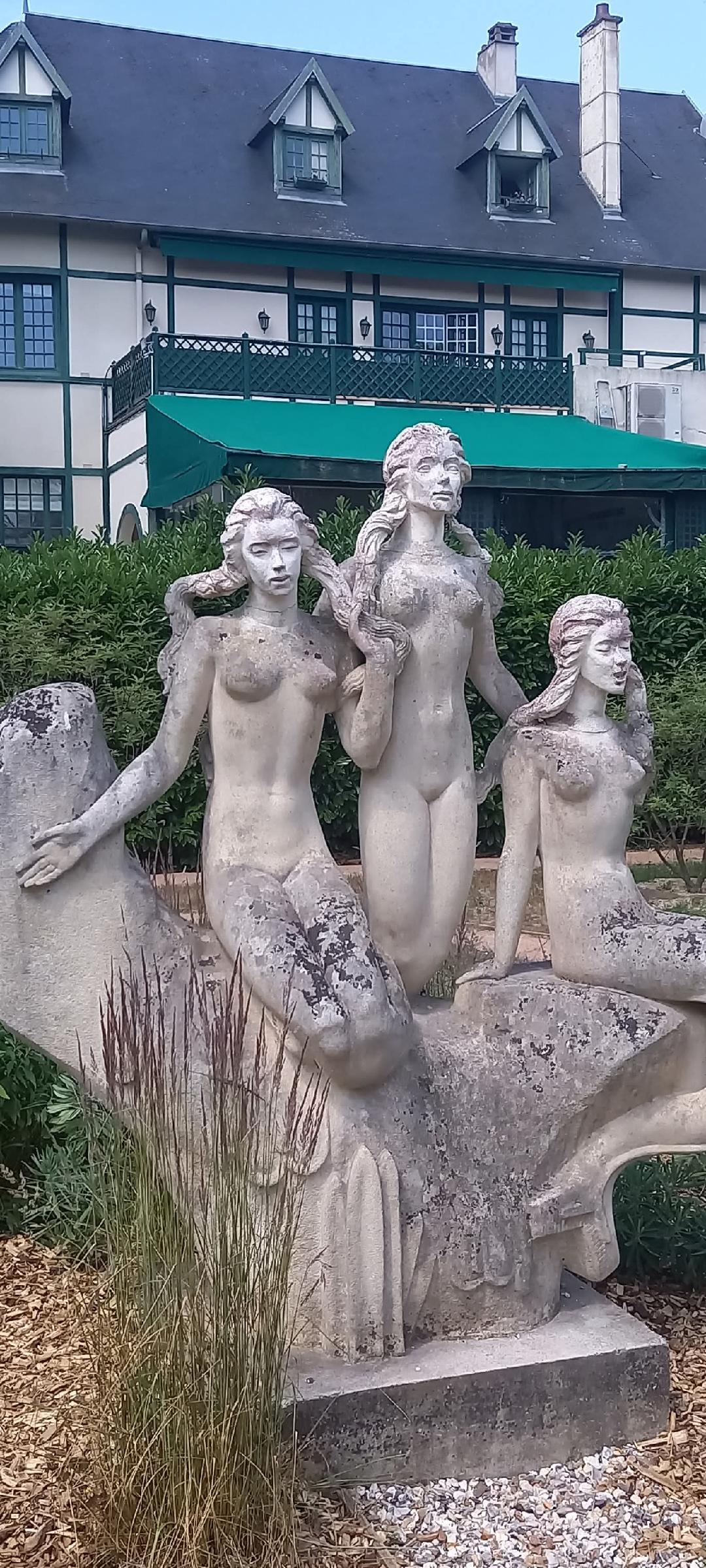
The statue le Chant des Sirènes or the Song of the Sirens, located in the Ibis Park near the Grand Lac., Ibis Island, also known as Ibis Park. The garden city is even more wooded than you could imagine. This 30-hectare island is a majestic and refreshing place. The island is open to the public and, of course, access is free all year round. The initial sculptor was Ulysse Gemignani in 1946 and by 2016 it was renovated by Christine Blanc.
Other things to see here are the many villas with picturesque architecture and very diverse styles from Anglo-Norman, neo-Gothic, Roman, etc, from the end of the 19C and the beginning of the 20C. The Wood Cottage at 122, boulevard des États-Unis, factory house built in 1864 The Sainte-Marguerite Church at place de l’Église, the first non-industrial building made of concrete in France. The church was built from 1862 to 1865, The Villa Berthe or La Hublotière at 72, route de Montesson built in 1896, it is one of the rare residential buildings of the architect Hector Guimard, The Sainte-Pauline Church at 55, boulevard d’Angleterre Initially attached to Sainte-Marguerite, Sainte-Pauline became a parish on January 15, 1919.
A bit of history tell us that the current territory of Le Vésinet was covered by a forest, part of the old Yveline forest, acquired by King Francis I in the 16C, and long remaining a hunting estate of the crown. From the Middle Ages to the reign of Louis XIV, the forest had a bad reputation; however, this did not prevent Louis XIV from hunting there. Cardinal de Noailles had the forest cleared and built houses and a chapel for the farmers. Le Vésinet was a hamlet of Chatou before 1726, then Le Pecq between 1726 and 1874. During the French revolution, on December 10, 1793, this territory was divided between the new towns of Croissy, Chatou, Montesson and Le Pecq. In 1855, Napoleon III decreed that an asylum for convalescent or mutilated workers during their work would be built south of the Bois du Vésinet. On September 29, 1859, the imperial asylum of Le Vésinet was inaugurated. It is still currently a health establishment, owned by the Yvelines department. In 1866, a racecourse was installed around the current Grand Lac, also called Lac des Ibis and called at the time “Lac du Champ de Courses”. On May 31, 1875, Le Vésinet was established as an autonomous town. The Tour de France started from Le Vésinet in 1925 and then every year from 1927 to 1939 inclusive. The organizer of the start was Julien Rudolphe, a track runner and middle-distance cyclist before the Great War or WWI. In 1917, he set up his workshop and cycle construction and repair shop in town in the building he had built at 15 bis boulevard Carnot, a building which now belongs to the City. A commemorative plaque is placed on the facade.
The official sculptor Christine Blanc : https://christineblanc.fr/les-sirenes-du-vesinet/
The Seine Saint Germain tourist office on the Grand Lac des Ibis : https://www.seine-saintgermain.fr/offres/grand-lac-des-ibis-le-vesinet-fr-5357029/
The town of Le Vésinet on its history : https://villeduvesinet.fr/la-ville/le-vesinet-ville-parc/histoire-de-la-ville/
The Yvelines dept 78 tourist office on the palais rose :https://www.destination-yvelines.fr/visites-et-decouvertes/le-grand-trianon-du-vesinet-le-palais-rose/
The history society of Vésinet (see édifices classé) : https://histoire-vesinet.org/
The Vésinet Site Initiatives and Defense Society on its heritage : https://sidslevesinet.fr/tourisme-2/les-monuments-historiques/
There you go folks, a nice chic town with nice history and beautiful architecture all over, worth the detour. Le Vésinet is one to know, and glad now fully in my blog. Again, hope you enjoy the post on curiosities of Le Vésinet !!! as I.
And remember, happy travels, good health, and many cheers to all !!!

 Paris1972-Versailles2003