
We have driven and walked in my eternal Paris, and would like to have an imprint in my blog on the wonderful family times we had there, There is so much to see , doing my best, and glad found me this picture in my cd rom vault ,which now transposing in my blog for you and me, This was my former worked city, so glad to post more memorable spots on it, I thank you for your readership over the years and to bear with my rants! After Paris is to rant, shout and yelled about, me think. Therefore, here is my take on curiosities of Paris , part XXXIX !!! Hope you enjoy the post as I.
The rue de Nesle is located in the Monnaie quartier or neighborhood in the 6éme arrondissement or district of Paris. It is so named because of the proximity of the former Hôtel de Nesle and the former Tour de Nesle. The street was opened in 1607 on the site of the former Collège de Saint-Denis, which was sold in 1595 and immediately demolished. It then took the name “rue d’Anjou-Dauphine,” in homage to Gaston d’Anjou, third son of Henri IV. It is mentioned under the name “rue d’Anjou” in a manuscript from 1636. It took its current name by a decree of February 26, 1867. It is served by metro Odéon, lines 4 and 10. Notable buildings here are at no. 8, in the 1960s, the bookstore of Jean-Jacques Pauvert. founder of Éditions Pauvert. founded in 1947, In 1979, Éditions Pauvert became the Compagnie Jean-Jacques Pauvert, In 1999, Éditions Pauvert became a subsidiary of Librairie Artheme Fayard, without Jean-Jacques Pauvert who kept his full name for the authors he would publish in co-edition with this or that other publisher of his choice. At no. 8, the Museum of Letters and Manuscripts from 2004 to 2010 transferred to 222, boulevard Saint-Germain. The place was transformed in 2013 into the Théâtre de Nesle theater. At no. 13 are remains of the old enclosure wall of Philippe Auguste.

The official Théâtre Nesle: https://www.theatredenesle.com/
The Paris tourist office on the 6éme arrondissment de Paris: https://parisjetaime.com/eng/article/explore-paris-s-6th-arrondissement-a823
The Mairie or City hall of the 9éme arrondissement of Paris is located at 6 rue Drouot. It occupies the Hôtel d’Augny, then Aguado, built in 1748 for the farmer-general Alexandre Estienne, Baron d’Augny. During the French revolution, the baron remained secluded in his mansion; he remained one of the few farmers-general to have escaped the guillotine. In 1829, this mansion became the property of the banker Alexandre Marie Aguado, Marquis of Las Marismas del Guadalquivir. The interior decoration was completely transformed; the Rococo ornamentation was replaced by a more sober decoration, typical of the Charles X era. The wrought iron balconies and the door knobs are marked with the initials “AA” Aguado kept the hotel until his death in 1842. In 1848, the hotel was acquired by the city of Paris and became the City/town hall of the former 2éme arrondissement, then hosted the municipal services of the city hall of the 9éme arrondissement of Paris from 1860. According to some contemporaries, the Hôtel d’Augny was “one of the most beautiful houses in Paris”, “with small apartments like those of the King, covered riding school, baths, farmyard, all decorated with paintings by the most famous artists” The hotel is served by metro line 7, Le Peletier station and by metro lines 8 and 9, Richelieu-Drouot station.
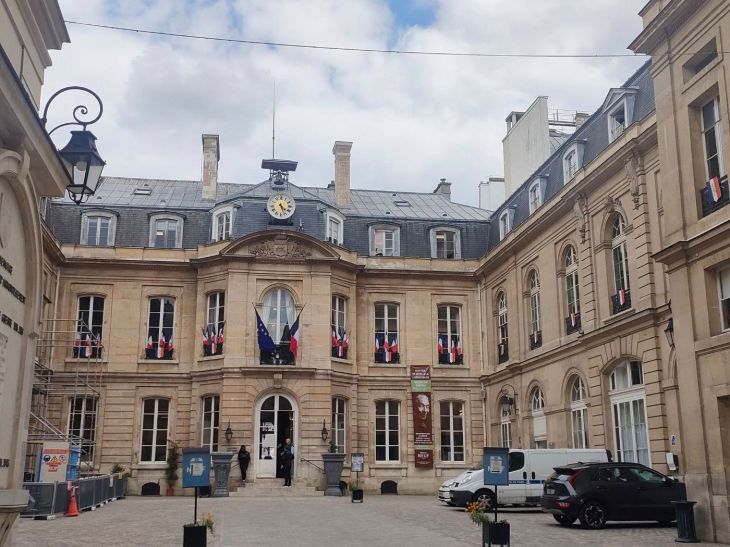
The City of Paris on the 9éme arrondissement City hall : https://www.paris.fr/lieux/mairie-du-9e-arrondissement-3859
The Mairie or City/town hall of the 10éme arrondissement of Paris is located at 72, rue du Faubourg-Saint-Martin. This site is served by the metro line 4 Château d’Eau station, and line 5 Jacques Bonsergent station. The City/town hall of the former 5éme arrondissement has had several successive locations. In 1800-1801, it was transferred from the former presbytery of the Saint-Laurent church to a building then bearing the number 30 rue de Bondy (now rue René-Boulanger). In 1811, the municipal services were moved and occupied number 2 rue de la Grange-aux-Belles (now 32, rue de Lancry). In 1823, the City/town hall moved once again to 24, rue Thévenot, where it remained until 1832 before returning to 20, rue de Bondy (now rue René-Boulanger). Finally, on July 1, 1849, the City/town hall was installed in the former barracks of the Municipal Guard, rue du Faubourg-Saint-Martin, on the site where it would be rebuilt, the current location, in the block formed by the streets of Faubourg-Saint-Martin, du Château-d’Eau, Pierre-Bullet and Hittorf. The program was established under the supervision of Charles Garnier and Adolphe Alphand. Construction began on January 10, 1892, and was inaugurated in 1896. The sculptures on the facade, completed in 1906, represent the trades of the district: Les Parfums by Ernest-Eugène Chrétien, Le Théâtre by Gaston Veuvenot Leroux, La Passementerie by Henri Barrau, La Verrerie by Louis Demaille, La Embroidery by Emmanuel de Moncel de Perrin, Ceramics by Raoul Larche, Goldsmithing by Jean Carlus, and Artificial Flowers by Julien Caussé.

The City of Paris on the 10éme arrondissement City hall : https://www.paris.fr/lieux/mairie-du-10e-arrondissement-3860
The Institut national du patrimoine or the National Heritage Institute, has its headquarters and the heritage curators’ department located in the Galerie Colbert, in the 2éme arrondissement of Paris between Place des Victoires and the Palais-Royal gardens. The site is accessible at 6, rue des Petits-Champs and 2, rue Vivienne. You can reach it on public transports by metro line 3 Bourse station, line 1 and 7 Palais royal – Musée du Louvre station, Also on bus line 29 arrêt/stop Bibliothèque nationale ou Victoires or bus line 39 arrêt/stop Sainte-Anne-Petits-Champs, The National Heritage Institute (Inp) is a major French school created in 1990. The Galerie Colbert is a covered Parisian passageway, built in 1827 of 83 meters long. It is built on the site of the former Hôtel Colbert, built in the 17C by Louis Le Vau for Guillaume Bautru de Serrant, then acquired by Colbert in 1665. Today it houses many institutions linked to the history of art and cultural heritage with which the institute has close ties, including the National Institute of Art History (INHA), the André Chastel Center and the French Committee for Art History. The building also houses most of the doctoral schools in art history and archaeology from the universities and institutions of Île-de-France region. The National Heritage Institute is on the 3rd floor (4fl US) of the Galerie Colbert. It has classrooms, a computer room and a student residence.
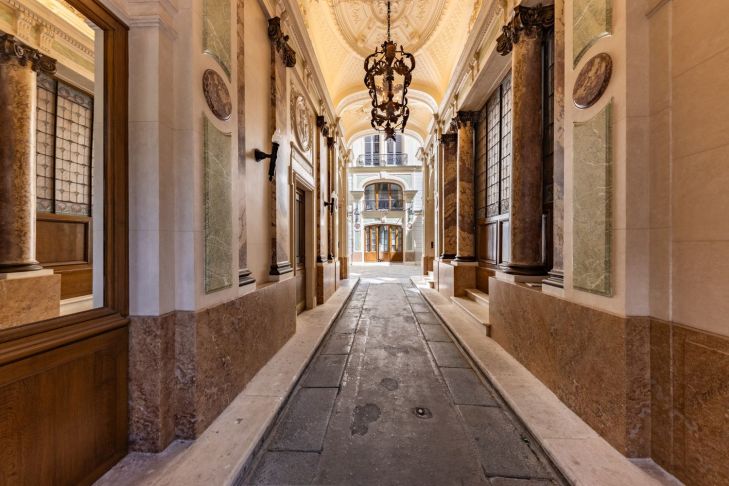
The official Institut National du Patrimoine ,galerie Colbert : https://www.inp.fr/formation-initiale/vie-etudiante/espaces-travail/site-galerie-colbert
The Pavillon de Marsan, part of the Louvre, and was part of the former Palais des Tuileries palace (see posts worked for it). By decree of 1801, Napoleon Bonaparte, who resided at the Tuileries Palace, expelled the artists and other residents of the Louvre. The houses established within the Louvre’s grounds were demolished. The north wing was extended from the Pavillon de Rohan to the Pavillon de Marsan, which became the corner pavilion of the Tuileries. To achieve architectural unity, a replica of Androuet du Cerceau’s façade was built on the waterfront gallery. The Pavillon de Marsan is located at the northwest end of the Louvre Palace , simultaneously forming part of the old Tuileries Palace, of which it was one of the two points of connection with the Pavillon de Flore to the south. It was destroyed by fire during the revolt of the commune de Paris in 1871, then rebuilt from 1874. The Pavillon de Flore served as a model for the Pavillon de Marsan which replaced that of Le Vau. Along the Rue de Rivoli, the north wing of the Louvre then doubled in width. Since 1905, the Pavillon de Marsan and the adjoining buildings have housed the Museum of Decorative Arts. You can reach it on metro line 1 and 7 Palais royal – Musée du Louvre station,line 1 Tuileries station or bus line 72 arrêt/stop Pyramides Tuileries, The Pavillon de Marsan (originally the Pavillon de Pomone) owes its name to the Countess of Marsan, Marie-Louise de Rohan, only daughter of Prince Jules de Rohan-Soubise. She married Gaston de Lorraine, Count of Marsan, on June 14, 1736, but he died prematurely in 1743. Indeed, this part of the palace served for a long time as a residence for the Countess of Marsan, who, in 1754, became governess to the children of France, notably the future kings Louis XVI and Louis XVIII. She died in 1803 at the age of 83. Other occupants were from 1789 – 1790, Adélaïde de France, known as Madame Adélaïde, daughter of Louis XV. From 1820 – 1830, Marie-Caroline of the Two Sicilies, Duchess of Berry, daughter-in-law of Charles X. From 1820 – 1830, Louise d’Artois, Duchess of Parma, daughter of the previous and from 1821 – 1830, Henri d’Artois, Count of Chambord, brother of the previous (was to be future king Henri V,see post),

The official Musée des Arts Décoratifs on the pavillon Marsans : https://madparis.fr/Musee-des-Arts-Decoratifs-1306
The Paris tourist office on the Musée des Arts Décoratifs : https://parisjetaime.com/eng/culture/mad-musee-des-arts-decoratifs-p3554
The Pavillon du Roi or the Hôtel du Pavillon du Roi is located on the Place des Vosges (see post). It occupies the central part of the southern buildings of the square. The equestrian statue of Louis XIII in the center of the square faces it. The passageway through the ground floor of the pavilion, in the axis of the square, leads to the Rue de Birague. The Pavillon du Roi adjoins the Hôtel Coulanges, at 1 bis, the birthplace of Madame de Sévigné. The Pavillon du Roi is one of the main buildings on the Place des Vosges. It was built between 1605 and 1608 at the expense of the French crown, during the creation of the Place Royale (future Place des Vosges). Its first inhabitants were the first valet, ordinary painter of King Charles de Court, and his wife Marie de Guille, who held the position of concierge of the place. In the revolutionary context, Alexandre-Joseph de Bonneval was forced to hand over the King’s Pavilion to the Nation. The hotel became a National Property. On February 5, 1799, the State decided to permanently part with the pavilion. It was acquired by Jean-Adam Muller who quickly sold it to the painter François Dumont, whose many miniatures are now exhibited at the Louvre. We also find, among the owners, a Swiss poet and novelist, Juste Olivier, who acquired the property in 1856. The writer received all of literary Paris at the King’s Pavilion. Upon his death, his widow and daughters inherited the hotel. In the second half of the 20C the place passed from hand to hand, it is today divided into co-ownership housing.
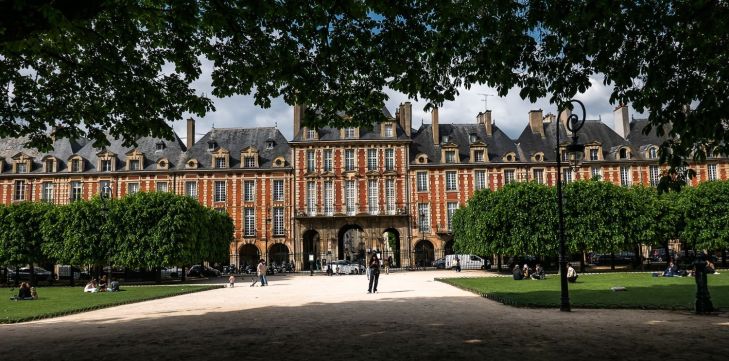
The Paris tourist office on the place des Vosges : https://parisjetaime.com/eng/transport/place-des-vosges-p1907
The Rue de Rivoli (see post) is located in the 1éme arrondissement or district of Paris ( heading from No. 41, odd side and heading No. 98, even side at the end) and the 4éme arrondissement or district of Paris ( heading from No, 39, odd side and from the beginning to No. 96, even side). It bears the name of a victory won by Napoleon Bonaparte over Austria in 1797. It extends for almost 3 km, from the Rue de Sévigné to the Place de la Concorde. It also crosses the Place de la Pyramide (famous for its statue of Joan of Arc). From the Square de la Tour Saint-Jacques in the center of which is the Saint-Jacques Tower. The Tour Saint Jacques (see post) is the only vestige of the Saint-Jacques-la-Boucherie church, whose new bell tower was built between 1509 and 1523, this bell-tower is erected in the middle of the first Parisian square, which bears its name , in the 4éme arrondissement of Paris.

The Paris tourist office on Paris Centre (arrond 1-4): https://parisjetaime.com/eng/paris-by-district/central-paris-a1850
The official Tour Saint Jacques : https://www.toursaintjacques.fr/fr
The Paris tourist office on the Tour Saint Jacques : https://parisjetaime.com/eng/culture/tour-saint-jacques-p993
The Folies Bergère Theater is a performance hall that opened on May 2, 1869. It is located in the 9éme arrondissement of Paris. You can come here on metro line 7 Cadet station, lines 8 and 9 Grands Boulevards station, and line 12 Notre Dame de Lorette station, I have passed by but if need parking there is one recommended by the theater at parking Chauchat-Drouot 12/14 Rue Chauchat, In 1860, a large bedding store opened on land formerly belonging to the Quinze-Vingts Hospital. On May 2, 1869, at the initiative of Louis Montrouge, this store opened a performance hall under the name “Folies Trévise,” then “Folies Bergère.” The chosen name refers to the “folies,” houses of entertainment in the 18C, then performance halls, and to the name of Rue Bergère, located not far from Rue Richer. This explains the absence of an “s” in Bergère and allows for a name with 13 letters, out of superstition. It was designed as a “café-spectacle” where the public attended theatrical performances, operettas, or singing performances, while drinking and smoking.
In 1886, Édouard Marchand, head of the Folies Bergère, invented the grand music hall revue. He hired the American dancer Loïe Fuller, In 1912 the first appearance on stage of a completely nude woman took place here, The building was completely renovated in 1926. The hall was enlarged and decorated with a magnificent Art Deco facade In 1936 on the program of the Super Folies,was the return of Joséphine Baker from New York, In August 1974, Antonia Derval passed on her powers to Hélène Martini, “the Empress of the Night”, who, twenty-five years earlier, had been a “nude model” at the Folies Bergère, after being deported to a concentration camp during WWII, In September 2011, the Folies Bergère theater was bought by Lagardère. In 2013, Lagardère SCA became the sole owner of the theater.
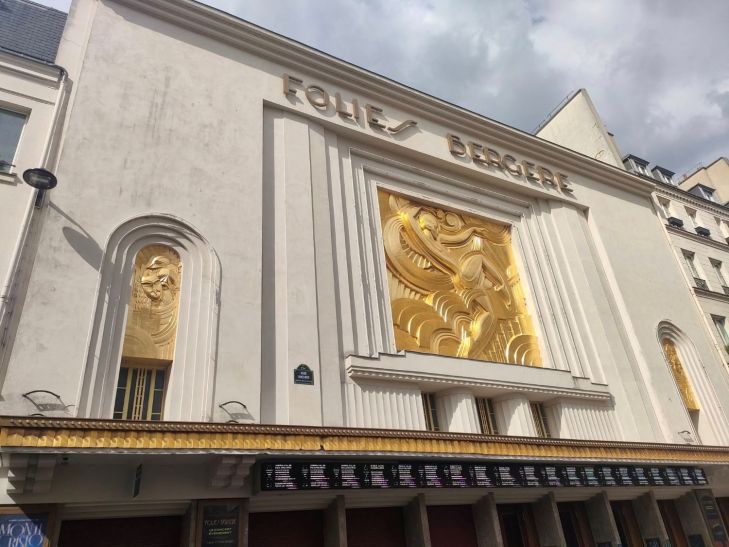
The official Folies Bergére : https://www.foliesbergere.com/fr
The Paris tourist office on the Folies Bergére : https://parisjetaime.com/eng/culture/folies-bergere-p1138
There you go folks, a dandy city to explore and enjoy with the family, Memorable moments in my eternal Paris, driving and walking all over in my road warrior trails brings out sublime awesome spots with nice memorable family visits of yesteryear always remember and always looking forward to be back, eventually. Again hope you enjoy the post on curiosities of Paris , part XXXIX !!! as I.
And remember, happy travels, good health, and many cheers to all !!!

 Paris1972-Versailles2003