
Well if you walk, then gardens are a must, and they are all beautiful! Often overlook by visitors because they want to see monuments but a wonderful part of any city and gorgeous statues fountains etc as well. A great way to rest amongst this beauty after a long city walk. This is a nature’s heaven that should be visited at least once and is easy to get there, Glad to finally find me some nice pictures of this wonderful place in my cd rom vault to show this garden to the world for you and me, Therefore, this is my take on the Jardin des Serres d’Auteuil of Paris !!! Hope you enjoy the post as I.
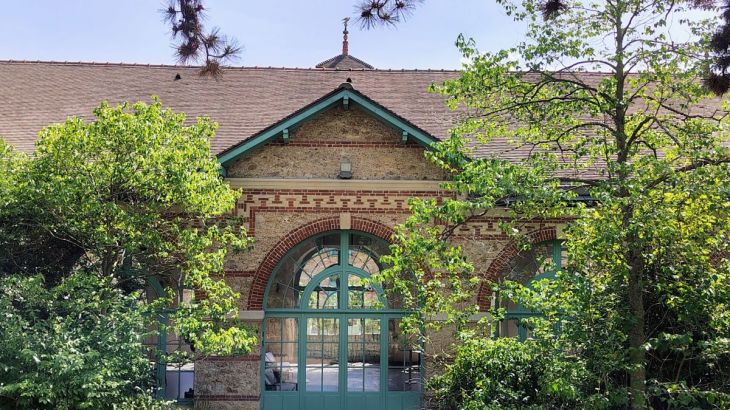
The Jardin des Serres d’Auteuil is a botanical garden open to the public, located on the edge of the Bois de Boulogne. The main gate is located to the north of the garden, on Avenue de la Porte-d’Auteuil. Other access points exist to the east, via the Jardin des Poètes, to the south via Boulevard d’Auteuil, and to the west via Avenue Gordon-Bennett. The site is served by metro line 10 at the Porte d’Auteuil and Michel-Ange-Molitor stations. The garden is organized around a vast French-style parterre. The five main greenhouses (the large greenhouse, the east and west greenhouses, the palm greenhouse, and the azalea greenhouse) overlook this central space in a 1900s style.
The Jardin des Serres-d’Auteuil garden greenhouses combines the elegance of a formal garden, the charm of late 19C architecture, the exoticism of tropical plants from distant lands, and the richness of a botanical garden. A large central lawn adorned with floral decorations, around which symmetrical classical-style architecture unfolds, typical late 19C greenhouses, an English-style landscaped garden with a more sinuous and undulating design, a Japanese-inspired garden, and a small garden with Mediterranean species. The garden contains 6,000 plants grouped into thematic collections (succulents, New Caledonian plants) or systematic collections (palm trees, ficus, begonias, ferns, etc.). The greenhouses contain information introducing botanical and ethnobotanical knowledge. Flanked by two gently sloping curvilinear paths, a 20-meters-wide staircase provides access to the vast, regular parterre. The pilasters adorning the terrace’s retaining wall are decorated with 14 mascarons believed to have come from Auguste Rodin’s studio. At the opposite end of the parterre stands a fountain designed by Jules Dalou, whose medallion depicts the Triumph of Bacchus.

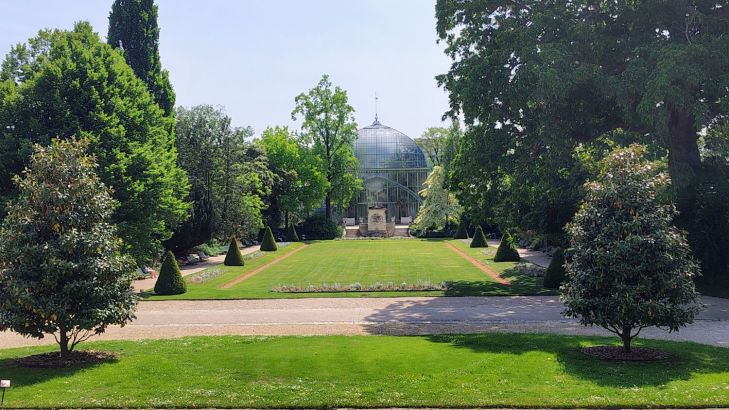
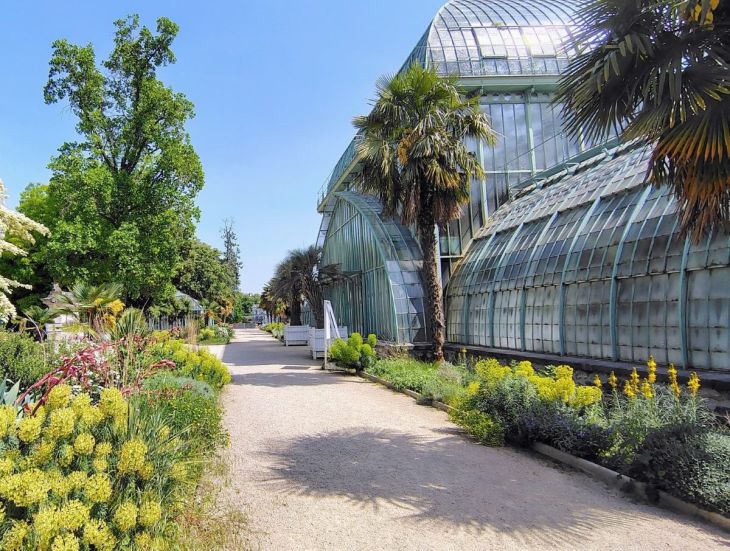
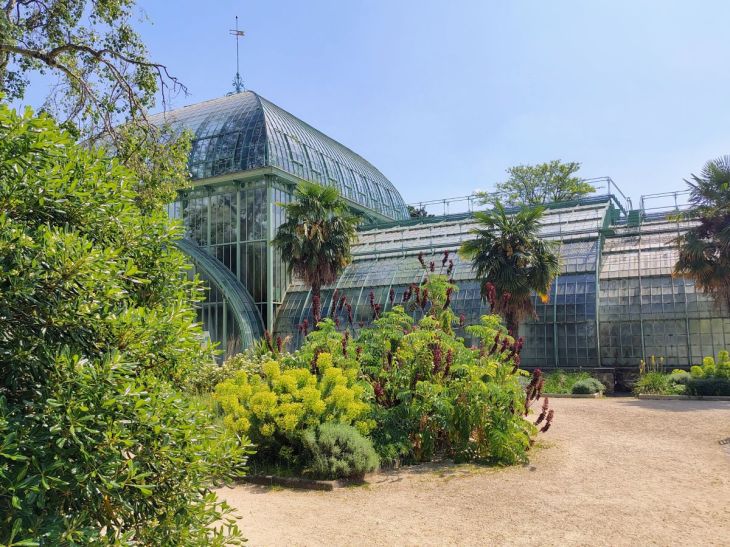
The greenhouses were the last large greenhouses to be built in France in the 19C, at the height of the winter garden trend. Their metal structure offers a range of shades of blue, green, and turquoise. The greenhouses house remarkable collections of tropical plants year-round: aroids, begonias, ficus, tropical ferns, and flora from four continents. The charm of late 19C architecture, the exoticism of tropical plants imported from faraway lands, and the richness of a botanical garden. Today, this horticultural center produces more than 3 million plants per year. Contemporary greenhouses designed opened in June 2019. They integrate into the existing landscaped garden and the ensemble formed by the historic greenhouses. These greenhouses bring together more than 1,000 plant species composed of more than 500 spectacular, and often rare, species and varieties, around the Simonne-Matthieu tennis court (5,000 seats). The 4 biotopes (natural environments) of the 4 continents are recreated: South America, Africa, Southeast Asia, and Australia.
A bit of history tell ust that in 1761, King Louis XV who from his earliest youth showed a pronounced taste for botany, had a garden laid out in 1761, decorated with numerous flowerbeds and already equipped with greenhouses built at 77 rue d’Auteuil, adjacent to his Château du Coq. It then extended to part of the current Boulevard Murat, the Porte d’Auteuil and a plot of land in the Bois de Boulogne now occupied by the Serres jardin d’Auteuil or greenhouse garden. In 1778, the château and garden were sold by Louis XVI , The site was divided up a century later. In 1855, further north, in the La Muette neighborhood or quartier, the florist garden of the city of Paris was created by the engineer Adolphe Alphand on the grounds of the Clos Georges, taken from the Bois de Boulogne. It then housed more than 30 greenhouses and produced three million plants each year. It was transferred to Auteuil in 1898. At La Muette, the site of the disused garden was pierced with new roads and then divided into lots (rue Guy-de-Maupassant, rue Edmond-About, rue Octave-Feuillet, rue Eugène-Labiche, rue Édouard-Fournier and boulevard Jules-Sandeau). Jean Camille Formigé was in fact commissioned by the city to create a new horticultural production site where plants intended for the city’s green spaces would be grown. The work lasted from 1895 to 1898. In June 2021, the Auteuil greenhouse garden obtained the Remarkable Garden label.
The city of Paris on the serres d’Auteuil: https://www.paris.fr/lieux/jardin-des-serres-d-auteuil-1780
The Paris tourist office on the serres d’Auteuil: https://parisjetaime.com/eng/culture/jardin-des-serres-d-auteuil-jardin-botanique-de-paris-p938
Ps, Huge beautiful spot in my eternal Paris, so the above material was taken from my books/brochures, the official sites ,and wikipedia,
There you go folks, another wonderful place to be full of architecture and history all around you. Indeed a gorgeous spot in my dear eternal Paris with full of interesting things to see. Again, hope you enjoy the Jardin des Serres-d’Auteuil of Paris as I.
And remember, happy travels, good health, and many cheers to all !!!

 Paris1972-Versailles2003