
In walking around my eternal Paris I often wonder how much time will take to catalog it all! I have an extensive library at home on architecture, history, and things to see in Paris in addition to around 100K pictures in cd roms ,external hard drives etc. However, found me new pictures not in my blog yet that should be here for you and me. A while back , walking the streets around the Hôtel de Ville I saw this church. Mind you, I know what it is but never had the time or effort to stop by. Until then,and now will like to tell you again more on the Church Saint Gervais-Saint Protais of Paris !!! Hope you enjoy the post as I.
The Church Saint-Gervais-Saint-Protais located on Place Saint Gervais behind the City/Town Hall,should benefit from being better known. It is indeed one of the most beautiful in Paris, with remarkable Renaissance stained glass!. Conceived by the wardens of the parish as a recasting and an extension of a previous consecrated church in 1420, it took almost one hundred and fifty years to build it. The chapels of the choir were first erected to the north, that of the axis, then those to the south. It was then refitted the central vessel of the choir. The western facade, where the three classical orders are imposed, was not completed until 1621. During the French revolution, Saint-Gervais will remain closed for a few years. It is reopened under the Directory and will suffer little from the turmoil. In 1802, it regained its status as a Catholic parish. It should be added that the church underwent extensive restoration at the start of the 21C.
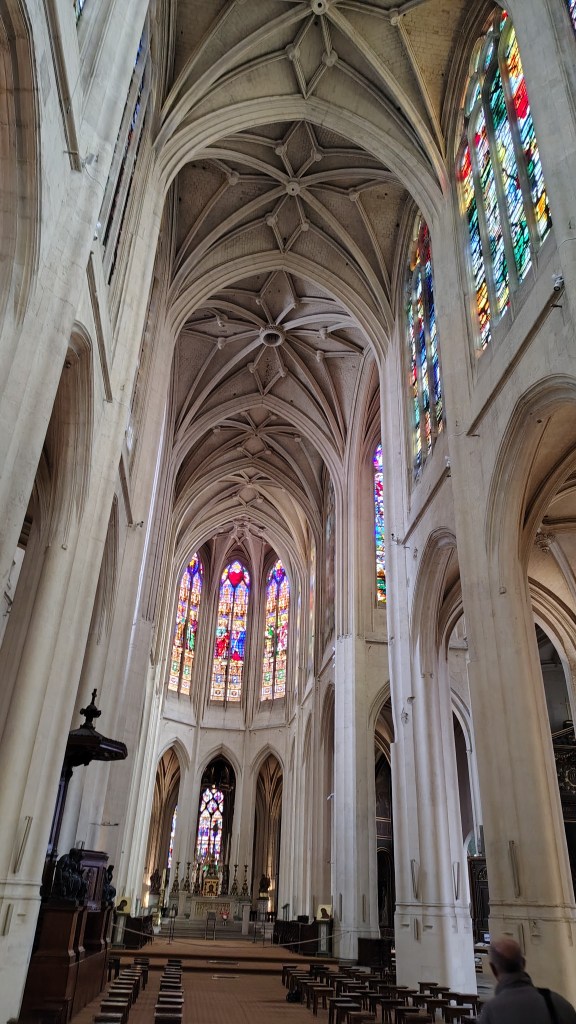
The architect of Saint-Gervais-Saint-Protais Church remains unknown. Anyway, the Saint-Gervais-Saint Protais Church has a narrow nave, marked by a very studied slenderness effect. Saint-Gervais is part of the history of Renaissance churches in Paris, in the flamboyant Gothic style. The 19C it has adorned its numerous chapels with murals that the exiguity of the architecture or the reflections of the light do not always allow to appreciate in good conditions. In the choir of the 16C stalls will delight the visitor with their variety of scenes from everyday life and small trades on the mercies. On the second level of the nave and the choir, magnificent and large canopies from the 16C illuminate the church. The stained glass windows of the Chapel of the Virgin and the famous stained glass window of the Wisdom of Solomon in a chapel south of the ambulatory. Note that the old white glasses of the lost canopies have been replaced by creations by modern artists. As for worship, since 1975, the Saint-Gervais-Saint Protais Church is no longer parish, but assigned to the monastic liturgies of the Fraternities of Jerusalem.
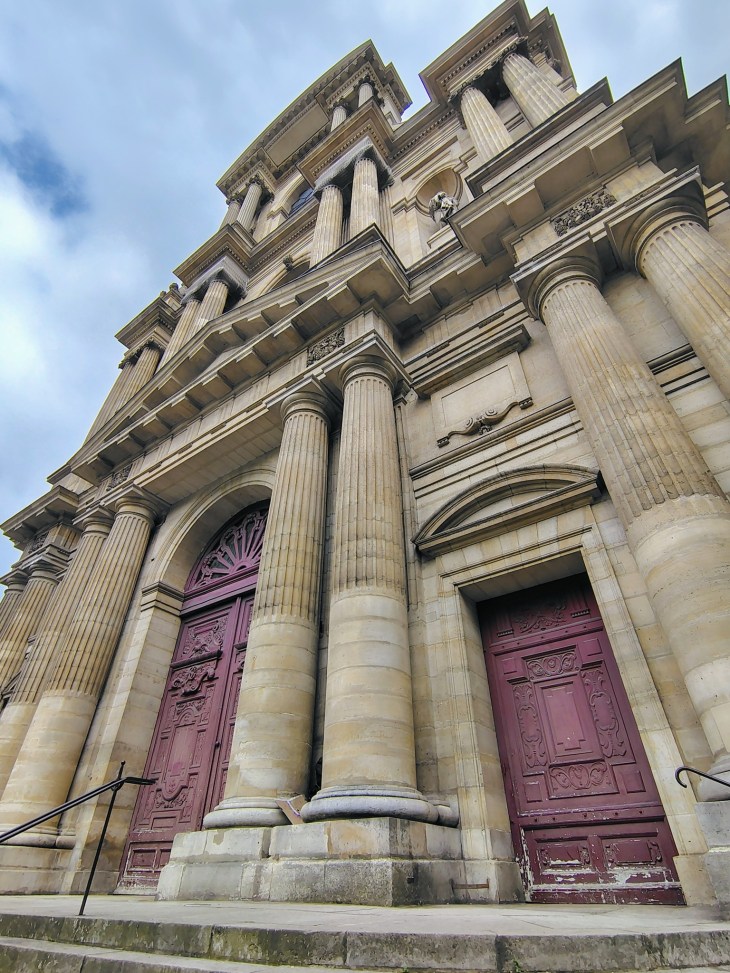
The exterior of Church Saint-Gervais-Saint Protais shows the church is almost entirely hidden by so-called perimeter of buildings. To the south, a narrow passage runs along the wall without the possibility of retreating. There remains the apse and the facade. Fortunately the facade is worthy of praise. It is the first erected in classical style in Paris. It is 1616 and this facade is an addition to the already built church. The architect therefore attaches its facade to the Gothic nave by creating an additional span. The two ends are closed by a chapel in an ogival quarter circle. The discerning eye immediately sees there the three classic orders: Doric, Ionic and Corinthian. The first level accommodates four pairs of columns. These pairs are repeated on the second level, only enriched by two niches housing the statues of the two legendary Saints Gervais and Protais. The Ionic order of the second level is crowned by Saint Matthew and Saint John. The elegance of the facade would only be a word without the beautiful slenderness of the third level. The Corinthian order occupies only the central part. Two pairs of columns surround a large canopy, the whole is surmounted by a curved pediment, hollowed out in its center. The facade of Saint-Gervais, which will serve as a model in France and Europe, heralds the arrival of the Baroque!.
The Church Saint-Gervais-Saint Protais has a narrow nave, marked by a very studied slenderness effect. Saint-Gervais is part of the history of Renaissance churches in Paris, in the flamboyant Gothic style. The 19C it has adorned its numerous chapels with murals that the exiguity of the architecture or the reflections of the light do not always allow to appreciate in good conditions. In the choir of the 16C stalls will delight the visitor with their variety of scenes from everyday life and small trades on the mercies. On the second level of the nave and the choir, magnificent and large canopies from the 16C illuminate the church. As for worship, since 1975, the church is no longer parish, but assigned to the monastic liturgies of the Fraternities of Jerusalem. Some details of the interior beautifully architecturally done that I like are: The baptismal font Chapel dates from the beginning of the 17C. Its existence is due to the creation of the west facade, built from 1616 to 1621 in front of the church. There is a Chapel commemorating the catastrophe of March 29, 1918. At the beginning of 1918, the Brest-Litovsk armistice enabled Germany to launch a vast offensive in the West. The Germans were approaching Paris. Towards Laon, with cannons installed on rail, they began to bomb Paris. On March 29, a large caliber shell fell on the nave of Saint-Gervais. The church, where the Good Friday Mass was to begin, was packed. The shell punctured part of the vault which collapsed on the faithful, killing 89 people and wounding 90 others. The base of the main altar houses a copy of the Dormition of the Virgin. This work, dating from the 13C, is located in the base of the altar in the north side Chapel of Saint-Laurent. On both sides of the altar take place the two wooden statues of Gervais and Protais, carved around 1620.
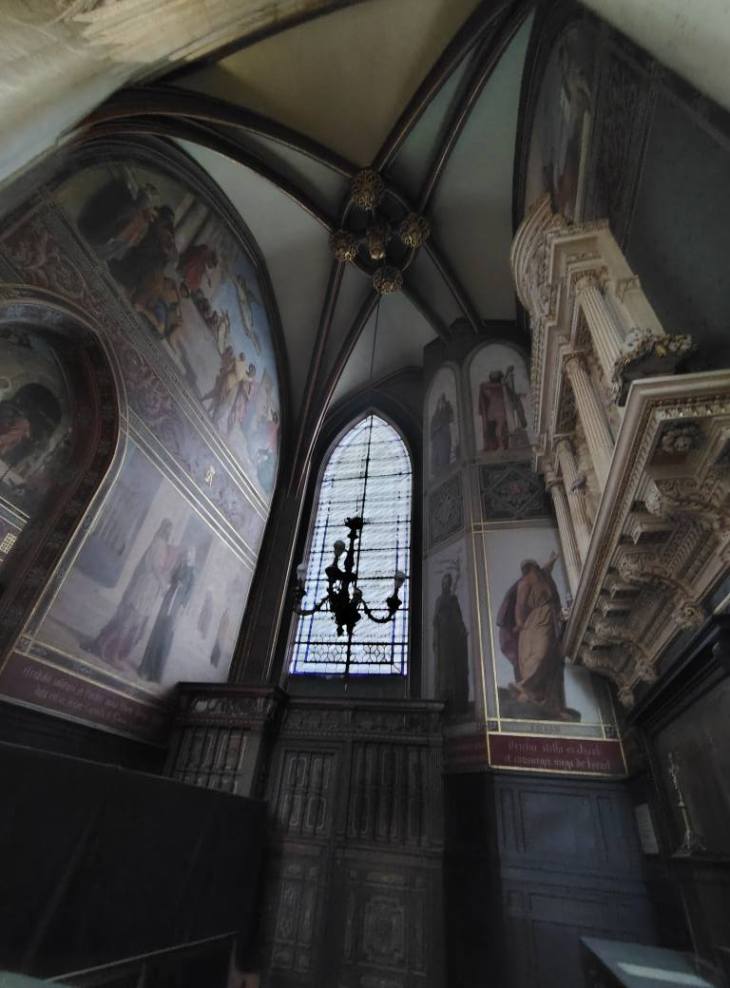
The stained glass window of the Wisdom of Solomon c.1531; it is one of the most beautiful Renaissance stained glass windows in Paris .The state of conservation of this stained glass window is so exceptional that experts from the 20C took original pieces for 19C restorations. The Judgment is spread over four lancets and consists of only one scene. It is a so-called unified canopy and, in 1531, it was even one of the first unified canopies posed in Paris. The author of the stained glass rest unknown. The Chapelle de Brégy chapel , apart from three large murals , the Brégy chapel houses the fragment of the funerary monument of Michel Le Tellier, a 17C work designed after the drawings of Jules Hardouin-Mansart. Nearby, you can also admire three prayers: those of the Potier family, husband, wife and son. The two windows are modern. The artist Sylvie Gaudin made a total of five very futuristic representations of the major themes of Christianity (Nativity, Crucifixion, Pentecost, etc.). The Chapelle de la Piéta is on the north side, very well lit by two white glass windows, offers a very beautiful Pieta surrounded by two angels in adoration. also chiseled a beautiful Ecce Homo, rich in draperies. Finally enriched the walls with four beautiful murals including The Works of Mercy and Jesus and the Evangelists showing the Evangelists writing under the inspiration of Christ. One of the two windows has a remnant of Renaissance stained glass in the tympanum. It illustrates the martyrdom of Saint James.
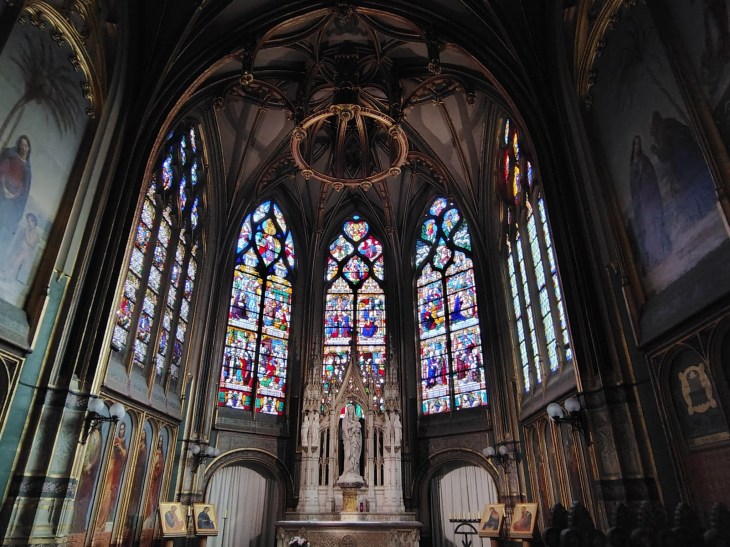
The Chapelle de la Vierge with great depth, the chapel of the axis of Saint-Gervais-Saint Protais Church was completed in 1517. The chapel of the Virgin is an artistic center of the Church of Saint-Gervais-Saint Protais. The Renaissance left the overall architecture and stained glass there, the 19C enriched it with paintings, an altarpiece and a statue of the Virgin. The three axial canopies, dated 1517, year of completion of the chapel, and which illustrate scenes from the life of the Virgin, 19C paintings illustrate scenes from the life of the Virgin as well as virtues. Let me add that the stained glass windows to the north show a remnant of the Tree of Jesse from the 16C with the Virgin and the patriarchs Isaac and Abraham. This Tree was partially completed in the 19C when David, Jacob and Solomon were added. 19C paintings illustrate scenes from the life of the Virgin as well as virtues.
The Chapelle de Saint Anne, Access to the Golden Chapel, 17C, See stone altarpiece, 17C. Mounted canvases: The Meeting of Saint Joachim and Saint Anne at the Golden Gate and Presentation of the Virgin Mary in the Temple,1860.
The Chapelle Le Tellier one of the nine chapels of the ambulatory, the tomb of Michel Le Tellier, Grand Chancellor under Louis XIV, then three statues of the Duke and Duchess of Tresmes and that of the Duke of Gesvres. A very beautiful wrought iron gate 1741 gives access to the sacristy, placed under the tower.
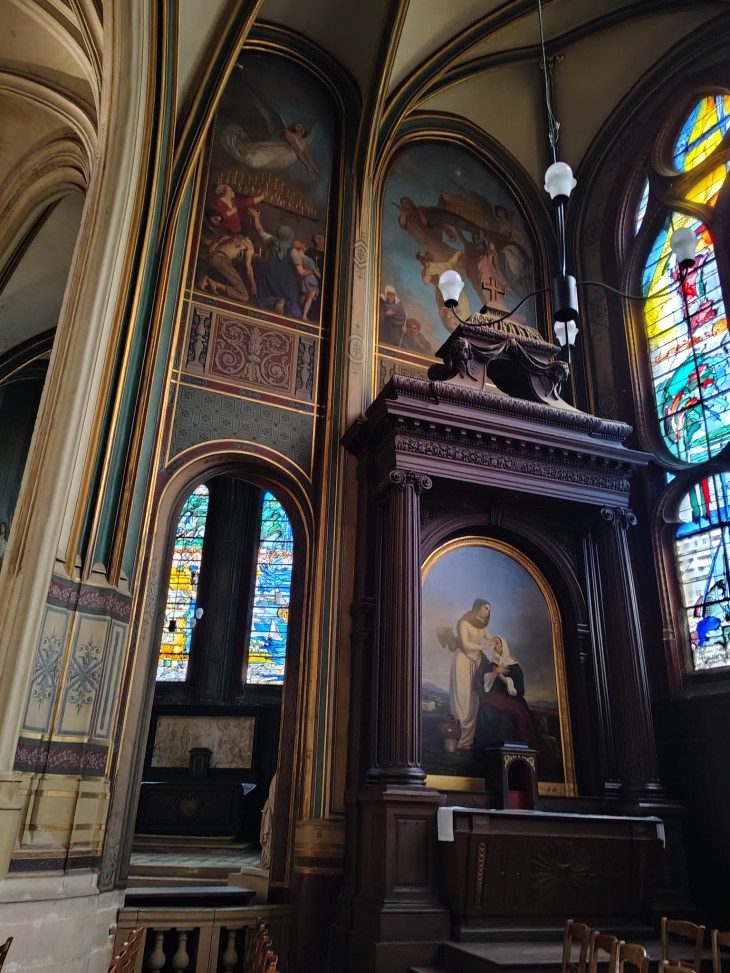
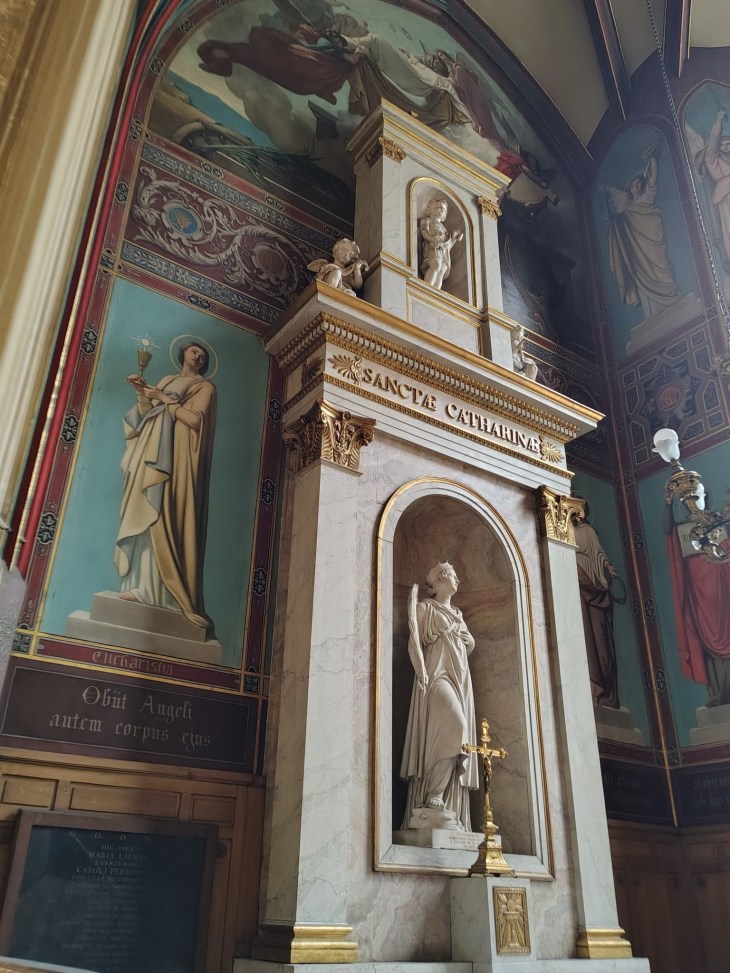
The Chapelle Sainte Catherine with painted panels: The Life of Christ, 17C. A statue of Saint Catherine by Jean-Pierre Cortot, 1824.
The keystone of the Choir bears the date of 1540. The large canopies therefore had to be put in place after this date, that is to say around the year 1550. The large canopies of Saint-Gervais in the nave and the choir of Saint-Gervais offer, in their upper parts, a magnificent panorama of stained glass windows from the Renaissance period. The gallery organ of Saint-Gervais-Saint Protais Church is a unique specimen in Paris of organs from the 16C and 17C. First built in the south transept in 1601, the large buffet dates from 1601. It was decorated in 1759.
Who were Saint Gervais and Saint Protais ? They were were holy twin brothers who were martyrs and lived in the 1C under Emperor Nero. They lived in Milan. They are denounced as Christians. Gervais was condemned to be beaten with a whip filled with lead until he died. Then, Protais was brought in and insulted Astasius and told him that his idols were disgusting filth. He was beaten with a stick. He was made to stand up. He then said to Astasius, “You do not know what you are doing, and I have compassion on your misery. So finish what you have started so that I may join my brother.” His head was then cut off. In the 4C, Saint Ambrose, while praying in the church of Saints Nabor and Felix, had dozed off slightly. He had a vision of two young men dressed in white clothes and praying with open arms. The next morning, at the crowing of the rooster, he had the same vision. The following night, the two young men appeared to him in the company of Saint Paul. The apostle said to Ambrose: “If you dig where you are, you will find the bodies of Gervais and Protais.” They dug and found the two bodies, which had been lying there for three hundred years. They were in the same state as they had been on the day of their death. Their bodies gave off a sweet fragrance.
The Monastic Fraternity of Jerusalem on the church: https://paris.fraternites-jerusalem.org/eglise-saint-gervais/
The Paris tourist office on the Church Saint Gervais-Saint Protais: https://parisjetaime.com/eng/culture/eglise-saint-gervais-saint-protais-p1248
There you go folks, another wonderful monument to visit while in Paris, the list is endless but I am working on it, The church is commonly just call the Saint Gervais. Again, hope you enjoy this post on the Church Saint Gervais-Saint Protais of Paris !!! as I.
And remember, happy travels, good health, and many cheers to all !!!


