
Well if you walk, then gardens are a must, and they are all beautiful! Often overlook by visitors because they want to see monuments but a wonderful part of any city and gorgeous statues fountains etc as well. A great way to rest amongst this beauty after a long city walk. This is a nature’s heaven that should be visited at least once and is easy to get there, Glad to finally find me some nice pictures of this wonderful place in my cd rom vault to show this Jardin des Plantes to the world for you and me, Therefore, this is my take on the Jardin des Plantes of Paris !!! Hope you enjoy the post as I.
The Jardin des Plantes is located in the 5éme arrondissement of Paris, This is a botanical, ecological and zoological park, the headquarters and main site of the National Museum of Natural History, which also has other sites in Paris and elsewhere. In addition to the green spaces typical of a garden , the Jardin des Plantes also has a menagerie, greenhouses, and scientific exhibition buildings including a Mineralogy Gallery and a Paleontology Gallery. The garden itself is open to the public free of charge during the day; the Museum galleries and the Menagerie are subject to a fee. It is accessible through twelve gates leading, in a clockwise direction and starting from the north, onto the Quai Saint-Bernard along the Seine, the Place Valhubert, a very short section of the Boulevard de l’Hôpital, and the Rue Buffon ,Rue Geoffroy-Saint-Hilaire and Rue Cuvier, which delimit an area of 23.5 hectares to which are added 3.5 hectares to the south of the Rue Buffon, You can reach the Jardin des Plantes by RER C Gare d’Austerlitz, metro lines 5 and 10 at the Gare d’Austerlitz, several bus lines same station my favorites were 24 and 91, You have a Station Vélib bikes near at Boulevard de l’Hôpital, There is a parking Jardin des plantes located at 25 rue Geoffroy Saint Hilaire ,and 15 rue Censier, the exit/sortie is on 8 rue du Fer à Moulin.
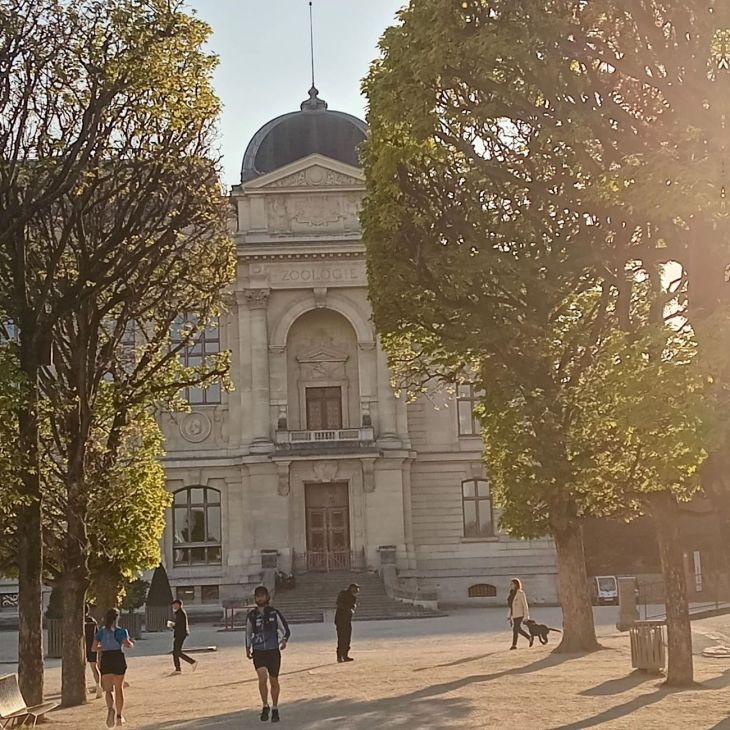
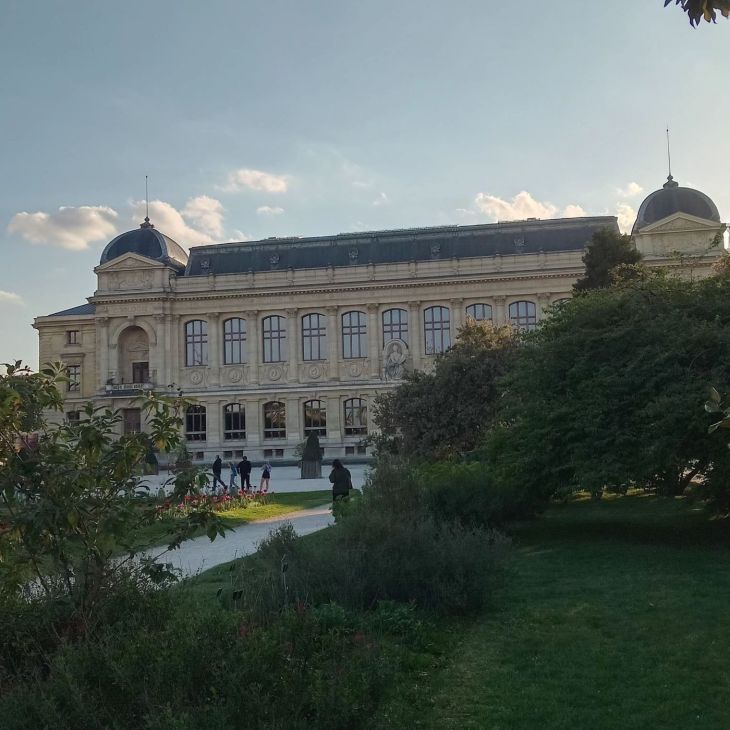
The Jardin des Plantes has to the north an English-style landscaped area created in the 18C, notably under the stewardship of Buffon, and to the south a large, older French-style perspective of 500 meters long for 3 ha, the upper half of which between the current rue Geoffroy-Saint-Hilaire, and the Canal des Victorins, has been present since the beginning of the garden in the 17C, while the lower half was completed in the 18C. The large French-style perspective extends from west to east from the Grande Galerie de l’Évolution to Place Valhubert. The perspective links two esplanades: to the west, the Esplanade Milne-Edwards which is at the foot of the Grande Galerie de l’Évolution, and to the east the Esplanade Lamarck on the side of the Seine river. The Esplanade Milne-Edwards covers the zoo, which is underground and houses hundreds of thousands of stuffed animals, insects, fish, reptiles and mammals. Opposite the large Gallery of Evolution, at the head of this esplanade, is a Monument to Buffon, in bronze from 1883. The English-style landscaped area includes, from west to east, the large labyrinth, topped by Buffon’s gazebo and housing Daubenton’s secular tomb, the small labyrinth which has become a biodiversity reserve, near the Hôtel de Magny and the large amphitheater, the Alpine garden and the Menagerie. The Jardin des Plantes extends on both sides of Rue Buffon, created from one of its paths: on the south side, we find the Clos Patouillet, former property of Buffon, today called the Buffon-Poliveau block, devoted to research, studies and the conservation of the Museum’s collections.
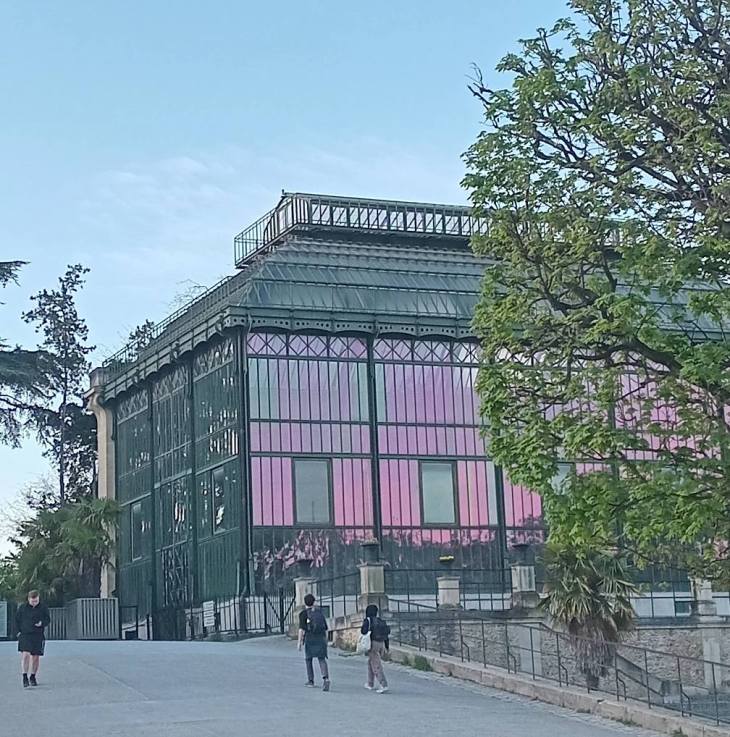
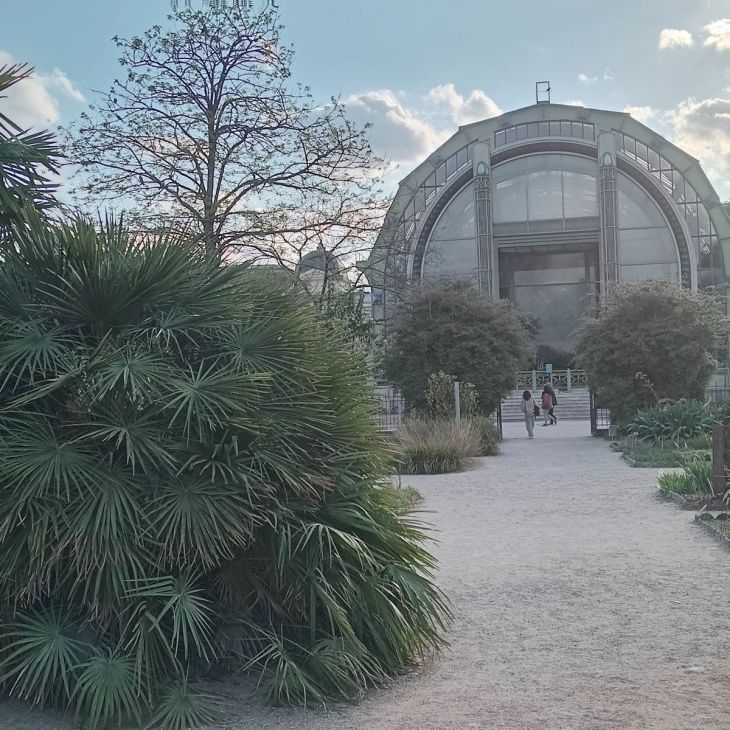
Five metal-framed serres or greenhouses (four of which are open to the public) are aligned along the perspective. The Tropical Rainforest Greenhouse, also called the “large greenhouse” or the “winter garden”, covers an area of 750 m2 and maintains an average internal temperature of 22 °C. In Art Deco style,(see pic) this greenhouse, inaugurated in 1937, includes a stream, ficus trees, palm trees, banana trees, climbing plants and epiphytes, etc.; the Desert and Arid Environments Greenhouse is longitudinally adjacent to the tropical rainforest greenhouse. This metal and glass greenhouse was built on the site of the former “colonial greenhouses”. Over an area of five plant scenes, it shows visitors species characteristic of arid environments: cacti, euphorbias, agaves, etc.; The New Caledonia Greenhouse was originally called the “Oriental Pavilion” in 1836. Since the second half of the 20C, this greenhouse has been known as the “Mexican greenhouse” or “Cactus greenhouse”, as it has been used since then to display plants specific to arid environments. It was renamed the New Caledonia Greenhouse after the 2005-2010 renovation, as it now displays the flora of the archipelago of the same name. The Plant History Greenhouse is the twin greenhouse of the New Caledonia greenhouse. It was identified as the “Western Pavilion” as early as 1836, but before the major greenhouses were redesigned in 2005-2010, it was called the Australian Greenhouse because it displayed plant collections from Oceania and New Caledonia. It is now intended to show the public fossil plant specimens side by side with living specimens from the present day, for educational and comparative purposes.
The roseraie or rose garden aims to present to the public the diversity of cultivated roses. It includes 170 horticultural varieties of roses, classified according to reasoned principles. The rose garden extends between the Haüy Alley (named after Abbé Haüy, a pioneer of mineralogy) and the Mineralogy and Geology Gallery, which runs parallel to it. This rose garden is adorned with two statues: Captive Cupid in marble) by Félix Sanzel and Venus Genitrix by Charles Dupaty. The Botanical spaces known as the School of Botany (see pic) and the Ecological Garden are located between the greenhouses and the Seine. The School of Botany was created by the botanist André Thouin in the 18C. Bringing together 2,500 varieties of shrubs and herbaceous plants, it is a systematic garden whose aim is to present plants according to botanical classification and to understand their phylogeny. It also includes historic trees, including a Corsican pine which was struck by lightning and has since presented a characteristic silhouette. The ecological garden is an enclosed area where human intervention is as discreet as possible in order to leave room for natural biodiversity. This garden presents reconstructions of different natural environments in the Île-de-France region: seven open environments (vineyard, meadows, pond, plateau, etc.), as well as four forest environments differing in the composition of the soil, where spontaneous plant species grow almost freely. The area is also home to some species of exotic trees and shrubs, witnesses of the plantations that preceded the creation of the garden. This space is also a refuge or a stopover for Parisian wildlife. Finally, located between the botany school and the Menagerie, the Alpine garden was created in 1931 , it aims to present shrubby and herbaceous plants from mountain environments around the world (Himalayas, Alps, Corsica). It has more than 2,000 plants grouped into biogeographical beds. It is accessible from the botany school by an underground passage. This garden includes a male pistachio tree from which the botanist Sébastien Vaillant highlighted the sexuality of plants in the 18C.
The Menagerie is the second oldest zoological park in the world. It was created in 1793 on the initiative of Bernardin de Saint-Pierre, by transferring animals from the royal menagerie of Versailles and from abandoned private and fairground menageries. During the siege of Paris by Prussia between September 17, 1870 and January 26, 1871, most of the animals were eaten by the besieged Parisians. Many buildings, sometimes sophisticated for the time, were built for this purpose in the 19-20C, replacing the simple enclosures and cages of the beginning: rotunda, bear pits, monkey houses, wild animals, houses for birds of prey and reptiles, pheasantries, etc. The largest of these is undoubtedly the large aviary built in 1888 and still in use. The Menagerie houses around 1,100 animals, mammals, reptiles and birds, on 5.5 hectares.
The buildings of the Jardin des Plantes belong to and are linked to the history of the National Museum of Natural History; the oldest, to the west of the Rue Cuvier and at the western end of the Rue Buffon, date from the beginning of the 18C. The Gloriette de Buffon is located at the top of the great labyrinth, a mound crossed by a spiral path in the west of the garden, near the Rue Geoffroy-Saint-Hilaire and Rue Cuvier. It is an iron and bronze aedicule, with a circular plan, measuring approximately 4 meters in diameter. It dates from the end of the 18C. The largest pond in the garden, at the foot of Buffon’s gazebo and the great labyrinth, is the Lions Fountain, whose basin once served as a water reservoir for summer horticultural watering and where, until the 1950s, frogs croaked. The garden also includes two wells, one at the southern entrance and the other in the Alpine Garden. In addition, several Wallace fountains scattered throughout the garden allow walkers to quench their thirst. Finally, one of the last two Wallace wall fountains still preserved in Paris is embedded in the wall of the Jardin des Plantes, rue Geoffroy-Saint-Hilaire. Several statues, animal or not, adorn the garden and the galleries, In 2011, the Museum installed two “bee hotels” to preserve the biodiversity of pollinating insects, particularly wild bees. In the basement of the Hôtel de Magny, which houses the management of the National Museum of Natural History, is the entrance to the underground quarries of the Jardin des Plantes, where Lutetian limestone was mined, notably under the “grand labyrinth” topped by a metal belvedere or gazebo.
Additoinal anecdotes I like shows that Alfred de Musset wrote a poem in 1852 entitled Une promenade au Jardin des plantes or A Walk in the Jardin des Plantes. Victor Hugo evokes the instructive role of the garden in the Poem of the Jardin des Plantes ,L’Art d’être grand-père or The Art of Being a Grandfather. Honoré de Balzac also evokes this role in his novel La Peau de chagrin or The Shagreen Skin. For Jules Michelet in La Mer, or The Sea, the Jardin des Plantes is a “fairy palace”. In Jules Verne’s Vingt Mille Lieues sous les mers or Twenty Thousand Leagues Under the Sea, the character of Pierre Aronnax is a professor at the Paris Museum with “a small apartment in the Jardin des Plantes”. Henri Rousseau’s painting La Charmeuse de serpents or The Snake Charmer is inspired by the Museum’s greenhouses.
A bit of general history tell us that the garden began with Jean Robin in the time of Henri IV and the great fashion for patterned clothes. The idea was to provide models for pattern designers, and the garden was then populated with exotic plants likely to inspire embroiderers. The garden soon became a dependency of the crown, taking the name of “Jardin du Roi” , An edict from the king of January 1626 created the Royal Garden of Medicinal Plants, ratified by parliament on July 8, It was opened to the public in 1634, The Jardin du Roi presented from its beginnings the general design of the current garden. During the French revolution, the garden was named “Jardin des Plantes de Paris”. The scientific establishment became the National Museum of Natural History by decree of the Convention in June 1793. The catacombs open to the left of the entrance to the Hôtel de Magny, an 18C building housing offices.
The official Jardin des Plantes of Paris: https://www.jardindesplantesdeparis.fr/en
The official Muséum national d’histoire naturelle on the Jardin des Plantes: https://www.mnhn.fr/en/jardin-des-plantes-garden-of-plants
Ps, Huge beautiful spot in my eternal Paris, so the above material was taken from my books/brochures, the official sites ,and wikipedia,
There you go folks, another wonderful place to be full of architecture and history all around you. Indeed a gorgeous spot in my dear eternal Paris with full of interesting things to see. Again, hope you enjoy the Jardin des Plantes of Paris as I.
And remember, happy travels, good health, and many cheers to all !!!


