
I have come here for several years ever set my foot firmly in France in 1990 on a visit and later visiting living near. It is one of the epitome places of my eternal Paris. I have written on Montmartre before, but found me a couple older paper pictures in my vault; that should be in my blog for you and me. I will indulge into my amateur history mind and my extensive history/travel library to tell you about Montmartre and its monuments. Therefore, this is my take on this is Montmartre in Paris !!! Hope you enjoy the post as I.
Clos de Montmartre 18 Rue des Saules is the last remaining vineyard in Paris. Created by the city of Paris in 1933 the little vineyard can be found tucked away in a peaceful spot on the northern slopes of Montmartre. Regardless of its small size the impressive vineyard creates 27 different kinds of wine. The vineyard has the ability to produce 500 liters of wine annually. To put it simply, that’s roughly a little over 1700 bottles of wine. At this time the vineyard is not open to the public, however peaking through the gate is still one of the best things to do in Montmartre. Vines have grown in Montmartre since at least 944 when viticulture was first attested in the area. However, in the entirety of the Île de France region, grapes have been grown much longer Indeed, centuries ago, around 40,000 hectares of wine were grown in the region. The first Fête des Vendages or Harvest Festival of Montmartre was held in 1934.

The official Fêtes des Vendages of Montmartre: https://fetedesvendangesdemontmartre.com/
Some other things to see here which are many other than cafe terraces are in place des Abbesses stands the Church Saint-Jean de Montmartre (see post). It is known as ‘Our Lady of the Bricks’ in honour of its art nouveau style brick facade. Abbesses metro station, the entrance to which is in the square, is Paris’s deepest. The platforms are 36 meters below ground level. You can reach them via a long spiral staircase, decorated with murals. Paris is called the City of Love, so it’s no surprise to learn that it has an I love you wall. You can find this touching work by artist Frédéric Baron, who collected the phrase ‘I love you’ in more than 300 different languages and dialects in Square Jehan Rictus on place des Abbesses. The Montmartre Cemetery Some of the most famous graves you will find are those of Edgar Degas, Gustave Moreau, Hector Berlioz, Sacha Guitry, Georges Feydeau, Stendhal, Théophile Gautier and Alfred de Vigny. There is also a striking monument to Émile Zola, whose ashes lie in the Panthéon. Last but not least, don’t miss Dalida’s spectacular tomb , The Moulin de la Galette (see post) was an entertainment venue popular with artists. Major painters including Auguste Renoir and Vincent Van Gogh featured it in their work. You can see Auguste Renoir’s Bal du moulin de la Galette at the musée d’Orsay in Paris. Vincent Van Gogh’s oil paintings from the Le Moulin de la Galette series are on display in various major museums across the world (Chicago, Tokyo, Berlin, Buenos Aires and others). The windmill itself is closed to the public, but you can eat in the restaurant of the same name, just below the monument.
The Lapin Agile (see post), the Maison Rose, numerous artists enjoyed shows at the Lapin Agile – among them Paul Verlaine, Auguste Renoir, Amedeo Modigliani, Guillaume Apollinaire, Guy de Maupassant and Pablo Picasso. It is one of Paris’s oldest cabarets still in operation. The history of the Maison Rose is similarIt was frequented, among others, by Albert Camus, Suzanne Valadon and Maurice Utrillo. Today, it is a little gem of a restaurant with a menu focused on local produce , The Musée de Montmartre No 12, rue Cortot is the oldest house in Montmartre. It is the former home of the painter Auguste Renoir, and it is here that he painted many of his masterpieces, including Bal du moulin de la Galette and La Balançoire (which you can see at the musée d’Orsay). The former studios, where Raoul Dufy and Maurice Utrillo also worked, now house the Musée de Montmartre. The Dalí Paris Museum, you will cross place du Calvaire, a small square dominated by a large house with an intriguing art nouveau front door. You are looking at the maison Neumont, built in 1905 by the painter Maurice Neumont. Place du Calvaire leads to the Dali Paris Museum. Place du Tertre (see post) is Montmartre’s most famous square. This small public square in the center of the Montmartre district was known as a place where local artists congregated as early as the nineteenth century. And the tradition continues today. Some 300 landscape and portrait artists make the square their studio.
The Sacré-Cœur Basilica (see posts) ,(the pic is front door) one of Paris’s major religious buildings, after the Paris Commune uprising (1871). Ground was broken in 1875 and the basilica took half a century to build. It was officially completed in 1923. Today, it is one of the most-visited sites in Paris. Walk around the halle Saint-Pierre to place Saint-Pierre, where you will find the entrance to Square Louise Michel. The Montmartre funicular (see post) with a line length is 108 meters , height difference 38 meters, accessible with a simple metro ticket, tranports passengers effortlessly up to the Square Nadar ,and the Basilica. More sporty types can climb the steps in Square Louise Michel or the 222 steps in Rue Foyatier. The marché Saint Pierre , just a short stroll from the multi-cultural Barbès neighborhood, is popular with not only Paris’s dressmakers, but also its interior and fashion designers.

Looking across the road, you will see an attractive brick building, the Halle Saint Pierre was built in 1868 as a covered market by a follower of the famous architect Baltard and has had a range of uses since. In 1986, it became an exhibition space dedicated to art brut and art singulier. It also houses a bookshop and a cafe. The Church Saint-Pierre of Montmartre (see post) located on Place Jean Marais is the last vestige of the Royal Abbey created in 1133 by Louis VI le Gros and his wife Adélaïde de Savoie, At the foot of the Butte is the Moulin Rouge (see post) built in 1889, a famous place of festivities made famous by the French Cancan and frequented by Henri de Toulouse Lautrec at the end of the 19C. The Moulin Radet is located at the corner of rue Lepic and rue Girardon mentioned for the first time in 1717. Its owner, Pierre-Auguste Debray offered it to the Vieux Montmartre society on the condition that it be transferred to another location. Restorations were carried out in 1978 and 2001, on the ground floor there is a restaurant.
And let me give you some quant streets of Montmartre to walk on full of charm and history I like, See posts on the streets of Montmartre in my blog as well,
The square of Place Constantin Pecqueur, now Square Joël Le Tac (since Feb 2 , 2012), with an area of 866 m², is located on the northern flank of the Butte Montmartre. It was created in 1935, the year next was installed a monument in memory of Théophile-Alexandre Steinlen painter, draftsman, author of the poster for the cabaret Le Chat Noir. The Square Suzanne Buisson, with an area of 2,484 m², laid out in terraces in 1951 in an art deco style is located 7bis rue Girardon at the top of avenue Junot near place Dalida, behind the Moulin de la Galette. A statue of Saint Denis thrones in the center of the garden because it is said that at this location was a fountain in which the beheaded Saint would have washed his head. The square Marcel Bleustein-Blanchet with an area of 4,715 m², created in 1998 is located behind the Sacré Chœur Basilica, It was built on the site of the old mill of Turlure which operated between 1770 and 1820 at the corner of rue de la Bonne and rue du Chevalier de la Barre, The square Nadar is located at the foot of the Sacré Chœur Basilica. In 1766, François Jean de La Barre was beheaded and burned for not having greeted a religious procession in Abbeville, A statue in his likeness was erected in front of the basilica in 1905, (An idea of Clemenceau to counter the religious meaning of the basilica). The Rue de l’Abreuvoir , very short and sloping, begins on rue de Saules and ends on place Dalida. It owes its name to the fact that it led to the old drinking trough of Montmartre, The Place des Abbesses located at the foot of the Sacré-Coeur Basilica is typical of Montmartre, it includes the entrance to the art nouveau style metro by Hector Guimard, the Saint-Jean-de-Montmartre Church in red brick, the square Jehan-Rictus built on the site of the former 18C City/Town Hall. a Wallace Fountain and many shops and cafes. The Square Louise Michel (formerly Square Saint Pierre then Square Willette) was opened in 1927. Covering an area of 23,737 m², it begins at the foot of the Sacré-Coeur Basilica and goes down to Place Saint-Pierre. It is embellished with a large staircase leading up to the basilica, several fountains including a monumental one, as well as numerous sculptures. All sublime !!
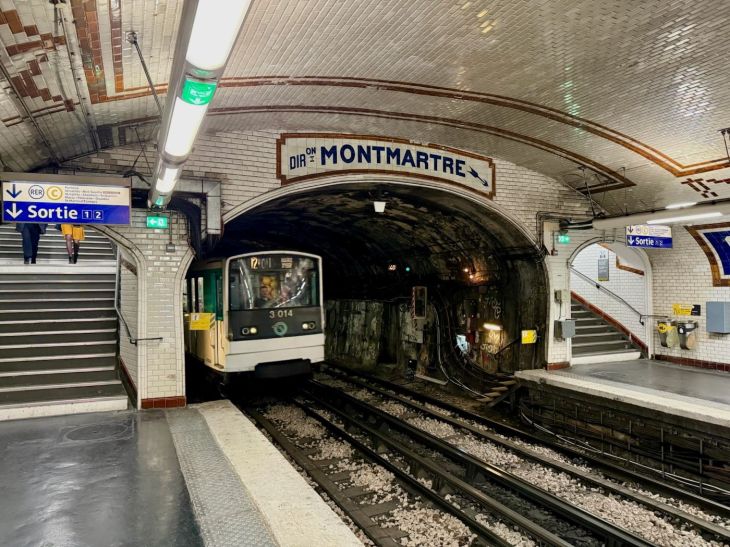
Montmartre is easily accessible by metro Abbesses station on Line 12, which you get by Place des Abbesses, I found me an older picture in my cd rom vault that should be here for the look at the older trains as well, This station provides direct access to the heart of Montmartre, including the famous Sacré-Cœur Basilica. It is, also, the deepest in Paris; you’ll have to climb 176 steps to reach Place des Abbesses. Elevators run every few minutes to help you ascend to Montmartre. Furthermore, the station platforms, located 36 meters below ground level, are the deepest in the Paris metro. It is also subtitled “Butte Montmartre” on the RATP map. Opened on January 30, 1913, on the former North-South line. The entrance to Abbesses station is one of the most photographed in the city, adorned with a kiosk designed by Hector Guimard. This one, composed of four pillars and a canopy formed by a marquee and a double-sloped glass roof, is the only one remaining of the nine kiosk of this model, known as model A. However, this constitutes a historical contradiction since originally, this type of kiosk was not installed on the North-South line. Thus, the Abbesses kiosk was initially that of the Hôtel-de-Ville station, moved in 1974.
The official RATP transports on the metro Abbesses : https://www.ratp.fr/en/discover/behind-the-scenes/daily-life/abbesses-station
The official RATP transports on metro line 12 : https://www.ratp.fr/plans-lignes/metro/12
The Paris tourist office on the Place des Abbesses : https://parisjetaime.com/transport/place-des-abbesses-p1976
A bit of history tell us that due to ancient mentions of probably ancient ruins and Gallo-Roman archaeological discoveries, it is undeniable that the Butte Montmartre has been occupied since antiquity by a Gallic place of worship. However, nothing has come to attest to this religious function during this period, whereas it was evident after the Roman conquest, as indicated by the discovery, in the 19C, of the foundations of an ancient temple. The precise location of this building has been lost, but it must have been near the Moulin de la Galette and was, according to local scholarly tradition, attributed to Mars. Another temple located towards the Sacré-Coeur is said to have been dedicated to Mercury. The location on the mound of the martyrdom of Saint Denis in the 3C, supposed apostle of the Parisians but of whom we know nothing, like the transformation of the name of Mont de Mars or Mercury into Mont des Martyrs could mark the Church’s desire to Christianize this place of pagan worship.
The Paris tourist office on the Butte Montmartre: https://parisjetaime.com/eng/transport/butte-montmartre-p1899
The Paris tourist office on walks in Montmartre: https://parisjetaime.com/eng/article/village-paris-a922
The Old Montmartre Society : https://www.levieuxmontmartre.com/english/index.html
The Paris tourist office on the 18éme arrondissement: https://parisjetaime.com/eng/article/explore-paris-s-18th-arrondissement-a832
There you go folks, a work of art, a wonderful place to visit my beautiful eternal Paris. It will be worth your time and effort, for walks into Montmatre ,sublime, worth the effort on the steps indeed. Again, hope you enjoy the post on this is Montmartre in Paris as I.
And remember, happy travels, good health, and many cheers to all !!!

 Paris1972-Versailles2003