
I am again to tell you about more streets of my eternal Paris. I have many many posts on Paris and several on the streets of the most beautiful city in the world. I have come up with pictures from cd rom vault that should be here for you and me. As always thank you for following my blog some since Nov 26, 2010. Therefore, here is my take on the streets of Paris, part XX !!! Hope you enjoy it as I.
The Boulevard de La Tour-Maubourg is one of the arteries of the 7éme arrondissement of Paris, starting from the Seine to reach the Place Vauban. It runs alongside the Invalides. Oriented north-south, 950 meters long, it begins at 43, Quai d’Orsay and ends at 2, Avenue de Lowendal. It is one-way for its entire length. From the Seine, it successively crosses the streets of the Université, Saint-Dominique, Grenelle, Avenue de la Motte-Picquet, Chevert and Louis-Codet. It is named after the French general, Minister of War and Governor of the Invalides, the Marquis de La Tour-Maubourg. It is served mainly by metro line 8 at the La Tour-Maubourg station. The boulevard was opened in 1827 between the avenues de Tourville and de La Motte-Picquet, that is to say along the Hôtel des Invalides. It was ceded by the State to the city under the law of March 19, 1838. In 1858, the boulevard was extended to the Seine. Notable buildings are at no. 1: Montesquiou-Fézensac mansion, built for Robert de Montesquiou and his brother in 1858, currently occupied by the China Cultural Center. No. 2: former Hôtel Le Bigre, built for the Roman Count Jean Le Bigre, currently the residence of the ambassador of the United Arab Emirates. Nos. 5 and 5b: mansion built around 1910, with a trapezoidal avant-corps; on the first floor, the balcony is equipped with a neo-Louis XVI railing. The politician Émile Javal resided here until his death. In 2015, the American University of Paris, a private university founded in 1962, established its offices there. No. 8: In 1925, Prince Léon Radziwill, who was one of the models used by the writer Marcel Proust for the character Robert de Saint-Loup, lived at this address. No. 13: The building is currently occupied by the Petrossian restaurant. Previously, there was a brasserie there, and in the 1970s, a Michelin-starred restaurant La Boule d’or. No. 18: Petrossian’s historic caviar shop, opened in 1920. No. 22: This number once housed the private mansion of Prince Bibesco, built in 1868, whose ceilings in the grand salon and fencing room were decorated by the painter Auguste Renoir. The poet and novelist Anna de Noailles was born at this address in 1876; a commemorative plaque pays tribute to her. See the Lady ahead!
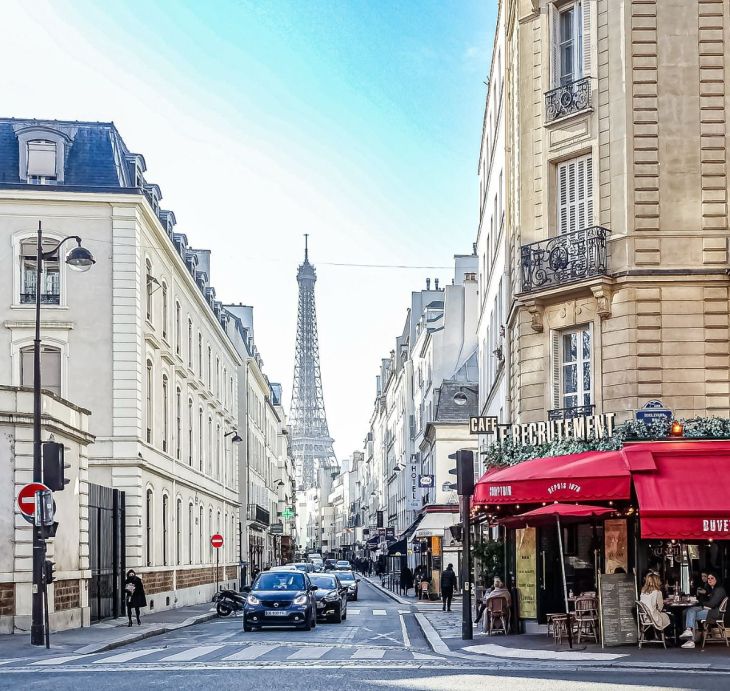
The Paris tourist office on the 7éme arrondissement : https://parisjetaime.com/eng/article/explore-paris-s-7th-arrondissement-a825
The Quai de Montebello is located along the Seine in the 5éme arrondissement of Paris. The street begins at the intersection with Rue Maître-Albert and runs one way to Place du Petit-Pont. This quay honors Jean Lannes, Duke of Montebello, a general of the Revolution and the Empire, elevated to the rank of Marshal of the Empire, killed at the Battle of Essling. On May 2, 1799, a report drawn up by the Civil Buildings Council provided for the creation of a quay between the Quai des Miramiones (currently part of the Quai de la Tournelle) and the Petit-Pont. The left bank of the small arm of the Seine was then called “Les Grands Degrés.” The creation of this quay required the destruction of the Hôtel-Dieu annex (Saint-Charles Hall). The project was not carried out and on March 25, 1811, a quay, called Quai de Montebello, was planned between the Pont Saint-Michel and the Pont de la Tournelle. Only the section between the Pont Saint-Michel and the Petit-Pont was completed; this new road was named Quai Saint-Michel. In 1817, a parapet wall was built between the Rue des Grands-Degrés and the Pont au Double. A ministerial decision of October 5, 1818 named the quay thus created “Quai de la Bûcherie”. Quai de la Bûcherie was renamed Quai de Montebello in 1843. Notable buildings No. 25: entrance to Square René-Viviani, at the intersection with Rue Saint-Julien-le-Pauvre. See pic ahead the Pont de la Tournelle,extension of Rue des Deux-Ponts crossing Île Saint-Louis, it provides access to the left bank in the 5éme arrondissement.
The Rue de Rivoli is located in the 1éme arrondissement or district of Paris ( heading from No. 41, odd side and heading No. 98, even side at the end) and the 4éme arrondissement or district of Paris ( heading from No, 39, odd side and from the beginning to No. 96, even side). It bears the name of a victory won by Napoleon Bonaparte over Austria in 1797. It extends for almost 3 km, from the Rue de Sévigné to the Place de la Concorde. It also crosses the Place de la Pyramide (famous for its statue of Joan of Arc). It is lined with arcades on its north side on a large part of its length. The western part of the street (which roughly corresponds to the arcade part) was pierced under the first Empire. The central and eastern parts were added during the work of Baron Haussmann in order to connect it to the rue Saint-Antoine to create a large east-west axis in the center of Paris. A really wonderful street that deserves more attention by visitors and one right at the corner of my old job in Paris. Yes sublime and full of memories. See ahead tour Saint Jacques!
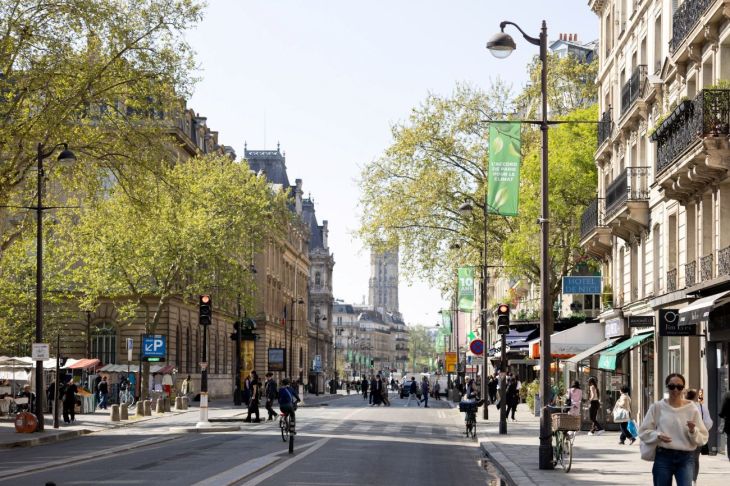
The Paris tourist office on Paris Centre (arrond 1-4): https://parisjetaime.com/eng/paris-by-district/central-paris-a1850
The Rue Soufflot is located at the junction of the Sorbonne and Val-de-Grâce quartiers or neighborhoods of the 5éme arrondissement or district of Paris. About 30 meters wide and almost 300meters long, it connects Place du Panthéon to Boulevard Saint-Michel. It faces Place Edmond-Rostand and, beyond this square, the gate of the Luxembourg Gardens. I stop right there on bus no 82 going to work in Paris (see post) In the opposite direction, this street offers a beautiful view of the Panthéon.It is accessible from the Luxembourg station on RER line B (“Sceaux line”) and several bus lines of the RATP network such as mine 82, also 84 and 89 . The street is named after Jacques-Germain Soufflot , architect of the Panthéon in Paris. The street was called “Rue du Panthéon-Français” during the French revolution. It returned to its former name in 1807. The Forum of Lutetia, the center of religious, civic, and commercial life in the ancient city, stretched along the axis of Rue Soufflot between the Cardo Maximus or Via Superior of today’s Rue Saint-Jacques, the main north-south axis, and the Cardo of today’s Boulevard Saint-Michel. The section from Place du Panthéon to Rue Saint-Jacques was developed around 1760 at the same time as the new Sainte-Geneviève Church, today’s Panthéon, to give it a perspective. the street was regularized during the 19C, on the north side by the extension of the Faculté de Droit or law faculty on the Soufflot model to rue Saint-Jacques, on the south side by the City/town hall of the 5éme arrondissement, built from 1846 to 1850 in imitation of the law faculty, and by the buildings at numbers 3 and 9. The buildings at numbers 5 and 7 built in 1734 along the edge of the old rue de la Bretonnerie backing onto the Philippe Auguste enclosure have however been preserved. This section of Rue Saint-Jacques to Boulevard Saint-Michel was developed on the grounds of the former Jacobin Convent, removing its last vestiges and also those of the ramparts of Philippe Auguste, whose diagonal route connected the current Rue Victor-Cousin to the Porte Saint-Jacques, which was located between numbers 172 and 151 bis of Rue Saint-Jacques. On the day of his inauguration, May 21, 1981, President François Mitterrand walked up Rue Soufflot from Place Edmond-Rostand toward the Panthéon (see post) to lay roses on the tombs of Jean Moulin, Victor Schœlcher, and Jean Jaurès. The street is generally used by the funeral procession when a prominent figure is transferred to the sanctuary of the Panthéon. Notable Buildings are at no. 3: Restoration-style building. A pharmacy had been located at this address since 1859. In 1892, it was taken over by Octave Lhopitallier, then in 1922 by his son Henri and finally in 1972 by his grandson Roger. The Lhopitallier pharmacy, whose clients included the writer Max Gallo and the politician Laurent Fabius, closed its doors for good in 2012, the pharmacist, Roger Lhopitallier, then donating the decor of his pharmacy to the Carnavalet Museum (see post). The street is mentioned in several songs in the 20C such as Quartier Latin by Léo Ferré and Place des Grands Hommes by Patrick Bruel. See ahead the Panthéon!
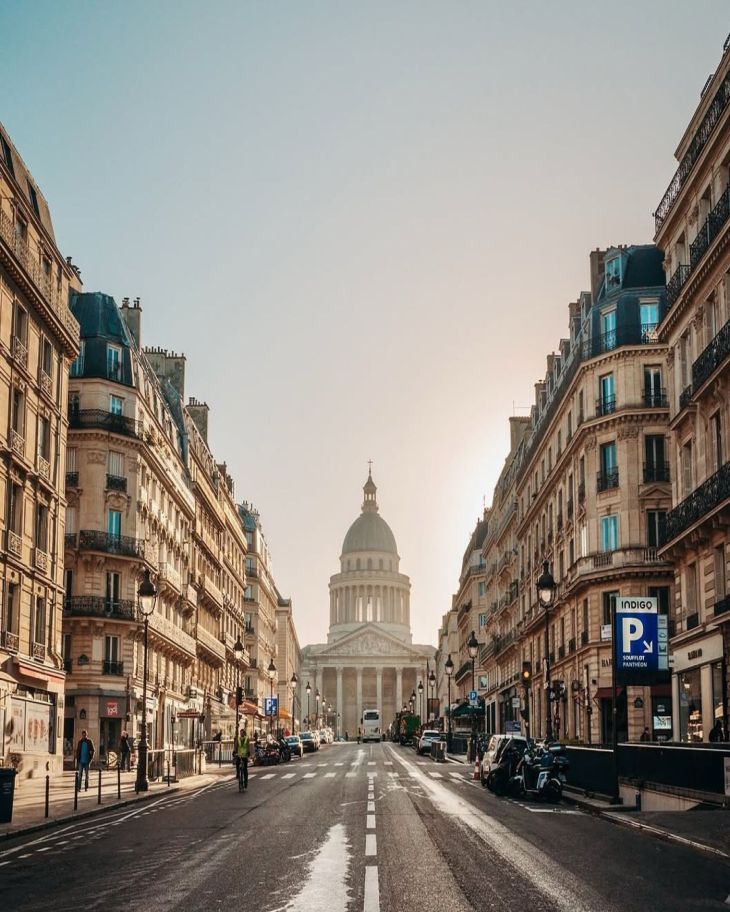
The Paris tourist office on the 5éme arrondissement: https://parisjetaime.com/eng/article/explore-paris-s-5th-arrondissement-a820
There you go folks, another dandy beautiful set of glorious streets of my eternal Paris. I have criss cross them many and have many in my blog already, Again, hope you enjoy this post on the streets of Paris, part XX !!! as I.
And remember happy travels, good health, and many cheers to all !!!

 Paris1972-Versailles2003