
I take you again to the passages of Paris, I have been to several but lots more to see , they are just gorgeous. Its Paris !!! Glad to have found me more in my old cd rom vault pictures to have in my blog for you and me, Therefore, here is my take on the Passage de l’Ancre of Paris !!! Hope you enjoy it as I.
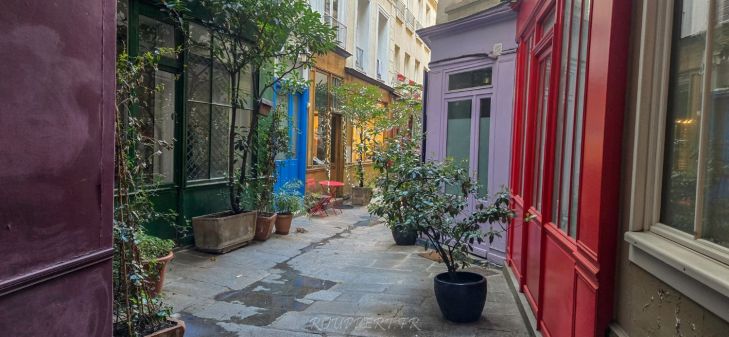
The passage de l’Ancre is a private road in the 3éme arrondissement of Paris. It begins on rue Saint-Martin, thus extending rue Chapon, and ends on rue de Turbigo, close to its intersection with boulevard Sébastopol. The passage is extended westward a little further, in the 2éme arrondissement, by the passage du Bourg-l’Abbé (see post) . This almost straight passage, almost 70 meters long measuring 2.5 meters wide; along its entire length, it is decorated with plants and flowers. Lined with shops at the beginning of the 19C ; several artists’ studios were converted into colorful shops. This passage is very different from the traditional covered passages of Paris. The pretty passage which is considered one of the oldest in Paris is now home to independent businesses and apartments above.
Discovering quiet secret passageways like this in Paris, are moments to be cherished. You won’t find a large glass roof or old collectors’ shops, but only a setting full of flowers lined with pretty colorful windows Today, Passage de l’Ancre meaning passage of the anchor, connects 223 Rue Saint-Martin with 30 Rue de Turbigo. I recommend entering by 223 rue Saint-Martin. You must pass through a blue carriage entrance or a large blue gate, depending on the street you access it from. The passageway is therefore not necessarily easy to find, and it is not always open. This site is served by metro lines 3 and 4 at the Réaumur – Sébastopol station.
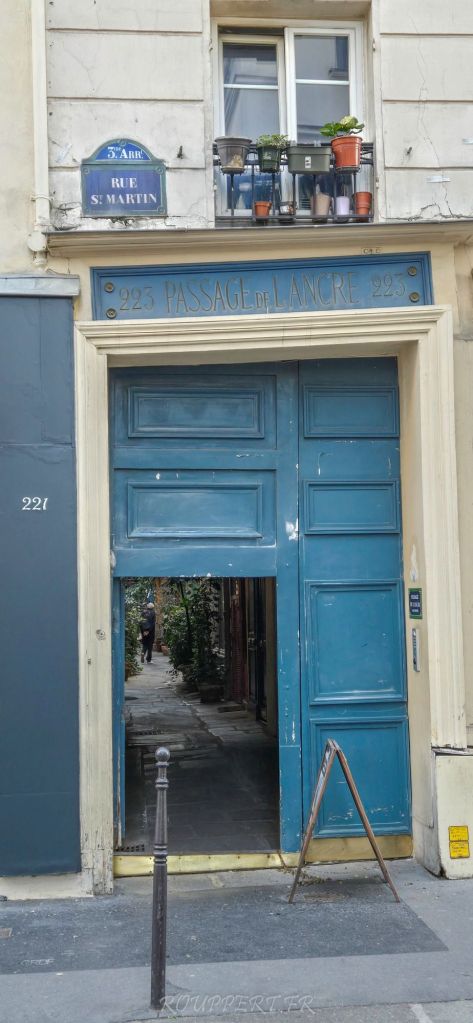
First called “passage du puits” in the 17C, then “passage de l’Ancre Royale”, or even “passage de l’Ancre Nationale” during the French revolution between 1792 and 1805, in reference to an old inn, “Au Grand Saint-Pierre”, whose sign was in the shape of a sea anchor. This is where in the 1640’s Monsieur Sauvage set up the first ‘taxi’ fiacre service at his Inn; Hôtel Saint-Fiacre. Saint-Fiacre became known as the patron saint for taxi drivers It is believed that some of his customers were Royal Navy personnel and perhaps this is where the anchor came into play. It once connected Rue Saint-Martin with Rue du Bourg l’Abbé until Boulevard de Sébastopol was created in 1855 severing the thoroughfare.
As a historical anecdote, it should be remembered, that during WWII, many of the passage’s Jewish occupants were deported following the Vél’d’Hiv roundup on July 16 and 17, 1942. The passageway was then abandoned, before being revived in 1998.
The Paris tourist office on the passage de l’Ancre : https://parisjetaime.com/eng/transport/passage-de-l-ancre-p2037
There you go folks, hope you find it helpful for your next trip to Paris. Or just browse these wonders of architecture in the most beautiful city in the world, Paris. Again, hope you enjoy this post on the Passage de l’Ancre of Paris !!! as I.
And remember, happy travels, good health, and many cheers to all !!!


