
I am again to tell you about more streets of my eternal Paris. I have many many posts on Paris and several on the streets of the most beautiful city in the world. I have come up with pictures from cd rom vault that should be here for you and me. As always thank you for following my blog some since Nov 26, 2010. Therefore, here is my take on the streets of Paris, part XIX !!! Hope you enjoy it as I.
The rue de l’Abreuvoir is located in the Grandes-Carrières quartier or neighborhood of the 18éme arrondissement or district of Paris. It is 133 meters long, and begins at 9, rue des Saules and ends at place Dalida. This street originates from an alley mentioned, as early as 1325, under the name of “ruelle qui va au But”, that is to say at the fountain of this name which would be found today at place Constantin-Pecqueur. In 1843, it was called “chemin de l’Abreuvoir” because of the path which led to the old Montmartre watering trough located at the corner of rue Girardon ; then name rue de l’Abreuvoir in 1863. It is served by line 12 at the Lamarck – Caulaincourt metro station. Notable buildings are at No. 2: La Maison Rose, founded by Germaine and Ramon Pichot, represented by many painters, including Maurice Utrillo, No. 4: sundial. The small building constructed in 1883 at no 12 was once the address of Camille Pissaro who rented a pied-à-terre there between 1888 and 1892. No. 16 (corner of rue Girardon): Villa Radet, Montmartre site of the Cité internationale des arts, located on the site of the old drinking trough of the village of Montmartre which still existed in 1854.
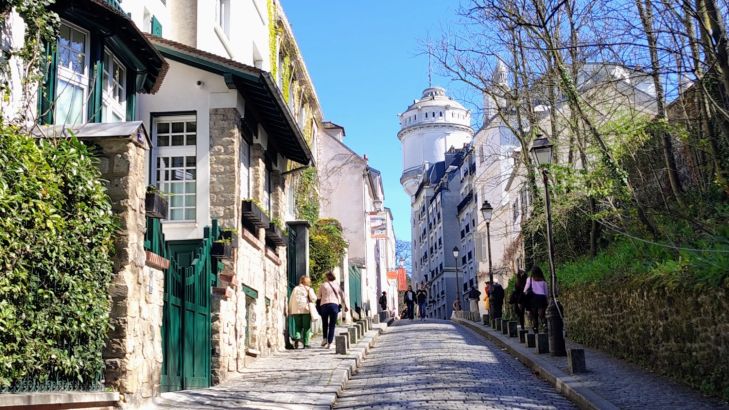
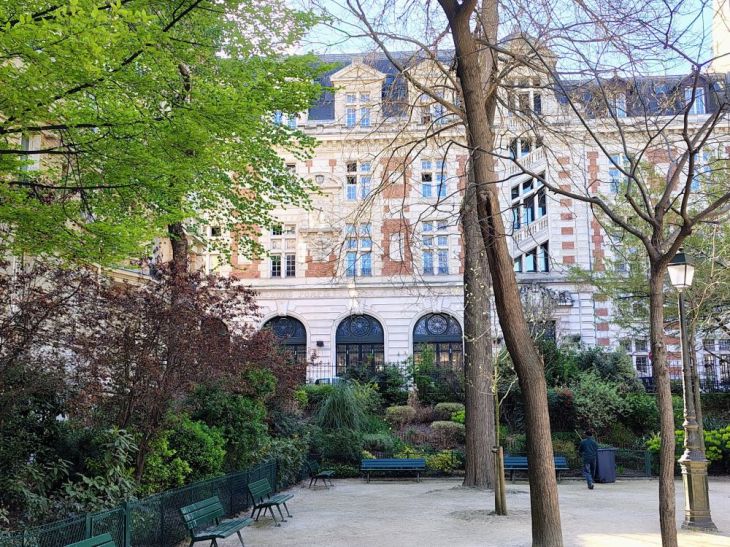
The square Carpeaux is located in the 18éme arrondissement of Paris. The square is accessible via Rue Carpeaux, Rue Marcadet (at nos. 207-227) and Rue Joseph-de-Maistre. It is named after the French sculptor, designer and painter Jean-Baptiste Carpeaux, who was a frequent visitor to Montmartre ,and is considered, along with François Rude and Auguste Rodin, to be one of the three greatest sculptors of the 19C. It is served by line 13 at Guy Môquet metro station. The Square Carpeaux was built at the end of the 19C on part of the old Montmartre cemetery, also known as the “Northern Cemetery”, which was decommissioned in 1879. A decree of April 18 of that same year gave it the name Carpeaux. It opened to the public in 1907. It is surrounded by a group of low-cost buildings (HBM) built between 1909 and 1919 for the Alexandre-et-Julie-Weill Foundation, whose initials (AWJ) appear on the pediment of the entrance to number 205 rue Marcadet. This garden, extending over 7,200 m2, is named in homage to the French artist Jean-Baptiste Carpeaux. He created numerous works, attempting to restore natural expressions, as illustrated by the group “La Danse” for the Opéra Garnier or the fountain in the Observatory gardens “Les Quatre Parties du monde”. In the garden is installed the leaning bust of Jean-Baptiste Carpeaux in stone, carved by Léon Fagel in 1929 and placed on a high stele designed by Henri Bans, on which are also affixed two bronze medallions. One represents Charles Carpeaux, the sculptor’s first son, who died in Indochina in 1904. The second represents Louis Carpeaux, the youngest son, who died in 1929. The two medallions were made by Jean-Baptiste Carpeaux’s daughter, Louise Clément-Carpeaux, also a sculptor. They were installed during a ceremony in 1930
The Paris tourist office on the 18éme arrondissement: https://parisjetaime.com/eng/article/explore-paris-s-18th-arrondissement-a832
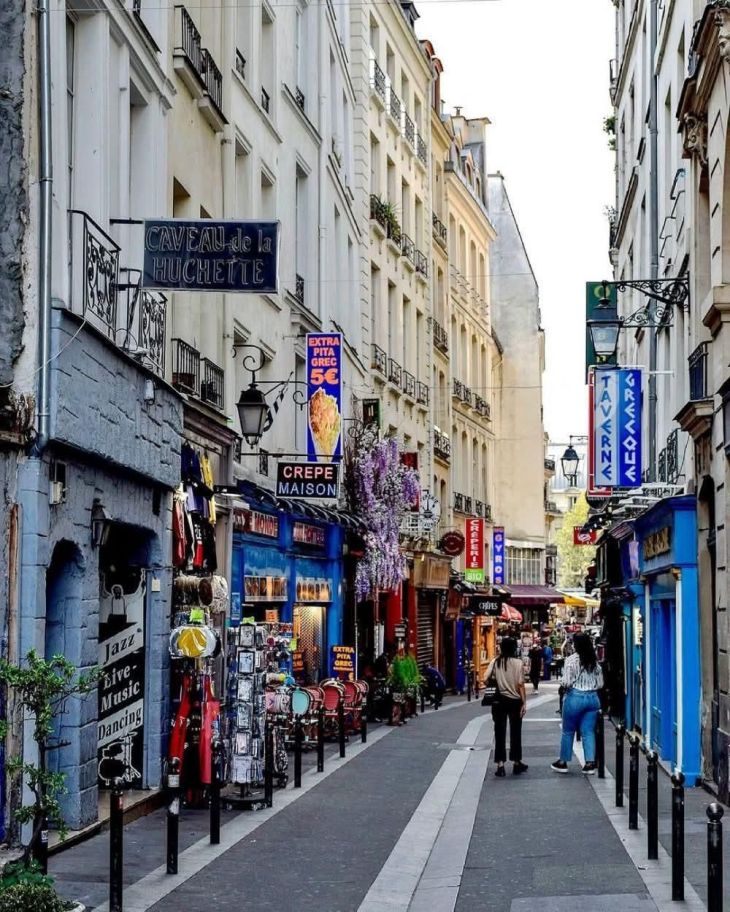
The rue de la Huchette is a narrow street located in the 5éme arrondissement of Paris. It is located between Boulevard Saint-Michel and Rue du Petit-Pont. It faces Notre-Dame Cathedral. Its name comes from a sign attested at the end of the 13C: La Huchette d’Or. The street is accessible from the Saint-Michel metro station on line 4 and from the Saint-Michel – Notre-Dame RER B and C stations, The street was laid through the Clos de Laas vineyard around 1210. It took the name “Rue de Laas.” In the 16C, it was one of the most beautiful streets on the Rive Gauche or Left Bank. The ambassadors of Maximilian I, the Dey of Algiers and Venice stayed at the “Hôtel de l’Ange”. In the 17C, the street specialized in the rotisserie trade and was called “Rue des Rôtisseurs”. This almost exclusively pedestrian street, very popular with tourists, is part of the Latin Quarter. It has one of the highest concentrations of restaurants in the whole city of Paris, with a predominance of Greek specialties. The street also has an intense nightlife with no fewer than four pubs and numerous bars. Notable buildings here are at no. 5: Le Caveau de la Huchette jazz club. It is one of the legendary jazz venues in Paris. No. 10: Napoleon Bonaparte lived here from August 1794 to July 1795, No. 23: Théâtre de la Huchette. No. 28: Hôtel-du-Mont-Blanc. During the 1930s, the writer Ernest Hemingway stayed here several times. The famous Aubert (born around 1769, attested alive in 1848), dean and syndicate of Parisian street singers, once lived on this street. Charles Aznavour lived here as a child; his parents ran a restaurant there.
The Paris tourist office on the 5éme arrondissement: https://parisjetaime.com/eng/article/explore-paris-s-5th-arrondissement-a820
There you go folks, another dandy beautiful set of glorious streets of my eternal Paris. I have criss cross them many and have many in my blog already, Again, hope you enjoy this post on the streets of Paris, part XIX !!! as I.
And remember happy travels, good health, and many cheers to all !!!


