
We have driven and walked in my eternal Paris, and would like to have an imprint in my blog on the wonderful family times we had there, There is so much to see , doing my best, and glad found me these pictures in my cd rom vault ,which now transposing in my blog for you and me, This was my former worked city, so glad to post more memorable spots on it, I thank you for your readership over the years and to bear with my rants! After Paris is to rant, shout and yelled about, me think. Therefore, here is my take on curiosities of Paris , part XXX !!! Hope you enjoy the post as I.
The Rue des Saules begins on the Butte Montmartre at 20, rue Norvins and 18, rue Saint-Rustique and ends at 135, rue Marcadet after running alongside the Montmartre vineyard and the Saint-Vincent cemetery. Its name comes from the fact that this road was once lined with willows. The district is served by line 12 at the Lamarck – Caulaincourt metro station. This road already existed in 1672. The section between the streets Saint-Rustique and Saint-Vincent bore, in 1843, the name “rue des Fontaines”; the one between the rue Norvins and that of Saint-Vincent was then part of the former village of Montmartre. Having become “rue de la Saussaye”, it took its current name in February 1867. The street was frequented at the end of the 19C and the beginning of the 20C by many painters whose works in the museums are testimonies of a life that was both popular and bohemian. It is in this street that one can still see in 1900 the last water carriers at the slip road. Remarkable buildings here are at No. 22: the cabaret Au Lapin Agile. (see below) Built in 1795, it was the favorite meeting place of artists of the early 20C. It was formerly called the Cabaret des Assassins. No. 53: Le Funambule Montmartre Theater. A famous street of bohemian Montmartre, Rue des Saules has been immortalized by Paul Cézanne (La Rue des Saules at the Musée du Luxembourg), Vincent van Gogh (La Guinguette at the Musée d’Orsay) and Maurice Utrillo (La Maison Rose à Montmartre at the San Francisco Museum of Modern Art, and Le Lapin Agile at the Arthur Ross Gallery at the University of Pennsylvania. The Au Lapin Agile, Pairs’s oldest bar cabaret and a Montmartre landmark since 1860, It is located on the Butte Montmartre, at 22 rue des Saules, in the 18éme arrondissement, near the Lamarck – Caulaincourt metro station. Established in the second half of the 19C, bought by Aristide Bruant in 1913, it was one of the favorite meeting places of the artistic bohemia of the early 20C, from Max Jacob to Pablo Picasso, including Roland Dorgelès, Francis Carco, Blaise Cendrars and Pierre Mac Orlan; later, in the 1940s and 50s, it was frequented by Jean-Roger Caussimon and François Billetdoux. It is still in operation today. The Lapin Agile would no longer regain its status as a meeting place for avant-garde writers and artists: the center of gravity of creation had moved to Montparnasse, just as it would move to Saint-Germain-des-Prés after the end of WWII. Nevertheless, painters maintained the custom, every year on the day of the inauguration of the Salon d’Automne, or Fall Fair of ending the evening at the Lapin Agile.
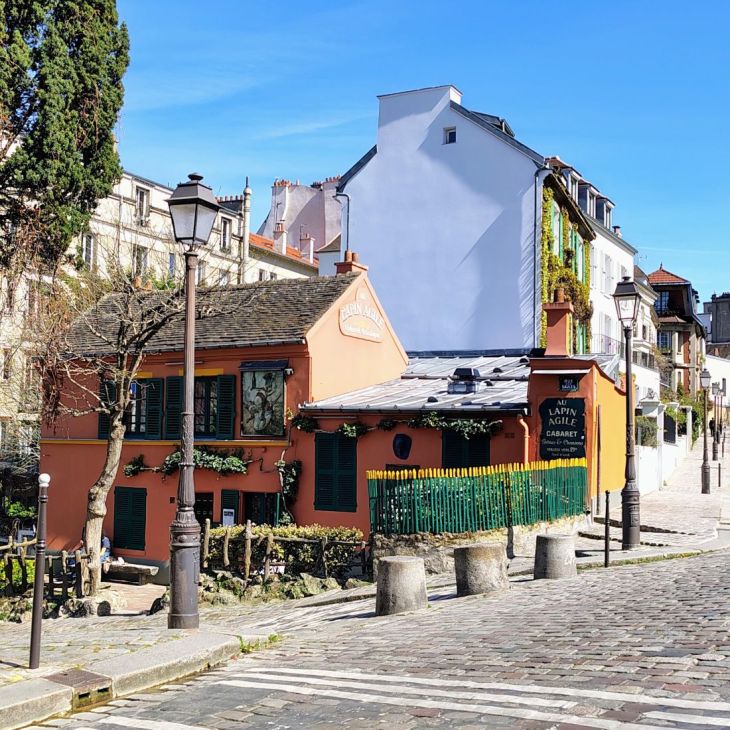
The official Cabaret Le Lapin Agile: https://au-lapin-agile.com/en/accueil-english/
The Paris tourist office on Le Lapin Agile: https://parisjetaime.com/eng/culture/au-lapin-agile-p3613
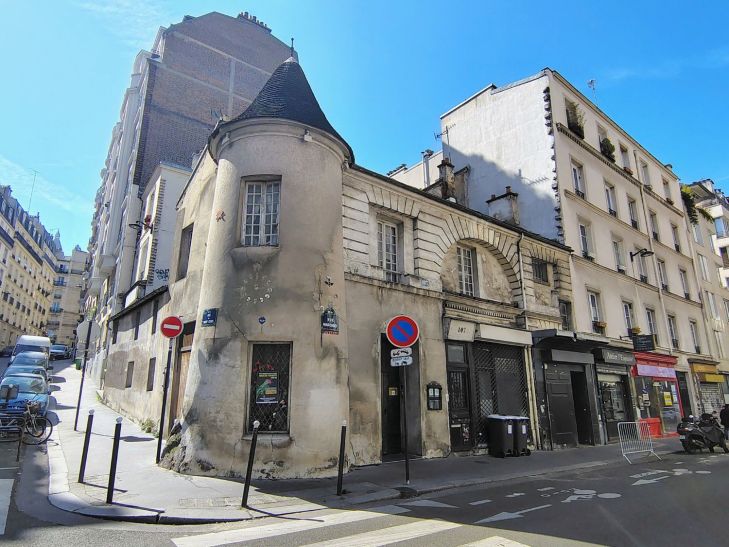
The Rue Marcadet is located in the 18éme arrondissement of Paris. Its name comes from a place name “la Mercade” or “la Marcadé”, the name of a former place name, located near the church of Saint-Denys de la Chapelle and where the Lendit fair was held. The street crosses Boulevard Barbès and Rue Damrémont. Its length is 2,030 meters and its width is 12 meters. Spinning the bundle of railway tracks serving the Gare du Nord (the Pont Marcadet, over which Rue Ordener passes), to the boundary with the 17éme arrondissement . Part of the old Chemin des Bœufs, which went from Paris to Clichy-la-Garenne, this road originally started from Rue de la Chapelle in the village of La Chapelle. It then crossed the village of Clignancourt in the village of Montmartre and then continued into the village of Clichy (Batignolles-Monceau after 1830) via the Chemin des Bœufs (currently Rue de La Jonquière). The current Rue Marcadet partly follows the route of the old departmental road no. 36. A law of 1859 attached the villages of La Chapelle, Montmartre and Batignolles-Monceau to Paris and, in 1863, Rue Marcadet was officially integrated into the Parisian road network. The Metro stations: Marcadet-Poissonniers: line 4 and line 12 and Guy-Môquet: line 13 serve this area, Remarkable buildings here are at No. 22: health center on Rue Marcadet. During WWII, resistance fighters Suzanne Leclézio and Yvonne Ziegler saved and hid many Jewish children in this establishment. Upon her return from deportation, Suzanne Leclézio remained the director of the center until 1984, No. 62: headquarters of the humanitarian organization Doctors of the World. No. 77 bis: Hôtel Mathagon, built by Pierre Mathagon, receiver general of lands and woods of the generality of Paris from 1766 to 1790, preserved and restored by the city/town hall in 1993. The two perpendicular main buildings are enhanced with stone corner quoins. It is crowned with a corner turret and a beautiful dormer window; it is one of the rare houses remaining in the village of Clignancourt. It was at this same address that Robert Sabatier spent his childhood, recounted in David and Olivier and in Les Allumettes suédoises. No. 103 (and nos. 61-63, rue du Mont-Cenis) remains of the old Clignancourt porcelain factory, (see photo) from the 18C. It was, before 2021, a libertine club, Le Château des lys [No. 108 (and no. 65, rue du Mont-Cenis): building from the Louis-Philippe era, witness to the village of Clignancourt before its annexation to Paris in 1860. No. 131: home of the maternal grandmother of the singer Barbara, with whom she lived from 1945 to 1946, No. 175: home of Auguste Rodin from 1866 to 1871 , Nos. 197-199: Mathilde-et-Henri-de-Rothschild Foundation, built in 1902, Nos. 203-207 (and no. 25, rue Carpeaux): group of low-cost buildings built from 1909 to 1919, for the Alexandre-et-Julie-Weill Foundation, whose initials (AWJ) appear on the pediment of the entrance. At no. 82, the building where the Doinel interior scenes for François Truffaut’s Les Quatre Cents Coups or The 400 Blows were filmed. Émile Zola, in L’Assommoir (1876), gives the following description of the street, as seen by the laundress Gervaise.
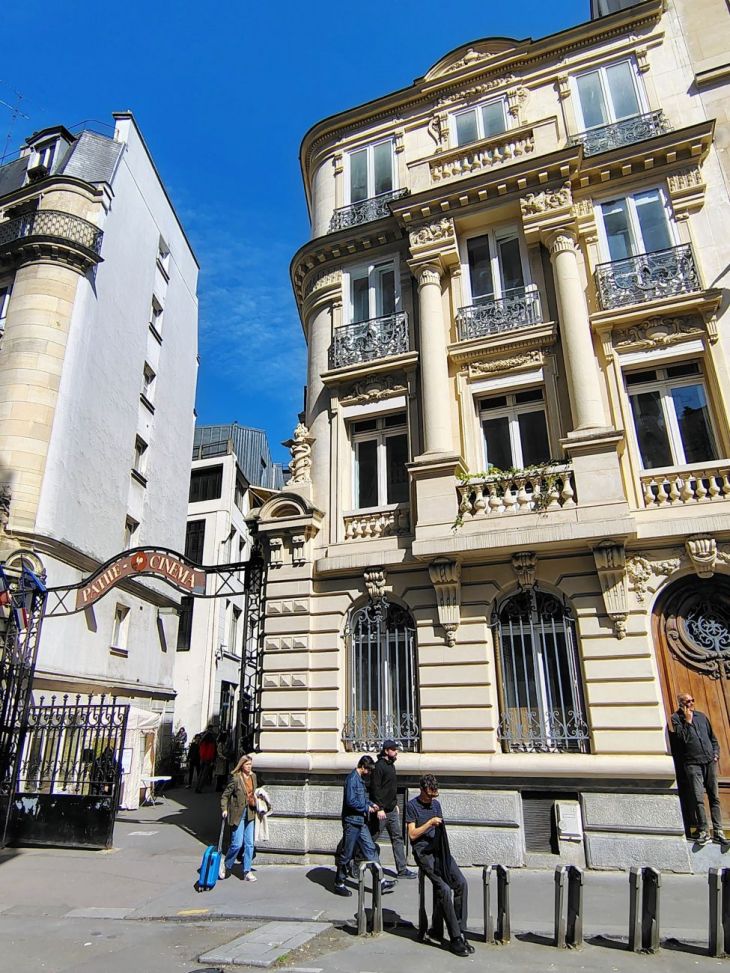
The rue Francœur is located in the Montmartre, Clignancourt and Grandes-Carrières quartiers or neighborhoods of the 18éme arrondissement or district of Paris. The street descends from Rue Caulaincourt to Rue Marcadet and, like many streets on the Butte Montmartre, has a steep gradient. The street takes its name from the mathematician Louis-Benjamin Francœur. This street was opened by a decree of August 11, 1867, and took its current name by a decree of February 10, 1875. Rue Francœur is served by line 12 at the Lamarck – Caulaincourt metro station. Notable buildings are at no, 6 the premises of Fémis (see below) in the former Francœur studios of Franstudio. At no 8, the French Association of Cinematographers. At the corner with Rue des Saules, the Le Funambule Montmartre theater. The La Fémis Pathé-Cinéma Studios came out in 1898, when the Daval family, owners of the “Bazar du Bâtiment”, had a private mansion and industrial buildings built on rue Francœur. Then Bernard Natan, director of the Rapid-Film company, rented all the premises and set up a film processing laboratory in 1926. He built two film studios that same year. In 1929, the Natan company merged with the Pathé company. Bernard Natan then had seven studios located in Joinville-le-Pont and studios on rue Francœur. Equipped for talkies, they were considered among the most modern in Europe. The greatest directors filmed there: Marcel L’Herbier, René Clair, Jean Grémillon, Jacques Prévert, Maurice and Jacques Tourneur. Pathé-Natan then became the largest French film production company. Pathé’s activity lasted until 1990. The Chargeurs Réunis group bought Pathé and stopped the studios’ activity. In 1996, the famous Fémis, National School of Image and Sound Professions, moved into the former Pathé studios.
The Paris tourist office on the 18éme arrondissement : https://parisjetaime.com/eng/article/explore-paris-s-18th-arrondissement-a832
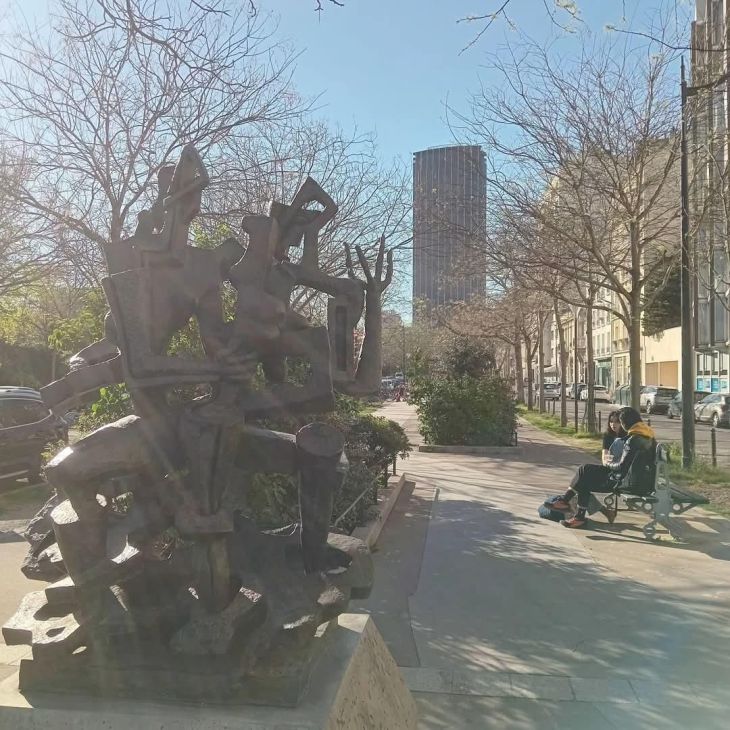
The Boulevard Raspail is in the 6éme, 7éme and 14éme arrondissements of Paris. It connects Boulevard Saint-Germain to Place Denfert-Rochereau, successively crossing the 7éme at quartier or neighborhood Saint-Thomas-d’Aquin , 6éme at quartier or neighborhood Notre-Dame-des-Champs, and 14éme in quartier or neighborhood Montparnasse. It crosses the axes of the rue de Sèvres, the rue de Rennes and the boulevard du Montparnasse. Its current name was given to it in 1887 in homage to the chemist, doctor and politician François-Vincent Raspail. The road is the longest in Paris, in a straight line. It can be reach on metro Raspail line 4 and 6 as the statue mentioned below can be reach easy on bus no, 68 , This boulevard results from the composition of several sections: the oldest part is the one located between the boulevards du Montparnasse and Saint-Jacques, opened from 1760 to 1767, to constitute one of the boulevards du Midi. The part between the boulevard Edgar-Quinet and the boulevard Saint-Jacques and the place Denfert-Rochereau was incorporated into the route of the wall of the Farmers General in 1784. It took some of the notable buildings me think such as at No. 45 (corner of rue de Sèvres): Hôtel Lutetia, ‘many times for drinks here), a palace with a long history, which housed the Abwehr from 1940 to 1944, then the deportees, in 1945, on their return from the Nazi concentration camps. The establishment changed its name in 2025 and became the Mandarin Oriental Lutetia, At no. 101, headquarters of the Alliance Française, an organization responsible for the dissemination of the French language and culture, and its Parisian school for foreigners taking a language course or settling in the city. Buildings of the Private Institute for Preparation for Higher Education. No. 110: Charles de Gaulle lived here from 1932 to 1937; a plaque pays tribute to him. On the central platform in the middle of the boulevard, a little set back to the north of the Place Pablo-Picasso, also called the “carrefour Vavin”, which is at the intersection of Boulevard Raspail and Boulevard du Montparnasse, the Monument to Balzac has stood since 1939, the base of which is surmounted by a statue of Honoré de Balzac by Auguste Rodin, No. 222: Jean-Paul Sartre was a tenant on the tenth floor from 1962 , No. 228: Pablo Picasso moved there in September 1912 with his new partner, Eva Gouel, No. 232, Ossip Zadkine -La Naissance des Formes or the Birth of Forms (see photo) bronze statue from the collections of the Zadkine Museum, created in 1947. The first monumental bronze print was created in 1958. On corner of Bd Raspail, and boulevard Edgar Quinet , No 236: the sculptor Pol Bury lived there from 1968 to 2005; a plaque pays tribute to him. Nos 240-242: Jules Huet de Froberville commissioned the architects and decorators Paul Huillard and Louis Süe to build these two houses. The two-phase construction project began in 1903 with number 240, then continued in 1905 with number 242. The two symmetrical houses are separated by a driveway leading to a courtyard, where several pavilions and workshops are located. Huet reserved one for himself. He named the whole “Cité Nicolas-Poussin”. Among the occupants of these places, we can mention Pablo Picasso, who stayed there twice: once in 1912 and 1913, and perhaps a second time during the Roaring Twenties. Home, from 1906, of the sculptor Cecil Howard, then a young student at the Académie Julian. He lived there with his mother. No. 261: headquarters of the Fondation Cartier pour l’art contemporain, opened in 1994 in a building with an architectural design in glass, steel and concrete by the architect Jean Nouvel. On this site was the American Center from 1920 (destroyed) until the move of this institution to 51, rue de Bercy, in 1988, In July 1832, Chateaubriand was arrested. He relates this event and his exit, through a small door opening onto the boulevard, in the thirty-sixth book of Memoirs from Beyond the Grave.
The Paris tourist office on the districts or arrondissements: https://parisjetaime.com/eng/discover-paris/paris-by-district/arrondissements-paris-i081
There you go folks, a dandy city to explore and enjoy with the family, Memorable moments in my eternal Paris, driving and walking all over in my road warrior trails brings out sublime awesome spots with nice memorable family visits of yesteryear always remember and always looking forward to be back, eventually. Again hope you enjoy the post on curiosities of Paris, part XXX !!! as I.
And remember, happy travels, good health, and many cheers to all !!!


