
This is a venerable institution that is worth the detour to visit, I happened to been a couple times over the years in official functions but it can be visited with appointment, I am glad found me a couple older pictures in my cd rom vault that should be in my blog for you and me, Parisis worth it and it brings back many memorable moments of my life. Therefore, here is my take on the Sorbonne Université of Paris !! Hope you enjoy the post as I.
The Sorbonne Université is composed of three faculties: the Faculty of Letters (formerly the University of Paris-IV), the Faculty of Science and Engineering and the Faculty of Health (formerly the University of Paris-VI). Created on January 1, 2018, it brings together the staff and resources of the two universities, Paris-Sorbonne and Pierre-et-Marie-Curie. In July 2023, the Faculty of Medicine was renamed the Faculty of Health Sorbonne University is located at 21, rue de l’École-de-Médecine, within the Cordeliers site, the historic site of the Paris School of Medicine and the Cordeliers College of the former University of Paris. The Sorbonne can be visited from time to time and by appointment only. You can get there on metro Cluny La Sorbonne Station of line 10, and the RER B Luxembourg Station.

The Sorbonne University of Paris appears in several international rankings: in the Academic Ranking of World Universities (ARWU, known as the Shanghai ranking): in 2021, 2nd in France and 35th in the world (in 2021, 3rd worldwide in mathematics and oceanography); in the Center for World University Rankings (CWUR): in 2022-2023, 3rd in France and 38th worldwide; in the QS World University ranking: in 2023, 3rd in France and 60th worldwide; in the Times Higher Education ranking: in 2022, 2nd in France and 88th worldwide; in the U.S. News Best Global Universities Rankings: in 2022, 1st in France and 46th worldwide, 3rd worldwide in mathematics; in the NTU World University Rankings: in 2021, 2nd in France and 30th in the world, 7th in the world in mathematics.
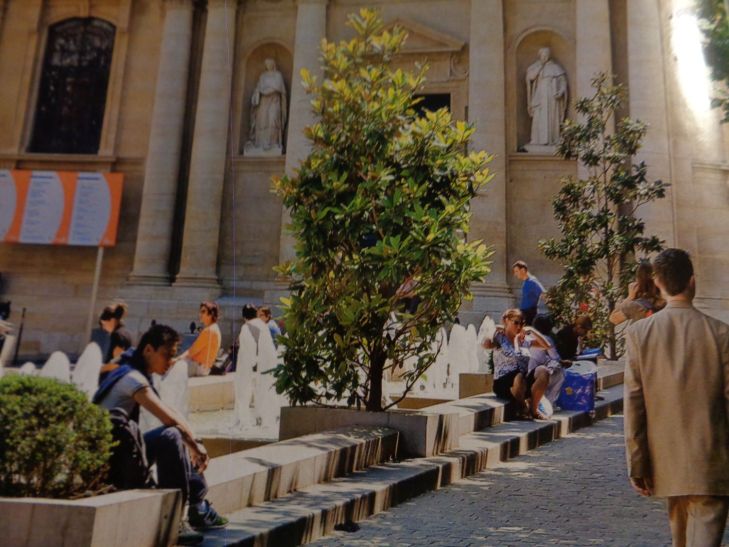
One spot directly related to the history of the university is the Place de la Sorbonne, It is bordered by the rue Victor-Cousin and rue de la Sorbonne; by boulevard Saint-Michel. Rue Champollion leads to the middle of it. This square owes its name to the Sorbonne University, which it adjoins on the side. The square was opened in 1639 under the name of rue Neuve-de-Richelieu. During the French revolution, it was renamed for a short time Place Chalier, and Petit rue Chalier, the aspect of the square was modified in 1980, the plane trees being replaced by silver lime trees, with the installation of a permanent flow fountain, The facade of the Sainte-Ursule Chapel of the Sorbonne (17C) closes the perspective of the square between the streets of the Sorbonne and Victor-Cousin. On both sides of this facade are the lateral entrances which give access to the University of the Sorbonne. The one on the left still bears the registration of the National School of Charters, founded in 1821 and hosted within the Sorbonne until its move, in 2014, to the Quadrilatera Richelieu or 65 rue Richelieu. Buildings built from 1838 on a part of the site of the old chapel of the Collège de Cluny. Founded in 1269, this college was seized during the French revolution and gradually dismantled in the years 1823 to 1866. Its chapel disappeared in 1833.
A bit of history condense as it can be huge, tell us that Sorbonne University is the heir to many institutions before it, dating back to the Middle Ages. Robert de Sorbon, chaplain to King Louis IX (Saint Louis), observed the material difficulties that poor scholars had in reaching the rank of doctor. In February 1257, he had a house officially established for a certain number of secular clergymen who, living in common and without concern for their material existence, would be entirely occupied with study and teaching. This house was named the Collège de Sorbonne. The old slogan of the institution, “Sorbonne University, creators of the future since 1257”, refers to this date. The Collège de Sorbonne is located on the site of the current Sorbonne building. Today, it shares its premises between the Chancellery, Sorbonne University and the Panthéon-Sorbonne and Sorbonne-Nouvelle universities. The Sorbonne College was dissolved in 1793 along with all the other colleges of the former University of Paris. Between 1793 and 1896, even though higher education existed, there was therefore no longer officially a university in France. In 1896, the University of Paris was reborn from its ashes, thanks to the law of April 28, 1893 granting legal personality to bodies formed by the merger of several faculties of an academy and that of July 10, 1896 giving the name of university to bodies of faculties. It was created as a grouping of the Faculty of Science, the Faculty of Letters, the Faculty of Law, the Faculty of Medicine, the Faculty of Protestant Theology (itself created in 1877, soon transformed into a free faculty in 1905), and the Higher School of Pharmacy. The University of Paris was inaugurated on November 19, 1896
In 1968, the University of Paris was dismantled and the universities of Paris-IV and Paris-VI were created. The University of Paris, which was divided into five faculties, was split into several interdisciplinary universities. Some, including the University of Paris-IV, retained the name “Sorbonne” and premises in the historic center of the university, which had until then been mainly devoted to the faculties of literature and science. The University of Paris-IV thus brought together “right-wing” professors as opposed to Paris-I “Panthéon-Sorbonne”, which was marked “left-wing”. In 1971, the University of Paris-VI was created from the majority of the teaching and research units of the Faculty of Sciences of Paris (the others joining the universities of Paris-Diderot, Paris-Sud in Orsay, Paris-Est-Créteil, and Sorbonne-Paris-Nord in Villetaneuse) and part of the units of the Faculty of Medicine of Paris (the others joining the universities of Paris-Descartes, Paris-Diderot and Paris-Nord). In 1974, the University of Paris-VI took the name of Pierre-et-Marie-Curie University,
As a little anecdote, Cardinal Richelieu was the headmaster in 1622, and Pierre de Coubertin founded the International Olympic Committee (IOC) there in 1894 in order to give birth to the modern Olympic Games.
The Paris tourist office on the Sorbonne Univ : https://parisjetaime.com/eng/culture/la-sorbonne-universite-p1079
The official Sorbonne univ on its history : https://www.sorbonne-universite.fr/universite/histoire-et-patrimoines
There you go folks, a wonderful institution and in a grand neighborhood of my eternal Paris. Again, hope you enjoy this post on the Sorbonne Université of Paris !! as I. And remember, happy travels ,good health, and many cheers to all !!!

 Paris1972-Versailles2003