
I have come here for several years ever set my foot firmly in France in 1990 on a visit and later visiting living near since 2003. It is one of the epitome places of my eternal Paris. I have written posts on its icons and its history. However, found couple pictures of its streets from my cd rom vault and they should be in my blog for you and me, This is Montmartre in Paris unique place a must to visit. Therefore, this is my take on the streets of Montmartre in Paris !!! Hope you enjoy the post as I.
Montmartre is a district of authentic charm, famous for its magnificent views over Paris. You can get to the top of the hill by taking the funicular, which costs the same as a metro ticket. The more energetic can climb the 222 steps through Square Louise Michel. After the not-to-be-missed visit to the Basilica, visitors set off on a historic stroll along the Butte Montmartre.. The walk continues back down , along the way, visitors can enjoy the creative and trendy shop windows of Rue des Abbesses and Rue Tardieu, the shops of Rue Lepic, the cosmopolitan atmosphere of Rue de Steinkerque, and the naughty district of Pigalle. Just a few minutes’ walk from South Pigalle, the tea room in the garden of the Musée de la Vie Romantique is ideal for a gourmet break.
The rue du Mont Cenis is a street in the Montmartre neighborhood, of the 18éme arrondissement of Paris in high slope, 1,304 meters long and 121 meters high, Te rue du Mont Cenis begins at the crossroads of rue Saint-Éleuthère and rue Azaïs, runs along the Saint-Pierre de Montmartre Church (see post) near Place du Tertre, crosses rue Saint-Vincent, rue Lamarck, Place Jules-Joffrin, rue Marcadet, rue Ordener, rue Championnet and Boulevard Ornano to end at rue Belliard. It includes many stairs: 52 steps between the Custine and Lamarck streets, 54 between the Paul-Féval and Saint-Vincent streets with 81 steps between the latter and rue Cortot. Formerly known as “petit rue Saint-Denis” on its southern part and “Chaussée Saint-Denis” on its northern part because an old chemin of the pilgrimage of Saint-Denis, the path, very steep, took the name of Mont-Cenis, a Massif of the northern Alps, It is served by the Mėtro line 12 at Jules Joffrin station and line 4 at the Porte de Clignancourt station.
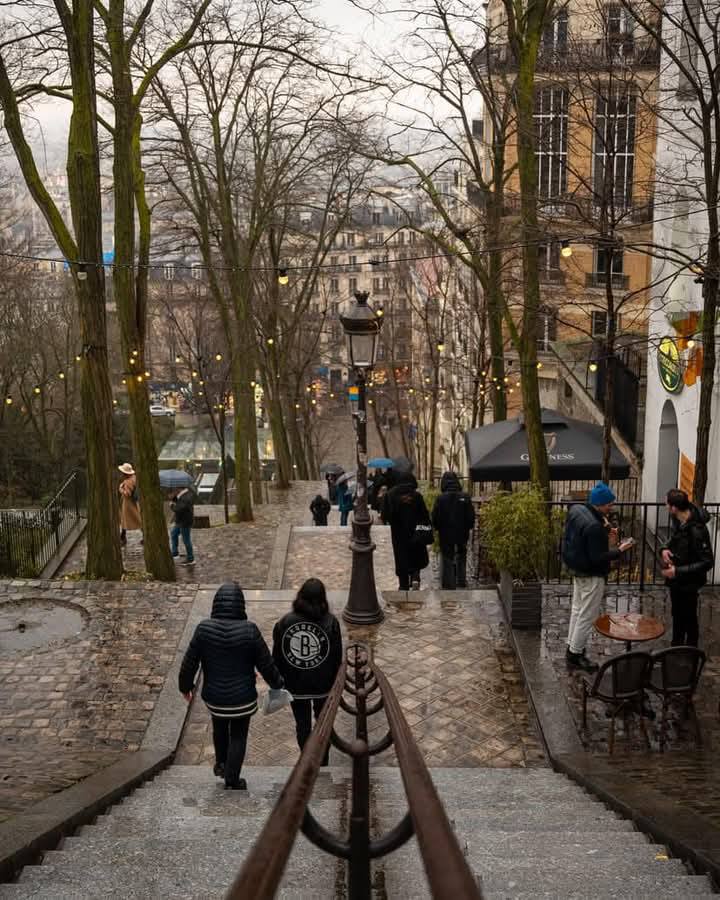
The remarkable buildings on it me think are at No. 2, the Saint-Pierre de Montmartre Church, an old abbey church built between 1133 and 1147 in an old place of devotion of the 6C. At no,19 lived from 1934 the couple of painters Bernard Lorjou and Yvonne Mottet, as well as the painter Jean d’Esparbès who died there in 1944, at No 22 was a house where Hector Berlioz lived, at No 65 , rue du Mont-Cenis and no,108, rue Marcadet, former Louis-Philippe building remarkably kept, Built before the attachment of the village of Clignancourt to the city of Paris. At no 67, location of the old chapel of the Trinity, built in 1579. It served, during septine processions, to attend mass on days of bad weather . It was closed in 1783, then sheltered a fire station in 1860, then a wines depot, then turned into a cabaret in the brand of the Belle Gabrielle, and was finally destroyed around 1920. It was said that it was the former sheep farm of Gabrielle d’Estrées , Up to Place Jules-Joffrin, rue Longes the city hall of the 18éme arrondissement and the Notre-Dame de Clignancourt Church.
A bit of history tell us that it already appears on the plan of Albert Jouvin de Rochefort, drawn in 1672. The site of the old farm of the lordship of Clignancourt would currently be located in the island between the streets of Mont-Cenis, Marcadet and Hermel, While the manor of this lordship was opposite the old way of the pilgrimage of Saint-Denis , Until 1784, the street was located, further north, in the exact extension of rue Adrien-Lesesne in Saint-Ouen which joins the Chemin des Poissonniers at the cemetery of Saint-Ouen. This continuity was interrupted with the development of the peripheral boulevard (BP). Every seven years, at the site of the current Metro station Jules Joffrin, representatives of the Abbess of Montmartre came to meet the monks of the Abbey of Saint-Denis, to accompany them to the summit of the mound. This path was called “Chemin de la Procession”, then “Petite rue Saint-Denis” between the Norvins and Marcadet streets, and “Chaussée Saint-Denis” beyond. After the attachment of Montmartre to Paris in 1859, rue Saint-Denis was officially classified in the Parisian roads on May 23, 1863 and took its current name rue du Mont Cenis by decree of July 20, 1868.
The rue du Calvaire is a steep short street from the 18éme arrondissement of Paris, on the Butte Montmartre. This street is actually a staircase that leads from rue Gabrielle to Place du Calvaire. It, also, connects passing the small place du Calvaire with the popular place du Tertre right by the restaurant Le Sabot Rouge, It held its name from the calvary that was built in 1805 at the top of the Butte, near the Saint-Pierre de Montmartre Church, This street of the former village of Montmartre was pierced in 1844, under its current name of rue du Calvaire, then was attached at the Paris roads in 1863.
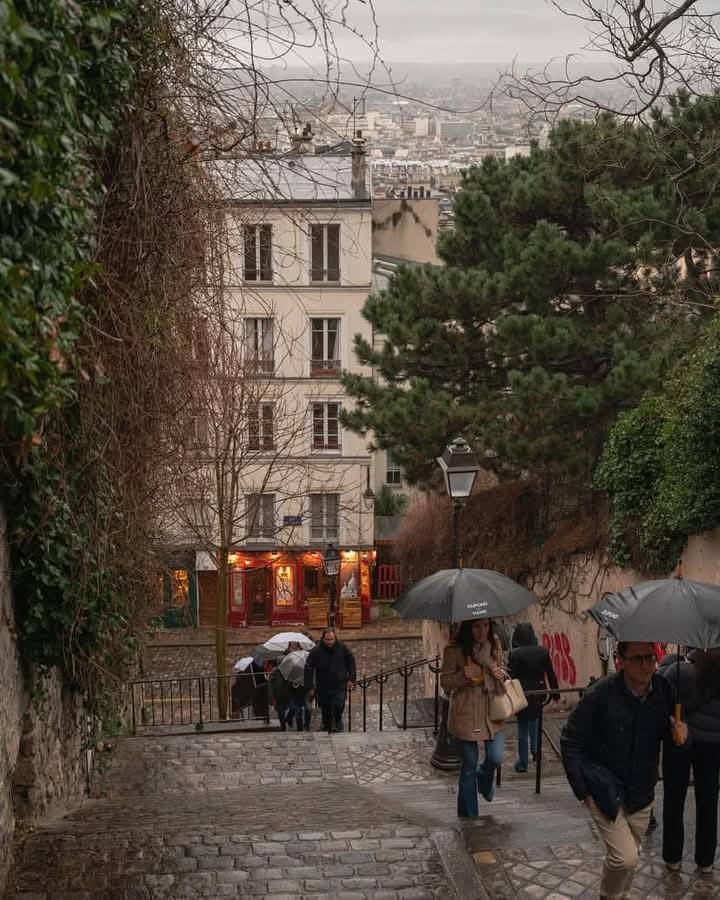
The Paris tourist office on the 18éme arrondissement (Montmartre) : https://parisjetaime.com/eng/article/explore-paris-s-18th-arrondissement-a832
The City of Paris 18 arrondissement or district City hall on things to do : https://mairie18.paris.fr/recherche/lieux?arrondissements=75018
The Old Montmartre Society : https://www.levieuxmontmartre.com/english/index.html
The Montmartre Addict for things about Montmartre : https://www.montmartre-addict.com/categorie-article/city-guide/
There you go folks, a work of art, a wonderful place to visit my beautiful eternal Paris. It will be worth your time and effort, for walks into Montmatre is a must. Again, hope you enjoy the post on the streets of Montmartre in Paris as I.
And remember, happy travels, good health, and many cheers to all !!!

 Paris1972-Versailles2003