
I am again to tell you about more streets of my eternal Paris. I have many many posts on Paris and several on the streets of the most beautiful city in the world. I have come up with pictures from cd rom vault that should be here for you and me. As always thank you for following my blog some since 2010. Therefore, here is my take on the streets of Paris, part X !!! Hope you enjoy it as I.
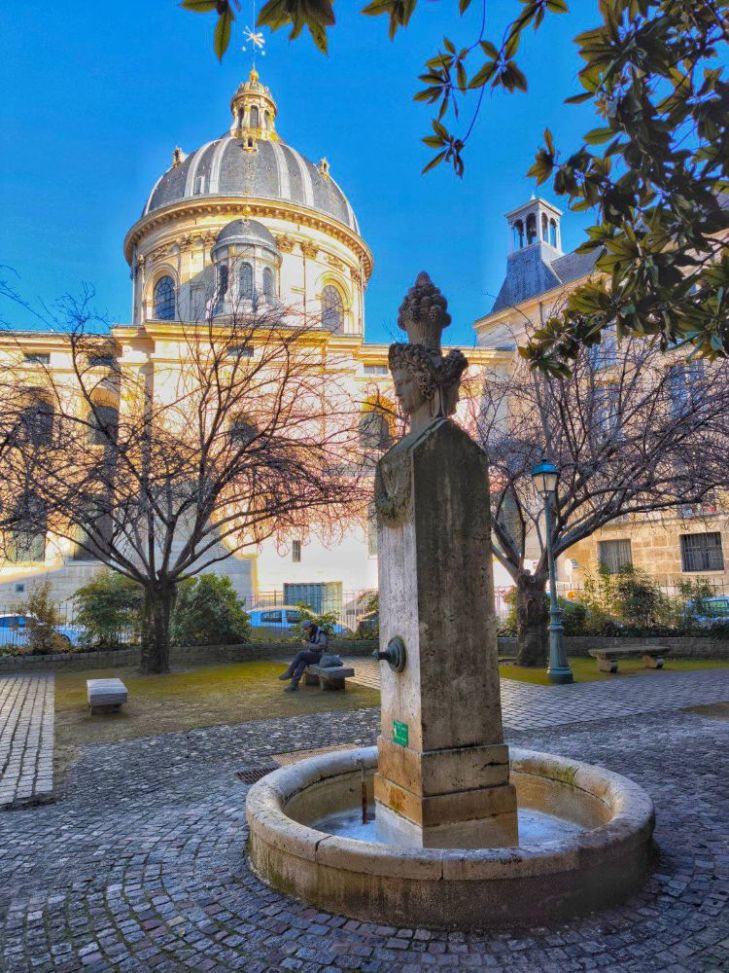
The Square Gabriel-Pierné is by the 5 rue de Seine is a green space taking in the quartiers or neighborhoods of Monnaie, Odéon, Saint Germain des Prés in the 6éme arrondissement or district of Paris. One of the two squares behind the Institut de France. If this area shines for its cultural and literary vocation, the Square Gabriel Pierné, nestled between the arts, the bookstores and the antique dealers, is the perfect symbol. It is in the spring that this 644 m² garden reveals all its splendor, thanks to a natural spectacle which we never tire of: the flowering of cherry trees,See pic back Institut de France. The fountain of the market-aux-carmes, of Alexandre-Evariste Fragonard which dates from 1830. It was installed here in 1930, The fountain was initially intended to serve the market for Carmes. After the demolition of the market in 1930, the Fontaine found a new house in the Square Gabriel-Pierné , The simplicity of a ground basin is enriched by a central column from which spurts two thin jets of water. To adorn everything, a representation of a two faces head symbolizes abundance and trade, recalling the commercial soul of the past district. The fountain is not only a decorative element, but a real historical benchmark, This square bears the name of Gabriel Pierné an organist, pianist, composer and conductor. The square was opened in 1938. It occupied the site of the “Paume des Métayers”, in which Molière began and the illustrious theater The Square Gabriel-Pierné is located at the crossroads of rue Mazarine and rue de Seine , just at the rear of the chapel of the College of Nurses. This site is served by line 7 at Pont-Neuf metro station, line 4 at Saint-Germain-des-Prés station and by line 10 at Mabillon station.
The City of Paris on the square : https://www.paris.fr/lieux/square-gabriel-pierne-2453
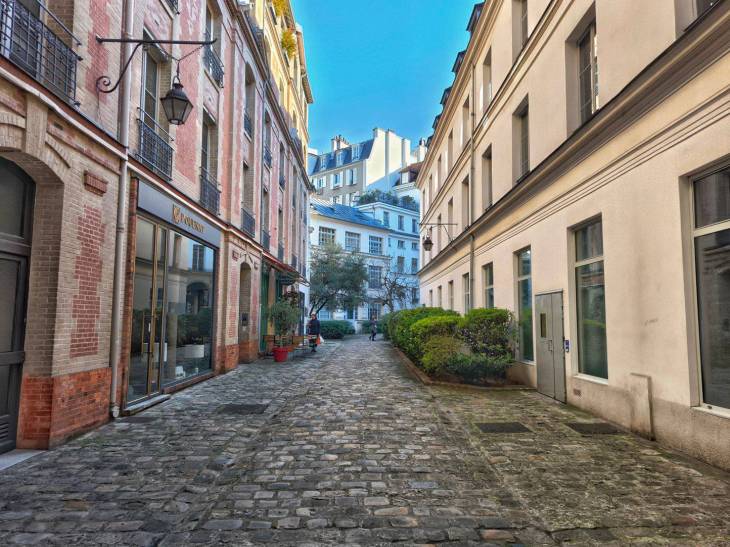
The Passage Dauphine is a path located in the Monnaie quartier or neighborhood of the 6éme arrondissement or district of Paris; between 30 rue Dauphine and 58 rue Mazarine in the extension of rue Christine, It opened in 1607 through the old gardens of the Augustinian convent, it was traced in the extension of the great royal square wanted by Henri IV, the Place Dauphine baptized in honor of the Dauphin, future Louis XIII. The Passage Dauphine was opened under its current name in 1825 , The rue Dauphine is a new axis connecting the brand new Place Dauphine on the île de la Cité to rue Saint-André des Arts. Its name comes from the dauphin, the son of Henri IV, future king Louis XIII. During the revolutionary days of 1830, the Passage Dauphine was one of the places to distribute ammunition to the insurgents, The Passage Dauphine is served nearby by line 4 at Odéon station. Remarkable buildings we have the Passage Dauphine hosts the remains of the enclosure of Philippe Auguste, At no 13 occupied by several institutes of foreign languages; the vestiges of the wall enclosure ,and a tower are visible in the Philippe-Auguste amphitheater located in the basement. In 1973, the construction of an underground parking park made it possible to update fragments of the old Philippe-Auguste enclosure which haunts the district. On the left by rue Mazarine, former rue des Fossés-de-Nesle, the entrance to the parking lot in question allows curious people to access at level-1 where the foundations of a tower of the wall dating from 1209 are integrated into the modern structure. At no 20, the International Language Center France, a foreign language institute, also retains traces of the defensive wall whose vestiges are out of the school in its main amphitheater.
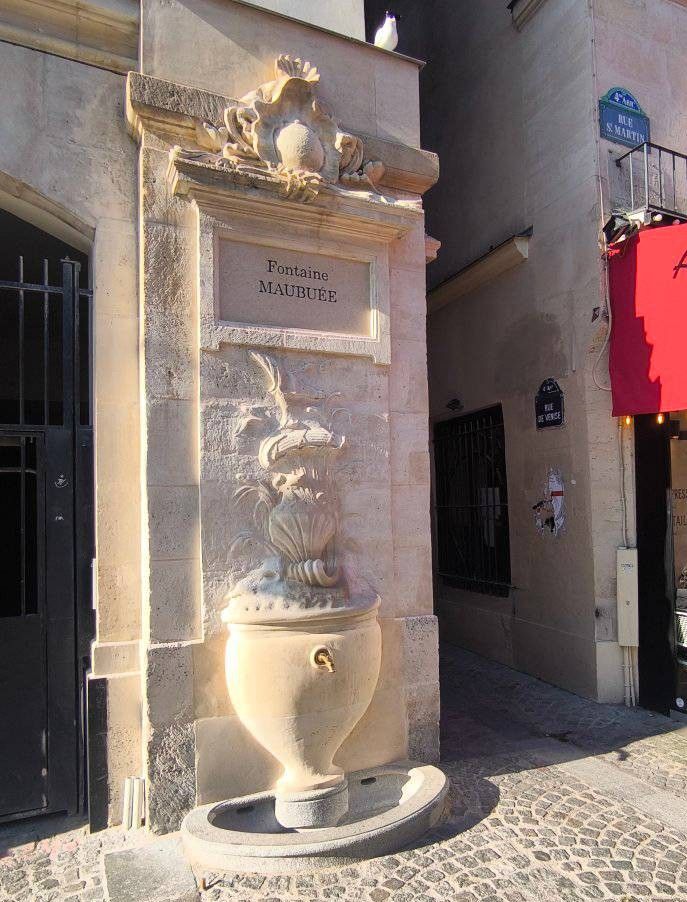
The Rue Saint-Martin street has a length of 1,420 meters is part of the 3éme arrondissement or district and on the Arts-et-Métiers and Sainte-Avoye neighborhoods or quartiers and the 4éme arrondissement, of the quartier or neighborhood of Saint-Merri. The street begins at nos, 8-12, Quai de Gesvres and ends at 1, boulevard Saint-Denis and 55, boulevard Saint-Martin. The street is extended north, beyond the Porte Saint-Martin gate, by rue du Faubourg-Saint-Martin. It is served by line 4 of the metro at the Châtelet -Les Halles, Étienne Marcel, Réaumur – Sébastopol and Strasbourg – Saint -Denis metro stations, One particular building/monument to see here is the Fontaine Maubuée (see picture) located at no, 129 Rue Saint Martin corner with rue de Venise, This fountain is one of the oldest Parisian fountains. It is mentioned in the letters patent of October 9, 1392 by which Charles VI tried to put an end to the particular concessions granted or usurped on the waters of Paris. The name “mau buée”, meaning “bad fog” or “bad laundry”, would have been given to this fountain due to the poor quality of its waters from the Belleville sources, according to the Old Paris commission, the name comes from Hugues Maubué as in the 13C, he made a Saint-Martin-des-Champs priory foundation in the non heridaru lands where rue de la Fontaine-Maubuée is located, The current fountain was rebuilt in 1733, at the corner of rue Saint-Martin and rue Maubuée. It is decorated with a bas-relief of the 18C representing a rocky vase, surrounded by reeds and aquatic plants in its lower part, surmounted by a rectangular cartridge, itself placed under a molded tear decorated with an oval badge. The lateral side of the fountain has a panel devoid of decor, but also surmounted by a molded tear decorated with the city of the city of Paris, in the form of a three -mast ship and two bridges pierced with sandbords. The fountain was dismantled in 1930 during the destruction of the insalubre island n ° 1 (location occupied today by the Centre Georges-Pompidou, and deposited behind the Saint-Julien-le-Pauvre Church, it went up in 1977 to its current location, at the corner of rue Saint-Martin and rue de Venise, and nowadays water does not flows there.
Other remarkable buildings here are the tour Saint-Jacques tower, At no 78: Saint-Merri Church. At no 80 and rue du Cloître-Saint-Merri: location of the Archet Saint-Merri, former door of the second Paris enclosure or wall. At no 89: Maison de l’Annonciation, arms sculpted at the level of the first floor, representing the Annunciation that is to say the announcement made to the Virgin Mary of her divine maternity by the Archangel Gabriel. At No 157: Passage Molière. At no 200: Location of the Porte Saint-Martin gate of the enclosure of Philippe Auguste. At no 223: Entrance to the passage de l’Ancre or anchor which leads to the rue de Turbigo. At no 252 bis: Saint-Nicolas-des-Champs Church. At nos 270, 278 and 292: the National Conservatory of Arts et Métiers (CNAM), former priory of Saint-Martin-des-Champs. The Fontaine du Vert Bois, at the corner with rue du Vertbois. At no 353: Location of the Porte Saint-Martin gate of the enclosure of Charles V. And the Arc de Triomphe de la Porte Saint-Martin.
Around the year 1200, it was almost completely bordered by constructions to the rue du Grenier-Saint-Lazare where there was a door of the third enclosure of Paris started in 1188, in order of Philippe Auguste. This door was later renamed “Faulce Porte”, so as not to confuse it with the new Porte Saint-Martin gate of the enclosure of Charles V. In 1418, rue Saint-Martin was extended to rue Neuve-Saint- Denis. It was finally under the reign of Louis XIII that it reached the location which still serves its limits today, In the middle of the 17C, Paris being declared an open city, the medieval door was replaced by the Baroque gate, that the we can admire even today. It was during this period that the street was renovated. During the French revolution, certain religious centers are destroyed, and the Saint-Martin priory was converted to the National Conservatory of Arts and Crafts.
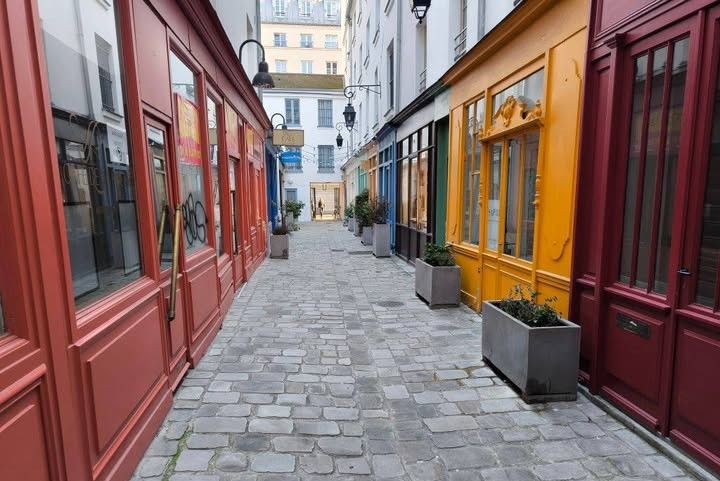
The passage Molière is a street of the 3éme arrondissement or district of Paris, It is a pedestrian public street entrance from 157, rue Saint-Martin and ending 46 meters further at 82, rue Quincampoix. The passage is perpendicular to these two streets. The passage takes its name from the old Molière theater, which was nearby, itself bearing the name of Molière. It was also called “Passage des Sans-Culottes” under the French revolution and “Passage des Nannus” The passage is open around 1791. It was the subject of a heavy renovation between 2017 and 2022, welcoming 34 social housing and 9 shops, including the Maison de la Poésie , Exc Librairie, specialized in contemporary poetry . There are also the artisanal paperwork writing the Paris and Misaki Iinuma, as well as the Maison Sapir, which takes care of the catering and the sale of old jewelry, and Le bar à vin Donna wine bar,The nearest metro stations are Rambuteau line 11, and Étienne Marcel line 4, both at about 200 meters. Remarkable buildings here are the former Molière theater, which has become the Maison del a Poésie located at the corner with rue Saint-Martin. The Clock district is located on the other side of rue Saint-Martin, at the outlet of the passage. Not far from the Centre Pompidou, this adorable and discreet little passage with charming cobblestones is quietly joining two animated streets. There are antiques and art shops, as well as a restaurant. The Former theater openned in the 18C, it was following its closure successively transformed into a arms room, a deposit store, a ballroom, then shared by shops. Completely renovated, the room has been offering poetic shows since 1983 as the Maison de la Poésie.
The City of Paris on the Passage Molière : https://www.paris.fr/pages/passage-moliere-vent-de-modernite-pour-lieu-historique-22275
The Paris tourist office on the 5éme arrondissement or district : https://parisjetaime.com/eng/article/explore-paris-s-5th-arrondissement-a820
The city of Paris on the wall enclosure of Philippe Auguste: https://www.paris.fr/pages/sur-la-piste-de-l-enceinte-medievale-philippe-auguste-rive-droite-episode-1-2-20729
The Paris tourist office on medieval Paris: https://parisjetaime.com/article/paris-moyen-age-a845
The Paris tourist office on the Marais area : https://parisjetaime.com/eng/article/exploring-the-marais-a1070
There you go folks, another dandy beautiful set of glorious streets of my eternal Paris. I have criss cross them many and have many in my blog already, Again, hope you enjoy this post on the streets of Paris, part X !!! as I.
And remember happy travels, good health, and many cheers to all !!!

 Paris1972-Versailles2003