
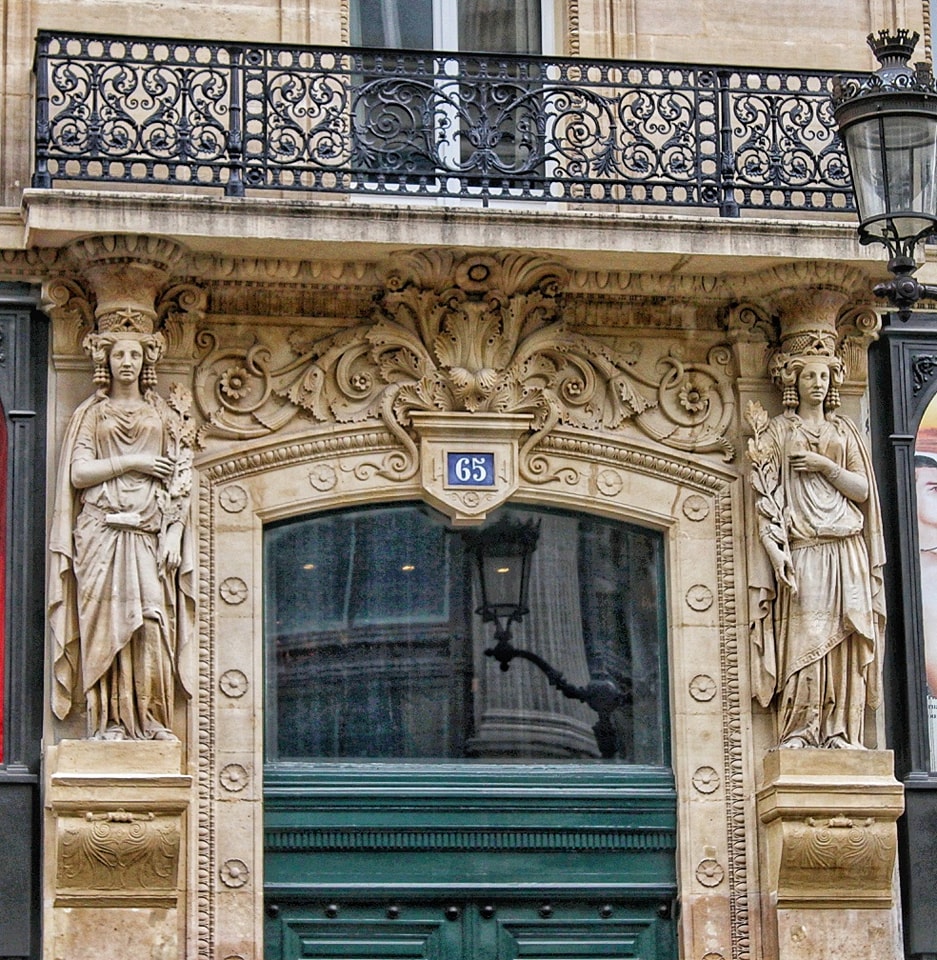
 The Paris tourist office on unexpected Paris closest to read about caryatids/atlantes, me think : https://parisjetaime.com/eng/discover-paris/paris-by-theme/unexpected-paris-i099
The fontaine Louvois is a fountain located in the middle of the square Louvois , created in 1830. This square occupies the place of an old opera, the opera of the rue de Richelieu, built in 1792 and demolished in 1820. The square is in the 2éme arrondissement by rue Richelieu, at the entrance to the National Library of France. The fontaine Louvois is surrounded by the Allée Andrée-Jacob and the Allée Élevine-Garnier, two alleys of the Louvois square named in 2019 in tribute to the couple of resistance fighters who distinguished themselves in the liberation of the National Library of France in August 1944 . The lower base of the monument is decorated with four newts riding a dolphin. On the edge of the large marble basin are sculpted the twelve signs of the zodiac alternating with mascarons spitting water.
The Paris tourist office on unexpected Paris closest to read about caryatids/atlantes, me think : https://parisjetaime.com/eng/discover-paris/paris-by-theme/unexpected-paris-i099
The fontaine Louvois is a fountain located in the middle of the square Louvois , created in 1830. This square occupies the place of an old opera, the opera of the rue de Richelieu, built in 1792 and demolished in 1820. The square is in the 2éme arrondissement by rue Richelieu, at the entrance to the National Library of France. The fontaine Louvois is surrounded by the Allée Andrée-Jacob and the Allée Élevine-Garnier, two alleys of the Louvois square named in 2019 in tribute to the couple of resistance fighters who distinguished themselves in the liberation of the National Library of France in August 1944 . The lower base of the monument is decorated with four newts riding a dolphin. On the edge of the large marble basin are sculpted the twelve signs of the zodiac alternating with mascarons spitting water.
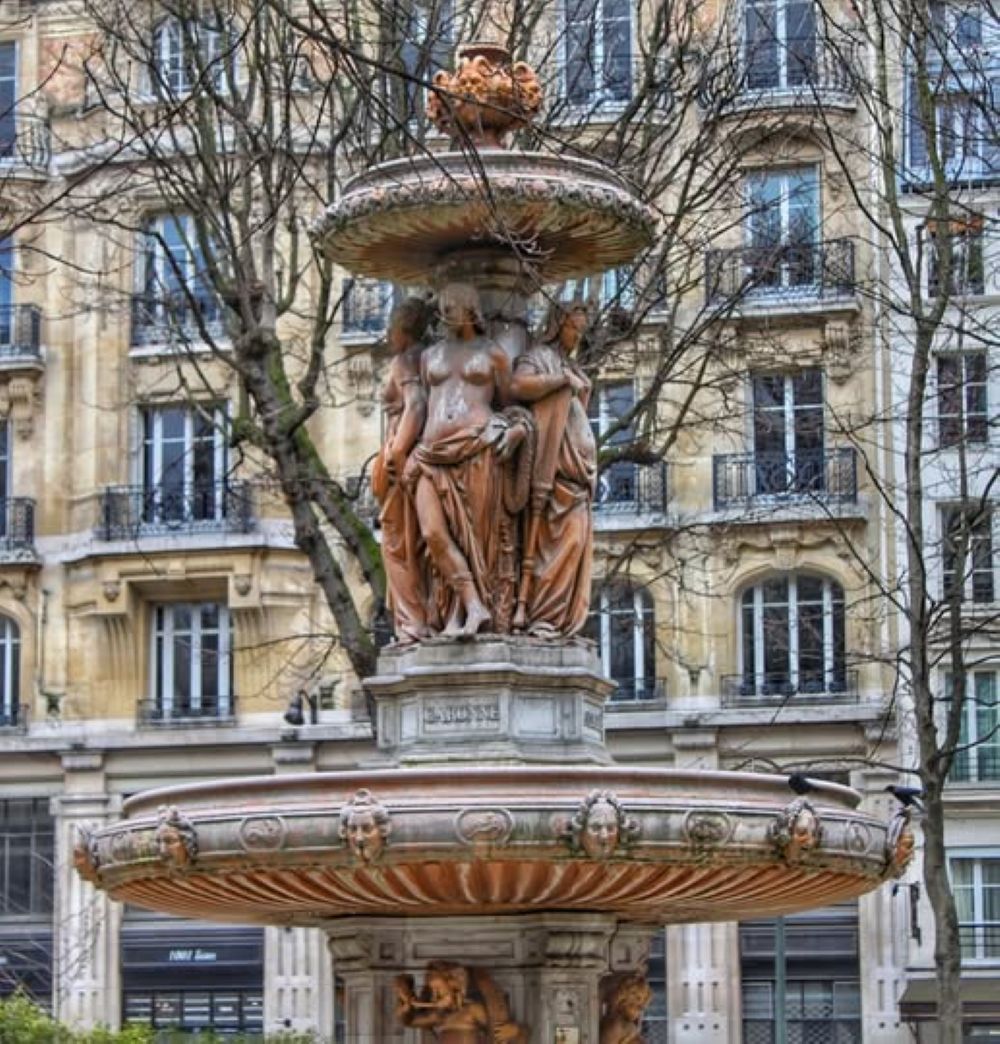 The city of Paris on square Louvois (see fountain): https://www.paris.fr/lieux/square-louvois-2416
The fontaine Molière, or Monument à Molière, is a fountain located in the 1er arrondissement, on Place Mireille, at the corner of rue Molière and rue de Richelieu. In 1838, a house was demolished in front of that where Molière died. A monument raised in honor of Molière who died in 1673 at No. 40, rue de Richelieu. A fountain surmounted by a statue of nymph was to be built in the space that remained free. Built in 1844, this monument is the work of several sculptors , The main bronze statue, enthroned under an imposing pediment portico, representing Molière seated, two marble female allegories, serious comedy and light comedy, confine the pedestal they hold each a parchment where the works of the great playwright are listed. At the lower level, lion-headed mascarons spit the water in a semicircular basin. A commemorative medal of the inauguration of the Molière fountain was executed in 1844. A copy is kept in Paris at the Musée Carnavalet (see post), This imposing monument 16 meters high and 6.50 meters wide at the top of the isle visible from rue des Petits Champs. The fountain is made up of a massive base formed of a pentagon basin in white marble veined which receives the water coming out of the 3 gules of the lion. It is surmounted by a niche framed by two double -legged Corinthian columns in which the statue of Molière is located and supporting a circular pediment with its base a garland of foliage where the genius is seated, Sublime !
The city of Paris on square Louvois (see fountain): https://www.paris.fr/lieux/square-louvois-2416
The fontaine Molière, or Monument à Molière, is a fountain located in the 1er arrondissement, on Place Mireille, at the corner of rue Molière and rue de Richelieu. In 1838, a house was demolished in front of that where Molière died. A monument raised in honor of Molière who died in 1673 at No. 40, rue de Richelieu. A fountain surmounted by a statue of nymph was to be built in the space that remained free. Built in 1844, this monument is the work of several sculptors , The main bronze statue, enthroned under an imposing pediment portico, representing Molière seated, two marble female allegories, serious comedy and light comedy, confine the pedestal they hold each a parchment where the works of the great playwright are listed. At the lower level, lion-headed mascarons spit the water in a semicircular basin. A commemorative medal of the inauguration of the Molière fountain was executed in 1844. A copy is kept in Paris at the Musée Carnavalet (see post), This imposing monument 16 meters high and 6.50 meters wide at the top of the isle visible from rue des Petits Champs. The fountain is made up of a massive base formed of a pentagon basin in white marble veined which receives the water coming out of the 3 gules of the lion. It is surmounted by a niche framed by two double -legged Corinthian columns in which the statue of Molière is located and supporting a circular pediment with its base a garland of foliage where the genius is seated, Sublime !
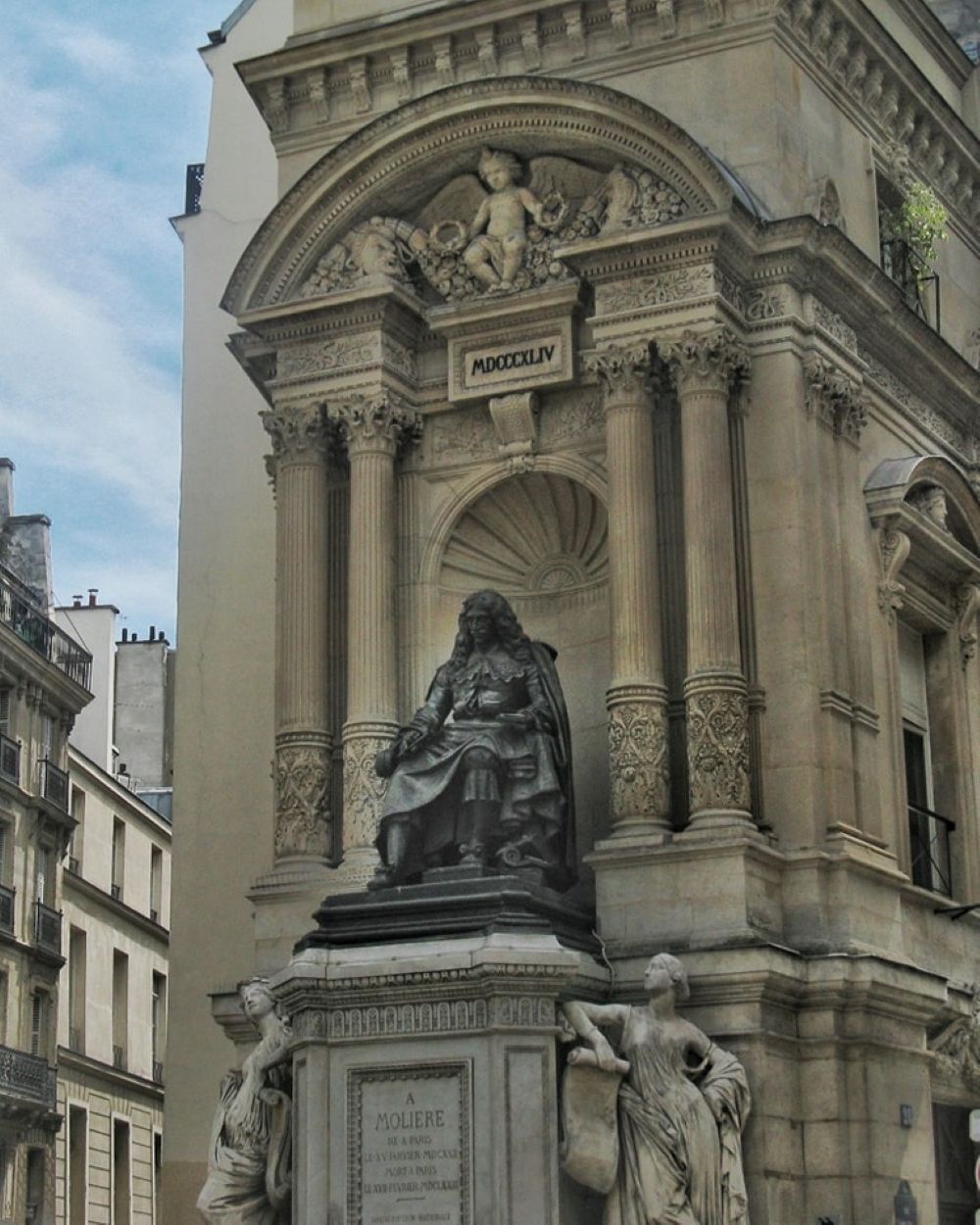 The city of Paris on Moliére: https://www.paris.fr/pages/sur-traces-de-moliere-comedien-et-dramaturge-de-genie-21032
The metro Bastille is a station of lines 1, 5 and 8, located at the edge of the 4éme, 11éme, and 12éme arrondissements, It is located under Place de la Bastille, it draws its name from the Place de la Bastille which it serves, a symbolic square of the French revolution, where the former fortress of the Bastille was destroyed between July 14, 1789 and July 14, 1790, The quays being established: on line 1, south of the square, outside above the Canal Saint-Martin , On line 5, west of the square between boulevard Richard -Lenoir and Boulevard Bourdon , On line 8, north of the square between Boulevard Beaumarchais and rue du Faubourg-Saint-Antoine. The station has nine access: Boulevard Henri-IV decorated with a stainless steel totem; Boulevard Bourdon; Rue de Lyon decorated with a stainless steel totem; Boulevard de la Bastille; Bastille opera; Garden of Port-de-l’Arsenal; Hospital of Quinze-Vingts; Rue de la Roquette decorated with a Dervaux mast; and rue du Faubourg-Saint-Antoine. I came once then by car park at the garden underground!
The city of Paris on Moliére: https://www.paris.fr/pages/sur-traces-de-moliere-comedien-et-dramaturge-de-genie-21032
The metro Bastille is a station of lines 1, 5 and 8, located at the edge of the 4éme, 11éme, and 12éme arrondissements, It is located under Place de la Bastille, it draws its name from the Place de la Bastille which it serves, a symbolic square of the French revolution, where the former fortress of the Bastille was destroyed between July 14, 1789 and July 14, 1790, The quays being established: on line 1, south of the square, outside above the Canal Saint-Martin , On line 5, west of the square between boulevard Richard -Lenoir and Boulevard Bourdon , On line 8, north of the square between Boulevard Beaumarchais and rue du Faubourg-Saint-Antoine. The station has nine access: Boulevard Henri-IV decorated with a stainless steel totem; Boulevard Bourdon; Rue de Lyon decorated with a stainless steel totem; Boulevard de la Bastille; Bastille opera; Garden of Port-de-l’Arsenal; Hospital of Quinze-Vingts; Rue de la Roquette decorated with a Dervaux mast; and rue du Faubourg-Saint-Antoine. I came once then by car park at the garden underground!
 The station was opened on July 19, 1900 with the commissioning of the first section of line 1 between Porte de Vincennes and Porte Maillot. It is established above the Canal Saint-Martin in order to avoid the foundations of the July column. A corridor then allows correspondence with the Paris-Bastille station. On December 17, 1906, the Line 5 station was open. It has the distinction of having foundations of one of the walls of counterscarp of the former Bastille prison, discovered during the construction of the line in 1905. On May 5, 1931, it was the turn of the station of Line 8 to open. Then in the 1970s, the quays of line 5 were renovated in the “Mouton-Duvernet” style with jambs covered with ceramic tiles in two tones of orange, a white-painted vault and characteristic lighting strips of this type of development. They were equipped with orange benches directly attached to the jambs. While line 8 quays have been renovated in orange “Andreu-Motte” style. The “sheep” decoration on the quays of line 5 is completely deposited on the occasion of the renovation of the station in “Gaudin” style. On this occasion, a red panel with different views of the old fortress and lines representing the old limits of the Bastille have been set up on the quays. In 2020, as part of the redevelopment of the Place de la Bastille, the canal Saint-Martin found daylight on the north side by the removal of the metal cover made in 1899 during the construction of the metro. For the first time, the viaduct spanning the canal is therefore visible on both sides of the station.
The official public transports RATP of Paris on the metro of Bastille: https://www.ratp.fr/en/vos-lignes/vos-stations/bastille
There you go folks, a dandy city to explore and enjoy with the family, Memorable moments in my eternal Paris, driving and walking all over in my road warrior trails brings out sublime awesome spots with nice memorable family visits of yesteryear always remember and always looking forward to be back, eventually. Again hope you enjoy the post on curiosities of Paris, part XVIII !!! as I.
And remember, happy travels, good health, and many cheers to all !!!
The station was opened on July 19, 1900 with the commissioning of the first section of line 1 between Porte de Vincennes and Porte Maillot. It is established above the Canal Saint-Martin in order to avoid the foundations of the July column. A corridor then allows correspondence with the Paris-Bastille station. On December 17, 1906, the Line 5 station was open. It has the distinction of having foundations of one of the walls of counterscarp of the former Bastille prison, discovered during the construction of the line in 1905. On May 5, 1931, it was the turn of the station of Line 8 to open. Then in the 1970s, the quays of line 5 were renovated in the “Mouton-Duvernet” style with jambs covered with ceramic tiles in two tones of orange, a white-painted vault and characteristic lighting strips of this type of development. They were equipped with orange benches directly attached to the jambs. While line 8 quays have been renovated in orange “Andreu-Motte” style. The “sheep” decoration on the quays of line 5 is completely deposited on the occasion of the renovation of the station in “Gaudin” style. On this occasion, a red panel with different views of the old fortress and lines representing the old limits of the Bastille have been set up on the quays. In 2020, as part of the redevelopment of the Place de la Bastille, the canal Saint-Martin found daylight on the north side by the removal of the metal cover made in 1899 during the construction of the metro. For the first time, the viaduct spanning the canal is therefore visible on both sides of the station.
The official public transports RATP of Paris on the metro of Bastille: https://www.ratp.fr/en/vos-lignes/vos-stations/bastille
There you go folks, a dandy city to explore and enjoy with the family, Memorable moments in my eternal Paris, driving and walking all over in my road warrior trails brings out sublime awesome spots with nice memorable family visits of yesteryear always remember and always looking forward to be back, eventually. Again hope you enjoy the post on curiosities of Paris, part XVIII !!! as I.
And remember, happy travels, good health, and many cheers to all !!! 
 Paris1972-Versailles2003
Interesting and informative, thanks
LikeLiked by 1 person
Thanks for stopping by Cheers
LikeLiked by 1 person