
We have driven and walked in my eternal Paris, and would like to have an imprint in my blog on the wonderful family times we had there, There is so much to see , doing my best, and glad found me these older pictures in my cd rom vault ,which now transposing in my blog for you and me, This was my former worked city, so glad to post more memorable spots on it, Therefore, here is my take on curiosities of Paris , part XVI !!! Hope you enjoy the post as I.
You see here the Cirque d’HIver, built in 1852 one of the most magnificent circus at 110 rue Amelot. The circus is a performance hall located in the 11éme arrondissement of Paris. It was successively called “Napoleon circus” then “national circus”. Since its purchase in 1934 by the Bouglione family, it is also known as the Cirque d’Hiver Bouglione, named after the circus family who owns and occupying it, Its plan is a polygon twenty sides pierced with forty windows, a diameter of 42 meters, with a wooden frame without an intermediate point. Its room, lit by twenty-one gas chandeliers, originally designed to accommodate 5,900 people, will see its current capacity reduced to 1,650 places according to contemporary fire safety standards. The Napoleon circus was emerging with interior and exterior decorations entrusted to the large sculptors and painters of the time The works began on April 17, 1852 and will last eight months. Prince Louis-Napoleon inaugurates, on December 11, the circus he will give his name. The site is served by metro stations Filles du Calvaire line 8, and Oberkampf ,lines 5 and 9,
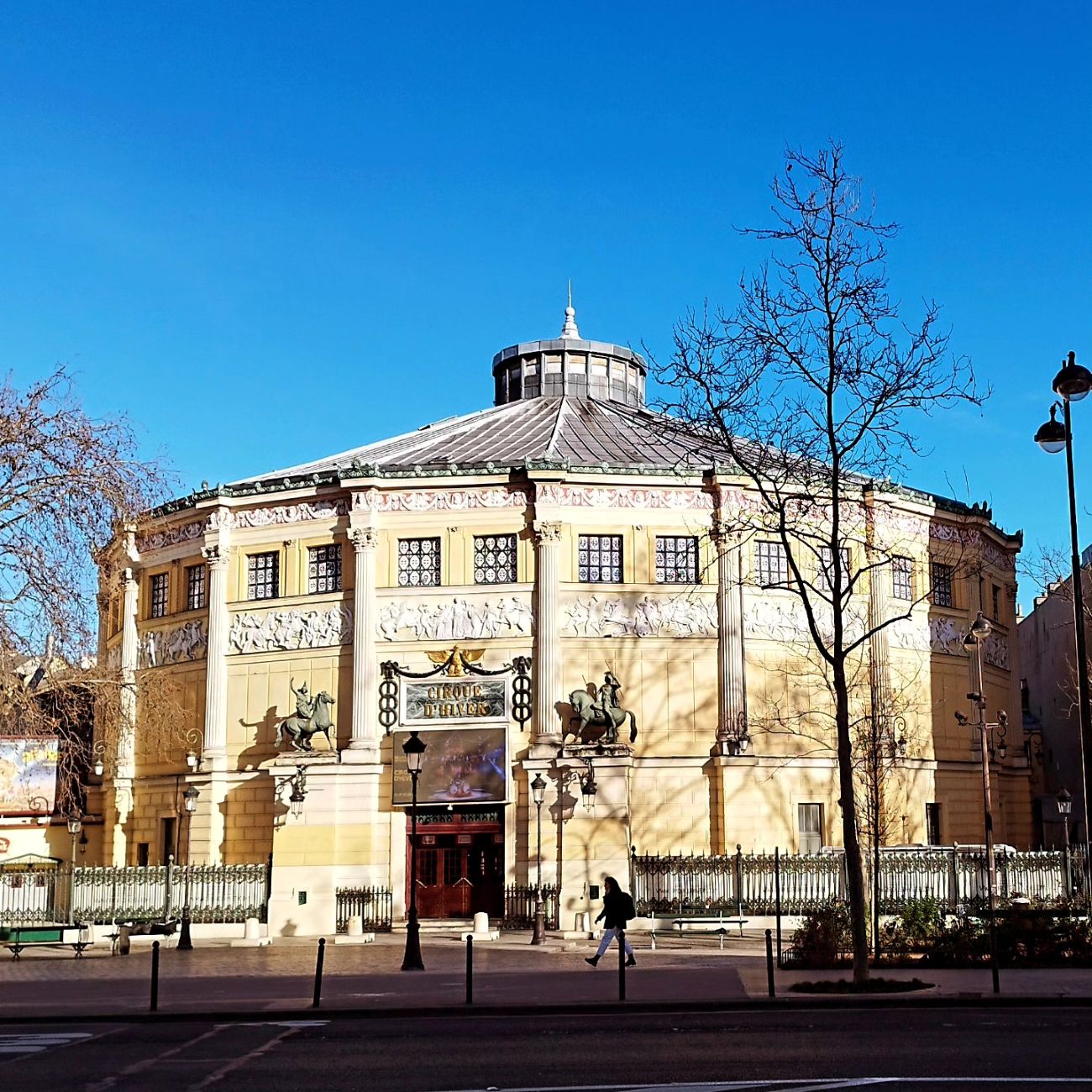
The Paris tourist office on the Circus d’Hiver: https://parisjetaime.com/eng/culture/cirque-d-hiver-bouglione-p1154
The Fontaine Cuvier is located at the corner of rue Linné and 20, rue Cuvier, facing the Jardin des Plantes, in the 5éme arrondissement. Made in 1840, this fountain, which replaces the old Saint-Victor fountain, pays tribute to Georges Cuvier. The statue, an allegory of natural history represents a young woman wearing tablets on which is written the motto of Cuvier: “Rerum Cognoscere Causas” (from a verse from Virgil), accompanied by a lion and animals sailors and amphibia. The passer -by can admire the statue of a crocodile at the neck turned at a right angle, which is impossible for him on the anatomical plane. This is a stylistic effect of the artist because it is impossible for this animal to make a movement, A very little known fountain and personality of Paris; will tell you more as no web, Jean Léopold Nicolas Frédéric Cuvier, aka Georges Cuvier is a French anatomist , promoter of comparative anatomy and paleontology in the 19C. He is a notable scientific supporter of catastrophism, precursor theory of evolution, His knowledge of self -taught and the originality of his methods made him admit to the Jardin des Plantes, within the very young national museum of natural history, created in 1793, In 1796, he was appointed professor of natural history at the central school of the Panthéon, current Henri-IV high school. The same year he held Merrud’s substitute for the Anatomy Chair of Animals at the National Museum of Natural History and, on this occasion, he published his courses given at the central school of the Pantheon in the Tableau élémentaire de l’histoire naturelle des animaux or table of the elementary painting of the natural history of animals (1797), a work which reviews the whole classification of animals and which ensures its notoriety.

Hidden in the heart of the Madeleine neighborhood (passed and visit on way to work!), Le Village Royal or the Royal Village is an elegant Parisian passage. It is an exotic place, out of time, where something interesting happens! This passage has existed for over 270 years. We appreciate today its calm and its beautiful shops: here is its story, which will, perhaps, make your next shopping session in the district even more enriching indeed! In the 18C, a renowned barracks occupied the land, it welcomed the royal guard of King Louis XIII, that is to say, the famous musketeers! In 1746, it was decided to create a passage along this building, to accommodate the Aguesseau market. Its attractive stands of early, butchers, fishmongers and other delights, therefore quickly attracted Parisians from all over the city. Also, build buildings all around, and the place becomes a real village in the city. A century later, the whole was renamed “Cité Berryer” in tribute to the lawyer Pierre-Nicolas Berryer, a famous opponent of Napoleon III, who marked his time. In the 1990s, the Cité Berryer was completely renovated , and the passage was then renamed Village Royal, and became the perfect setting for luxury brands. Since then, it has welcomed many events and installations. Memorable spot in my eternal Paris,

The official Le Village Royal:https://www.villageroyal.com/
There you go folks, a dandy city to explore and enjoy with the family, Memorable moments in my eternal Paris, driving and walking all over in my road warrior trails brings out sublime awesome spots with nice memorable family visits of yesteryear always remember and always looking forward to be back, eventually. Again hope you enjoy the post on curiosities of Paris, part XVI !!! as I.
And remember, happy travels, good health, and many cheers to all !!!


