
I am taken you back to Paris, yes a never ending story, The eternal city never stop amazing me of its beauty and things to see even if worked in it for almost 10 years while visiting zillion times living nearby in Versailles, Once again, found me older pictures in one cd rom that should be in my blog, These are wondertful architecture gems glad to have them here for you and me. Therefore, here is my take on the Church Saint Etienne du Mont of Paris, part I !!! Hope you enjoy the post as I.
The Church Saint Etienne du Mont that house the relic of Sainte Geneviéve, Patron Sainte of the city of Paris and whre were buried Pascal and Racine showing a beautiful jubé from 1545 unique in Paris, The gallery shows stained glass from the 16C and 17C . The church is located on the Sainte-Geneviève hill, in the 5éme arrondissement. After being briefly transformed into a temple of filial piety under the French revolution, it was returned to her parish church functions in 1801 and has not changed assignments since. The Shrine of Sainte Geneviève,(patron saint of Paris) empty of its relics since the French revolution in 1793 (when thrown in the sewers) with only one piece of bone remaining, as well as the stone of her coffin is now preserved there. The church also houses an organ whose origins and the buffet date back to the years 1630. It is the last Parisian church where you can still see a rood!
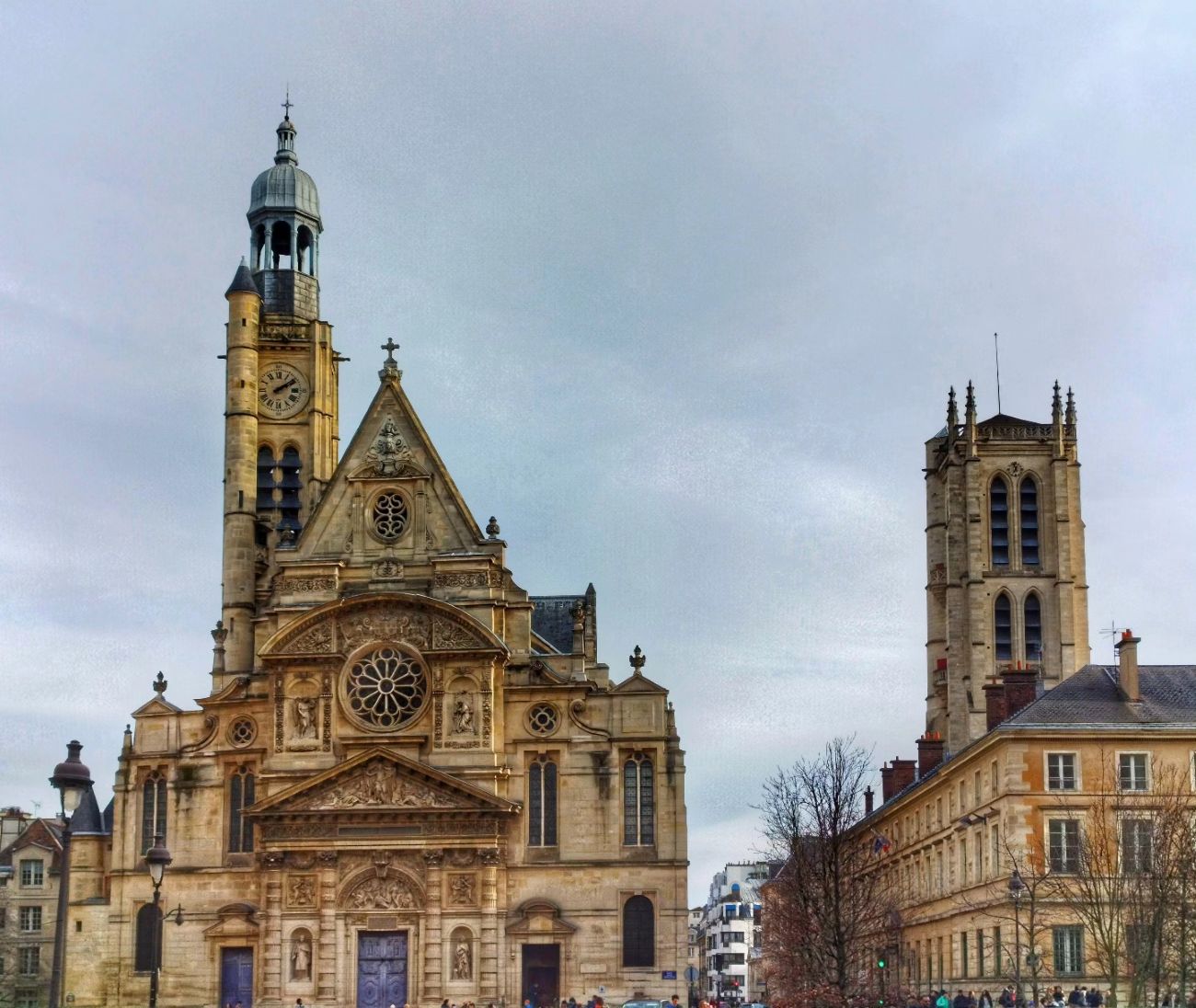
In one shot see on the right,the Tour Clovis, the last vestige of the old Sainte-Geneviève church, the Saint Patron of Paris which also gave its name to the famous mont or hill of the 5éme arrondissement. She was also buried here, alongside King Clovis and his wife Clotilde. The church is destroyed after the French revolution, but its 12C bell tower is miraculously spared! However, it is only very often open to the visit: it is therefore a secret and unknown place for the general public In 1796, the Sainte-Geneviève abbey was replaced by a school: the central school of the Panthéon . The latter becomes the Lycée Napoleon or high school, then Corneille and finally Henri IV, as we know it today.
The Church Saint-Étienne-du-Mont originates from the Sainte-Geneviève abbey, where the Holy eponym had been buried in the 6C. In 1492, the Génévéfains monks donated part of their land for the construction of the new church. This takes place in several stages, giving the current church a composite appearance. The apse and the bell tower are sketched out in 1494; The first two bells were made in 1500. The choir, flamboyant Gothic period, was completed in 1537; The following year, it was the frame to be laid. Jube is built around 1530-1535. The nave, from Renaissance period, was not vaulted before 1584. The foundation stone of the facade was laid in 1610 by Marguerite de Valois , the church was dedicated on February 25, 1626 by Jean-François de Gondi, first archbishop of Paris, uncle of Cardinal de Retz , The church keeps, in the chapel of communion (or catechisms), The gallery that surrounds the bedside, adorned with twenty-four stained glass windows was built from 1605. Finally the bell tower is raised in 1624 while the gate is built in 1610. The architect Victor Baltard restored the façade of the church between 1861 and 1868. a very beautiful collection of stained glass painted at the enamel from the end of the 16C or the beginning of the 17C, mutilated and dispersed during the French revolution, they were again gathered in 1834; There are only 12 out of the initial 22 left.
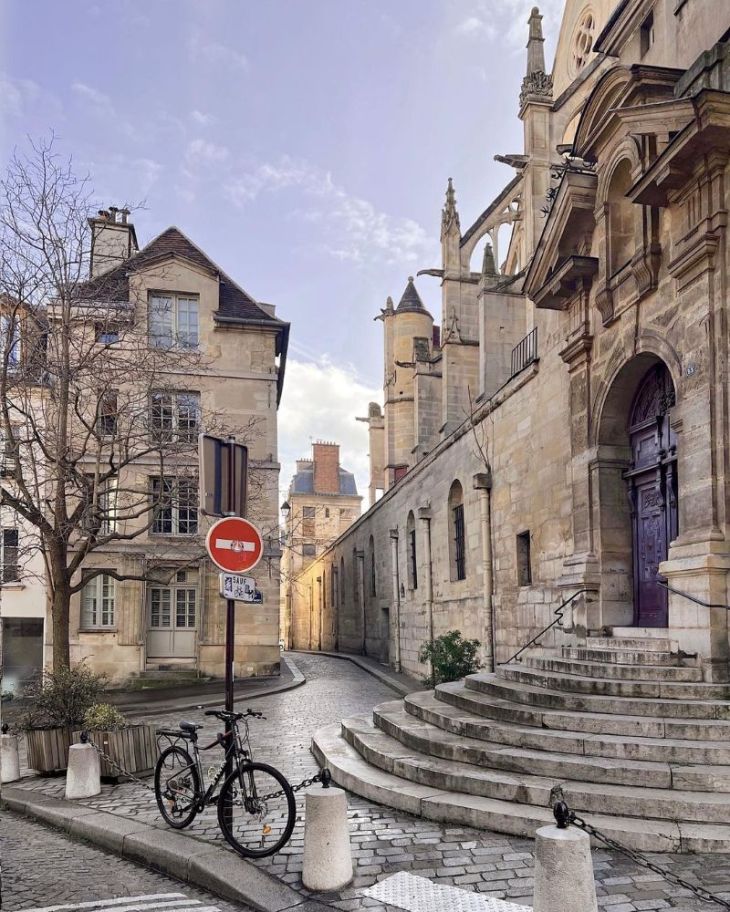
The Church Saint-Etienne-du-Mont is remarkable for several things such as a finely sculpted stone roodle (one of the last existing in Paris), dating from around 1530 and mixing with a perfect elegance the late Gothic vocabularies and Renaissance, A chair drawn by Laurent de la Hyre and sculpted by Claude Lestocart, as well as an organ buffet (1631), the oldest in Paris. The church also contains the shrine which contained the relics of Saint Geneviève until 1793 (date on which they were thrown at the sewers, only a piece of bone left), the tomb of Blaise de Vigenère, of Blaise Pascal , of Louis Nivelle, Racine, and Mgr Sibour. Huysmans described it on the way in 1895 as one of the prettiest churches in Paris. The Church , also welcomes the remains of Pierre Perrault, father of the author of the Tales of Charles Perrault, the painter Eustache Le Sueur and Pascal. Those of Racine and Isaac Lemaistre de Sacy are also transferred in 1711 from Port-Royal to Saint-Étienne.
The grave, sculpted group in terracotta composed of eight characters which dates from the end of the 16C the carved wooden pulpit, made around 1640 its periphery is adorned with seven allegorical statues representing the cardinal virtues (prudence, justice, temperance, Force) and theologales (hope, faith, charity), separated by bas-reliefs carved on the panels telling the story of Saint Etienne The pulpit is supported by a standing character on an extended lion, holding in his right hand a jaw of donkey: it is therefore Samson, a biblical character endowed with a legendary force, who struck a lion , and killed a thousand Philistines with a donkey jaw . The Virgin and Child between Saint Peter and Saint Lucie, by Pier Ilario Mazzola, commanded in 1518 for a church of Parma; The Christ on the cross, accompanied by Saint John, King Louis XIII and Aristotle, of an anonymous early 17C. Saint John in Pathmos, dated 1693, The buffet, built by Jean Buron in 1630, is considered a real carpentry masterpiece. The organ itself is of Pierre Pescheur and dates from 1636. The organ was seriously deteriorated in 1760 during a violent fire. He was rebuilt by Cliquot in 1777, then Aristide Cavaillé-Coll enriched it in 1863 and 1873. The most impressive here other than the relics of
Sainte Geneviève are the rood. Towards 1540 the Rood, will be built, in an oval style for the arches and Renaissance style for the enablement, in 1580 the vaults of the nave and the transept. The roods have disappeared from most of the Gothic Churches, and their use has been lost in modern churches. They served for certain rites, but suspended between the chorus and the nave, they further isolated the priests of the faithful, which probably explains their destruction. Several cities in France still have roods but one of the most curious and remarkable is that of the Church of Saint-Étienne-du-Mont, the only one surviving n Paris. This rood conjugates a Gothic structure with Renaissance ornamentation. The balustrade, a veritable interlace of stone lace, is carved in St. Leu Limestone and its two staircases wrap around the pillars while serving both the rood and the courtyard. Strangely, the author of this masterpiece is unknown when most of the names of the craftsmen who participated in the construction of the Church are known to us. On the other hand for the sculptures of the Rood, whose two figures of young men with ecstatic glances above the doors leading to the choir, the author is well identified: it is about Pierre Biard the Aîné.
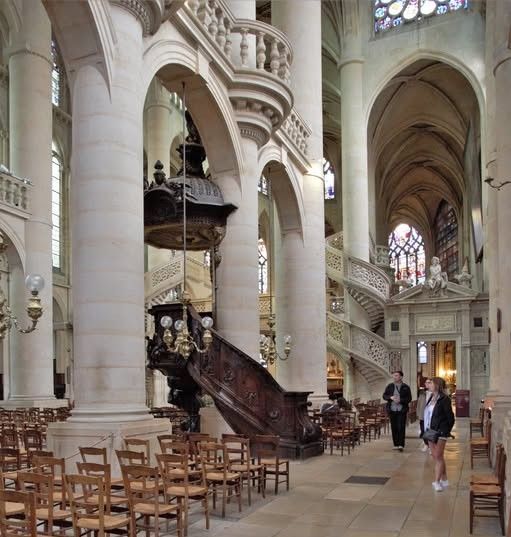
The Church Sainte Etienne du Mont stands on the site of an abbey founded by Clovis, King of the Franks (466-511) and later dedicated to Ste. Geneviève, the patroness of Paris. St. Geneviève was so popular in the Middle Ages that the abbey had to be enlarged to accommodate all the pilgrims. Construction on the present abbey church began in 1492 and encountered numerous delays before it was finally finished in 1626. All that remains of the ancient abbey is the Tour de Clovis (Tower of Clovis), which is now part of the Lycée Henri IV. The attractive church, named for St. Stephen but still devoted to Ste. Geneviève, is located right next to the Panthéon. The interior of St-Etienne-du-Mont is Gothic, an unusual style for a mostly 16C church. Along with the patroness of Paris, such illustrious men as Pascal and Racine were entombed here. Ste. Geneviève’s tomb was destroyed during the French revolution, but the stone on which her coffin rested was discovered later, and her relics were gathered for a place of honor at St-Etienne. The church possesses a remarkable early-16C rood screen. Dramatically crossing the nave like a bridge with spiral staircases on either side, it’s unique in Paris and beloved by many . Also notable is the wood pulpit, supported by Samson with a jawbone in hand and slain lion at his feet. The fourth chapel on the right from the entrance contains impressive 16C
stained glass. The arches of the apse and the steeple are built in 1492, the heart of flamboyant Gothic style up to the transept in 1537.
The organs are wonderful indeed and great concerts are given. The buffet organ, built in 1630, is considered a true masterpiece of carpentry. The organ itself dates from 1636. The organ was severely damaged in 1760 during a violent fire. It was rebuilt by Cliquot in 1777, then Aristide Cavaillon-Coll enriched it in 1863 and 1873. Theodore Puget makes improvements in 1911. The House Beuchet-Debierer performs a radical transformation in 1956 at the instigation of Maurice Duruflé. Danin-Gonzalez realigns the whole and changes the console to 1975; Bernard Dargassies performs a lift in 1991 and another in summer 2011. And the smaller one is the Choir organ an instrument of 14 games, of which 12 are real, distributed on two keyboards of 56 notes and a pedal of 30. Built by Puget in 1902, it is placed on the north side of the choir behind stalls. The transmission is pneumatic. The instrument is housed in a two-storey Gothic style buffet with a high bedrock. Horizontally, the buffet is organized in a tripartite way, A must to hear it play.
The official Church Saint Etienne du Mont: https://www.saintetiennedumont.fr/
The Paris tourist office on the Church Saint Etienne du Mont: https://parisjetaime.com/eng/culture/paroisse-saint-etienne-du-mont-p1214
The organs of Paris on the Church Saint Etienne du Mont organs: https://www.organsparisaz4.orguesdeparis.fr/St%20Etienne%20Mont.htm
There you go folks, this is another memorable post on my eternal Paris! Yes, the most beautiful city in the world, is the least we can say, And while at it marvel of its wonderful architecture and history, Again, hope you enjoy the post on the Church Saint Etienne du Mont of Paris, part I !!! as I
And remember, happy travels, good health, and many cheers to all !!!

 Paris1972-Versailles2003