
We were here several years back, sadly just passing going south and into Spain, and were surprise with a nice castle at Verteuil sur Charente, It must have been one of those road warrior trips of yesteryear that made passed by this village, and glad to have found me a picture in my cd rom vaults to have in my blog for you and me, The village of Verteuil-sur-Charente is located in the Charente department no 16 , in the Nouvelle-Aquitaine region of my belle France. The village of Verteuil was established in 1793 and officially became Verteuil-sur-Charente in 1962. Therefore, this is my take on this is Verteuil sur Charente and its castle !!! Hope you enjoy the post as I,
The village of Verteuil sur Charente is is 6 km from Ruffec, 42 km from Angoulême, 75 km from Poitiers, 408 km from Versailles, and 381 km from my current home from which I came along the N165 dir Nantes, around rocade N444 and N844 to connect with the A83 dir Niort to connect with the A10 dir Bordeaux get off at exit/sortie 32 dir Angoulême on next roundabout bearing left onto the D174 road to next roundabout bearing right onto the D948 road dir Angoulême going thru City center Melle but continue same direction go around Sauzé Entre Bois continue same road to connect with the N10 highway dir Ruffec/ Angoulême go around Ruffec and continue same road then bear left onto the D192 road dir Verteuil sur Charente ,continue to turn right onto the D24 road dir Verteuil sur Charente arriving to village on Rue du Château continue Rue des Halles turn left onto Rue des Douves and find parking on your right walk to castle on your left. The main road here is the N10, from Paris to Hendaye, forms its western boundary for a length of six km. The town is situated at a crossroads of minor departmental roads, including the D26 between Ruffec and Valence, which crosses the Charente river.
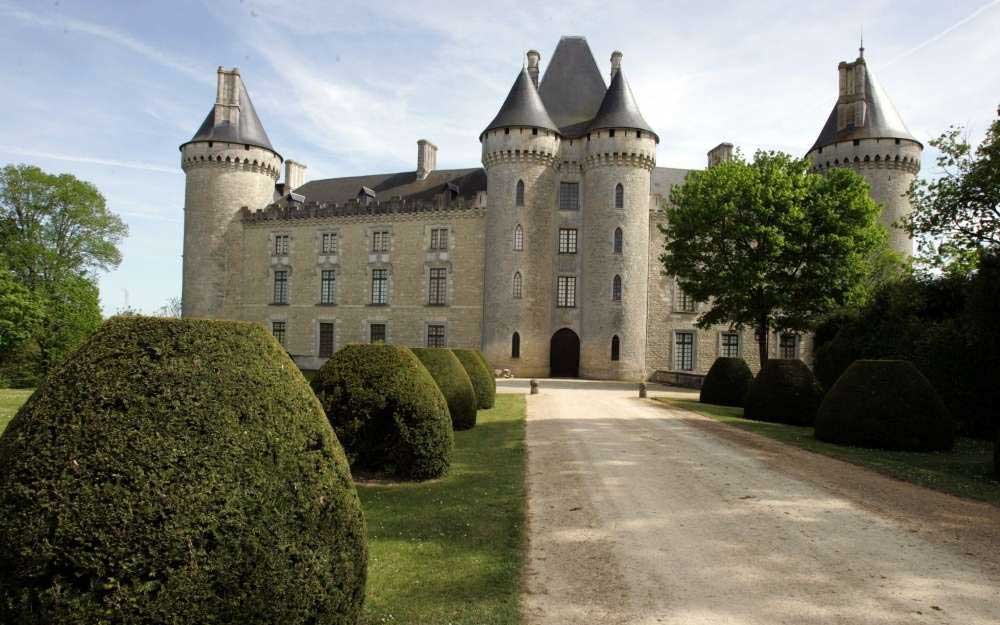
The present Château de Verteuil, with its five conical towers and watchtower topped with slate roofs, began construction in the 15C and has been modified and enlarged several times since. A park was laid out in the 19C, through which a wide avenue led visitors to the main gate. This gate is the entrance to the central square tower with its pyramidal roof. This square keep is the principal remaining part of the medieval structure. The present building is designed on a triangular plan. The large tower at the apex of the triangle is the medieval gatehouse, with wings extending on either side. A detached tower, now converted into a library, separates the wall to the east. The buildings were barely affected by the 19C restoration, with the exception of the chapel. The walls of the 12C tower have largely survived, partly rebuilt in the 15C, and there are traces of a Romanesque chapel.
An inventory was drawn up in 1728 after the death of Duke Francis VIII. The library contains 1,069 books. The master bedroom features an elegant bed with sumptuous purple velvet upholstery embroidered with gold and silver, armchairs upholstered in the same velvet, a large Turkish rug in an alcove, a walnut table, and other furnishings.Designed on a triangular plan, it includes five conical towers and a watchtower topped with slate roofs. Archaeologists have discovered traces of earlier buildings on the site, dating back to the 11C. Hippolyte’s son, Count Aimery de La Rochefoucauld, continued to collect his ancestors’ mementos, transforming the château into a kind of family museum. He redecorated the chapel and added stained-glass windows. The so-called Unicorn Tapestries, which hung in the master bedroom, were rediscovered in 1850 and later sold to John D. Rockefeller, Jr., in 1923. These were shipped to New York, which in 1937 donated them to The Cloisters Museum,in the Washington Heights neighborhood of northern Manhattan.NYC, where they are now on display in the medieval galleries.
A bit of history I like on the castle tell us the Château de Verteuil occupies a strategic location overlooking the Charente Valley. This magnificent castle, steeped in history and home to a wealth of artistic treasures, is one of the most remarkable monuments in the Charente region. Its construction dates back to 1080; it has been extensively modified since then, although some 12C walls remain. The castle has always belonged to the La Rochefoucauld family. During the Hundred Years’ War (1337–1453), the castle was occupied several times by the English. It was demolished in 1442 but was quickly rebuilt using the original stones. During the Wars of Religion in the 16-17C, the castle served as a stronghold for the Huguenots. During the Fronde uprising in 1650, it was partially destroyed by royal troops. Another castle was rebuilt, but suffered significant damage in a fire in 1793, during the French revolution. The château was renovated in the Romantic style after the Bourbon Restoration in 1815 and has been considerably altered since. After the French revolution, Hippolyte de La Rochefoucauld , who served as Minister Plenipotentiary to Germany and Florence, purchased the château. It was renovated in the early 19C in the Romantic style, fashionable during the Bourbon Restoration after 1815. During the Second Empire (1852-1870), further changes were made, primarily to the interior. During WW II, the château housed French troops and refugees from Alsace-Lorraine who arrived in 1940. For several months, it was partially occupied by nazis units. In 1944, members of the French Resistance hid there. The château, furnished and inhabited, remained the family property of the La Rochefoucauld family. It belonged to Anne de La Rochefoucauld, Marquise de Amodio, who founded the heritage preservation association Vieilles Maisons Françaises (Old French Houses) in 1958, until her death in 1980. The Marquise de Amodio was succeeded at Verteuil by Count Sixte de La Rochefoucauld-Estissac, who died in 2023. In August 2020, the château, which had belonged to the La Rochefoucauld family for nearly a millennium, was officially put up for sale. The sale, which took place on July 5, 2021, was followed by the sale of some of the château’s furnishings. As such the castle is now closed, I must have been by there few years back and took the picture from afar,
Other things to see here are the parish Church of Saint-Médard, a former priory, was built in the 12C. The former Cordeliers convent, located on Rue du Docteur Deux-Després on an island in the Charente river, was built in the second half of the 15C and is privately owned.
A bit of history of the village tell us that in the Middle Ages, particularly in the 12C and 13C, Verteuil lay on a north-south variant of the Via Turonensis, a pilgrimage route to Santiago de Compostela that passed through Nanteuil-en-Vallée, Tusson, Saint-Amant-de-Boixe, Angoulême, Mouthiers, Blanzac, and Aubeterre. By 1080, the Château de Verteuil was already the property of the lords of La Rochefoucauld. In 1135, it was besieged by Vulgrin II Taillefer, Count of Angoulême, who seized it but later returned it to Aymeri de La Rochefoucauld. During the Hundred Years’ War, the Château de Verteuil played an important role: the Treaty of Brétigny (1360) ceded it to the English, but they had to besiege it to take possession. In 1384, the Duke of Bourbon and Geoffroy de La Rochefoucauld recaptured it from the English after a month-long siege, following a duel as a sign of submission, and surrendered the stronghold the next day. In the 15C, the castellany of Verteuil was raised to a barony. Protestantism gained a considerable following in Verteuil; consequently, the Wars of Religion in the 16C had a significant impact there. Several conferences were held there between the principal Catholic and Protestant leaders. In 1567, the Protestants held the sixth national synod there. We know the active role played by Duke François VI de la Rochefoucauld, the author of the Maxims, in the Fronde uprisings; the Château de Verteuil was then seized by order of the Court. When peace was restored, the Duke regained ownership of the château, retired there, and lived in seclusion. At several times, illustrious figures received hospitality at Verteuil: King François I, having authorized Emperor Charles V to cross France, the latter stopped at the Château de Verteuil, where he was the guest of Anne de Polignac, widow of Count François II. In 1616, on his return from Bordeaux, King Louis XIII also stayed at the Château de Verteuil, with Queen Anne of Austria, his wife, and Queen Marie de Medici, his mother. This castle will host, among other figures, the French kings Henry II, Henry III, Henry IV, but also Catherine de Medici, the papal legate, etc.
The Village of Verteuil sur Charente: https://verteuil-charente.fr/histoire-et-patrimoine/
The Petites Cités de Caractére of France on Verteuil sur Charente : https://www.petitescitesdecaractere.com/cites/verteuil-sur-charente/
The local Destination Nord Charente tourist office on Verteuil sur Charente : https://www.destination-nordcharente.com/activites/visites-historiques/6523200_village-de-verteuil-sur-charente/
The Private Heritage site on the castle : https://www.patrimoine-prive.fr/le-chateau-de-verteuil/
There you go folks, another dandy if in off the beaten path of my belle France ,indeed worth a detour, me think. Another gem found in my world map, to be continue, Again, hope you enjoy the post on this is Verteuil sur Charente and its castle !!! as I.
And remember, happy travels, good health, and many cheers to all !!!


