
We have been lucky enough to visit several towns/villages of my belle France, this was an unique visit on our road warrior trails in the Orne dept 61, and we reach Sées! I ,again, found me pictures in my cd rom vault that should be in my blog for you and me, Surely need to come back for more,eventually, Therefore, here is my take on this is Sées and its cathedral !!! Hope you enjoy the post as I.
The town of Sées is located in the Orne department no 61 , in the Normandie region of my belle France. The town, part of the Normandy-Maine Regional Natural Park, lies near the Écouves Forest. It is served by two highways: the A28, which connects Rouen to Tours, and the A88, which connects Sées to Falaise. It is 139 km from Rouen, 87 km from Caen, 22 km from Alençon, 25 km from Argentan, 298 km from my current home, and 169 km from Versailles from where I came to the town along the N12 highway dir Dreux then Alençon and got off at exit/sortie D8 road dir Sées entering the town on Rue Louis Forton ,then bear left onto rue Auguste Loutreuil continue thru the place du Général de Gaulle to parking and the cathedral,
The Cathédrale Notre-Dame, located on Place du Général-de-Gaulle, is a Gothic construction dating from the 12-13C. It was restored in the 19C. Originally dedicated to Saints Gervais and Protais, Saint Latuin, the first bishop of Sées, founded the first cathedral around 440. Dedicated first to Our Lady and then to Saints Gervais and Protais, it was initially a small church. The Carolingian cathedral was destroyed during Viking raids in 878 or 910. Azon the Venerable (c. 986-1006) rebuilt the cathedral, raising it from the ruins around 986 using stones from the city’s fortifications. Yves Bellême left Normandy and ventured on a long journey to beg in Apulia, and even to Constantinople, where many wealthy Normans had settled. From his journey, he brought back a considerable sum and a relic of the True Cross, a gift from the Emperor. Around 1053, he began construction of the new cathedral, but would not live to see its completion. Its consecration did not take place until March 21, 1126 during the episcopate of John of Neuville. In 1174, during the wars between Henry II and Louis VII, the cathedral was once again burned, The cathedral is located within the fortified enclosure of Bourg l’Évêque, which in the Middle Ages isolated the cathedral quarter, and of which a gate still remains at the exit of Argentan. Notre-Dame is perhaps the fifth church erected on this site. Its construction began in 1210 and it was consecrated in 1310. A vast Latin cross measuring 106 meters long and 42 meters wide, it is a masterpiece of the 13C, typical of Norman Gothic for the nave and Île-de-France Gothic in the choir.
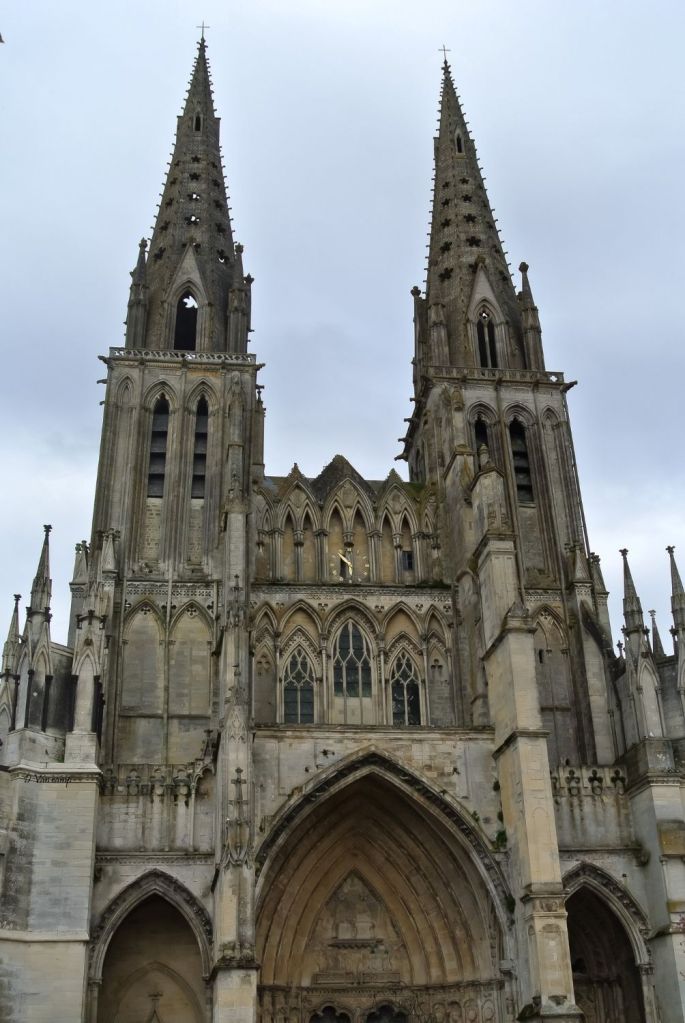
The west facade is framed by two spires. Three portals open onto this facade. The two side portals support the spires. Above the central portal is a tympanum, whose sculptures were destroyed by revolutionaries. At the top, it depicts two figures: Christ on the right, crowning the Virgin, and below, figures behind sarcophagi surrounding the Virgin on her deathbed and at her Assumption.
The nave, six bays long, has side aisles. It incorporates the vocabulary of Norman architecture. It consists of three levels: the great arcades, the triforium, and the clerestory with its gallery. The south transept. The south rose window resembles a wheel, a symbol of the ever-changing world. At the center is Jesus Christ, around him the twelve apostles, and beyond them the twenty-four elders of the Apocalypse. Below are ten figures from the Old Testament. The north transept’s north rose window is shaped like a snowflake, predominantly blue. At its center is Jesus on the cross, surrounded by six medallions depicting the appearances of the resurrected Jesus: Jesus at the tomb, the holy women, Jesus and Mary Magdalene, Jesus and Saint Thomas, the disciples on the road to Emmaus, and the breaking of the bread. Below are depictions of saints and bishops of the diocese: Loyer, Godegrand, Opportune, Céronne, Raven, Rasiphe, Cénery, Osmond, Raverein, and Alnobert. The north transept contains a Louis XIV altar from the Cordeliers convent in Sées, an 18th-century lectern, and two praying figures. It provides access to a chapel housing the relics of Saint Latuin.
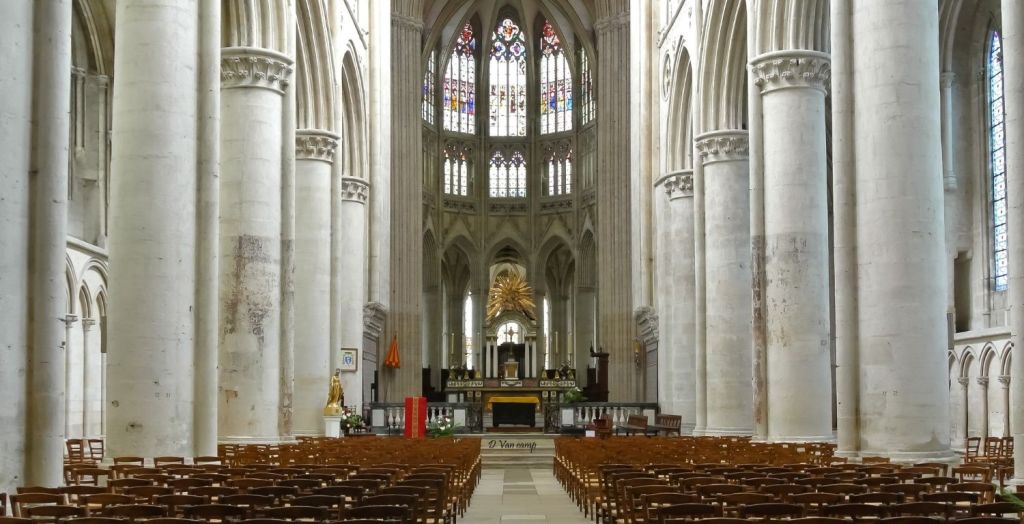
The chancel is more French than Norman in style, consisting of two bays and a five-sided apse. It is surrounded by an ambulatory that leads to five radiating chapels. These chapels are: the Chapel of Saint Nicholas; the Chapel of Saint Godegrand, a stained-glass window depicting him and his sister, Saint Opportune. It houses a modern statue of Saint Thérèse of Lisieux, who came on pilgrimage to the cathedral; the axial Chapel of the Blessed Sacrament, dedicated to Our Lady of the Fields; the Chapel of Saint Augustine; and the Chapel of Saint Mary Magdalene, depicted in a stained-glass window at the feet of Christ. It contains the tombs of three bishops of Sées: Claude Bardel, represented as a recumbent effigy, Octave Pasquet, and André Pioger. Without an organ until 1743, it was repaired in 1812, but four years later it was dismantled and installed on a new gallery. Aristide Cavaillé-Coll built the new organ from 1881 to 1883. The organ case dates from 1743. It is highlighted by the same nighttime lighting technique as that of the Eiffel Tower.
Other things to see here are the departmental museum of religious art was established in 1969 in part of the former chapter house. Saint-Martin Abbey, located on Place Saint-Martin, dates from the 12-13C: while the abbey itself is now privately owned, the Church of Notre-Dame-de-la-Place remains public ,featuring a 16C bas-relief and a Renaissance organ loft.
The Basilica of the Immaculate Conception, on Rue Charles-Forget, dates from the 19C; it was the first church erected under this dedication in France. The chapter building, on Place De Gaulle, incorrectly called the “canons’ chapel,” dates from the 12C and was remodeled in the 13-14C, and 18C. Heavily renovated in 1963, it is one of the last remaining vestiges of the former canonical enclosure. The Hôtel-Dieu and its listed chapel, on Rue de la République, feature paintings by the young Nicolas-Jacques Conté, who revealed his inventive spirit and his passion for mechanics and painting at a very early age, drawing with nothing but charcoal and painting with colors he made himself. The City/town hall dates from the 19C. The Palais d’Argentré, a former 18C bishop’s palace named after Bishop Jean-Baptiste du Plessis d’Argentré, is now occupied by the Institut d’Argentré-Sainte Anne, a private, independent school for girls affiliated with the Priestly Fraternity of Saint Peter. The Jardin d’Argentré, located opposite, is open to the public. Remains of a feudal motte, near the ruins of Saint-Pierre Church
A bit of history I like tell us that the town greatly weakened by the Scandinavian invasions of the 9C, Sées was rebuilt around three distinct boroughs: Bourg-l’Évêque, around the cathedral, ruled by the bishop; Bourg-le-Comte, around a motte-and-bailey castle belonging to the Count of Alençon; and Bourg-l’Abbé, around Saint-Martin Abbey. At the very end of the 10C or the very beginning of the 11C (c. 996-1006), the walls of Sées were dismantled, and the stones were used to rebuild the cathedral. To compensate for the weakness of the city’s fortifications, destroyed by the invasions, the strongholds of Exmes and Gacé were reinforced by the Dukes of Normandy. Around 1060, the episcopal city was entirely controlled by the Bellême family. Sées was thus almost entirely undefended when the Hundred Years’ War began. During the Wars of Religion, Bourg-l’Évêque, which had been surrounded by a wall in the Middle Ages, suffered an assault from Montgomery’s Protestants. At the beginning of 1590, the town was taken by Henry of Navarre. By the 18C, the three boroughs had merged into a single agglomeration. Sées, where numerous convents were located, was used as a neutral hospital town during the Battle of Normandy, which prevented it from being razed like neighboring, more strategically important towns due to the railway . To this end, several buildings were requisitioned by the occupying forces as early as June 1944 to treat wounded soldiers and provide temporary burials if necessary.
The local sources de l’Orne tourist office on the heritage of Sées : https://www.tourisme-sourcesdelorne.fr/d%C3%A9couvrir/patrimoine/
The town of Sées on its history : https://www.ville-sees.fr/notre-commune/histoire-de-sees/
The Orne dept 61 tourist office on the Cathedral : https://www.orne-normandy-travel.co.uk/visits-leisure/cathedrale-de-sees/
The Normandy region tourist office on the heritage of Sées : https://www.normandie-tourisme.fr/beaux-detours/sees/
There you go folks, another dandy of my belle France. A town worth the detour to see more of its architecture and history. We will be back, eventually, The cathedral needs more,me think, Again, hope you enjoy the post on this is Sées and its cathedral !!! as I
And remember, happy travels, good health, and many cheers to all !!!


