
I take you now on a bit of an off the beaten path of my belle France. A quant nice village of Montfort le Gesnois , worth the detour, me think, I like to tell you a bit on thanks to having found a picture in my cd rom vault that should be in my blog for you and me, Therefore, let me tell you a bit on this is Montfort le Gesnois !! Hope you enjoy the post as I,
The village of Montfort-le-Gesnois is located in the Sarthe department no 72 in the Pays de la Loire region of my belle France. The village of Montfort-le-Gesnois was formed by the merger of two villages: Montfort-le-Rotrou and Pont-de-Gennes, on January 1, 1986. It is 19 km from Le Mans and 28 km from La Ferté-Bernard, 58 km from Alençon, 87 km from Tours,181 km from Versailles, and 305 km from my current town, We came here on our road warrior trails from Versailles along the N12 highway dir Vélizy-Villacoublay to connect with the A86 highway to connect with the N118 highway dir Biévres continue passing Orsay ,Les Ulis then connect with the A10 autoroute l’Aquitaine dir Bordeaux then bear right to connect with the A11 autoroute dir Chartres/Le Mans but get off at exit/sortie 6 dir Bonnétable/Connerré on a loop to connect with the D119 road to enter Montfort le Gesnois on the Route de Connerré continue thru village center thru Rue de la Ferte then Grande Rue or D25 road continue bearing right onto the Place Notre Dame and the church,
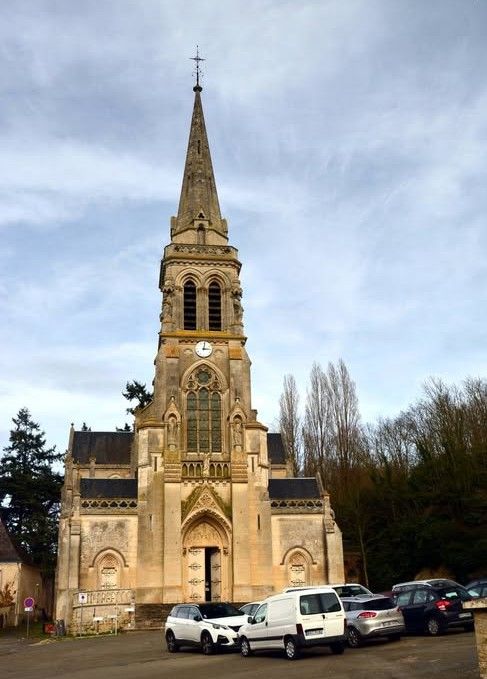
The Church Notre-Dame, dating from 1858, is located in the former village of Montfort-le-Rotrou. The old church, threatening ruins, is demolished. The neo-Gothic church, begun on March 1, 1856 was financed almost entirely by the local lord, Marquis Aymard de Nicolaÿ, and completed in 1858, under the name of Notre Dame de l’Immaculée Conception or Immaculate Conception It was consecrated on September 28, 1858. The church is in the Neo-Gothic style and has a Latin cross plan. Its bell tower rises 75 meters above the Huisne river. On the façade, near the buttresses, are the statues of Blessed Aymard of Cluny (patron saint of the church’s benefactor, Marquis Aymard de Nicolaÿ, then mayor of Montfort) and Saint Adelaide (patron saint of the Marquise de Nicolaÿ), on either side of the stained-glass window, with the four Evangelists surrounding the bell tower. The statue of the Virgin and Child stands above the portal on the pinnacle. The tympanum is adorned with a bas-relief of the Immaculate Conception.
Inside, the stained-glass windows depict Saint Augustine (1857, restored in 1969), and the Virgin Mary (late 19C). The Virgin’s rose window (late 19C) features twelve quatrefoils surrounding a medallion of the Virgin and depicting angels. The stained-glass window of the ascent to the limestone dates from the 20C. An oil painting depicts the translation of the relics of Saint Theodora.
Other things to see here with more time are the Italianate Château de Montfort-le-Rotrou , perched on a hill bordering the Huisne meadow, just behind the Church of Notre-Dame. The Roman bridge over the Huisne river, dating from the 15C, is one of the original structure from the year 50. Only a few arches remain today. The 24 Hours Bridge spans the national highway A11 autoroute l’Océane from Le Mans to Chartres, allowing passage under the road during the Grand Prix race, the precursor to the future 24 Hours of Le Mans. The Church of Saint-Gilles, dating from the 11C, is located in the former village of Pont-de-Gennes. In the 12C Saint-André Cemetery lies the Crusader’s tomb. The Priory of Pont de Gennes, aka the Priory of Saint-Gilles-et-Saint-Victor du Pont-de-Gennes, is situated at the foot of Montfort in Maine. It was founded during the episcopate of Hoël du Mans, Bishop of Le Mans, by Agnès, wife of Hugues de Gennes. It appears that the name was later changed to Saint-Gilles-et-Saint-Loup. This priory was dependent on the Abbey of Saint-Avit-les-Guêpières. The Church of Saussay, dating from the 10C to the 12C and from the 16C, is located in the hamlet of Saussay. Its architecture is Romanesque. Mural paintings were discovered beneath the plaster in the 1980s.
A bit of history tell us that as the name “Rotrou” indicates, the first known lords of Montfort were the Counts of Perche, Viscounts of Châteaudun, and Lords or Counts of Nogent and Mortagne. More precisely, around 1100, Montfort-le-Gesnois was in the hands of Rotrou I of Montfort. Montfort then passed to the Parthenay family when Guillaume VI of Parthenay married Jeanne de Rotrou of Perche, and subsequently to the Harcourt family and several other families thereafter too long to mention. The old feudal fortress known as Montfort-le-Rotrou was transformed at the beginning of the 19C into a large residence. In 1820, Count Raymond de Murat commissioned the construction of a large Italianate villa with a low-pitched roof. This neoclassical building was remodeled again at the end of the Second Empire (Napoléon III), enlarged and given high attics, in a style inspired by the 18C. The landscaped park was redesigned in 1860 and included an orangery.
The village of Montfort le Gesnois on its heritage : https://www.montfort-le-gesnois.fr/ma-ville/la-ville/histoire-patrimoine-et-pont-romain/
The local le Perché Sarthois tourist office on Montfort le Gesnois : https://en.perche-sarthois.com/montfort-le-gesnois/
The Sarthe dept 72 tourist office on Montfort le Gesnois : https://www.sarthetourisme.com/itineraire/parcours-decouverte-de-montfort-le-gesnois/
There you go folks, a unique walk and very educational to get knowledge into the off the beaten path of my belle France, We arrive at the village of Montfort le Gesnois, and as usual very worth the detour, me think, Again, hope you enjoy this post on this is Montfort le Gesnois !! as I.
And remember, happy travels, good health, and many cheers to all !!!


