
Several years back while visiting my belle France, took a ride into this area. Not aware had some older pictures in my cd rom vault and glad to found them! . Not back since but left a nice impression ,and hope to be back, eventually. The city of Le Puy-en-Velay is in the Haute-Loire dept, no 43 in the Auvergne-Rhône-Alpes region of my belle France. Therefore, here is my take on the Cathédrale Notre-Dame-de-l’Annonciation of LePuy Velay !!! Hope you enjoy the post as I.
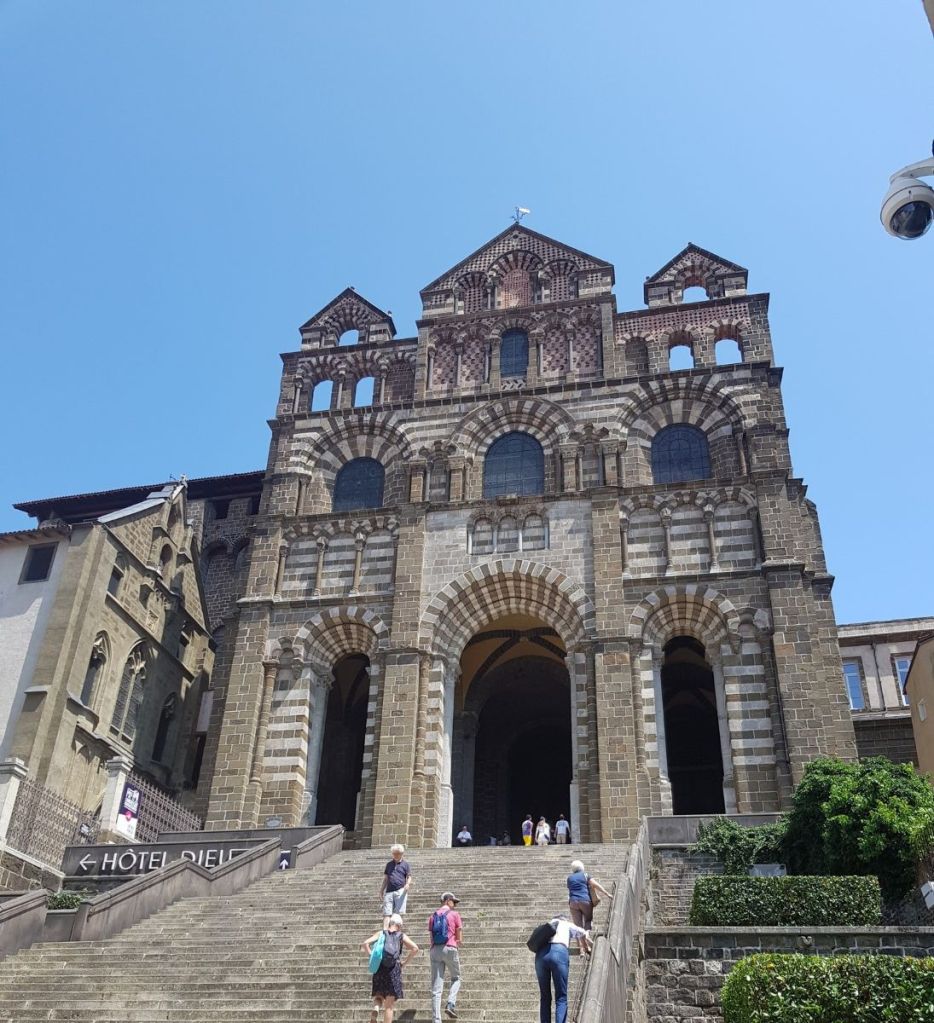
A major monument of Romanesque art, the Cathédrale Notre-Dame-de-l’Annonciation was erected as a minor basilica by a brief apostolic of Pius IX, on February 11, 1856. It has the main entrance at 2 Rue de la Manecanterie, The facade of the cathedral stands at the top of a large staircase of 102 steps. It has five architectural floors in polychrome apparatus, with semicircular arcs with alternating colors keystones, as well as stones decorated in diamonds like a mosaic with its semicircular arches, this facade belongs to the Romanesque style and can be dated from the end of the 12C, The western façade presents itself like a gigantic screen. It also evokes the grandeur and majesty of God, who gazes upon his creation to reveal its meaning to us. Here we perceive an opposition between the powerful, infinitely great God and the tiny God incarnate in the womb of Mary, represented here by the little staircase of the womb. The rest of the facade is almost entirely geometric.
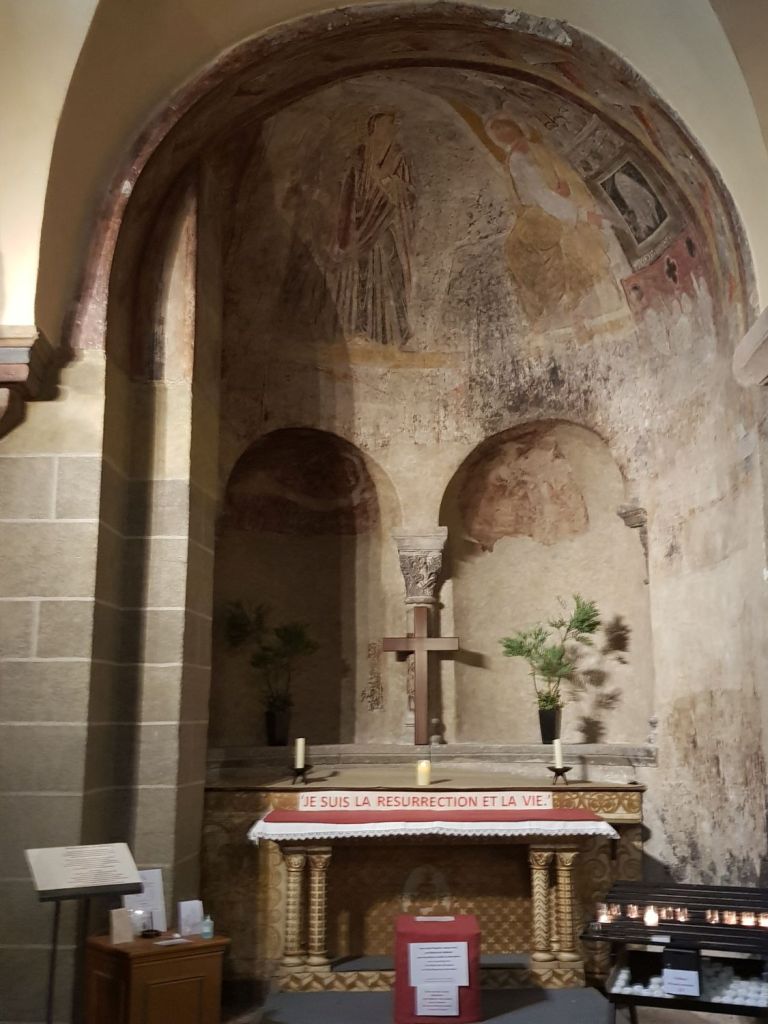
The porche de la Parole or porch of the Wordis notable for the sculptures representing the four Evangelists. Beneath each sculpture, scrolls indicate their names: Saint John is depicted as an eagle, Saint Matthew as a man, Saint Luke as a bull, and Saint Mark as a lion. This symbolic representation, known as the Tetramorph, originates in the Book of Revelation; the first living creature resembles a lion, the second a young bull, the third a man, and the fourth an eagle. The fresco in the western porch depicts the Virgin and Child Enthroned, Mary, Mother of God. This fresco, in a style typical of Byzantium, faces the Transfiguration of Jesus on Mount Tahbor. It portrays the Virgin and Child Enthroned. The Virgin is the Seat of Wisdom. She presents her Son to the world, seated on a richly ornamented throne that also stands out against the blue background of the fresco. The whiteness of Christ’s garment contrasts with the crimson of the Virgin’s mantle. This crimson color, reserved for the emperor’s mother under the Byzantine Empire, underscores the dignity of the Mother of God and refers to the Marian dogma of Mary, Mother of God. The cathedral of Le Puy thus honors Mary in connection with the Magisterium.
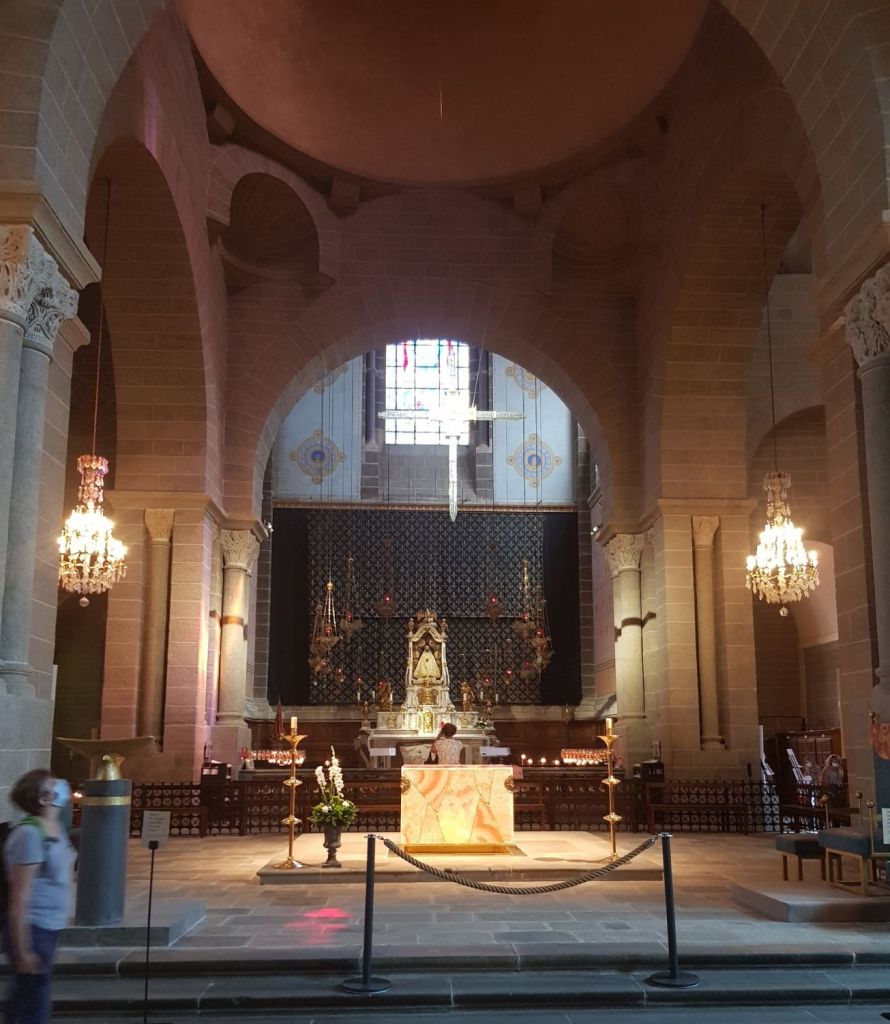
The high altar, erected at the expense of the Chapter of Notre-Dame, It is adorned with a bas-relief depicting the Annunciation and surmounted by a pelican. Bronzes by the renowned Caffieri decorate it. The famous Virgin, crowned on June 8, 1856, stands on the high altar, replacing the ancient statue that was burned in the Place du Martouret.
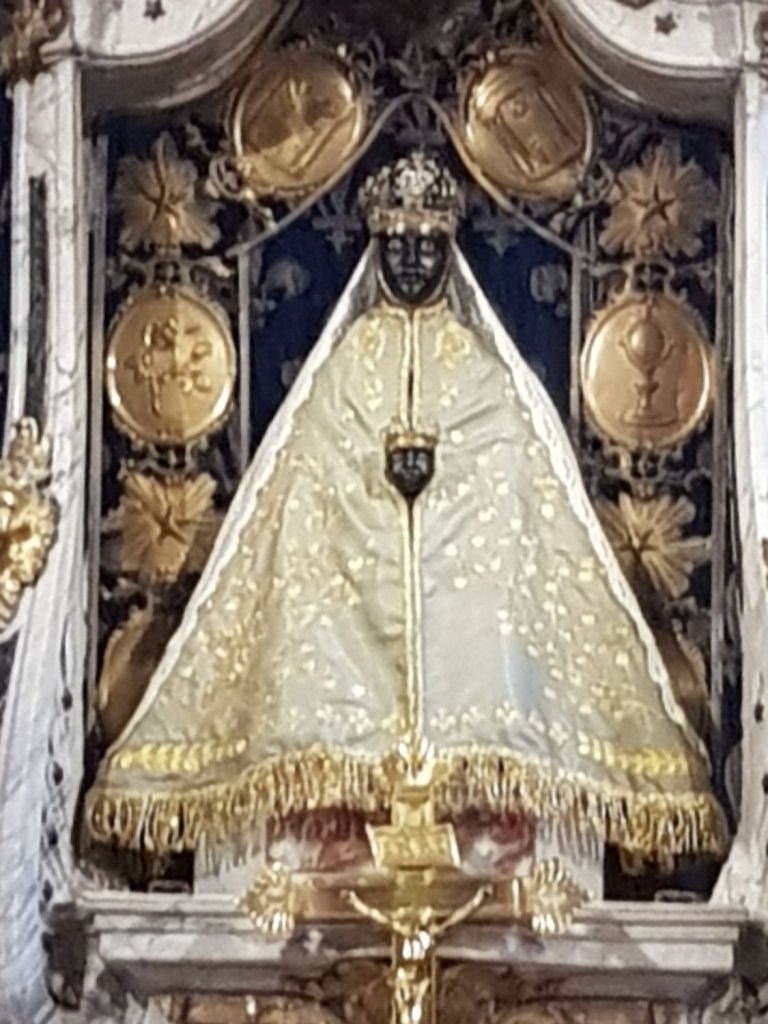
A Black Virgin or Madonna, object of many pilgrimages during the centuries, throne on a Baroque high altar. The current effigy replaces that which would have been offered by Saint Louis on his return from the Crusade of Egypt, and which was burned during the French revolution. The Virgin was dressed in an oriental-style robe in shades of red, blue-green, and ochre and crowned with a kind of ear-cupped helmet of gilded copper, adorned with antique cameos. The statue was entirely wrapped in several strips of fairly fine cloth, firmly glued to the wood and painted. Every August 15th, the solemn procession of the Black Madonna takes place through the streets of the upper town. This tradition dates back to August 15, 1578, but was interrupted in 1882. It was Norbert-Georges-Pierre Rousseau, the bishop at the time, who reinstated this solemn procession on August 15, 1933, and since then it has been one of the most important religious festivals in this region, attended by many faithful from around the world, with the exception of 1944.
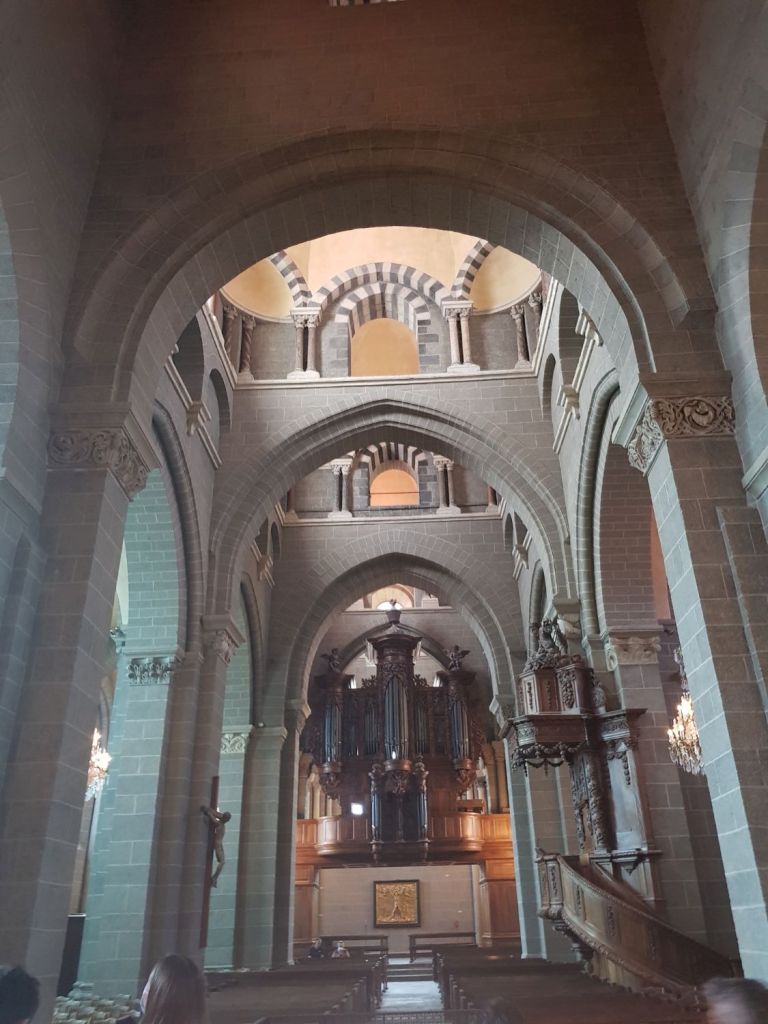
The organ is a classical French organ adapted for the performance of works from the 17C and 18C, and even the 19C. The organ case has two facades. The remarkable pulpit dates from the late 18C.
The 56-meter-high bell tower is a separate structure from the church. Square in plan, it comprises seven identical stories, each slightly set back, giving the tower the appearance of stacked cubes. The upper stories are supported by banded arches with barrel vaults. The ground floor contains three tombs: those of two canons and a bishop. It is said that its pyramidal shape and its rooster, a symbol of republican vigilance, are responsible for its survival during the French revolution. It houses four bells, including a large bell.
The legend of “stone of fevers” or “stone of appearances” part preserved in a chapel of the Holy Crucifix sort of slab 3 meters in length by 2 meters in width. Even today, pilgrims lie on the stone to receive the benefits. The rectangular cloister, its galleries were vaulted with edges. Dating from the 12C, it was in a Romanesque style, but was restored between 1850 and 1857, The Arab architecture in Spain is discussed when we see this polychrome mosaic of red, ocher, white or black diamonds that decorates its arcs . But these diamonds and arches in stones of alternate colors come rather from the Carolingian architecture which precedes the Romanesque architecture ; notice the variety of subjects treated on the capitals of the 12C: representation of the four evangelists, race of the centaurs, an abbot and an abbess arguing the staff, Next to this cloister is dominated by a large 13C building, which was once part of the defensive system of the cathedral and the episcopal palace. This building, known as the “Machicolated Building,” contains the Chapel of Relics on the ground floor and a museum of religious art on the first floor. It is open to the public independently of the cathedral.
The pilgrim, arriving from below, ascends the cathedral steps beneath the pillars and enters through a kind of trapdoor located in front of the altar. Passing by the staircase under the porch, entering directly into the nave, before the transept and the choir of the cathedral, emerging at the foot of the altar and the modern Cross which occupies a central place, the pilgrim gains access to the heart of the Christian Mystery. The symbolism of the Middle Ages merges with the faith and allows us to understand its coherence. This is what makes entering the cathedral of Le Puy so unique.
A bit of history tell us that around the year 430, the outline of what would later become one of the first Marian shrines in Christian Gaul, is said to have been traced in its course. The foundations of this first church, measuring 12 x 24 meters, have been discovered beneath the paving stones of the choir. In reality, construction did not begin until the late 5C, around 485–555. According to local tradition, the angelic church was sanctified by angels who transferred relics from Rome. The Marian shrine quickly became a pilgrimage site, boosted by a relic given by King Louis XI to the chapter of Notre-Dame du Puy: a thorn from Christ’s crown. Even today, pilgrims lie on the stone to receive its blessings. While the origin of the cult of Our Lady of the Annunciation lies in the “stone of fevers,” the Middle Ages and the Modern Era primarily venerated the Black Madonna. On August 15, 1095, during the Feast of the Assumption celebrated in Le Puy, Pope Urban II announced the First Crusade (1095–1098) and appointed the city’s bishop, Adhémar de Monteil, to lead it. Accompanied by approximately four hundred crusaders from the Velay region, the author of the famous Salve Regina thus left Le Puy for the East. He was mortally wounded during the siege of Antioch, but others were fortunate enough to return home. During the Middle Ages, the cathedral of Le Puy was both a major stop on the pilgrimage to Santiago de Compostela and an important pilgrimage destination itself, drawn by its Black Madonna, attracting pilgrims from all over Europe.
The official Cathédrale Notre Dame de de-l’Annonciation of Puy en Vélay: https://www.cathedraledupuy.org/
The Puy en Vélay tourist office on the cathedral: https://en.lepuyenvelay-tourisme.fr/decouvrir/incontournables/la-cathedrale-notre-dame-du-puy/
The Haute Loire dept 43 tourist office on the ND Cathedral of Le Puy en Vélay : https://www.myhauteloire.fr/en/patrimoine/monuments-a-visiter/cathedrale-notre-dame-du-puy-en-velay/
The official plus beaux detours de France on Le Puy en Vélay: https://www.plusbeauxdetours.com/tous-les-plus-beaux-detours/detour-par-le-puy-en-velay-en-haute-loire/
There you go folks, another spot in my world map or rather France’s map. Glad to have found the old pictures to give credit to Le Puy Velay in my blog; good for the memories of always. Again, hope you enjoy the post on the Cathédrale Notre-Dame-de-l’Annonciation of Le Puy Velay !!!as I.
And remember, happy travels, good health, and many cheers to all !!!


