
This is for the nostalgia of family times; and glad to found me a picture in my cd rom vault that allow me to tell you about it as well. Not really a tourist attraction, just a regular local town with one nice castle complex. Childhood memories of this town, memories forever. Therefore, let me tell you about this is Alcorcon !! Hope you enjoy this post as I.
The City of Alcorcón is located in the Comunidad de Madrid region and in the kingdom of Spain, It is located 15 km from the Puerta del Sol of Madrid, 72 km from Toledo, We always come here from Madrid Retiro park leaving by Atocha on the Paseo Santa Maria de la Cabeza over the inner beltway M30 passing becomes the A42 highway dir Toledo passing under tunnel of Plaza Eliptica continue on the A42 to connect with exit/salida 5 onto the M40 beltway road dir Badajoz then get off exit/Salida 31 to connect with the A5 autovia or paseo de Extremadura dir Alcorcon to A5R Alcorcon Norte to connect with the M406 road on next roundabout bear left onto Calle Ptroleo continue and then bear right onto Avenida los Castillos bear right on Avenida de la Libertad for parking castle park is in front,
The main highways by Alcorcon ; which yours truly has rode are the Autovia A5 of Madrid – Badajoz: exits to the places of San José de Valderas, Alcorcón, Tres Aguas, Parque Oeste, The beltway road M40 from San José de Valderas, Alcorcón and Ventorro del Cano, The beltway road M50 from Ensanche Sur, Avenida de Móstoles, Parque Oeste and Campodón-Tres Aguas, The M406 road connects withthe A-4 Getafe – A-5 M-40 Alcorcón: Urtinsa industrial park, San José de Valderas and Avenida de los Castillos and Avenida de Lisboa. The radial R5 road connect with the M-40 Madrid – A-5 Navalcarnero with no direct access to Alcorcón, You have the Madrid Metro Line 12 line of Alcorcón, Móstoles, Getafe, Leganés, and Fuenlabrada available without needing to go through Madrid city center. The Line 12 begins and ends at Puerta del Sur station, where the interchange connecting to Line 10 is located. The C-5 cercanias line crosses the city, connecting Alcorcón with Madrid, Móstoles, Leganés, Fuenlabrada, and Humanes de Madrid, with three stations within the city limits: San José de Valderas, Alcorcón (connection with Metro Line 12): located near the city center, serving the Centro district, and Las Retamas.
Los Castillos is an urban park built in 1991 in the San José de Valderas neighborhood of Alcorcón. It is considered the cultural center of the neighborhood, featuring the Valderas Castles, the Alcorcón Glass Art Museum (MAVA), and the group of 16 sculptures created in concrete, entitled “The Refuge of Life,” can be seen within the park along the Avenida los Castillos,
The castle/palace was built in 1917 for the Marquesses of Valderas, who had purchased the land and constructed the original Saxon-style castle-palace as their residence. Next to it, he had another, smaller, square building constructed, in which he installed his private oratory dedicated to Saint Joseph. At the rear, he built a third building for the servants. It was visited by King Alfonso XIII, Primo de Rivera, and other figures associated with the monarchy. With the outbreak of the Spanish Civil War in 1936, the castles were abandoned by the Marquises of Valderas. Furthermore, from November 4, 1936, a front-line headquarters for the Nationalist zone was established in the main castle, due to its proximity to the Carabanchel camp, and its strategic location. It housed a radio station run by Gregorio Marañón, Jr. Francisco Franco and Emilio Mola were stationed there during the offensives on Madrid. After the Civil War ended, the castles were abandoned and, despite their imposing presence, fell into ruin. After the war, it fell into ruin. In 1976, the commuter rail arrived, and at the end of the century, Metro Line 10 opened at Joaquín Vilumbrales station. Around that time, the building was restored, along with the annex visible in the background, to house a cultural center and a unique glass art museum, the only one of its kind in the country, next to a beautiful sculpture park. Due to the state of the castles, the Alcorcón City Council began the process of acquiring them in 1985, but it wasn’t official until 1988, when the 6th Marquis of Valderas, Hipólito Sanchiz y Núñez-Robres, donated the castles to the City Council.
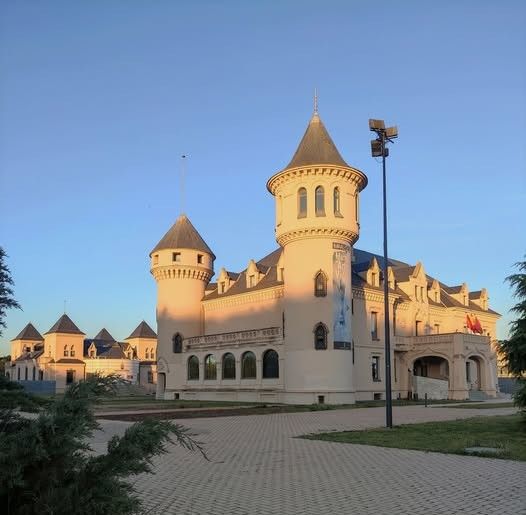
The Alcorcón Museum of Glass Art (MAVA) is a contemporary art museum with international works created entirely or partially from glass. The MAVA (Museum of Contemporary Art of Alcorcón) was founded in 1997 with the aim of promoting glass as a material in contemporary art, making the city of Alcorcón a national and international benchmark for contemporary glass art. Initially, the museum’s permanent collection consisted of works from two sources: firstly, the donation of more than sixty works from Ms. Takako Sano’s private collection, and secondly, the group of 107 works donated directly by artists.The main palace has housed the Glass Art museum , although it is also used for exhibitions and other cultural activities. The much smaller service building is dedicated to courses, workshops, seminars, and cultural activities, through the Department of Culture and Participation.
Other thing to see here me think is the Church of Santa María la Blanca (St Mary the white) ,the first references are in the Relaciones de Felipe II (Reports of Philip II), and the current church can be dated between the late 16C early 17C for the chancel and apse, with construction completed in the 18C.
A bit of history I like tell us that the first medieval document referencing Alcorcón dates from July 28, 1208, which mentions the Cañada de Alcorcón as a route for sheep. Another letter, dated December 12, 1208, confirms the boundary of the Cañada de Alcorcón between the Council of Segovia and the Council of Madrid. In 1222, Ferdinand III of Castile granted new charters to the town of Madrid. The jurisdictional territory of Madrid was divided into three rural districts: Vallecas, Villaverde, and Aravaca. The Aravaca district comprised Aravaca, Majadahonda, Boadilla del Monte, Alcorcón, Leganés, and Carabanchel. In 1485, during the reign of the Catholic Monarchs, the municipal districts of Alcorcón and Móstoles were divided. In 1496, the boundaries between the jurisdictions of Madrid and Toledo were established, with Alcorcón belonging to the former and Móstoles to Toledo. During the so-called Golden Age of Spanish literature, Alcorcón appears in several literary works, such as Calderón de la Barca’s *La Tarasca de Alcorcón* and Agustín Moreto’s *El Alcalde de Alcorcón*. At the beginning of the 17C, an expedition to the Indies, commanded by Alonso de Mendoza, took place. Upon their return to Castile, news of a miracle performed by the Virgin of Los Remedios spread throughout Madrid. This devotion took root in Alcorcón and continues to this day. At the beginning of the 20C, the Marquesses of Valderas settled in Alcorcón. The husband of the then Marchioness, José Sanchiz de Quesada, had been assigned to the artillery regiment in Cuatro Vientos in 1915. To be close to his family, he bought some estates near his regiment and commissioned the construction of several “castles” or palaces to live in with them. The Marquesses’ Castles were completed in 1917.
The City of Alcorcon on its cultural offerings : https://www.ayto-alcorcon.es/es/servicios/cultura
The official museum of glass or museo del vidrio : https://www.mava.es/
The Comunidad de Madrid region tourist office on Alcorcon : https://www.visitmadrid.es/en/where-to-go/metropolitan-area/alcorcon
There you go folks ,another of my memorable spots in my Madrid area of always, youthful days and more , memories that will not go away. Again, hope you enjoy this post on this is Alcorcon !! as I.
And remember, happy travels, good health,and many cheers to all !!!


