
I have past by it onwards to see friends and my Madrid, got off a tangent to stop it and see the cathedral that I have heard was wonderful and it is, glad to do it even if took me longer driving time, This is Santander and finally made it after knowing about it since my high school days with one of my best friend then was from nearby Santillana del Mar. I found me again pictures in my cd rom vault that should be in my blog for you and me, Therefore, here is my take on the Catedral de la Asuncion de Nuestra Señora of Santander !!! Hope you enjoy the post as I.
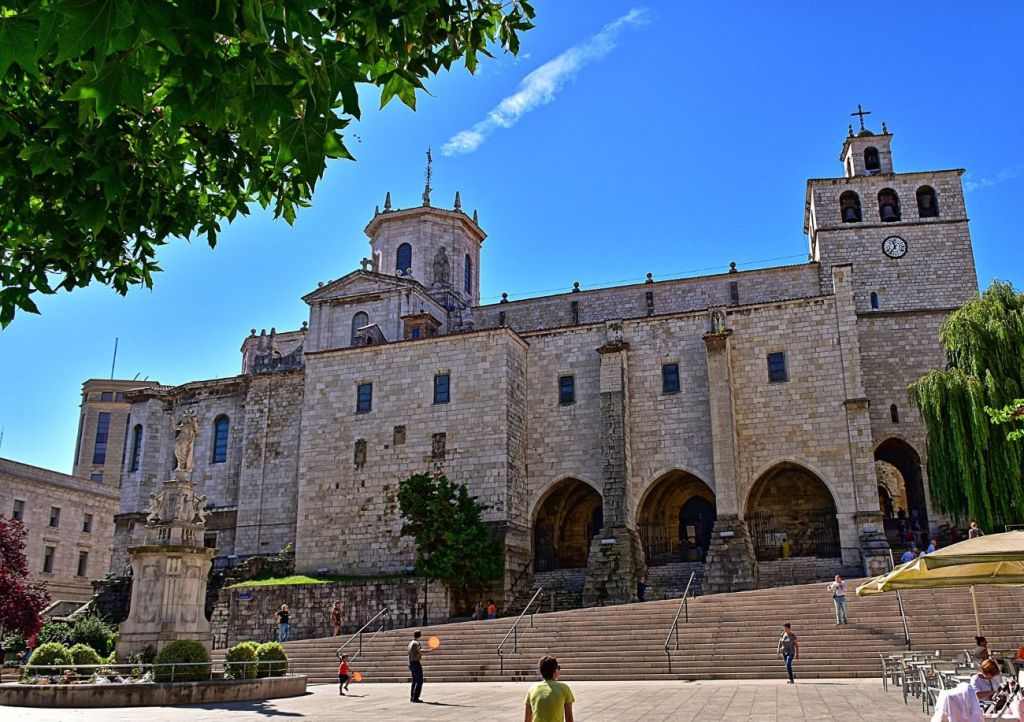
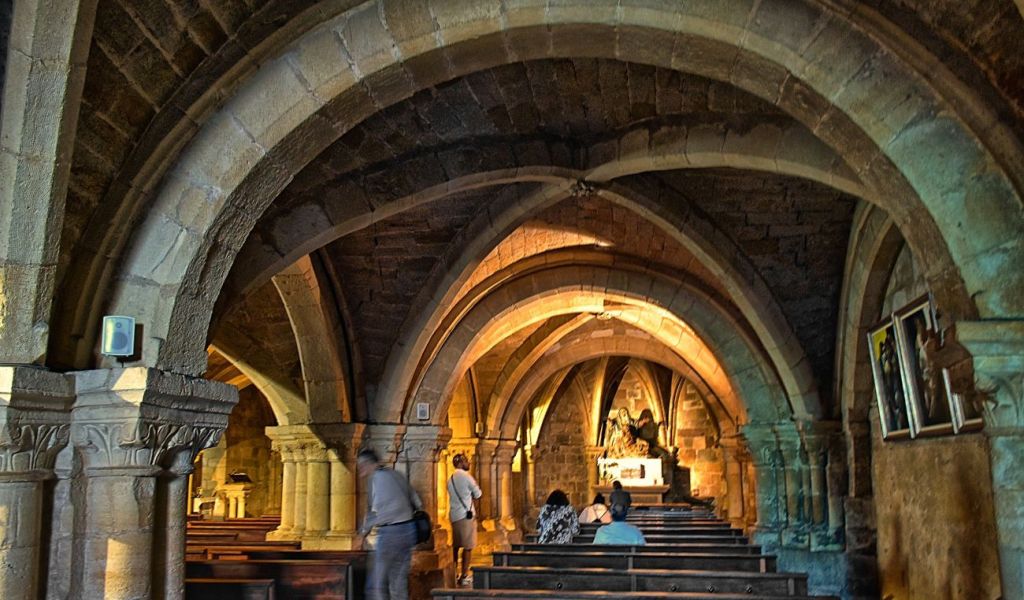
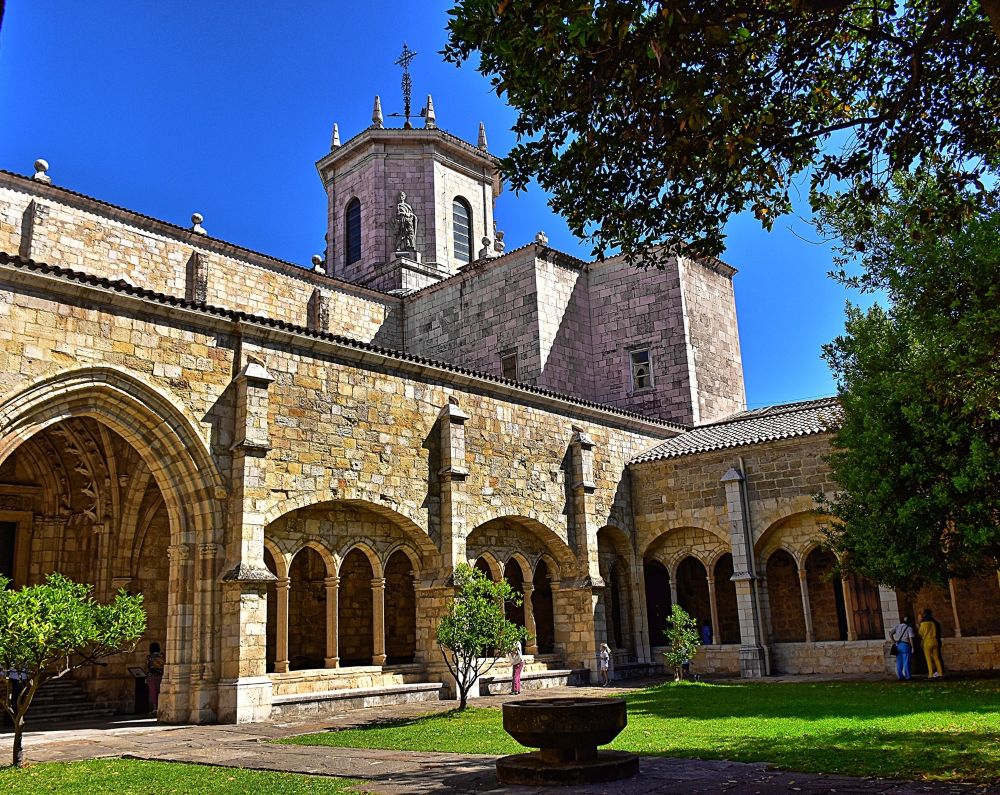
The Catedral de la Asunción de Nuestra Señora or Cathedral of the Assumption of Our Lady is primarily Gothic in structure, although it has been subsequently enlarged and renovated. It is located on a hill that forms the last vestige of the ancient Somorrostro hill, which was chosen by the Romans as a strategic point for supplying the present-day city. The cathedral church has a three-aisled structure with four bays, The lower church, known as the crypt or the Church of Christ, was built around 1200 on top of earlier Roman-era buildings. The upper church, known today as the Basilica of Santander, was built in the mid-13C and its apse features three polygonal chapels. The church has a ribbed vault with pointed arches resting on cruciform columns. The cloister is square with pointed arches and no decoration. Inside are the remains of the Holy Martyrs of Saint Emeterius and Saint Celedonius (San Emeterio and San Celedonio) who, according to tradition, arrived in Portus Victoriae ;ancient Roman Santander by boat.
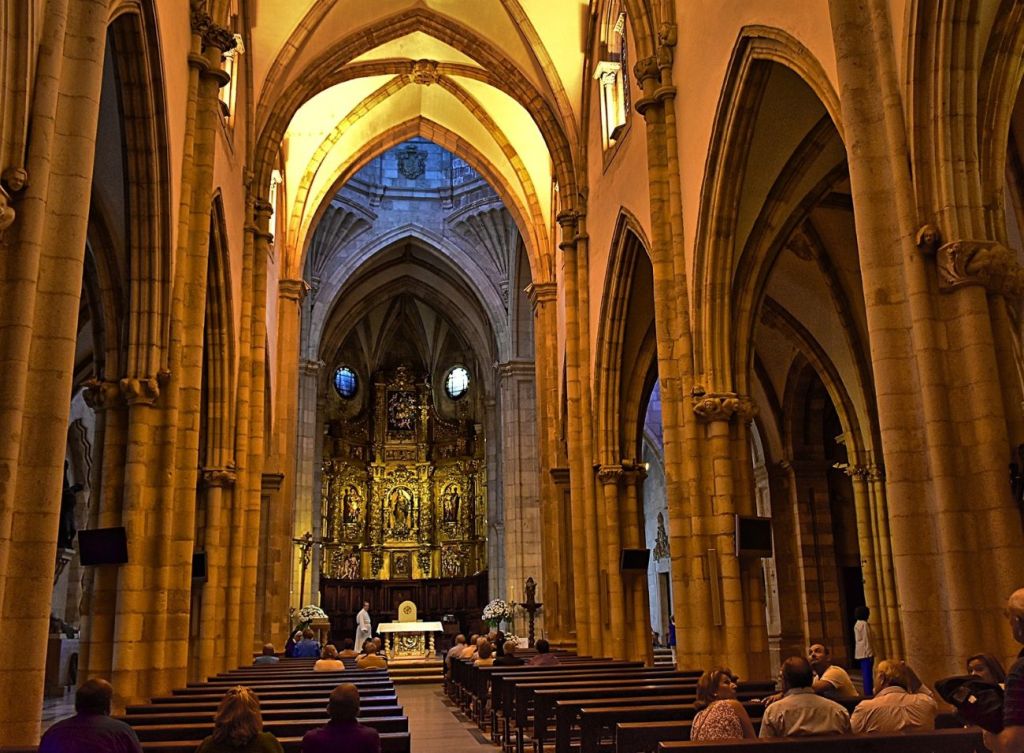
The lower and older church, commonly called the parroquia del Cristo or Church of Christ and aka the crypt, consists of three naves and four bays. Its dimensions are 31 meters long by 18 meters wide. The entire arched structure supports the weight of the upper level, giving it considerable thickness and robustness. Its decoration consists mainly of plant motifs. The upper church of this monumental complex was built during the 13C, in the same austere Gothic style as the Church of Christ. It lost a large part of its treasures in the aforementioned fire, although some were preserved and others were recovered. Much of the decoration of the arches, columns, and entablatures, as well as the doors, is preserved, especially the entrance door, which features one of the oldest representations of the coats of arms of the kingdoms of Castile and León together. The windows of the church are decorated with stained glass, although these are modern additions. The Cathedral-Basilica of Santander has numerous chapels distributed along the walls of the two side aisles, In the south aisle, the first chapel dates from 1624; the second from the beginning of the 17C; and the third from 1622. In the north aisle, the first chapel dates from 1671 and is Baroque in style; the second is the penitential chapel and contains a baptismal font; and the third contains the tomb of Marcelino Menéndez Pelayo. a Spanish philologist, historian, philosopher, literary critic, historian of ideas, politician, and writer. He was a prominent cultural figure of his time, a member of the Royal Spanish Academy, the Royal Academy of History, the Royal Academy of Moral and Political Sciences, and the Royal Academy of Fine Arts of San Fernando.
The church was enlarged in the mid-20C with the addition of a new presbytery and ambulatory. The construction of the new presbytery, dome, and ambulatory, along with the stone choir stalls that had survived the fire, the Puerta de los Mártires or Gate of the Martyrs, and the monumental adjacent staircase, were also carried out. The presbytery was the work in the 17C. These latter elements were dismantled, their ashlar stones numbered, but their whereabouts have been unknown ever since. The presbytery is surrounded by the ambulatory, which contains two altars dedicated to Ferdinand III of Castile, the Saint, and Saint Matthias. On its north side is a marble baptismal font with an Arabic inscription, supposedly captured during the conquest of Seville. On the south side is a gallery decorated with a fresco. The vaults are simple ribbed vaults, their slenderness accentuated by the light that enters through the clerestory windows into the wider and taller central nave. The old collegiate church consisted of three naves, to which a fourth, formerly occupied by the Abbot’s Palace and other chapels, has been added. From the 15C to the 17C, several side chapels were added. The cloister, trapezoidal in plan, was built during the first half of the 14C, maintaining the same architectural style as the rest of the complex. The doors in its western wall provided access to the large Hospital of the Holy Spirit and the church for pilgrims to Santiago.
The General Council of the Town of Santander met on exceptional occasions in the Chapter House and the adjoining nave. The cathedral hosts numerous benefit concerts and charitable events. In 2023, in support of Ukraine, Ukrainian Christmas carols were sung at the Epiphany Mass by Anastasia Golub, soprano, first soloist of the National Opera and Ballet Theatre of Odesa in Ukraine.
A bit of history I like tell us that this is a historical and monumental complex, built between the late 12C and 14C on the site of a former monastery. Initially, it served as an abbey, dedicated to Saints Emeterius and Celedonius, and known as the Abbey of the Holy Bodies. The church was erected on a hill surrounded by water, the site of the Roman settlement of Puerto de la Victoria, beginning in the 8C, to house the relics of the martyrs sacrificed in Calahorra five centuries earlier. It was elevated to the rank of collegiate church in 1131 by King Alfonso VII, the Emperor, and the reconstruction of the current church began at the initiative of Alfonso VIII, following the granting of the charter of Santander in 1187. The upper part of the building was constructed between the end of that century and the beginning of the 14C. The Gothic cloister was added afterward. Later, it received the title of Collegiate Church of the Holy Bodies. Of particular interest is the main gate, erected around 1230, where the first coats of arms of the kingdom are carved, depicting castles and lions together, following the definitive unification of León and Castile during the reign of Ferdinand III, whose son Sancho was abbot of the site. The church was enlarged in the 16C and 17C with the addition of new chapels. In 1754, the Diocese of Santander was created, and the Colegiata de los Cuerpos Santos or the Collegiate Church of the Holy Bodies was transformed into a cathedral by Pope Benedict XIV, as the head of the new bishopric of Santander. Since 2015, it has housed the Santander History Interpretation Centre.
The Official Catedral de Santander : https://catedraldesantander.es/
The Santander tourist office on its religious buildings, see Cathedral : https://turismo.santander.es/en/discover-the-city/religious-buildings
The local Cantabria tourism on Santander : https://turismodecantabria.com/descubrela/santander/
There you go folks, a dandy in my dear Spain, you must come to Santander, The cathedral is a must to visit here, me think, Again, hope you enjoy this post on the Catedral de la Asuncion de Nuestra Señora of Santander !!! as I
And remember, happy travels, good health, and many cheers to all !!!


