
This is for the nostalgia of family times; and glad to found me a picture in my cd rom vault that allow me to tell you about it as well. Not really a tourist attraction, just a regular local town with one nice cathedral. Childhood memories of this town forever. Therefore, let me tell you about this is Getafe !!! Hope you enjoy this post as I.
The City of Getafe is part of the Comunidad de Madrid region in the kingdom of Spain,It is located bordering Madrid and forming part of its metropolitan area. Also, borders on the Villaverde and Villa de Vallecas districts of Madrid, and Rivas-Vaciamadrid, (where my office branch is located), San Martín de la Vega, Pinto, Fuenlabrada, and Leganés. Four highways pass through Getafe: two radial highways ,the A-42, the autovia de Toledo, formerly known as the N-401 (the old way used to come here), and the A-4, the autovia del sur, formerly known as the N-IV (yes from old days!) , and two ring roads around Madrid ,the M-45 and further M-50. The M-406 road passes through Alcorcón, Leganés, and Getafe. Upon entering Getafe, this road becomes Calle Leganés.
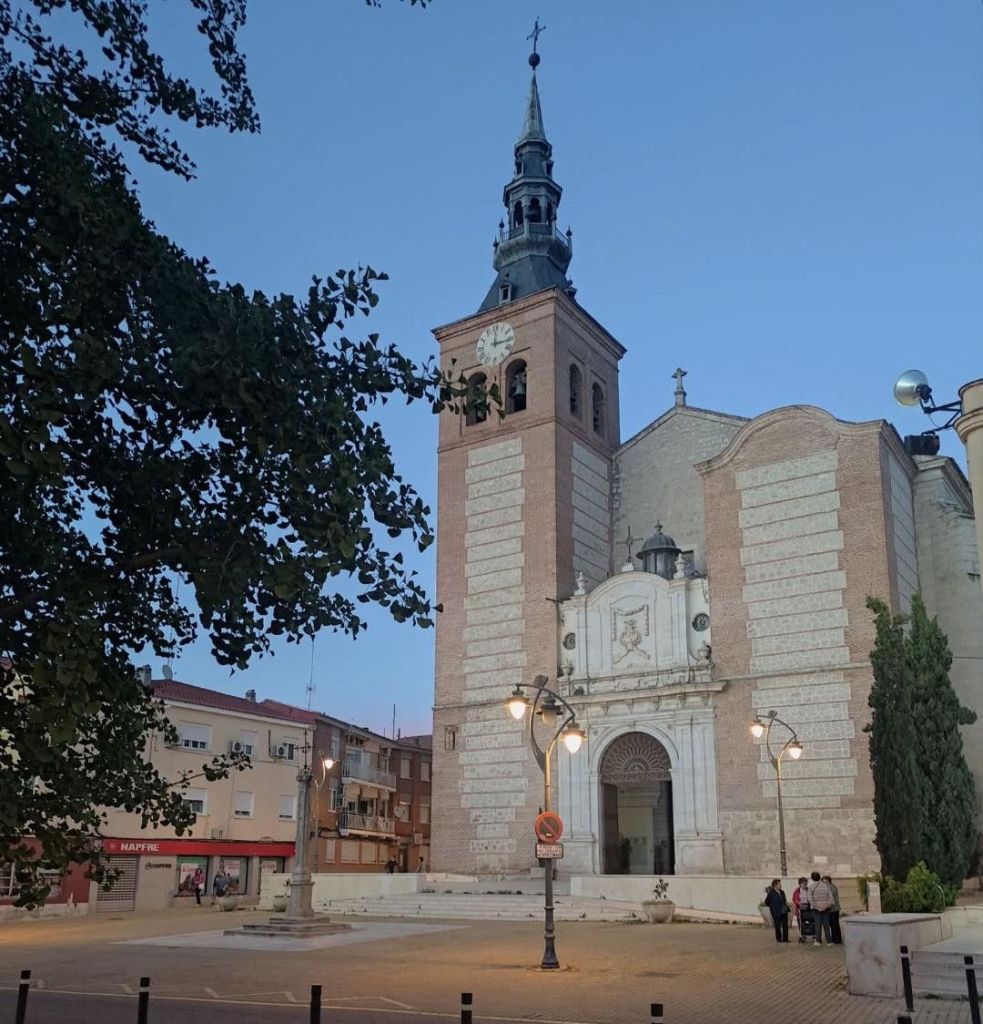
The Catedral de La Magdalena Cathedral located at the plaza de La Magdalena is the seat of the bishopric for the southern part of the Community of Madrid. Construction began in 1549 and was completed in 1770. The predominant styles are Renaissance and Baroque. The Mudéjar-style tower dates from the previous church. It is considered one of the finest examples of Renaissance architecture in the Community of Madrid. The church was consecrated as a cathedral on July 23, 1995. This church stands on the site of an old Mudéjar church built in the mid-14C. Only the square-based tower remains of the original structure. The main façade,features the principal entrance to the church. It is framed by a white stone portal in a sober style. The entrance rises to form a semicircular arch, above which is a frieze. Above the frieze is a decorative relief beneath a canopy of garlands, and below it, the date of the church’s completion (1770). The heavy wrought-iron gate leading into the church was made in Getafe in 1770 by Francisco Manzano, master blacksmith and locksmith of the Royal Palace of Madrid. The north tower, in the Mudéjar style is divided into three sections and has a 17C Baroque slate spire. The two lower sections are the oldest part of the cathedral, dating from the 14C. The bell tower houses two bells on the upper level and seven more on the lower. The oldest of these dates from 1541 and the largest, which has a diameter of 124 cm, weighs 1104 kg. The south tower is the newer one and its construction began in the 17C.
The Catedral de La Magdalena has a columnar hall plan, divided into three naves, with thick exterior buttresses and a pentagonal apse. The naves are separated by thick Tuscan columns supporting semicircular arches. The decoration on the walls and vaults is very understated and elegant. The dome is decorated with 18th-century frescoes depicting eight angels with the symbols of the Passion in the dome’s cupola and the four Evangelists in the pendentives. The main altarpiece, created between 1612 and 1618, is historically significant as one of the few surviving altarpieces from the first half of the 17th century in the Community of Madrid. It is dedicated to Saint Mary Magdalene, whose sculpture is located in the second tier of the central section. In the central section of the first tier stands a freestanding tabernacle or sanctuary dedicated to the Good Shepherd, inspired by the one in the Monastery of El Escorial. It is surmounted by a statue representing Faith. The tabernacle has a mechanism that allows the image of the Good Shepherd to be lowered, revealing a small opening in which the Blessed Sacrament is placed for Eucharistic adoration. The sculptural elements are completed by the figures of the Assumption of the Virgin and Calvary, the latter in the attic flanked by sculptures dedicated to Saint John the Baptist and Saint Isidore, with God the Father at the top. Finally, the predella features a series of saints in twelve reliefs. The six larger paintings located in the side aisles are dedicated to the life of Mary Magdalene. In the transept arms are two side altarpieces in a more advanced Baroque style, though retaining a certain classical restraint, dedicated to Our Lady of Peace and the Holy Name of Jesus. Besides these, on the sides facing the side atriums are a group of four other Baroque altarpieces: the altarpiece of Our Lady of the Angels, the altarpiece of Our Lady of Sorrows, the altarpiece of the Immaculate Conception, and the altarpiece of Our Lady of Mount Carmel. In the sacristy, in addition to an 18th-century wooden chest of drawers, several paintings are kept, among which a 17th-century depiction of the Holy Burial stands out. The cathedral has a Baroque organ dating from 1750. It is located above the main entrance in the choir area.
Other things to see here are the Cerro de los Ángeles (Hill of the Angels): At its summit are the Hermitage of Our Lady of the Angels and the monument to the Sacred Heart, as well as a Discalced Carmelite convent. The Convent of the Sacred Heart of Jesus and Saint Joseph of La Aldehuela is a Discalced Carmelite monastery located in the La Aldehuela area of Perales del Río. The faculties of Humanities and Law, and the Rector’s Office of the Carlos III University of Madrid, are located in the Las Margaritas neighborhood. The Getafe Air Base, famous for being one of the first in Spain, is situated near the city center and is used almost exclusively by the military, although it is also used by the aeronautical construction company, Construcciones Aeronáuticas SA. (CASA) In the center of Getafe , the area with the most shops and businesses is along the axis of Calle Toledo and Calle Madrid, which runs through the city from north to south. Much of this boulevard is pedestrianized, making shopping on foot more convenient. Another central and bustling commercial area is Avenida Juan de la Cierva.
A bit of history I like tell us that from the 2C to the 3C, the Romans arrived in the area, building the Roman villa of La Torrecilla on the banks of the Manzanares river. The Visigoths in the 6-7C left their mark with a necropolis near La Torrecilla. In the 8C, the area where Getafe is currently located was invaded by the Muslims, and in 1085, Alfonso VI conquered the villages then situated within the present-day city. In 1549, Alonso de Covarrubias began construction of the Church of Our Lady of La Magdalena (now the cathedral) on the site of the old hermitage, and in 1610, the Hermitage of Our Lady of the Angels was built on the Hill of the Angels. In 1737, the Piarist School of La Inmaculada – Piarist Fathers was founded in Getafe . In 1763, during the reign of Charles III, the new road to Aranjuez was built, passing along the foothills of the Cerro de los Ángeles (Hill of the Angels). Between 1808 and 1812, Napoleonic troops occupied Getafe, and in 1851 the Madrid-Aranjuez railway line was inaugurated, passing through the city. In 1911, the air base was permanently established, and two years later, the School of Civil Aviation was created. On May 30, 1919, Alfonso XIII inaugurated the first monument to the Sacred Heart on the Cerro de los Ángeles, and in 1924, the C.A.S.A. company established its factory in the City, That same year, the first flight in the autogyro, created by Juan de la Cierva, took place at the air base. Franco’s troops captured the city of Getafe on November 2, 1936, threatening to seize Madrid. In 1961, the Canal de Isabel II began supplying the city with water, and in 1979, the first democratic municipal elections were held after the 1978 Constitution. In 1989, the Carlos III University of Madrid was inaugurated, with its rectorate and faculties of humanities and law. In April 2003, Line 12 of the Madrid Metro opened, with eight stations in Getafe , connecting the southern cities with Madrid. Additionally, two Cercanías commuter rail lines , the C-3 and C-4 pass through Getafe, with five stations in the city. In 2019, the government of the Community of Madrid to extend Line 3 of the Madrid Metro to El Casar station in Getafe. I come by car never taken these public transport lines,
The City of Getafe on its history : https://getafe.es/la-ciudad/historia/
The Comunidad de Madrid region tourist office on Getafe : https://www.visitmadrid.es/en/where-to-go/metropolitan-area/getafe
The Diocese of Getage on the Cathedral : https://www.diocesisgetafe.es/catedral/
There you go folks ,another of my memorable spots in my Madrid area of always, youthful days and more , memories that will not go away. Again, hope you enjoy this post on this is Getafe !!! as I.
And remember, happy travels, good health,and many cheers to all !!!


