
I take you back to my dear Spain again !! love it !! We came by car on our road warrior trails and saw this town of Medina de Rioseco in our radar so decided to take a look, first time, and we love it, will be back for more eventually, The town of Medina de Rioseco is located in the province of Valladolid, in the autonomous community of Castilla y León, and in the kingdom of Spain. It holds the honorary titles of “very noble” and “very loyal,” as well as the title of “city,” and is also known by the nicknames “City of the Admirals” and “Little Old India.” Therefore, here is my take on the Church of Santa Cruz of Medina de Rioseco !!! Hope you enjoy the post as I.
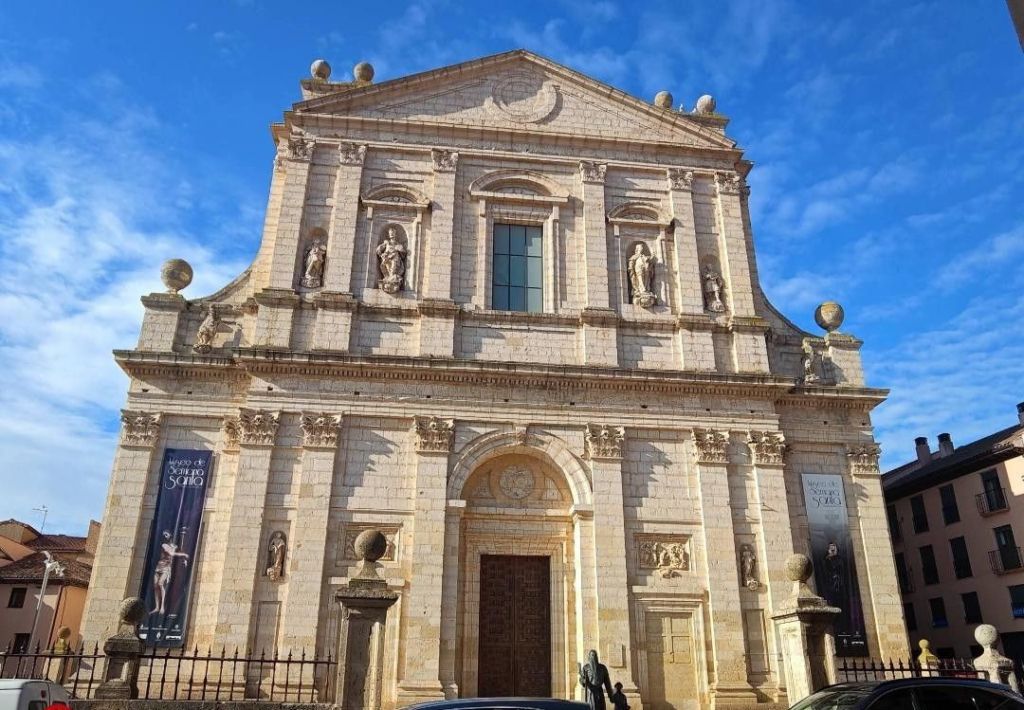
The Church de Santa Cruz or of the Holy Cross: Construction began at the end of the 16C, but due to a lack of funds, it was never completed. It replaced an earlier church, which had a clock tower. Only one of the chapels of that earlier church remains, in an early Gothic style, and is now incorporated into a house on the left side of the square. Construction took place throughout the 17C, marked by numerous changes. The façade is its most distinctive feature; it recreates the design of the Church of the Gesù in Rome, although with Herrerian influences that lend it a certain severity. The interior follows the model of Jesuit churches, with the widest central nave in all of Spain and side chapels connected by passageways. In 1996, the atrium was restored, and the old stone lions that marked the parish’s jurisdictional boundary in earlier times were removed and replaced with a plaque bearing an erroneous Latin inscription. Today, it houses the Holy Week Museum and preserves several altarpieces from the original church.
The Church of the Holy Cross features a single nave with a Latin cross floor plan, with three niche chapels on either side, connected longitudinally by corridors. At its straight apse, a rectangular sacristy from the early 18C stands out at the Gospel end, along with a robust tower on the opposite side. The main decorative element is the façade, preceded by a spacious atrium facing the town’s main street. Here stands the bronze sculpture “Monument to the Brotherhood Member,” a tribute to those who make the city’s Holy Week celebrations possible, depicting a brotherhood member and a child. This work is a 2006 piece. The façade is structured in two stories, divided by a wide architrave, frieze, and cornice. The projecting central section of the façade results in the entire structure being organized with Corinthian pilasters, ten at the top and eight at the bottom, and crowned with a pediment and spheres. The entire ensemble is completed with semicircular arched niches containing sculptures of figures related to the miracle of the Holy Cross. At the top are Heraclius and Alfonso VIII in the larger niches, and Saint Helena and Constantine the Great in the smaller ones. On the outermost sides are King David and the prophet Isaiah. Two reliefs are located at the bottom, depicting Saint Helena discovering the Cross and again the saint with Bishop Macarius certifying the cross’s authenticity after the miraculous healing of a sick woman. The Cumaean and Samian Sibyls are depicted in the niches at the bottom.On either side of the church entrance are two altarpieces from two chapels located on the Epistle side, known by the names of their founders. Its aesthetic is very similar, of a classicist type with certain elements that show a calm Baroque style, and it dates from the mid-17C.
Preceded by a large, temple-like tabernacle, stands the High Altarpiece, created in 1666. Its architectural design is remarkable, featuring a pronounced predella and three sections supporting a powerful attic flanked by large volutes. It is structured with giant-order Solomonic columns and pilasters with projecting cornices, creating dramatic contrasts of light and shadow. Decorated in a highly Baroque style with voluminous vegetal motifs, its spaces are covered with paintings, from bottom to top: Attic: Battle of the Milvian Bridge. Central Section: Baptism of Constantine by Pope Sylvester / Architectural Painting / Exaltation of the Cross with Constantine and retinue under the Celestial Choir. Gospel Side: Emperor Constantine / Constantine’s Dream before the Battle of the Milvian / Narration of his vision of Christ to his followers / Apparition of Saint Peter and Saint Paul. Epistle Side: Saint Helena / Constantine’s vision of the Cross before the sun / Order to the soldiers to engrave the labarum on their shields / Constantine indicates the vision of Christ
The side altarpieces delivered in 1679. Gilding completed in 1697. Highly Baroque in style, they feature a very high base, a central section, and a pronounced attic with lateral volutes. On the Epistle side is the Altarpiece of Our Lady of Piety, whose titular image has been replaced by a small image of Christ tied to the column, and on the predella, the torso of an Ecce Homo. The four small reliefs in the central section depict, on the left, the Holy Burial and the Circumcision, and on the right, Our Lady of Sorrows and the Presentation of the Child Jesus in the Temple. Centering the attic is a large relief of the Descent from the Cross. On the Gospel side, the Altarpiece of the Holy Christ of the Passion repeats the same design as its counterpart on the Epistle side. It is a work of the Castilian school from the early 17C. On the left side are the reliefs of the Flagellation and the Agony in the Garden, and at the other end, the Ecce Homo and the Arrest of Christ. Occupying the center of the attic is the relief of the Holy Christ of Nazareth.
On the Epistle side is the altarpiece of the Medina Prado Chapel. Above the tabernacle door is a 16C painting of Christ’s head. The central figure is the Immaculate Conception, with Saint Anthony to her right and Saint Elizabeth to her left, a work by Pedro Salvador “the Younger” (1669). In the upper section, beneath a triangular pediment, is Saint Anne with the Virgin Mary as a child. On the opposite side, the Gospel side, the altarpiece known as the Fernández Isidro Altarpiece replicates the style of the previous one. The central section features a high relief of God the Father with the Holy Spirit, and below it, the Holy Family, all resting on a glass case containing a 17C recumbent Christ figure, which occupies the center of the predella. A Franciscan saint flanks it on the left, and on the opposite side, an image of Saint Teresa, depicted beneath a small painting of Saint Mark. An image of Saint Atilano is located in the upper section.
The Museo de Semana Santa or the Holy Week Museum of Rioseco currently houses most of the floats belonging to the brotherhoods and confraternities that make up the collection. Its exhibition catalog consists of objects, instruments, and symbols belonging to the confraternities and brotherhoods, such as habits and processional materials, documents, photographs, and floats and sculptures that have had or have had a connection to the museum’s main theme. The altarpieces that have been preserved from the church complement an exhibition space that showcases the tangible and intangible heritage of Rioseco’s long-standing tradition and religious devotion, making it a virtually unique example at the national level. Currently, the exhibition is managed jointly by the Medina de Rioseco Churches Association and the Holy Week Board.
The Castilla y Léon region tourist office on Medina de Rioseco : https://www.turismocastillayleon.com/en/heritage-culture/medina-de-rioseco
The Castilla y Léon region tourist office on the Holy Week Museum : https://www.turismocastillayleon.com/en/heritage-culture/museum-holy-week
The Medina de Rioseco tourist office on the Holy Week Museum : https://turismo.medinaderioseco.org/que-ver/museos-para-visitar-en-medina-de-rioseco
There you go folks , another wonderful trip to my dear Spain, This time first time in Medina de Rioseco nice, awesome will be back, eventually, Very convenient on off the A62 highways connecting to all of Castilla y Léon region, Again, hope you enjoy this post on the Church of Santa Cruz of Medina de Rioseco !!! as I
And remember, happy travels, good health, and many cheers to all !!!


Well shared. I learnt lot
LikeLiked by 1 person
Glad you did. Thanks for stopping by. Cheers
LikeLike