
I came across several pictures in my laberynth cd roms vault that should be in my blog for you and me. The tour of
Castilla La Mancha is very sentimental and always will remain so, just see the posts. I came upon Valdepeñas on my road warrior trails to find me some wines, and surprise, it is a quant pretty town as well with plenty of things to see and enjoy, Once again, I take this opportunity to thank you for reading me over these last 16 years! Therefore, this is my take on this is Valdepeñas !!! Hope you enjoy the post as I.
The town of Valdepeñas is located in the province of Ciudad Real, in the autonomous community of Castilla-La Mancha
in the kingdom of Spain, The A-6 Autovía del Sur crosses the town from north to south between km markers 181 and 211.The other roads are the A-4/E-5 , and the CM-45 or Autovía del IV Centenario, .It is 63 km from Ciudad Real, 38 km from Almagro, 157 km from Albacete, 205 km from Madrid, and 241 km from Cuenca from where we came from along the Avenida de los Reyes Catolicos ,becomes same road Carretera de Alcazar after roundabout becomes the N420 highway dir Mota del Cuervo , a curvy mountaneous highway continue then at junction take left onto the A3 or autovia de Este dir Albacete/Valencia then at exit/salida 177B bear right onto the A43 highway or Autovia de Extremadura a la Comunidad Valenciana dir Ciudad Real then get off at exit/salida 51 dir Manzanares onto the A4 or Autovia del Sur continue to exit/salida 200 Valdepeñas Centro y Sur continue around roundpoint bearing left onto the CM412 passing over the A4 highway continue bearing right on the CM412 to roundabout Homenage al Gañan bear right onto the Avenida Castilnuevo cross over railroad tracks and bear right onto Avenida Primero de Julio continue to roundabout Homenaje al Quijote bearing left onto Calle de la Virgen continue arriving to find on street parking by Plaza de España,
The Church Asunsion de Nuestra Señora (see pic) or of the Assomption of Our Lady is located in the Plaza de España. Its origins can be traced back to the late 12C and early 13C, originally being part of the fortress of the Knights of Calatrava. The facades feature sturdy buttresses and several doors. On the south facade, which faces Plaza de España, there is the “Puerta del Sol,” dated to the second half of the 15C and dedicated to the Assumption, in the Isabelino Gothic-florid style, and the “Puerta de los Catecúmenos,” possibly of Romanesque origin, framed by a lintel that once held an image of the Piety. On the opposite side is the “Puerta de Umbría,” with a classical pediment flanked by two medallions of the Order of Calatrava, beneath which is a niche with an image of Saint Lawrence. The tower, from the 16C, consists of five sections and is topped with a slate spire, above which there is a ball and a cross. Inside, the temple has two naves: the main nave, which houses the altarpiece of which the six original panels are preserved. This altarpiece has three sections, each with eight paired columns. Opposite the head, and above a pointed arch, is the choir with an organ dating from 1962. The nave of Saint Lawrence is shorter and is separated from the main nave by arches from the 18C. It has a small altar with panels of the four evangelists. Another curiosity we can find inside is a small Mannerist chapel or penitential chapel accessed through two gates decorated with the Calatrava cross, where we find tombstones and the triptych of the descent. In the sacristy, we can admire the frescoes depicting the Calvary of Jesus Christ, with Dimas and Gestas on either side. On the upper floor, we have the parish archive from 1565. During the restoration in 2018, burial niches from past centuries were uncovered, when it was customary to bury bodies in sacred ground beneath or adjacent to churches.
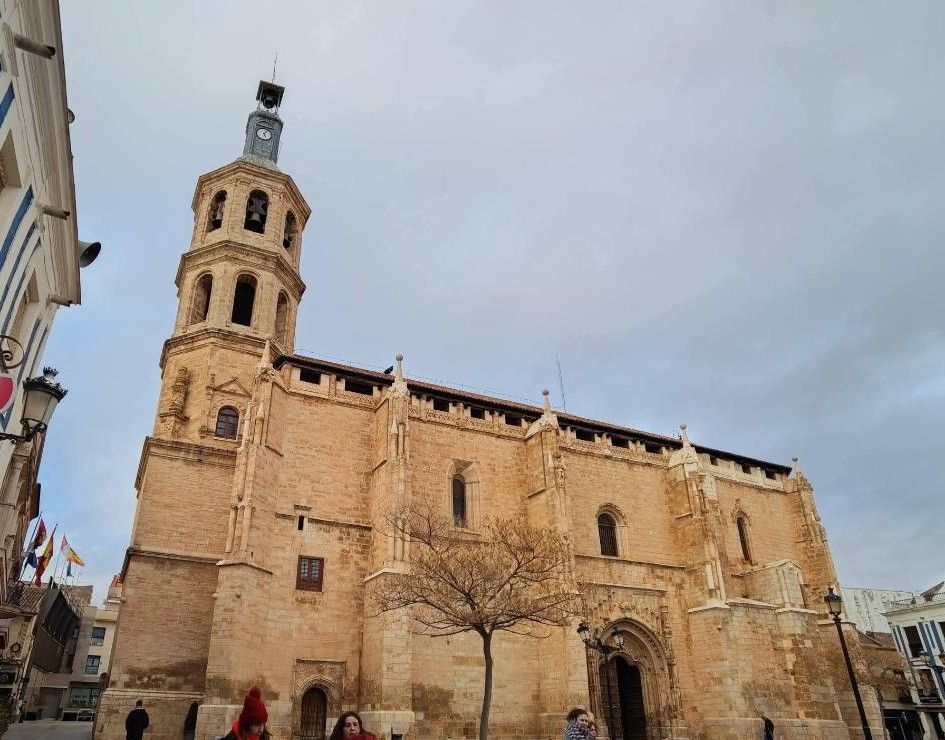
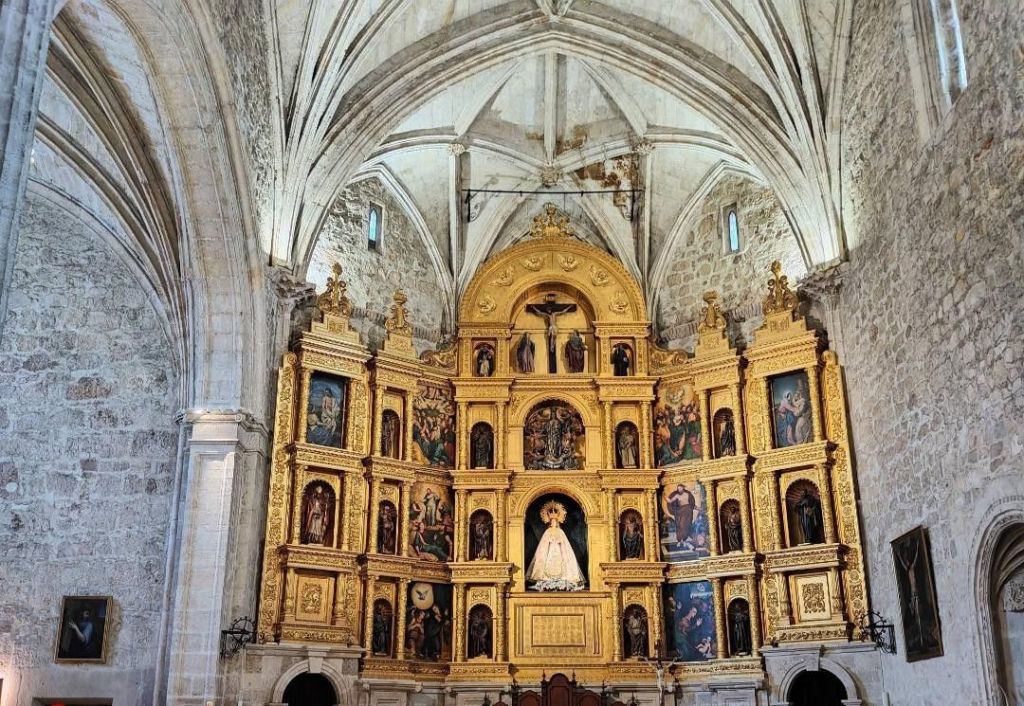
On the Plaza de España (see pic) once stood the Commander’s House, built upon the last vestiges of an early fortress and later rebuilt as the Palace of the Marquis of Santa Cruz, Lord of Valdepeñas. It was located on the corner of the Plaza and Calle de la Virgen, which is still known locally as la cuesta del Palacio or Palace hill. Throughout its history, it has witnessed autos-da-fé, executions, celebrations, fairs, and more.
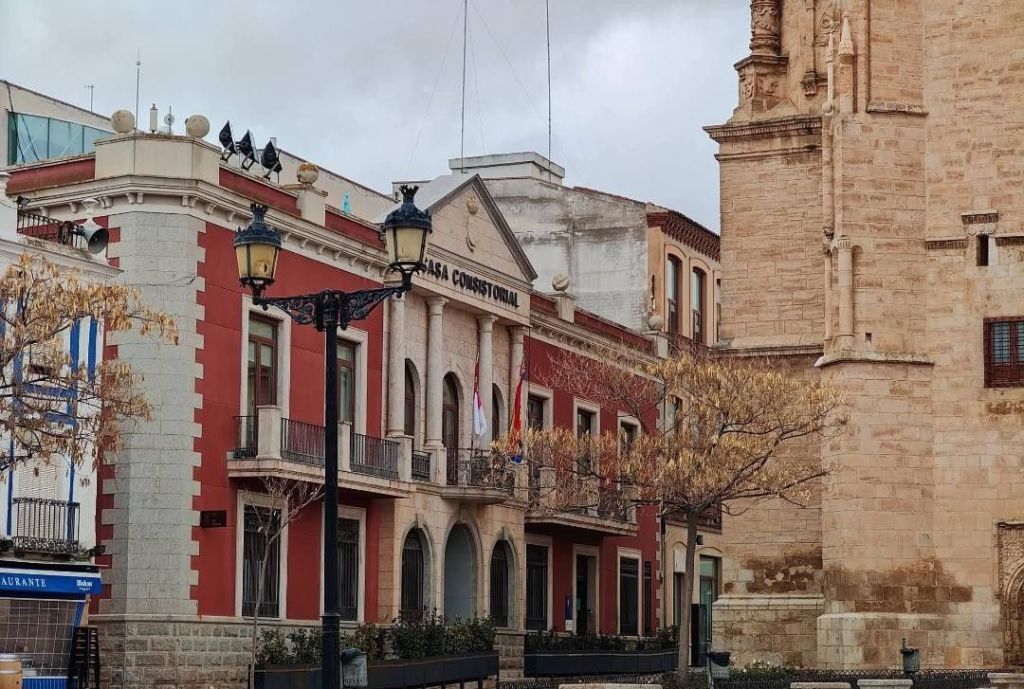
This urban space houses the City/town hall (see pic), This building dates back to the 16C, though no documentation exists. It was renovated in 1864 and has undergone several alterations since then. The building’s foundation is original to the first city hall, built in a Parisian style, with a double staircase as a symbol of power. The Salon de Plenos or Plenary Hall maintains its classical aesthetic and original structure, including the original railings. As a nod to the original design, a framed recess in the ceiling reveals the hall’s original ceiling.
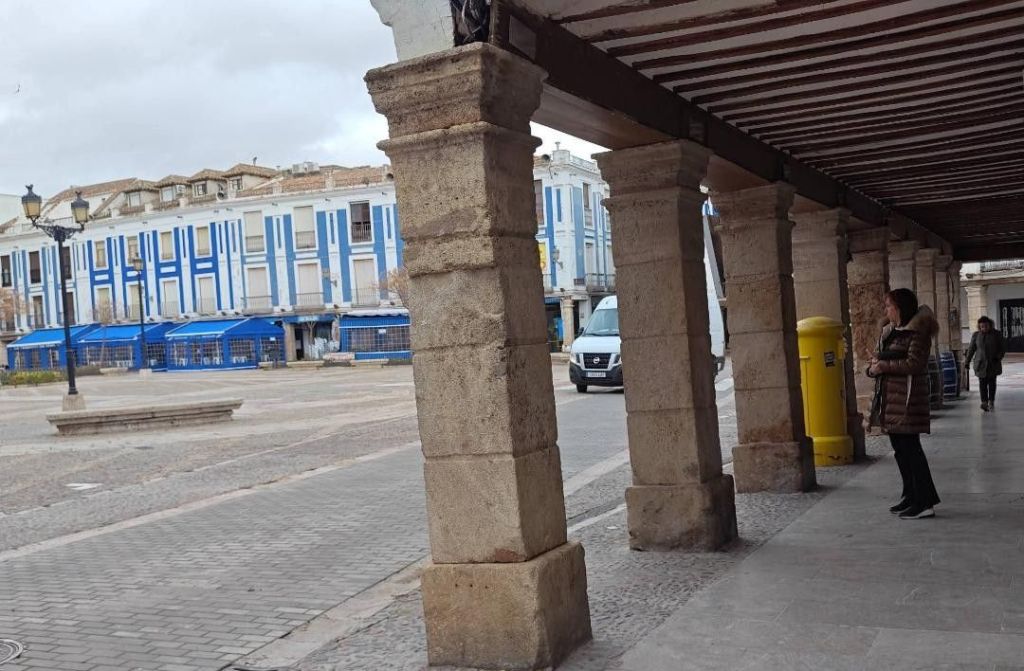
Other things to see here are the Museo de los Molinos or Mill Museum: the world’s largest mill-museum. Gregorio Prieto Museum, with the most extensive collection of works by the painter Gregorio Prieto, as well as letters and paintings by fellow members of the Generation of ’27 (Alberti, García Lorca, etc.). Wine Museum. In the above Plaza de España there is ,also, an interesting central fountain dating from 1926 and featuring a wine press, and a multitude of other businesses and private residences located in its doorways and homes. The white and indigo colors give it a distinctly Manchegan character. Also, with more time see the Hermitage de Veracruz, Church of Trinitarians, Hermitage de la Virgen de Cabeza, Hermitage of San José, Hermitage Santo Cristo de la Misericordia, Hermitage de San Marcos and Hermitage Cristo de Burgos,
One other thing to see in Valdepeñas are its wines with a Protected Designation of Origin (PDO) in Spain. Since 1895, when Valdepeñas wine was first tasted in Madrid, it was also one of the major exports to the Philippines, Cuba and Central America through the Port of Cadiz. The production area of the Valdepeñas Designation of Origin is located in Campo de Montiel to the east, Campo de Calatrava to the west and Sierra Morena to the south. An area of more than 24,000 hectares. My favorites over the years (see posts) have been the Bodegas Los Llanos Pata Negra Gran Reserva ,and Bodegas Félix Solis Viña Albali Gran Reserva,
The official Bodegas Los Llanos (showing Reserva only) : https://www.senoriodelosllanos.com/en/producto/pata-negra-do-valdepenas-reserva-red-wine/
The official Bodegas Féliz Solis Viña Albali : https://www.felixsolis.com/fr/wine/vina-albali-gran-reserva-seleccion-privada/
A bit of history I like tell us that as early as the 16C, funerary stelae, Roman coins, and the foundations of a Roman villa dating from the 1C BC were found at the site where the Trinitarian convent was being built. This villa continued into the Visigothic period. Also noteworthy is the discovery in October 2021 of a Roman wine cellar in El Peral, which forms part of an archaeological complex from the 3C and 4C. During the Islamic period, the area belonged to the Kingdom of Toledo. From this era, the remains of a wall from an ancient fortress are visible in the walls of the Church of the Assumption, where a sundial and several Arabic inscriptions can be seen on its southern façade. The town of Valdepeñas was founded around the current church of the Assumption , an old fortress by decision of Queen Berenguela of Castile after the battle of Las Navas de Tolosa, (1212) bringing together the inhabitants of several nearby villages. The first text in which the population is mentioned as such is found in the archives of the Order of Calatrava in 1243, citing the commander of Valdepeñas. From that moment on, Valdepeñas belonged to the Order of Calatrava. During this medieval period, the presence of a Jewish community is noteworthy, as evidenced by the existence of at least two synagogues. One could be the one that was later converted into a hermitage (the current Inés Ibáñez Braña Municipal Auditorium), and the other would be the old building that housed the Church of Christ, behind its current location. On February 18, 1488, the Catholic Monarchs (Fernando II and Isabel I) stayed at the house of Alonso de Merlo’s mother located on Calle Torrecilla on their way to the conquest of Granada. They left the Infantas (daughters) in the care of the widow in this house for part of the campaign. Alonso de Merlo himself was appointed captain and marched with more than two hundred men to conquer Granada, covering the expenses with his own money. This would be recognized by the Catholic Monarchs when they granted him the title of knight. To alleviate the depleted state coffers, King Felipe (Philip) II sold the town of Valdepeñas, on April 22, 1575, to Álvaro de Bazán, first Marquis of Santa Cruz. Valdepeñas became a lordship, separating from the Order of Calatrava. It was the promotion of Valdepeñas wines by successive Marquesses that led to their great prestige and their consumption at the Spanish Habsburg court, thus spreading their fame throughout the country. Later, Carlos (Charles) III stipulated a bonus in Valdepeñas wine on the wages paid to the artisans who built the most prestigious buildings in Madrid such as the Puerta de Alcalá and Puerta de Toledo (see posts). From the beginning of the 18C, with the seventh Marquess of Santa Cruz, the lordship of Valdepeñas became linked to the House of Silva (currently, to the Silva-Bazán branch).
On June 6, 1808, during the Napoleonic occupation of Spain, the Spanish army fled Valdepeñas due to the imminent passage of Napoleonic troops heading to Andalusia as reinforcements. The entire town (including women and children, along with residents of nearby villages) rose up in arms during the Battle of Valdepeñas, blocking the passage of troops and, at a high cost in lives and with part of the town burned, forcing the French to withdraw from the old province of La Mancha. This delay undoubtedly facilitated the Spanish victory at the Battle of Bailén.(1808), During the 19C, Valdepeñas, like the rest of Spain, was convulsed by civil wars ;the Carlist Wars, with significant intrigues between liberals and absolutists, as well as guerrilla warfare, being particularly prominent. As a consequence of a new territorial division of Spain in 1833, which replaced most of the existing Spanish provinces with those that exist today, the province of La Mancha disappeared, giving way to the new province of Ciudad Real. Various territories of the former were separated and incorporated, and Valdepeñas became administratively dependent on the latter. In 1895, Queen Regent Maria Cristina gave it the title of city. The Spanish Civil War brought the city’s development to a standstill. During the 1940s, 1950s, 1960s, and 1970s, Valdepeñas underwent significant changes. Large housing developments have sprung up in what was once countryside or farmland.
The town of Valdepeñas on its heritage : https://turismo.valdepenas.es/en/monuments/
The province of Ciudad Lineal tourist office on Valdepeñas : https://www.turismociudadreal.com/pueblos/valdepenas/
The official Wine Museum of Valdepeñas : https://museodelvinovaldepenas.es/
There you go folks, a wonderful deep town in the wonderful Castilla La Mancha region, this is quant, architecturally and historical Valdepeñas. Again, hope you enjoy the post on this is Valdepeñas !!! as I.
And remember, happy travels, good health, and many cheers to all !!!


