
I bring you back to my beloved Spain. In my road warrior state of mind I was driving around what is the Province of Cuenca in the Autonomous region of Castilla La Mancha and heard on brochures of this place. Loving architecture and history so much, of course, we went there and glad we did! I found me a couple pictures in my cd rom vault that should be in my blog for you and me, Therefore, let me tell you about Arqueology in Segobriga ,part II !!! Hope you enjoy the post as I.
The site belongs to the village of Saelices witha population of 464 (INE 2024) It is located 72 km from Cuenca, 4 km from the Segóbriga Archaeological Park, The site remotely old ,its very interesting for a stop if you are into history and architecture as I am. The archaeological park of Segóbriga is the most important archaeological complex of the Spanish Meseta. From the 1C onwards, the city developed as it became an important communication node, an agricultural center ,and the administrative capital of a large territory, until its abandonment after the Muslim conquest of the Iberian Peninsula.
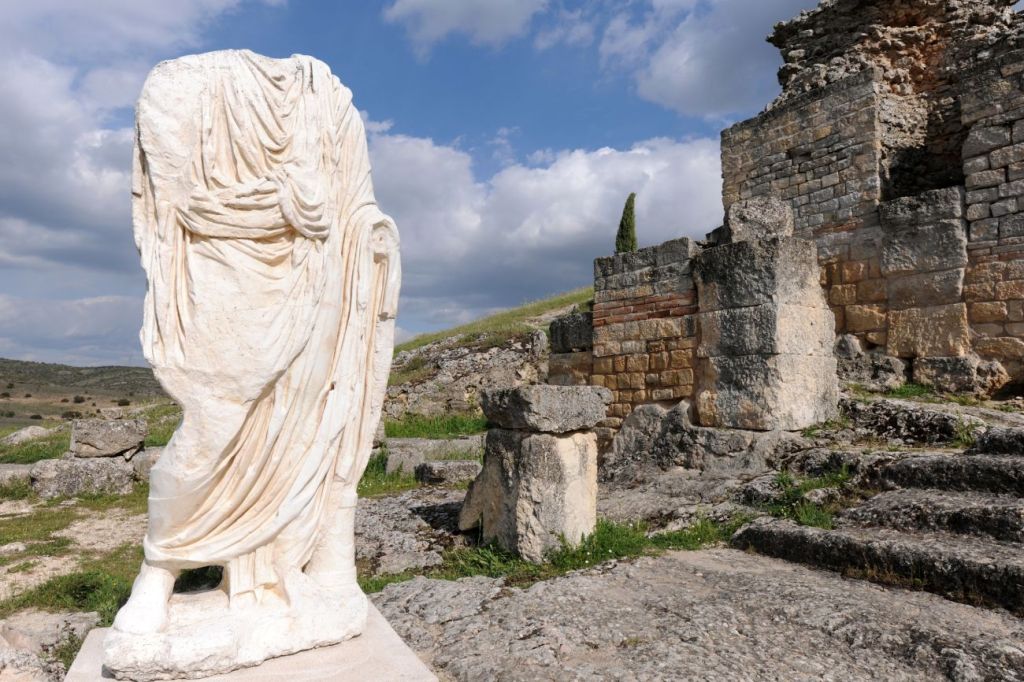
Here you will find the Roman theater (see pic) construction likely began during the reign of Tiberius and it was inaugurated during the reign of Emperor Vespasian, around 78 AD. It retains the orchestra, semicircular in plan, with three steps for dignitaries and a space for the musicians. The scaena, or stage, used for performances, was made of wood on stone pillars, behind which stood a monumental stage decorated with columns and marble sculptures, presided over by the goddess Roma. You can ,also, see a Roman headless personage in a toga ! (see pic),
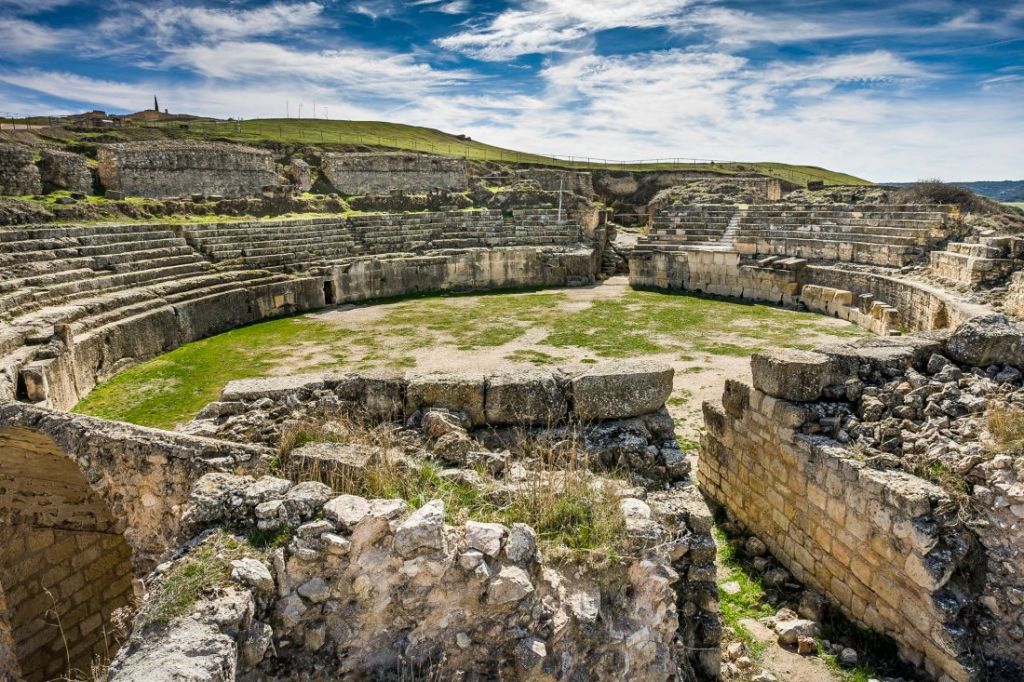
And in addition, from the Celtiberian period you have the Necropolis (outside the walls). From the Roman era: The wall and the North gate; the amphitheater, was built in front of the theater. The elliptical shape of the latter and its 75 meters in length make it the largest monument of the archaeological complex, with a capacity of about 5 500 spectators. The theater’s construction began at the time of Tiberius and probably ended during the reign of Vespasian, circa 79AD. The well-preserved bleachers were divided into three parts, separating the different social classes from the public. The monumental baths; the gymnasium and the baths, the Forum; the Acropolis; the Rock Sanctuary of Diane (outside the walls); the Aqueduct (outside the walls), the quarries (outside the walls), the Circus (outside the walls). The most recent research has shown that this construction was carried out on a necropolis, but the building was never completed. From the Wisighote period is the Basilica Cabeza de Griego (Outside the walls) or the Greek’s head Basilica.
At present, the ancient city is part of an archaeological complex, and the visit is subject to the payment of an entrance fee for the museum. At the entrance to the park, a small museum was built to preserve the many parts that could degrade, such as some statues and mosaics, which, if exposed to the weather, can quickly deteriorate. There is a free guided visit to the park,
The official site of Segobriga: https://www.segobriga.org/en/
The Castilla La Mancha region on Segobriga: https://www.turismocastillalamancha.es/es/cultura-y-patrimonio/arqueologia/parque-arqueologico-de-segobriga
The informative site of roman aqueducts on the site of Segobriga: http://www.romanaqueducts.info/aquasite/segobriga/index.html
There you go folks, another wonderful spot in my beloved Spain, and dream lands of Castilla la Mancha. This is wonderful country, and a nice spot to visit at Segobriga. Again, hope you enjoy this post on Arqueology in Segobriga, part II !!!as I.
And remember, happy travels, good health, and many cheers to all !!!


