
A wonderful memorable City we have visited couple times over the years, Gladly found me again pictures in my cd rom vault that should be in my blog for you and me. I stop by on one of my road warrior trips searching for wines , and got hook up as usual with the exuberance of architecture and history in the city, Therefore, here is my take on this is Aranda de Duero !!! Hope you enjoy it as I.
The town of Aranda de Duero is located in the province of Burgos, in the autonomous community of Castilla y León, and in the kingdom of Spain. The town is traverse by the Duero river. The access is done by the Autovia del Norte highway A-1 from Madrid to Irún, the N-122 highway Soria-Valladolid, CL-603 Aranda-Segovia, and the CL-619 Aranda-Palencia. Glorious road warrior trails on them done by yours truly over the year, It is locate 86 km from Burgos
The Museo Sacro or Sacred Art Museum in the Church of San Juan (see pics), A museum with part of Aranda’s religious heritage , where the Council of Aranda was held in 1473. Now, thanks to the Aranda de Duero City Council, the church houses a permanent exhibition of interesting works from the Ribera del Duero region. The Church of San Juan is a Gothic church with a Renaissance altarpiece and a fortified tower, indicating that it was originally used for defense.
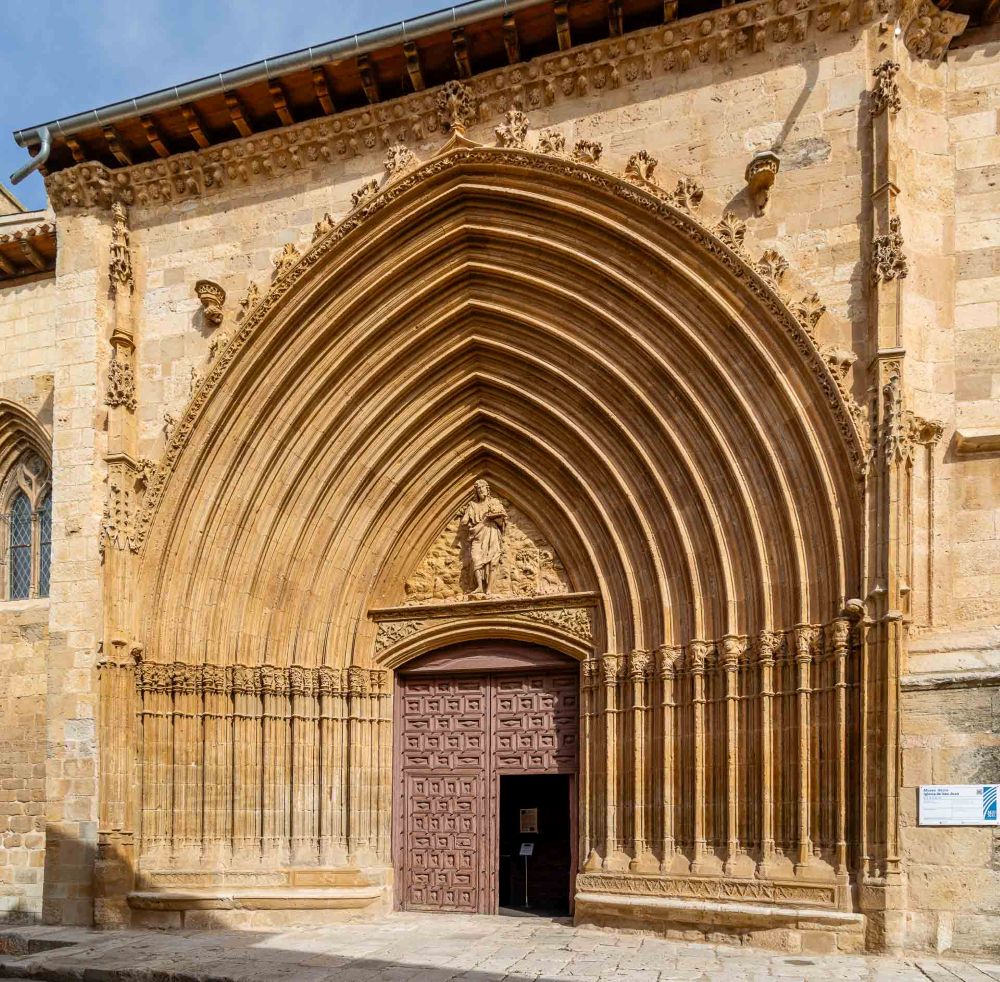
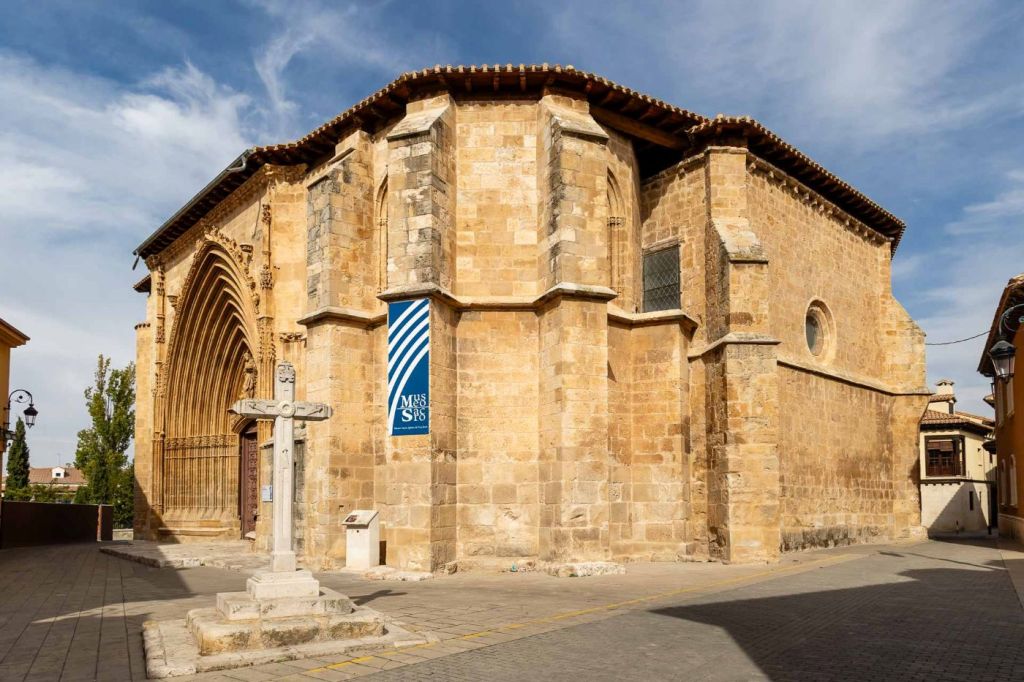
Other things to see here with more time are the more than 300 cellars that once made up the underground city of
Aranda de Duero were built between the 12C and 18C, Large harvests of wine were stored in these galleries, as they provide the ideal temperature (between 10 and 13 °C) and humidity conditions for its maturation. They are one of the largest and best-preserved groups of medieval cellars in existence. Currently, there are more than 120 cellars with a network extending over 7 km beneath the old town. The Plaza del Trigo (Wheat Square): home to some of Aranda’s most representative buildings, as well as numerous historic wineries. Church of Santa María la Real: built between the 15C and 16C, it features an Isabelline Gothic portal . The portal is crowned by a cresting. . Sanctuary of Our Lady of the Vineyards: This 17C hermitage is located north of the city on a small hill overlooking the park of the same name. It houses the image of Our Lady of the Vineyards, patron saint of the city. Church of Saint John of the True Cross: This church contains remains of the original altarpiece from the Dominican convent of Sancti Spiritus. It was home to the Vera Cruz school, one of the town’s first educational institutions. Centro de interpretación de la Arquitectura Asociada al Vino (CIAVIN) or Wine-Related Architecture Interpretation Centre is a museum that helps visitors discover the historical legacy that wine culture has left in the Ribera del Duero region. Since Roman times, winemaking and preservation have shaped the city’s heritage (mosaics, wineries, wine presses, vats, vessels, etc.), and especially the medieval underground cellars of the town.
A bit of history tell us that the origins of Aranda de Duero are difficult to establish due to a lack of documentation proving its existence in ancient times. The first Roman presence in these lands can be dated to 135 BC when Publius Cornelius Scipio, in the context of the conflict between Rome and Numantia, marched from Cauca to Numantia, crossed the Duero River, and burned the fields of the Vaccaei to deprive the Numantians of wheat and provisions. Two years later, Numantia finally fell to Scipio the Younger. From the beginning of the 5C, the Visigoths had carried out various actions on the Iberian Peninsula, settling here after their defeat at the hands of the Franks. The Visigothic Kingdom of Toledo was established, expanding its domains into what is now Castile and León, particularly Burgos, Palencia, Soria, and Segovia. This Visigothic rule lasted until the Muslim invasion of the Iberian Peninsula. The Muslim invasion of the Visigothic Kingdom began in 711, and after the Visigothic defeat at Guadalete at the hands of Tariq, a rapid advance northward across the peninsula commenced. It was probably Musa who, in 714, during a punitive expedition against Amaya, placed these lands under the jurisdiction of the Vilayet of Córdoba. The conquest was completed in 716, and it wasn’t until 722, after the Battle of Covadonga, that the Reconquista began; however, this did not immediately affect these lands. In 931, Fernán González, “the Count of Good Deeds,” unified Castile, uniting Burgos, Lara, Lantarón, Cerezo, and Álava, linking it to himself and his descendants, and securing a position of primacy within the Kingdom of León, Fernán González crossed the Duero River and occupied Sacramenia and Sepúlveda, thus planting a spearhead in Moorish territory and establishing a new defensive line in the Somosierra mountains. The Muslims counterattacked, and it is during this period that we find the first explicit mention of Aranda, in 940 or 941. In 1133, a new council convened in Burgos made adjustments to the territories of the dioceses, including Aranda in the diocese of Osma, to which it would belong until 1954. During the reign of Ferdinand III, Aranda became a large medieval town, favored by its geographical location and fertile lands. He was succeeded on the throne by Alfonso X the Wise, who had to face constant intrigues from the nobles. In 1269, Infante Henry, Lope Díaz III de Haro, and the House of Lara conspired against the king in Lerma, although Aranda remained loyal to the monarch. Aranda de Duero is known for hosting the Council of Aranda in 1473, attended by the then-Princess Isabel I of Castila (later the Catholic Queen) , It is also famous for the map of Aranda, drawn in 1503, which is the oldest urban map in the country and the oldest cartographic document in the General Archive of Simancas (see post). This map served as a basis for the development of cities in the New World, recently discovered by the Crown of Castile
During the Revolt of the Comuneros of Castile, Aranda de Duero joined the rebellion. On September 11, 1520, the town violently deposed the corregidor and the mayors from their posts, appointing other ordinary mayors who then exercised their office on behalf of the Community. In the 18C, during the Bourbon monarchy, Aranda de Duero consolidated its status as a royal town. The Treaty of Fontainebleau stipulated the entry of the imperial armies into the peninsula for the planned invasion of Portugal. In October 1807, preparations began for the entry of French troops into Burgos, initially restricted to Burgos, Pancorbo, and Miranda de Ebro. In March 1808, the first French troops crossed Aranda, under the command of Marshal Murat, heading towards Madrid. On April 7, Infante Don Carlos passed through the town on his way to Bayonne, and on the 11th, King Ferdinand VII arrived and was received with full honors and enthusiasm. At the end of the month, news arrived of the anti-French uprisings in Burgos (April 18) and León (April 24). On May 5, three more members of the royal family arrived in a procession: the Queen of Etruria, Infante Don Francisco, and Don Antonio, bound for France, along with the first news of the May 2nd uprising in Madrid. Thus began the War of Independence in Spain. On July 17th, Napoleon’s new king, Joseph Bonaparte, passed through Aranda on his way to the Court in Madrid, receiving a cold welcome from the local authorities. However, just twenty days later, he crossed through the town again, this time with 25,000 French soldiers, on his way to Vitoria, after learning of the defeat suffered by Dupont’s French army at the Battle of Bailén, at the hands of General Castaños’s Army of Andalusia, which included the Aranda militiamen of the aforementioned Burgos Provincial Regiment. The entire French garrison of Aranda departed with him, but not before sacking the town. Thus, on August 6th, 1808, Aranda was free of French invaders.
The town of Aranda de Duero on its heritage : https://www.arandadeduero.es/patrimonio/
The official memory of wine on the Bodegas of Aranda de Duero : https://bodegas.arandadeduero.es/bodegas.html
There you go folks, another gem in my dear Spain, This isan easy ride by car all worth it for a pleasant quant town of wonderful wines too !!. Again, hope you enjoy this post on this is Aranda de Duero !!! as I.
And remember, happy travels, good health, and many cheers to all !!!


