
Let me tell you about something personal, nostalgic, memorable, historical architecturally stunning beautiful off the beaten path Noisiel. I am lucky to have found me these couple paper pictures of yesteryear in my albums that should be in my blog for you and me, Sorry for the quality on pic upon a pic, all I have ,for the memories of always. My dear wife Martine inherited them from her maternal grandma Fourré and I in turn from my wife. Therefore, here is my take on this is Noisiel !!! Hope you enjoy the post as I.
The City of Noisiel is located in my memorable Seine-et-Marne department no 77 in the Île-de-France region of my belle France, It is 28 km from the center of Paris, 52 km from Versailles, 24 km from Disneyland Paris, and 36 km from Meaux from where we came here along the A140 to connect with the A4 dir Paris get off on exit/sortie D499 road dir Noisiel bear left on big ramp towards Noisiel on the D199 road then bear right to get on the D10 road or Bd Salvador Allende go around roundabout Château d’eau des Quatre Pavés bearing right onto Bd Pierre Carle to next roundabout bearing left onto the factory buildings, The town is ,also, served by a station on RER line A, which connects Châtelet-Les-Halles from Poissy and Cergy via Paris/Marne-la-Vallée Chessy – Disneyland Paris. The city is bordered by the Marne river, which forms the northern boundary of the town. The river is not navigable within Noisiel due to the Noisiel Dam, built in the 19C near the Menier chocolate factory, to which it provided greater hydraulic power. This dam does not have a lock, as navigation on this section is via the Chelles Canal, which runs parallel to the river.
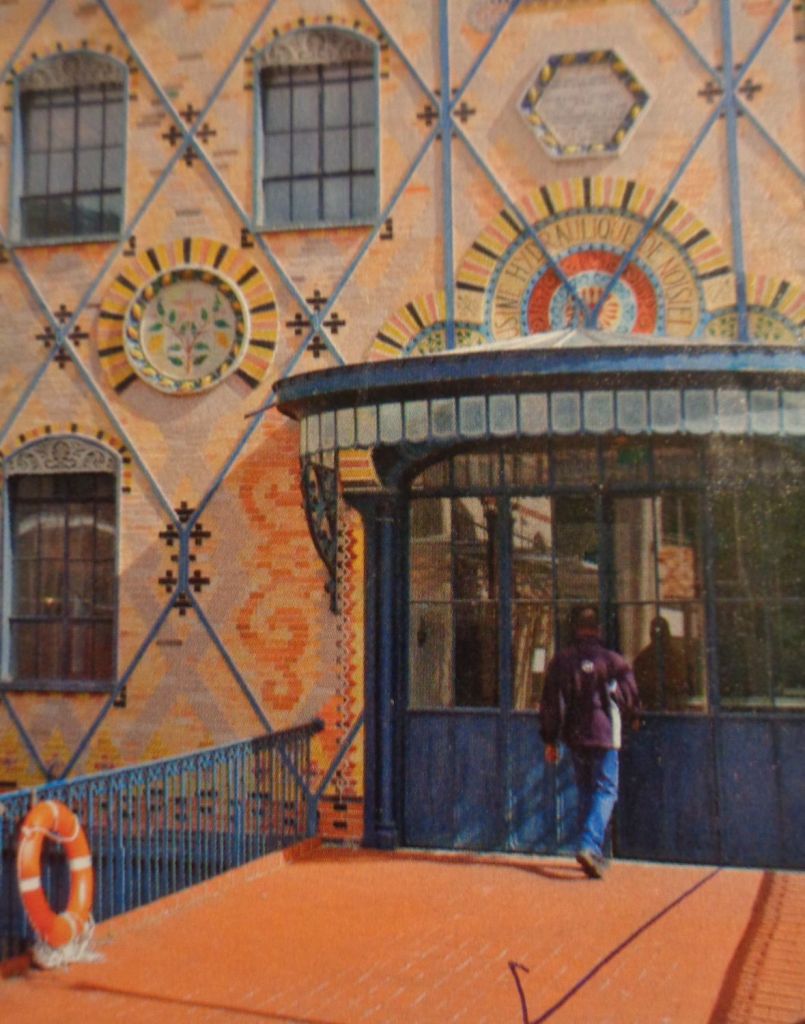
We came here, a must as my dear late wife Martine grandma Fourré who raised her, worked in the Menier chocolate factory for many years, Nowdays open only during European Heritage Days, the former Menier factory, headquarters of Nestlé France until 2020, comprises three buildings on its site: The Saulnier Mill, the first building with an exposed metal structure, was built between 1865 and 1872. It housed the cocoa bean grinding workshops. The “Eiffel Hall,” another metal-framed building constructed between 1882 and 1884, housed the refrigeration machines that maintained a temperature of 4°C to preserve chocolate in 4,800 m² of cellars. It is named for its resemblance to the structures of Gustave Eiffel. The Cathedral, built between 1906 and 1908, is one of the very first buildings constructed of reinforced concrete with a post-and-beam-slab structure. It was in this building that sugar and cocoa were mixed to make chocolate. The Hardi Bridge, which connects the cathedral to the courtyards on the other bank of the Marne, held a record span of 44.50 meters at the time.
The 14-hectare site also includes many other remarkable functional buildings: La Verrière, built between 1864 and 1866, housed the roasting workshop, the sugar and cocoa warehouses, and the bean sorting workshop. The roasting workshop was raised in 1923. The Patios, built between 1864 and 1867, housed the shaping, folding, packaging, and shipping workshops. The building opposite the cathedral, built between 1907 and 1913, was reserved for new packaging workshops capable of accommodating nearly 800 workers. The Confectionery: built between 1919 and 1923, it was the place where candies were made individually. The Colonnade, built between 1880 and 1887, allowed for the expansion of the cocoa and sugar warehouses. The Naves, built in 1885-1886, housed the metal workshop and the wood workshop, through which a railway line ran. The Arcade, built in 1889-1890, served as a carriage house and stables.
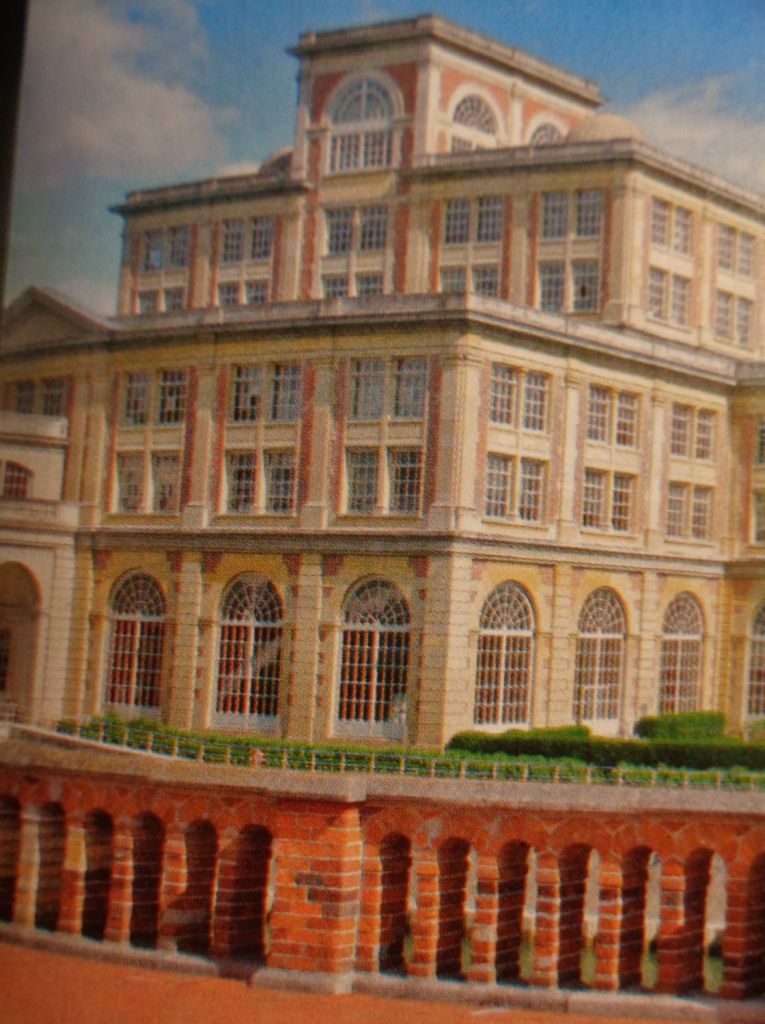
After WWII, unable to adapt, the company declined, facing competition from chocolate bars imported from the United States. With the death of Hubert Menier (Georges’ third child) in 1959, the struggling company was acquired by Cacao Barry. Antoine Menier, Hubert’s older brother and co-manager of the company since 1953, died childless in Paris on August 12, 1967, becoming the last of the Menier family to head the firm. The company was bought in 1965 by the Perrier group, then by Rowntree in 1975 and by Nestlé in 1988. Between 1996 and 2020, the Menier site, on the banks of the Marne, is the headquarters of the Nestlé division for France, A great company of many family stories, they have been largely recognised, In 1878 Menier won 7 gold medals in the World’s Fair in Paris for excellence of their products and the way in which they looked after the welfare of their employees. The factory in New York was constructed in 1891 on West Broadway and Leonard Street. At the 1893 World’s Fair in Chicago they were billed as the leading chocolate makers in the world. first company in 1929 to cover the roads and hour before the racers pass in the Tour De France with the distribution of paper hats and samples of their chocolate.The Menier Family left the management of the company in 1959 and also the city of Noisiel. By 1965 the Menier family held no interest in the company. The Menier factory in Noisiel was sold to Group Ufico-Perrier which became part of British confectioners Rowntree Mackintosh in 1971. In 1988 it was acquired by the Swiss food and drinks company Nestle. The main building at the Noisiel Factory
site was turned into Nestle France’s headquarters and other parts of the site have been turned into a chocolate museum, open to the general public. In 2004, the derelict Menier Chocolate Factory in Shoreditch, London reopened as a theater with café, bar and art space and can be visited. In 2014, the factory in Noisiel is listed as a UNESCO World Heritage site.
Other nice thing to see if more time is the Ferme du Buisson , whose buildings are those of the former farm purchased by the Menier family in 1879, boasts beautiful 19C architecture. It is now a national cultural center.The Romanesque-style Saint-Médard Church is located not far from the Menier housing estate. In 1856, the Duke of Lévis commissioned the construction of the current church. In 1879 the Menier family bought the castle and its park, already designed in the English style, the parc de Noisel. The confectionery building of the former Noisiel chocolate factory served as the location for the reconstruction of Rodin’s studio in the film about Camille Claudel. (1988 ) with Isabelle Adjani, Gérard Depardieu, and Laurent Grévill
A bit of history tell us that the first mention of Noisiel is in a text from 841 under the toponym Nucedo. A flour mill existed on the Marne river in Noisiel as early as the 11C. The medieval village grew up around it and not far from the first church of Saint-Médard. In the 15C, a river port existed within the town’s territory, focused on trade and the transport of timber to Paris. The Noisiel estate and its château were acquired by the Michel family in 1777. In 1825, the Parisian pharmacologist Antoine Brutus Menier decided to move his pharmaceutical factory, then located in the Marais quartier/neighborhood of Paris, to the banks of the Marne in Noisiel, where he rented a flour mill. From the pharmaceutical industry, the factory’s activity gradually shifted towards the chocolate market. In 1867, Émile-Justin Menier decided to refocus the factory on chocolate production. A dozen imposing machine buildings were constructed in a row along the Marne river. The construction led to the disappearance of the old village. It was between 1860 and 1874 that the factory took on its current appearance, symbolized by the central mill. The architecture was innovative: It was one of the first buildings to be constructed with a metal frame, which is still visible. It is therefore the ancestor of the skyscraper. From colored paper to wrap the tablets to crates for distribution, everything had to be manufactured on site to accelerate production. The cocoa enters at one end of the factory, is sorted in a warehouse, roasted in the next, mixed with sugar, heated, and then shaped into bars in other buildings, before being cooled in cold storage and exiting at the other end as bars. The chocolate factory buildings, including the very beautiful and colorful mill, had belonged to Nestlé since 1988, which had made it the headquarters of its French division.
The City of Noisiel on its heritage :https://www.ville-noisiel.fr/loisirs/patrimoine-et-tourisme/visites-de-noisiel/
The Saga Menier on the history of the family and the chocolate factory : https://www.saga-menier.fr/
The Seine et Marne dept 77 tourist office on the former Menier chocolate factory in Noisiel : https://www.tourisme-seine-et-marne.fr/en/explore-the-area/727473-old-menier-chocolate-factory/
The local Paris-Vallée de la Marne tourist office on the former Menier chocolate factory in Noisiel : https://www.tourisme-pvm.fr/en/apidae/fiche/727473/ancienne-chocolaterie-menier
The Île de France region tourist office on the former Menier chocolate factory in Noisiel : https://www.visitparisregion.com/en/the-former-menier-chocolate-factory-in-noisiel
There you go folks, a wonderful quant off the beaten path city of Noisiel ,but worth the detour, me think, To me it will always bring nice memories that will not go away, The memories will never be forgotten and my travels, and blog is a constant reminder of those beautiful wonderful times. This city was of family stories and anecdotes that will be kept forever in my heart and mind. Again, hope you enjoy this post on this is Noisiel !!! as I.
And remember, happy travels, good health, and many cheers to all !!!


