
This is a very memorable City for us going way back many years, My dear Mom Gladys told me about it and we came eventually and have ever since with the family. I am glad found me more pictures in my cd rom vaults that should be in my blog for you and me,The City of Calatayud is in the province of Zaragoza in the autonomous community of Aragon , and in the kingdom of Spain, Therefore, here is my take on the Church San Pedro de los Francos of Calatayud !!! Hope you enjoy the post as I.
The Church San Pedro de los Francos is a Gothic and Mudéjar style church. The church is located on Calle La Rúa, in the historic center of the city, but is only open to the public for certain events. The church was built after the Battle of Cutanda (1120), when, upon the entry of King Alfonso I the Battler into Calatayud, a contingent of Franks from Bigorre, under the command of the Count of Alperche, also entered the city. These Franks had supported the king in the Reconquista. As many of these Franks settled in Calatayud due to the advantages of its charter, the king commissioned the construction of the church as a token of gratitude for their service, as a place of devotion.
The current Church San Pedro de los Francos was built in the 14C, two centuries after the first foundation, and maintains a Mudéjar structure. It was after the battle of Cutanda in 1120 when a contingent of Frenchmen from Bigorra under the command of the Count Alperche who had aided King Alfonso “el Batallador” in his conquest, entered Calatayud. Since many of them remained to live in the city under the advantages of his concession, the King, in thanks for services rendered, founded a church dedicated to Saint Peter as their parish. It quickly became known as San Pedro de los Francos or Saint Peter of the Frenchmen, because of the origin of its parishioners.
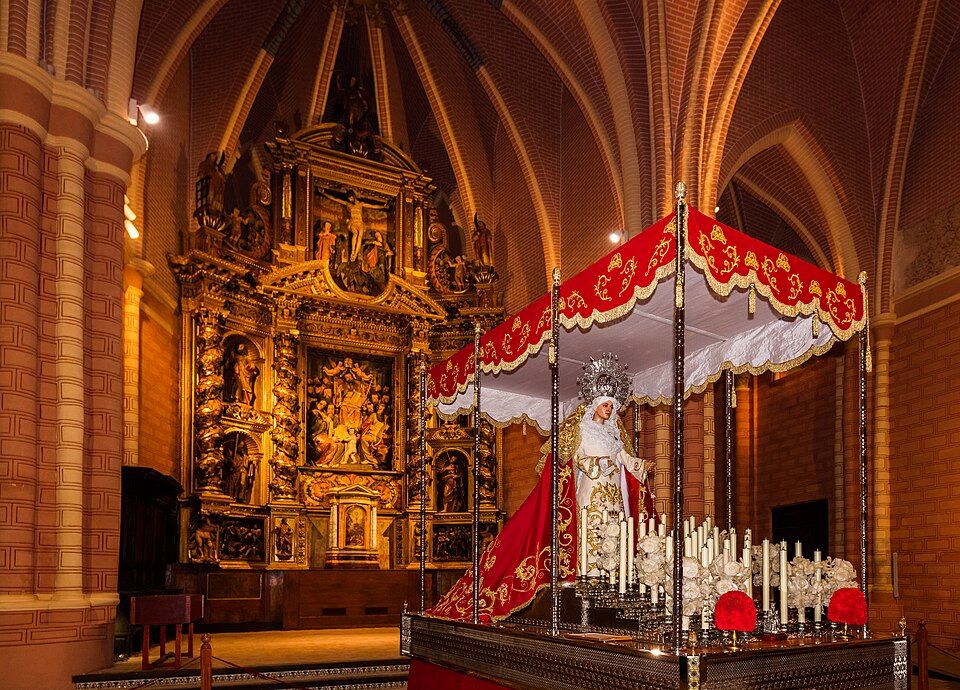
The main altarpiece, a sculpted work, is a Baroque piece from 1669. Dedicated to Saint Peter, it consists of a predella and three sections separated by Solomonic columns adorned with grapevines, the side sections resting on supporting angels. On the bench are reliefs depicting the Washing of the Feet and the Giving of the Keys to Saint Peter. In the central niche is Saint Peter enthroned. The central nave is almost twice as wide as the side aisles, and they are separated by clustered pillars whose section results from attaching half-columns to a square pillar at the center of its four sides and four smaller columns, like moldings, at the corners. The three naves have three bays each, and the three apses are polygonal with seven sides. The vaulting of the side apses is resolved with a double keystone, while the central apse has a single keystone.
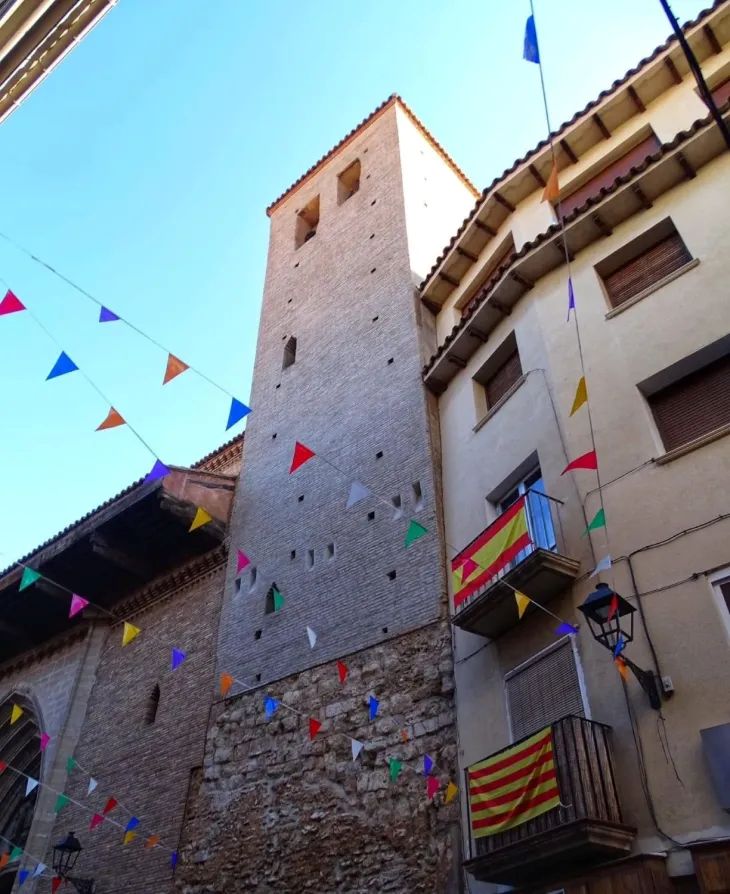
The square brick tower, also in the Mudéjar style and possibly built before the 14C, rises to the right of the main entrance at the foot of the church. Visitors can access this church on la Rua, which is near the center of town. It leans more than a meter and a half above the narrow street on which it stands. It is of the Almohad minaret type with a central pillar and stairs, and is covered with corbelled vaults. The bell tower was demolished in 1840 by the Calatayud City Council on the occasion of the visit of Queen Isabel II and her mother, the regent Maria Cristina, for fear that its inclination would frighten them, given that they stayed overnight in the palace located directly opposite. The four sides of the tower are undecorated and only have small windows to allow light to enter the stairwell.
The organ case, dating from the late 15C, is an extraordinary work of Mudéjar carpentry from Calatayud. Its decorative motifs are related to the plasterwork of the vault in the side chapel of Nuestra Señora de la Peña or Our Lady of the Rock. It may be connected to the presence in Calatayud of the organ builder Miguel de Monreal, active around 1498-1499, who, as documented, built an organ for the Colegiata de Santa María la Mayor (see post) as well.
Here in 1411, the parliament convened, with representatives from the three kingdoms, to resolve the succession issue arising from the death of King Martin I, which would later be settled in the Compromise of Caspe. In 1461, John II convened the Cortes in this church, and upon receiving news of the death of the Prince of Viana, Prince Ferdinand was sworn in as heir to the throne on October 11, 1461, after swearing allegiance to the Aragonese fueros (charters of rights and privileges). The Charter of Calatayud was also signed here in 1481 between the Catholic Monarchs and Ferdinand of Guanarteme, by which the Canary Islands were incorporated into the Crown of Castile.
The City of Calatayud on the Church San Pedro de los Francos :https://www.calatayud.es/turismo/ficha_visitar/san-pedro-de-los-francos
The Aragon region tourist office on the Church San Pedro de los Francos : https://www.turismodearagon.com/ficha/iglesia-y-torre-de-san-pedro-de-los-francos-calatayud/
The province of Zaragoza on Calatayud: https://www.turismodezaragoza.es/provincia/comarcas/comarca-calatayud.html
The Spain National Tourist Office on Calatayud: https://www.spain.info/en/destination/calatayud/
There you go another jewel in my memorable Calatayud, yes indeed. We shall meet again if you are going by Calatayud ,eventually, This is worth the detour, and we will, Again, hope you enjoy this post on the Church San Pedro de los Francos of Calatayud !!! as I
And remember, happy travels, good health, and many cheers to all !!!


