
This is a very memorable City for us going way back many years, My dear Mom Gladys told me about it and we came eventually and have ever since with the family. I am glad found me more pictures in my cd rom vaults that should be in my blog, Therefore, here is my take on curiosities of Calatayud, part I !!! Hope you enjoy the post as I.
The City of Calatayud is in the province of Zaragoza in the autonomous community of Aragon , and in the kingdom of Spain, It sits on the banks of the Jalon river. Wonderful Calatayud, full of nice memories needed to tell you more , gladly in my blog, for the souvenirs of always. You too will love if visit the city, and we will be back, eventually, The City is 88 km from Zaragoza, and Molina de Aragon, 145 km from Teruel, 268 km from Cuenca, and 232 km from Madrid, We have come down from France or going back several times over the years,
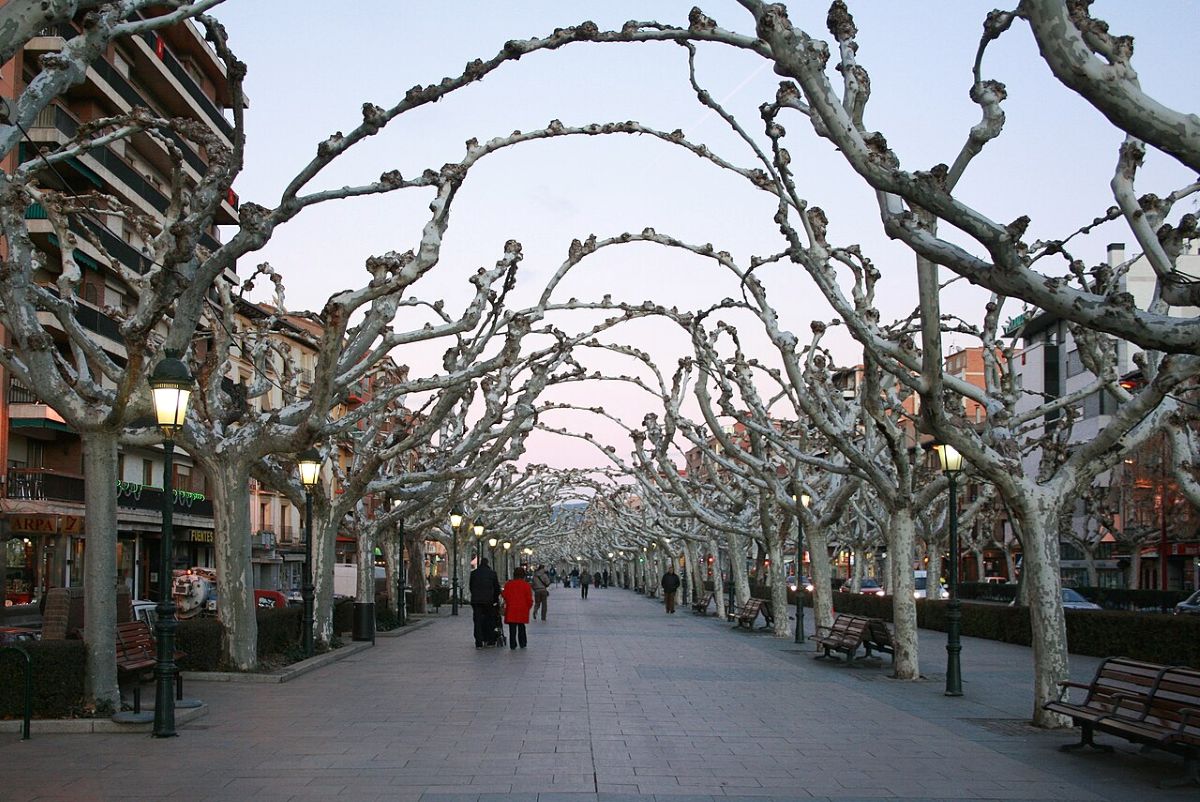
The Paseo Cortes de Aragón is flanked on both sides by over 200 plane trees, some reaching 16 meters in height. Their branches intertwine, forming a vaulted canopy that provides ample shade during the summer months. This makes it a popular spot for strolling and socializing, with numerous restaurants and bars offering a wide variety of tapas on their terraces. The promenade also encompasses one of Calatayud’s largest and most diverse shopping areas. Originally, this promenade ran parallel to the city wall that enclosed Calatayud from the Puerta de Alcántara to the Torre de la Oveja, hence its initial name, Paseo del Muro (Wall Promenade). When the Madrid-Zaragoza A23 highway was built, it became known as Paseo de Zaragoza. Following political changes, it would be called Paseo del Marqués de Linares, Paseo Alcalá Zamora, Paseo Calvo Sotelo and the current Paseo Cortes de Aragón.
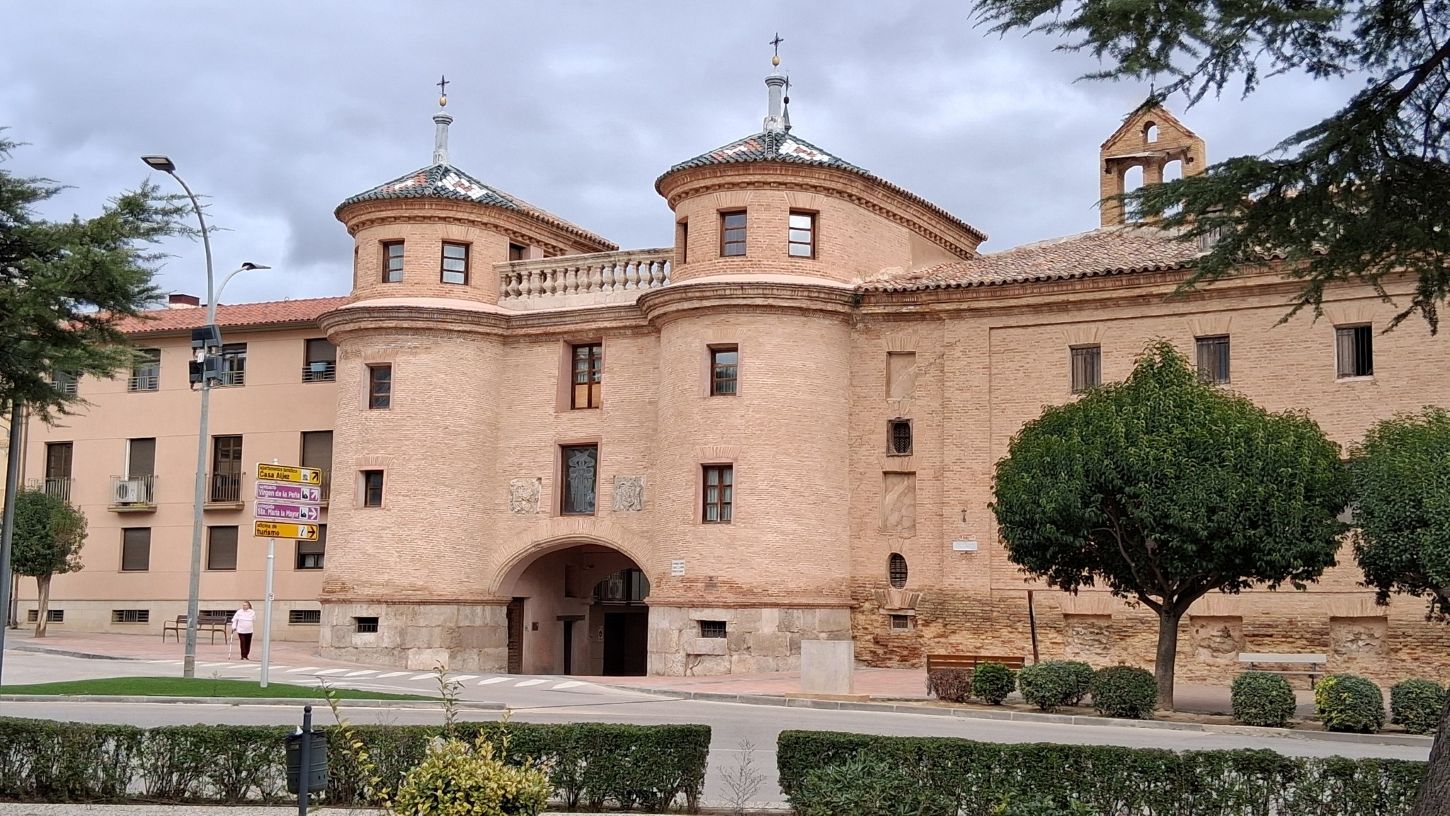
The Puerta de Terrer, or Terrer Gate, formerly known as the Matador Gate, is a late Renaissance construction, dating from after 1580. It consists of two semi-cylindrical towers, built of brick and topped with conical spires. A segmental arch connects the two towers, upon which rested the city’s angel, which disappeared in the second half of the last century, and in whose place a balcony now opens. On either side of the balcony are a coat of arms with the arms of the city of Calatayud and another with those of the Habsburgs. The construction of most of this urban defensive system is documented in 862, during the emirate of Muhammad I, making it the oldest preserved medieval system on the Iberian Peninsula ! It comprises five castles linked by long stretches of walls with towers. The five castles are: Castillo Mayor or “Castillo de Ayub”, Castillo de la Torre Mocha, Castillo de la Peña, de Doña Martina and del Reloj or Real with a large bell is rung on the two Patron Saint Festivals of San Iñigo and Virgen de la Peña.
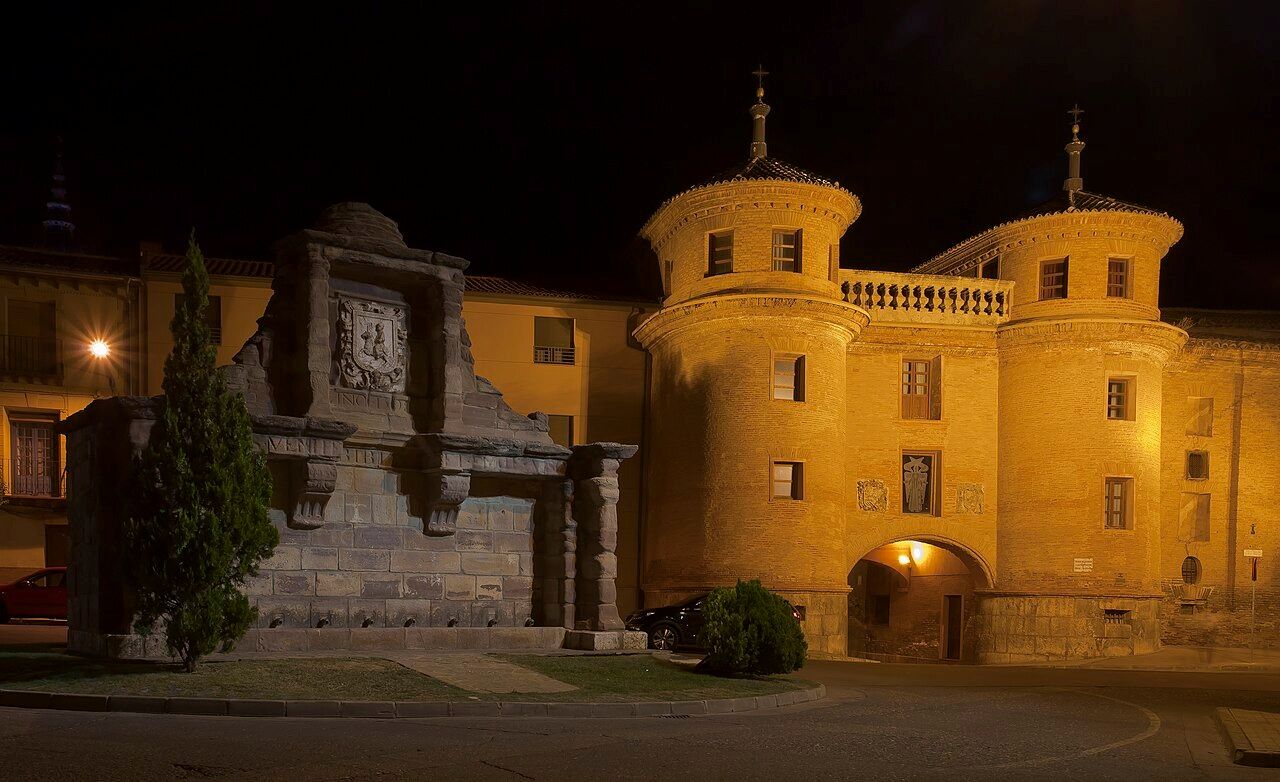
The Fuente de los Ocho Caños architectural ensemble dates from 1598 and is artistically Mannerist in style. Remarkably austere, it is divided into two sections, with an entablature whose frieze bears an inscription that is a variant of a verse from Isaiah. The upper section features an alabaster coat of arms of Calatayud, depicting a horseman facing forward, carrying a banner. A simple convex finial crowns the structure. Initially, it had an angled plan, leaving two spouts towards the Paracuellos road reserved for the city’s executioner and infamous people, and this part disappeared when the Sagunto-Burgos road was raised, leaving the main front slightly modified, which resulted in the loss of one spout, the irregular distribution of the remaining eight, and alteration of the inscription on the frieze, dismantled in 1969. This fountain was moved next to the Puerta de Terrer gate (see above and pic), on the puente seco or dry bridge. Calatayud decided to bring water from the meadows of the Cifuentes district and build a monumental fountain on the right bank of the Jalón river, near the Alcántara Gate, on the road to Valencia. The water supply for this fountain was confirmed by a papal bull from Pope Innocent VIII, along with improvements to the city’s defenses, on May 13, 1491. This fountain was popularly known as the fuente de los once caños or ountain of the eleven spouts or also, ten spouts
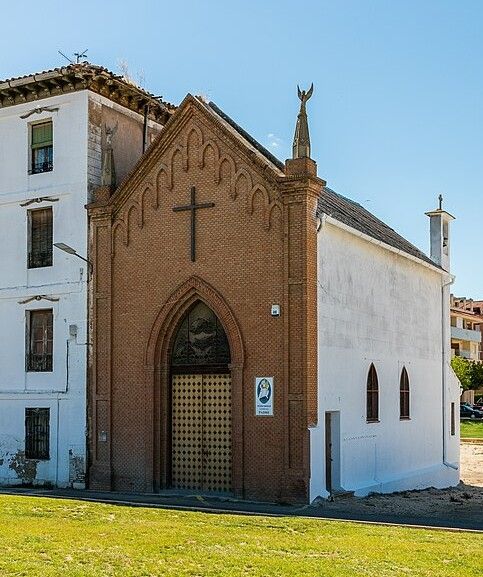
The Capilla de la Virgen del Carmen is owned by the Church of San Juan el Real (see post), it is the chapel in the area popularly known as the Station or Carmen neighborhood. Built in the late 19C early 20C, it is dedicated to Our Lady of Mount Carmel, although it may have originally been dedicated to the Sacred Heart of Jesus. It is attached to one of the houses in the neighborhood and faces the train station. It is a Neo-Gothic chapel with a brick facade flanked by pilasters topped with sculptures of angels. The entrance is at the foot of the church, with a pointed archway, and in the tympanum, a stained-glass window in the Venetian style; above the arch is a crucifix and it has a studded door with a wooden lintel. It has a rectangular floor plan, a single nave, several modern carvings in niches and shelves, including a Virgin of Carmen.
The city of Calatayud on the old town: https://www.calatayud.es/turismo/ficha_visitar/casco-historico-de-calatayud
The province of Zaragoza on Calatayud: https://www.turismodezaragoza.es/provincia/comarcas/comarca-calatayud.html
The Aragon region tourist office on Calatayud : https://www.turismodearagon.com/en/ficha/calatayud/
The Spain National Tourist Office on Calatayud: https://www.spain.info/en/destination/calatayud/
There you go another jewel in my memorable Calatayud, yes indeed. We shall meet again if you are going by Calatayud ,eventually, This is worth the detour, me think, Again, hope you enjoy this post on curiosities of Calatayud, part I !!! as I
And remember, happy travels, good health, and many cheers to all !!!


