
This is a very memorable City for us going way back many years, My dear Mom Gladys told me about it and we came eventually and have ever since with the family. I am glad found me more pictures in my cd rom vaults that should be in my blog for you and me,The City of Calatayud is in the province of Zaragoza in the autonomous community of Aragon , and in the kingdom of Spain, Therefore, here is my take on the Church San Juan el Real of Calatayud !!! Hope you enjoy the post as I.
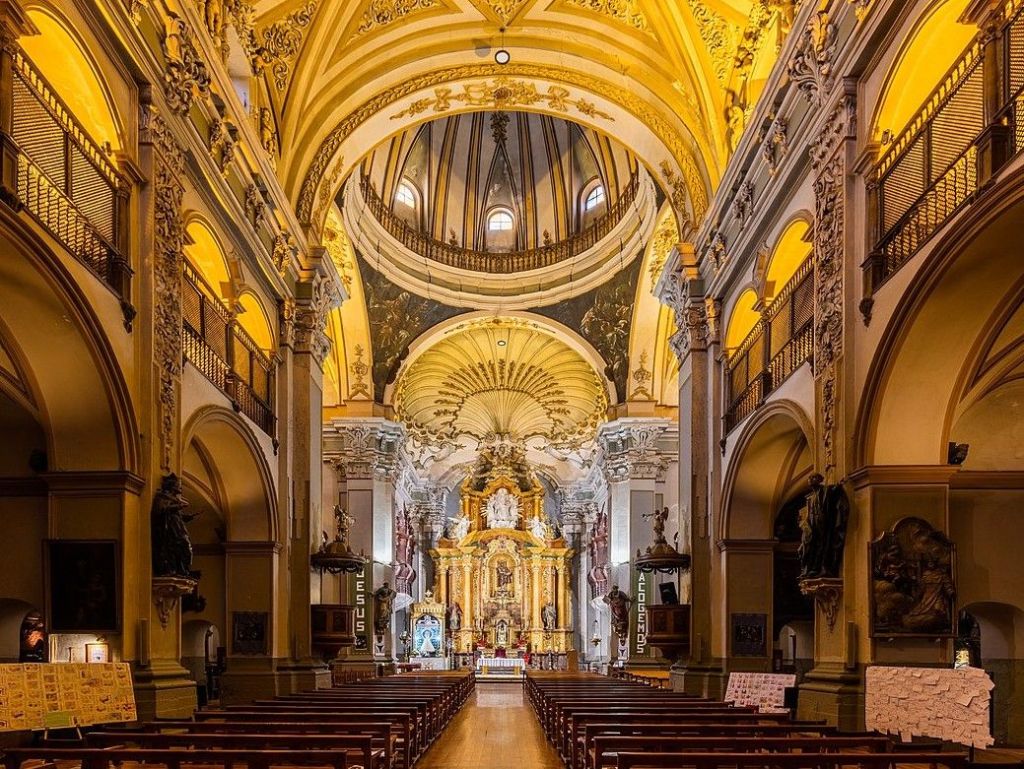
The Church San Juan el Real was built in the Baroque style during the 17C and 18C, this church, before becoming a parish church, was the church of the former Jesuit College. Its most valuable heritage comprises the oil paintings that cover the four pendentives beneath the central dome and the panels on the doors of a reliquary cabinet located in thevvSala Capitular or Chapter House. These works are attributed to a young Francisco de Goya, an attribution not universally accepted by experts. The Society of Jesus established itself in Calatayud at the end of the 16C, founding a college.
The Renaissance portal on the main façade likely comes from an earlier church. In the shape of a Latin cross, the building consists of a large nave flanked by two side aisles containing chapels surmounted by a gallery opening onto the central nave, a transept, and a rectangular chancel ending in a straight apse and covered by a vault in the shape of a scallop shell. The crossing of the transept is covered by an octagonal dome with a lantern, supported by pendentives. These pendentives feature four canvas paintings depicting the Church Fathers, Saint Augustine and Saint Ambrose, bishops; Saint Jerome, cardinal; and Saint Gregory, pope. Goya painted them at the young age of 20, in 1766, after training at the Zaragoza Academy of Drawing.
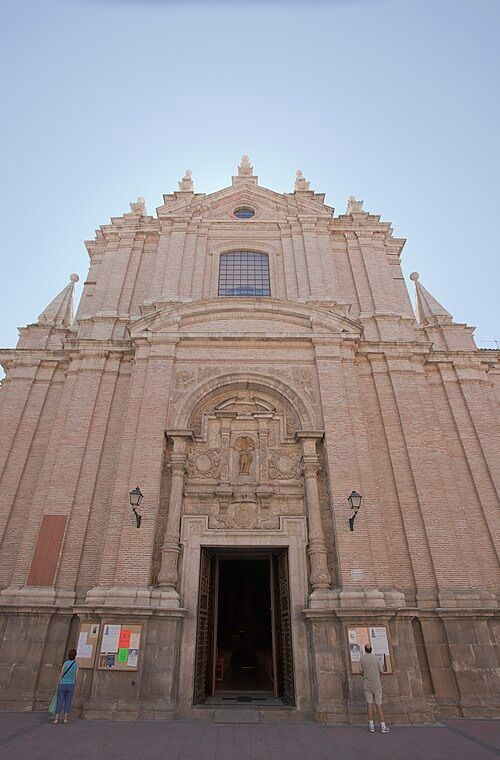
The tower located near the chancel was built in 1775 in the Mudéjar style prevalent in the old town. Its four stories are topped by a Baroque onion dome. Another work attributed to Goya can be seen in the church museum. These are two canvases covering the doors of a reliquary cabinet. What is truly the most interesting feature of the Church San Juan el Real is the magnificent presbytery bench made of carved wood, made for the priest, deacon and subdeacon, which came from the destroyed church of San Juan de Vallupié, and is now in its parish museum. Although it is a Gothic work in form, since the tracery of the motifs that decorate the three chair backs reflects the flamboyant Gothic style, with nothing Islamic about it, it is considered a Mudéjar piece because it was made by Moorish masters. The current organ, located in the gallery above the main portal, impresses with its size and the richness of its decoration and gilding. Its origins are unknown; but this spectacular organ came from the Church San Saturnino in Pamplona and was placed in this location in 1910. At the end of the 20C, its trumpet pipes were completely rebuilt.
A small parish museum occupies the space encompassing the sacristy, the chapter house, and their access points. The sacristy, divided into three sections by mixtilinear arches, is a very interesting ensemble, both for the woodwork of its furniture and doors and for the decoration and works of art it contains. Of particular note are the elaborate Baroque walnut inlaid cabinetry from the 17C, intended for storing liturgical vestments and ornaments; cabinets with paintings of the four archangels (Michael, Gabriel, Raphael, and Uriel); and sculptures of the Jesuit saints Ignatius of Loyola, Francis Xavier, and Francis Borgia, plus one of Saint Peter. The vestibule connecting the Sacristy and the Chapter House features walnut doors with reliefs alluding to the Virgin Mary. Here hangs a 16C canvas, a gift from a parish almoner, depicting Our Lady of the People. In the Chapter House, one can see the aforementioned reliquary cabinet, as well as canvases from the Italian and Spanish schools dating from the 16C to the 18C, two reliquaries from the Parish Church of Sediles, liturgical silverware, and, from the former parish church of San Juan de Vallupié, a Gothic seat for the officiants’ vestments, a 15C Mudéjar work by the Farax and Brahem brothers, nicknamed the Rubio brothers , plus a 16C polychrome wooden carving of Saint John the Baptist.
In the following century, the Jesuits built a sumptuous church dedicated to the Virgen del Pilar or Our Lady of the Pillar in the Baroque style of the period. After the expulsion of the Jesuits from Spain in 1767, and shortly after Goya’s alleged artistic collaborations, the church became a parish church, relocating the old parish of San Juan de Vallupié, in 1769 whose medieval church was in danger of collapse. Requested at the time the transfer of the Jewish church to translate all the cult of the clausured parish, and in May of 1770, the Church of the Pilar was sheltered from new worship under the advocación of San Juan el Real. In 1771 it adopted the definitive name of San Juan el Real. In 1999 a small parish museum was opened, housed in the sacristy, the chapter house and the access areas to them.
The Company of Jesus established itself in Calatayud in 1584, concretely on the 1st of October, when its education center was solemnly inaugurated. They remained in the city until Carlos III decreed their expulsion from Spain in 1767.
The City of Calatayud on the Church San Juan el Real : https://www.calatayud.es/turismo/ficha_visitar/iglesia-de-san-juan-el-real
The province of Zaragoza on Calatayud: https://www.turismodezaragoza.es/provincia/comarcas/comarca-calatayud.html
The Aragon region tourist office on the Church San Juan el Real : https://www.turismodearagon.com/ficha/iglesia-de-san-juan-el-real-calatayud/
The Spain National Tourist Office on Calatayud: https://www.spain.info/en/destination/calatayud/
There you go another jewel in my memorable Calatayud, yes indeed. We shall meet again if you are going by Calatayud ,eventually, This is worth the detour, and we will, Again, hope you enjoy this post on the Church San Juan el Real of Calatayud !!! as I
And remember, happy travels, good health, and many cheers to all !!!


