
Well when you are on the road as I am still get to see lots of towns villages, cities all over my belle France. Some I stayed, others passed by and others come back. The case is while getting on my way to see the castles of the Loire valley, and going to see Loches (see post), The village of Montrésor is in the Indre-et-Loire department no 37 in the Centre-Val de Loire region of my belle France. I stumbled upon Montrésor or my treasure! This is one that is must to see , aren’t they all,,,,Therefore, let me tell you of the Château of Montrésor !!! Hope you enjoy the post as I.
The village of Montrésor is 17 km from Loches, 25 km from Montrichard Val de Cher, 33 km from Valencçay ,397 km from my current home, As said we came from Loches on our way home we left by Rue Saint Jacques on roundabout bear right onto the D764 road to 2nd roundabout on rue des Ees bear right connect with the D760 road dir Montrésor go into town on the Grande Rue and left turn into Rue de Château and the castle
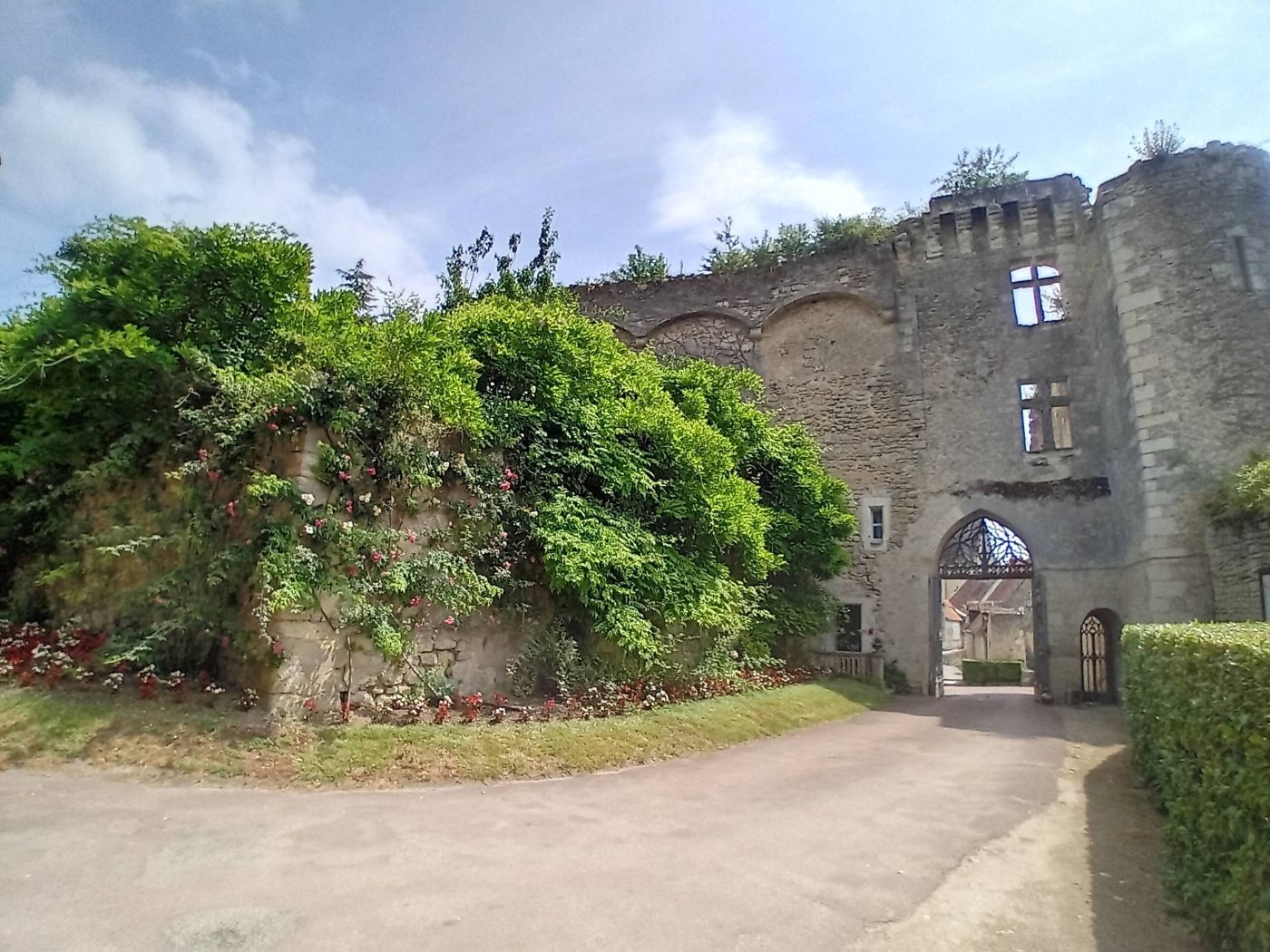
The story of the Château de Montrésor goes that at the very beginning of the 11C, the keep of Fulk Nerra was a polygonal building of approximately 11 × 7 meters, the south face of which was buttressed by a smaller tower 6 × 4 meters. All that remains of this entire complex,the site and overlooking the tip of the spur, is a section of the west wall of the keep, approximately 4 meters long and 5 meters high, built of irregular medium-sized stones and altered since its construction. The only access to the site, at the extreme east, is through the old gatehouse-keep built in the 12C and altered at the end of the 14C. To this access system, a drawbridge, replaced by a fixed wooden bridge over moats now filled in, controlled the whole and another drawbridge rebuilt in stone under the name of Pont Bouvet completed the defenses at about 60 meters. The double enclosure is well preserved over almost its entire perimeter. The 12C inner wall, which enclosed the entire site, still bears the corbelled arcades that supported the wall-walk, as well as, in places, the succession of crenellations and merlons. The 14C wall was built outside the inner wall and reinforced the defenses on the north and east sides, the most vulnerable. Lower than the inner wall, it features three towers on the north side, on whose platforms bombards could be mounted. While the 12C wall abutted the walls of Fulk Nerra’s keep to the west, the 14C wall bypasses it on the outside.
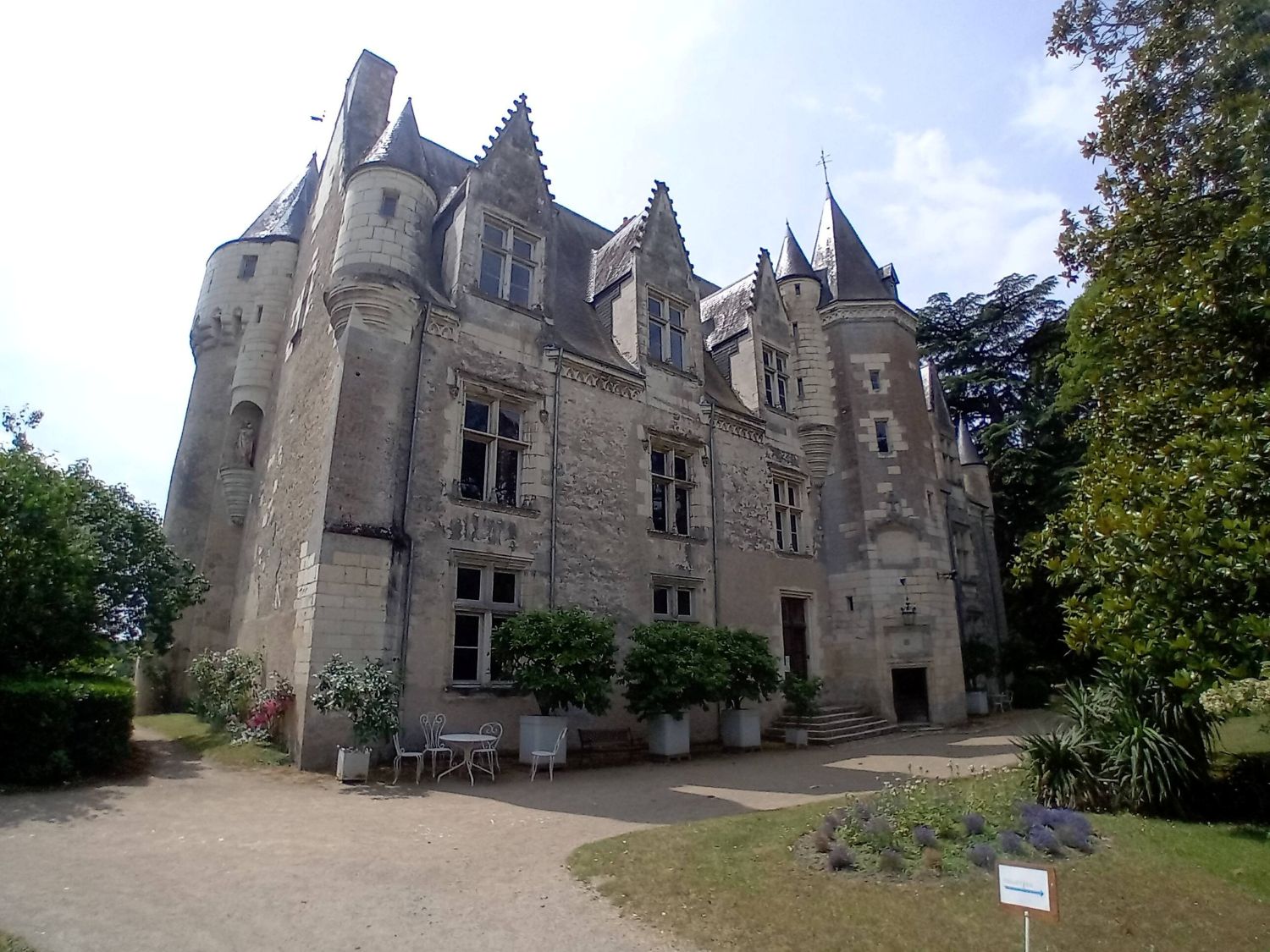
The 16C manor house consists of a rectangular main building flanked at each corner of its south façade by a conical turret; the north façade is adorned, in place of turrets, with two corbelled watchtowers resting on corbels; all four turrets are topped with conical roofs. With two stories, the second of which is a mansard roof, the building features, on both the north and south sides, five rows of windows and five dormer windows illuminating the attic. While the western section dates from the 7C, the eastern section, in ruins at the very beginning of the 19C, was rebuilt before the middle of the century without any break in architectural style, and the entire complex was then remodeled after the château was purchased by Xavier Branicki. The main logis or living quarters houses paintings by masters, particularly by Tony Robert-Fleury; portraits including one by Winterhalter, and finally a treasure from Poland ;silver goblets that belonged to Sigismund II, King of Poland, and a large gold repoussé dish recalling by its figures in relief the victory of Sobieski over the Turks, offered to the victorious Pole during his triumphal entry into Vienna. The Renaissance castle was refurnished in the middle of the 19C and no modifications have been made to it since. While Second Empire style furniture dominates, with for example ebony chests of drawers inspired by André-Charles Boulle, Italian Renaissance furniture is also present, such as a hidden sideboard that belonged to the Medici family. King John Sobieski of Poland played a decisive role in the victory alongside the Austrians against the Turks who were besieging Vienna in 1683. In gratitude, the city of Vienna offered him pieces of very valuable tableware and silverware, which Xavier Branicki was able to recover and bring back to Montrésor. These pieces, along with others such as a 10 kg gold dish, archaeological remains found during the work on the castle or brought back from Egypt, Murano crystals from the 18C and 19C, trinkets taken from the Turks after the Battle of Vienna, constitute a veritable treasure. Among the many works of art are paintings by the Italian primitives such as The Crossing of the Red Sea, by Filippino Lippi, portraits of members of the Branicki family, including several executed by Franz Xaver Winterhalter, a painting by Veronese won in a game of cards against Prince Jérôme Bonaparte or a charcoal drawing by Artur Grottger, The Genius of Music (1860); bas-reliefs in oak carved by Pierre Vaneau also evoke the story of Jean Sobieski. The history of Poland is of course represented, with Warsaw, April 8, 1861, a painting by Tony Robert-Fleury. Numerous European, Asian, and African hunting trophies, as well as collections of edged weapons and firearms, adorn the walls, testifying to Xavier Branicki’s passion in this area.

The castle’s outbuildings are built against the northern part of the enclosure. The eastern section of the castle, constructed under Jean IV de Bueil as a lord’s residence, dates from the 14C, but the upper floor was remodeled by Xavier Branicki. This part of the building retains traces of the fortress’s defensive purpose: the attic contains remains of the old wall-walk, and the north-facing windows are few and narrow. The ground floor consists mainly of rooms used for agricultural purposes, a barn, and a wine press. The upper floor is accessed by a stair tower opening onto the inner courtyard. The western section, entirely rebuilt in the 19C, is divided into three floors including mansard roofs to house Xavier Branicki’s guests; the doors of the numerous rooms are even numbered. The mullioned windows, on the south side but especially on the north, are much wider than in the medieval structure. Further west, an orangery adjoining the outbuildings also dates from the 19C.
In addition to an orangery added as an extension of the outbuildings to the east, the park was completely redesigned and redeveloped in the second half of the 19C and planted with exotic species; it also contains two works by famous sculptors: The Fallen Angel by Costantino Corti (1869) and, more symbolically, a copy of the statue The Dying Soldier by Jules Franceschi (1862), which, in the Montmartre cemetery, decorates the tomb of Mieczysław Kamieński.
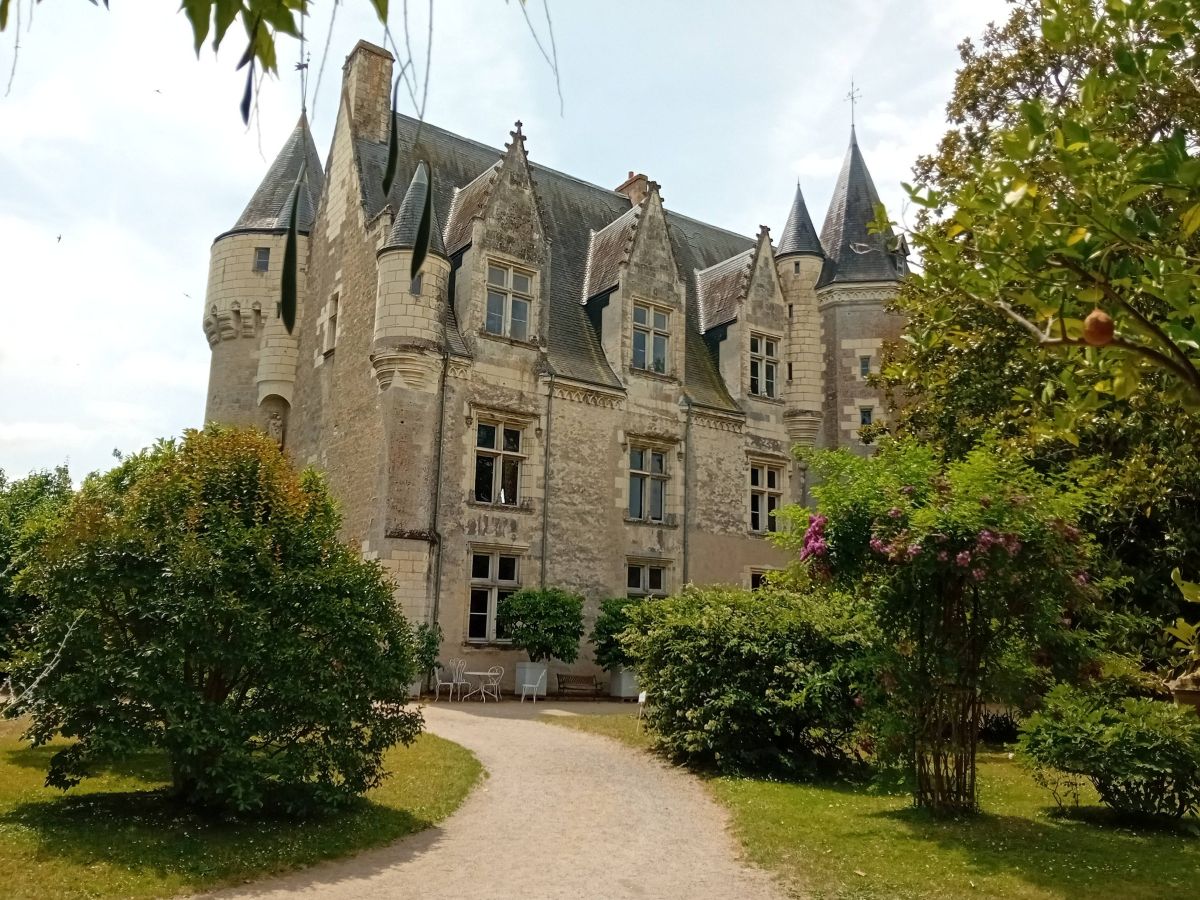
A bit of history on the Château of Montrésor I like tell us that in a rocky spur successively housed a keep attributed to Fulk Nerra and integrated into the defensive system of the Counts of Anjou in Touraine, a medieval fortress built by Jean IV de Bueil, Grand Master of the Crossbowmen, and then a Renaissance residence erected by Imbert de Batarnay, an influential figure to four kings of France. After the French revolution, during which the poorly maintained castle passed through the hands of several successive owners, Count Xavier Branicki, a Polish émigré, patron of the arts, and mayor of Montrésor from 1860 to 1870, bought back the estate in 1849, repaired some parts of the castle, and rebuilt others; he furnished the main residence in the Second Empire style and decorated it with numerous works of art. His family, still the owners, lives in part of a castle almost entirely open to the public. The village itself, initially built at the foot of the castle, only truly developed from the Middle Ages onwards; in the 21C, it has turned to tourism, with the castle as one of its main attractions.
The Château of Montrésor situated on a terrace at an altitude of 106 meters, the castle site overlooks the Indrois valley by about 15 meters. The plateau has been excavated to a depth of approximately 10 meters to create a defensive dry moat. The natural tip of the spur completes the defended perimeter. Its history is largely intertwined with that of its castle, built at the beginning of the 11C at the end of a rocky outcrop overlooking the Indrois valley and rebuilt or remodeled several times since. The first lord of Montrésor mentioned, but whose name is unknown, participated in 887 in the escort who accompanied the relics of Saint Martin from Auxerre to Tours. From this period, the presence of a dwelling at the tip of the spur, protected to the north by a moat and an earthen palisade, is mentioned. The fief of Montrésor then fell under the jurisdiction of the treasurer of the chapter of Tours Cathedral, dedicated at that time to Saint Maurice of Agaune, hence its name, attested in the 9C, of “Mons Thesauri” in the Chronicle of the Counts of Anjou. A rocky spur overlooking the Indrois valley was the site chosen by Fulk Nerra, Count of Anjou, to have his captain Roger, known as the Little Devil, build a powerful fortress around 1005, not far from that of Montrichard, which he also controlled. In the 12C, Montrésor fell into the hands of Henry II Plantagenet. It is likely that, since Fulk Nerra, Montrésor always remained under the control of the Counts of Anjou , Henry II was a direct descendant of Fulk Nerra in the 5th generation. Philip Augustus temporarily recaptured Montrésor from the English in 1188, but the fief remained an English possession with Andrew I of Chauvigny of Châteauroux a companion of Richard the Lionheart during the Third Crusade, who became Lord of Montrésor after his return (he would rally to the Capetian king Philip Augustus in 1200. It was only at the beginning of the 13C, with the Palluau family, that Montrésor definitively returned to the allegiance of the French crown. It then passed to Antoine de Bueil, who had to part with it definitively in 1491. There was also an initial transfer in 1451/1452 to the Villequier family, more precisely to André de Villequier of La Guerche-en-Touraine. It was in the 1490s that an important chapter in the history of the Château de Montrésor came to a close. Antoine de Villequier de St-Sauveur bought back the castle in 1491. He undertook the construction of a new residence at Montrésor, in a typically Renaissance style, while the old fortified castle near the entrance fell into ruin. However, no significant architectural modifications appear to have taken place until 1789. The fact that, after Francis I and the last Valois kings, the kings of France resided less regularly in the Loire Valley likely led the lords of Montrésor to neglect their castle.
The events that marked life in Montrésor during the French revolution are poorly documented. At the beginning of the 19C, the gatehouse served temporarily as a prison. In 1849, the Polish Countess Rose Potocki purchased the Montrésor estate and the château, which was in a state of complete disrepair, on behalf of her eldest son, Xavier, who, due to his opposition to Russian hegemony over Poland, had his property seized by Nicholas I and had chosen exile. The western part of the outbuildings was rebuilt; in the 21C, it served as the residence of the château’s owners. The main house was completely restored, including its dilapidated roof, and furnished. All the buildings and the surrounding grounds underwent essential repairs, a terrace was built along the south façade of the main house, and the park was entirely redesigned. A new pavilion, at the far west of the enclosure, is built against a preserved wall of Fulk Nerra’s keep. During WWII, Auxiliary Hospital 25 was set up in part of the castle, allowing it to accommodate up to 32 wounded soldiers. After the end of the WWII, and for about a week in early November 1945, a squadron of the 19th Dragoon Regiment was quartered in the castle.
The official Château de Montrésor :https://chateaudemontresor.com/
The town of Montrésor on its heritage : https://www.montresor.fr/decouvrir/que-voir/
The Touraine Valley local tourist office on Montrésor : https://www.tourainevaldeloire.com/en/discover/towns-and-villages/the-most-beautiful-villages-in-france/montresor/
The local South of Touraine tourist office on the castle : https://www.sudvaldeloire.co.uk/offers/chateau-de-montresor-montresor-en-2608534/
The most beautiful villages of France on Montrésor : https://www.les-plus-beaux-villages-de-france.org/fr/nos-villages/montresor/
There you go folks, a nice find, and will be back as said. Another nice castle in the immense répertoire of the Loire Valley. Again, hope you enjoy the post on the Château of Montrésor !!! as I
And remember, happy travels, good health, and many cheers to all !!!


