
Here is another wonderful off the beaten path road warrior trails in my belle France, As close to family had the opportunity to spread my wings on several villages in the Nord. Bouvines is worth the detour for its history especially ; we were passing and glad we did. I again found me pictures in my cd rom vault that should be in my blog for you and me. Therefore, let me tell you on this is Bouvines !!! Hope you enjoy the post as I
The village of Bouvines is located in the Nord department no 59 , in the Hauts-de-France region of my belle France. It is part of the European Metropolis of Lille, The village is 13 km from Lille, 69 km from Cambrai, 83 km from Caudry, 53 km from Arras, 26 km from Tournai, Belgium, We came on our road warrior trails from family home in Caudry going out of town on Rue de la République left for a short stay on the D643 road quickly right onto the Rue de Bévillers or D16A road continue past the village of Bévillers where it becomes the rue du Calvaire or D74 road continue just before entering Avesnes les Aubert turn left onto the Route National or D942 then turn right onto the Rue de Boussiéres or D970 road continue past City center Rieux en Cambresis continue on the D118 road continue to next village of Iwuy and go thru City center out on the D630 road continue to connect with the A2 autoroute by exit/sortie 15 dir Hordan continue by Douchy les Mines continue bordering Pouvy continue to exit to the A23 autoroute dir Lille continue past Hasnon, Orchies, continue to exit/sortie 2a dir Grand Stade go by Luzennes dir Lesquin the bear right onto the M146 road or Rue de Lille continue to Bouvines on the Rue Félix Dehau or D955 road to the church,
The Church Saint Pierre, was built between 1880 and 1885. In 1878, the parish council decided to rebuild the village church, which everyone considered too old and too small. This new sanctuary was also intended to be the memorial to the Battle of Bouvines (1214), Construction began in 1880 and was completed in 1886. The church was commissioned and drew inspiration from 13C architecture to design a neo-Gothic building without pillars, The church was consecrated by the Archbishop of Cambrai on July 25, 1910.
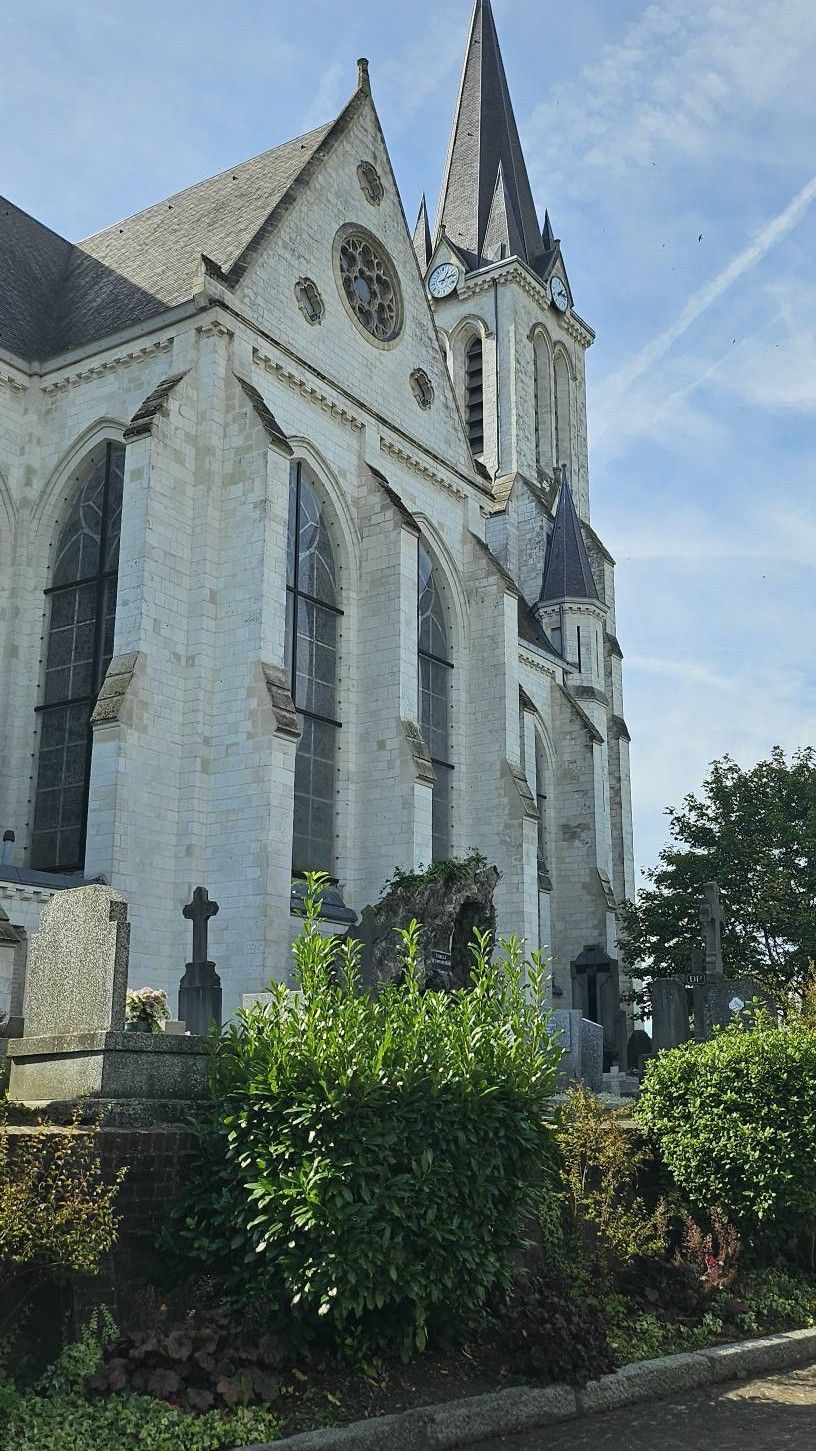
The Church Saint Pierre was designed to showcase the 21 immense stained-glass windows depicting the battle.The first stained-glass window was installed in 1889, the last in 1906. They were restored around 1990. Each stained-glass window is composed of three parts: the upper part contains medallions painted with angels, the lower part contains the coats of arms of the donors who contributed to its financing, and the central part illustrates a moment from the Battle of Bouvines according to the chronicle of William the Breton, chaplain to King Philip Augustus.
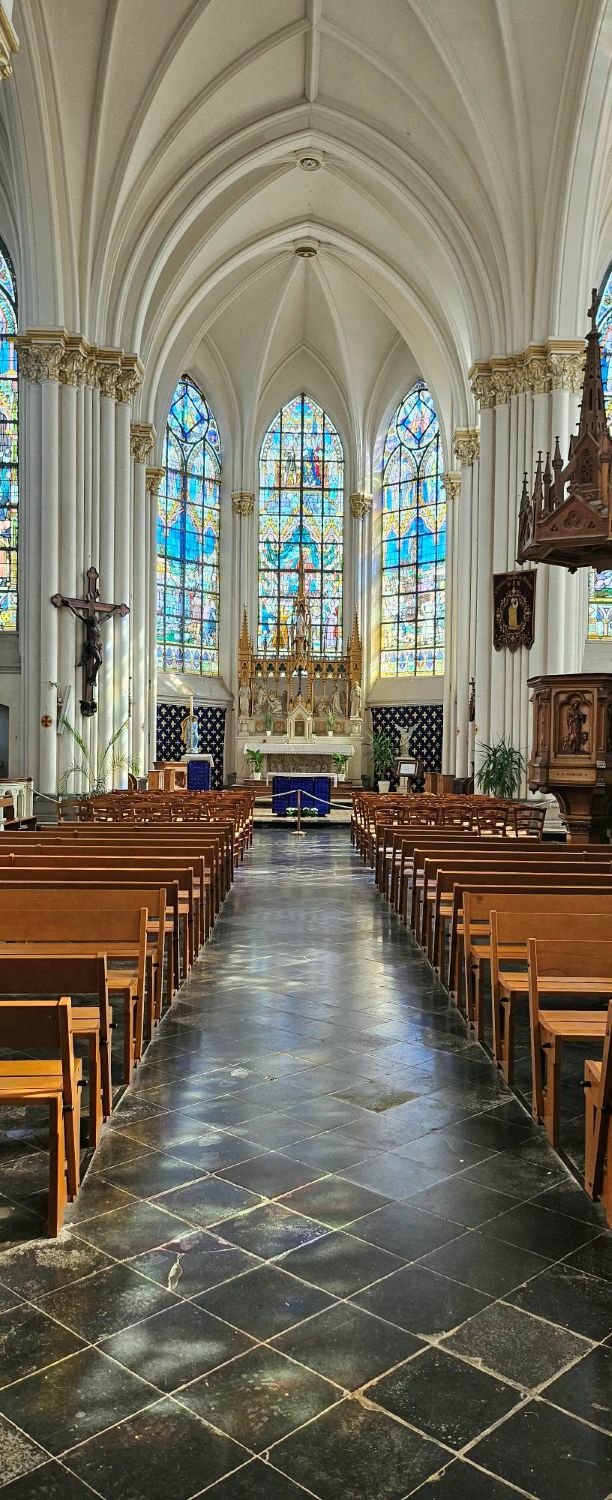
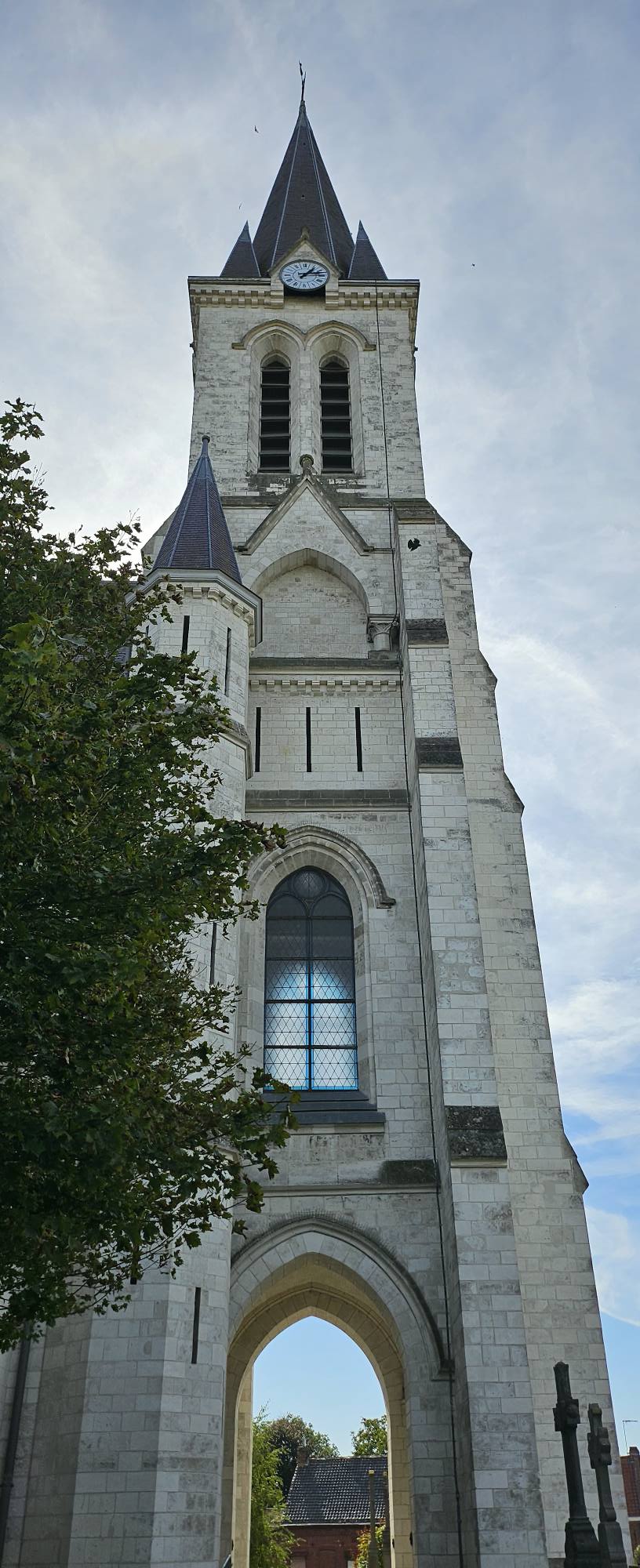
The Church Saint Pierre has a single nave in the shape of an oriented Latin cross, preceded by a tower with a spire above the porch, and a chancel closed by a three-sided apse. The church tower, with a total height from the ground to the rooster, is 52 meters. It is a quadrangular bell tower flanked by two hexagonal turrets, surmounted by an 18-meter-high timber spire covered in slate. A four-faced clock was installed in 1907.
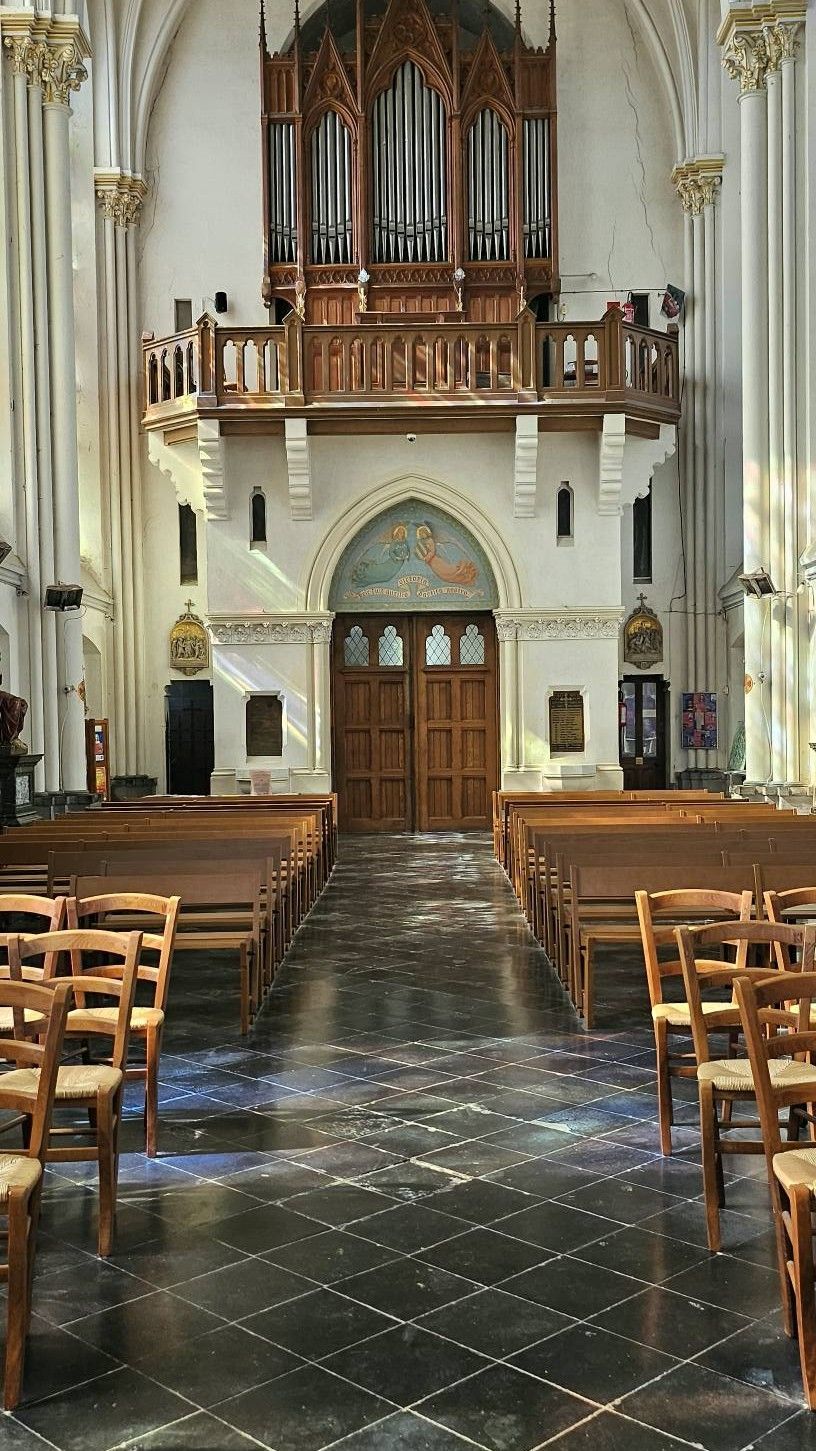
In a niche in the south transept: a reproduction of the statue of Saint Cecilia, Virgin Martyr, patron saint of musicians and embroiderers. Two arcosolia at the side altars: relics of young martyrs under Diocletian, brought from the Roman catacombs in 1903. South transept: Saint Fulgentius. North transept: Saint Saturnina. Opposite them are statues of Our Lady of the Treille and Saint Peter. The church has an organ in excellent condition, dated from 1906 ; highly regarded by organists in the region.
Other things to see here are the Saint-Pierre fountain ,where Philip Augustus is said to have rested before the battle. The obelisk commemorating the Battle of Bouvines, erected in 1865.
A bit of history I like tell us that a diploma from 899 of Charles the Bald mentions a place called Bovingole, while the charter of the Count of Flanders in 1002 refers to Villa bovinas. On July 27, 1214, King Philip Augustus of France won the Battle of Bouvines, which pitted the French royal troops of Philip Augustus against a coalition led by the Holy Roman Emperor Otto IV. The victory for the King of France marked the beginning of the decline of feudal dominance. Before the French revolution, Bouvines was the seat of several lordships. While a defeat would have led to the disappearance of the French nation, it was on a plain now smoldering in Hauts-de-France that, for many historians, particularly those of the 19C, the Battle of Bouvines marked “the birth of the nation.” For the first time in its history, on a Sunday in July 1214, the people felt united in a common ambition: “to be French.” The memory of this battle remains vivid in our national collective consciousness. The painter Horace Vernet illustrated it in 1827 in a famous painting, now displayed in the Gallery of Battles at the Palace of Versailles.
The village of Bouvines on the Church Saint Pierre : https://www.bouvines.fr/tourisme/eglise-saint-pierre
The Lille tourist office on the church of Bouvines : https://en.lilletourism.com/explore/hello-culture/museums-and-cultural-venues/all-cultural-sites/eglise-saint-pierre-bouvines-en-4431896/
The Nord dept 59 on the Bataille of Bouvines : https://info.lenord.fr/il-y-a-812-ans-la-bataille-de-bouvines-
There you go folks, a bit lof off the beaten path trails of the Nord ! Worth the detour, me think on real country France, and wonderful memories in my life and the wonderful times spent passing by Bouvines. Again, hope you enjoy the post on this is Bouvines !!! as I
And remember, happy travels ,good health, and many cheers to all !!!


