
We have driven in the area and would like to have an imprint in my blog on the wonderful towns of my belle France. There is so much to see , doing my best, and glad to have visited if only briefly. The City of Strasbourg is located in the European community of Alsace;in the Bas-Rhin dept no 67 in the Grand Est region of my belle France. Do see my other post on the City in my blog ; Strasbourg as a whole is a must to see, the cathedral you need to run drive fly to it a dire must indeed, I knew I had pictures on it and glad finally found them in my cd rom vaults to share in my blog for you and me, Therefore, here is my take on the Cathédrale Notre Dame of Strasbourg !!! Hope you enjoy the post as I.
The City of Strasbourg is 466 km from Paris, 512 km from Versailles and 987 km from my current house,I came here on my road warrior trails from Versailles along the N12, A86 to connect with the A4 autoroute de l’est dir Metz/Nancy/Reims continue on the A4 dir Sarrebrûck, continue keep right onto the N4 dir Strasbourg Centre which becomes the D263 road go around roundabout place de Haguenou and continue onto Rue du Faubourg de Pierre go over bridge over the Canal du Faux-Rempart same road becomes the Rue de la Nuée Bleue continue and turn left onto Place Broglie continue and by the Opéra National du Rhin turn right onto Quai Lezay Marnesia with the beforementioned canal on your left hand side and continue then right on Rue des Récollets change name to Rue des Juifs and turn left onto Rue du Dôme and the Cathedral, We use the underground parking in front parking Gutenberg.
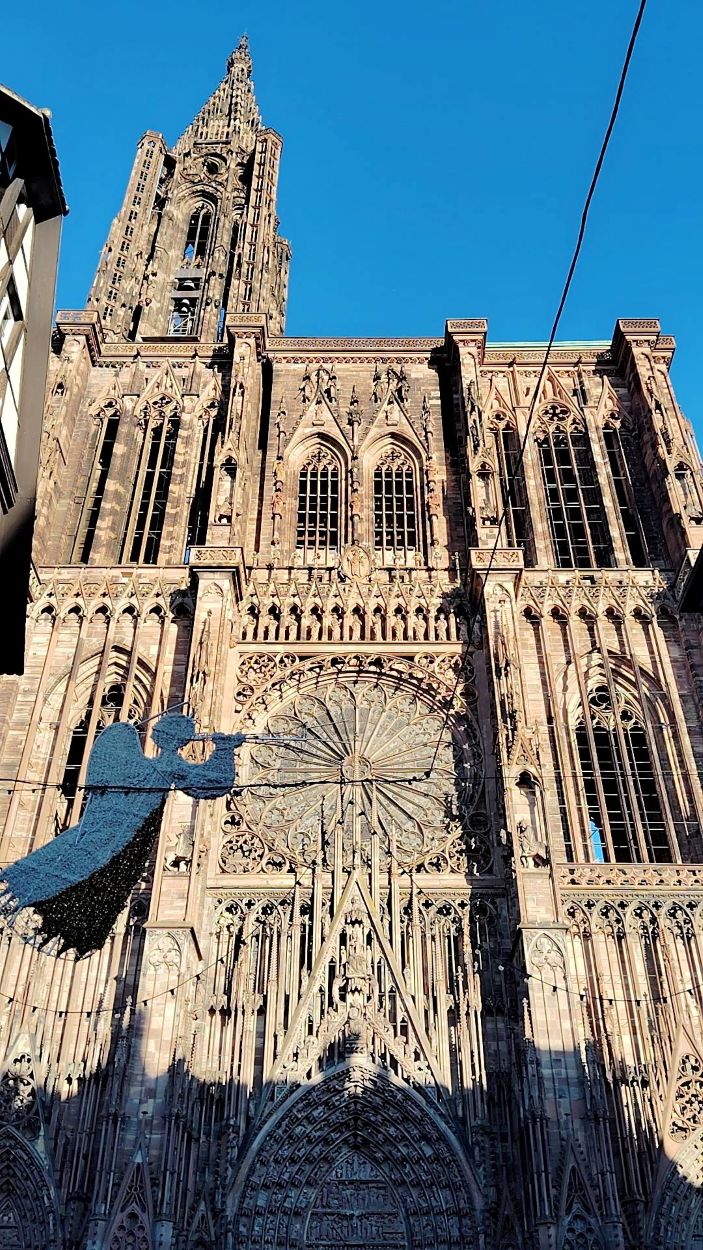
The Cathédrale Notre Dame is the seat of bishops who were suffragan bishops of the province of Mainz until the Concordat of 1801, was contested during the Reformation. Afterwards, it was exclusively dedicated to Roman Catholic worship. Since 1988, it has been the seat of its own archdiocese. Founded in 1015 on the remains of a previous cathedral, it was built from 1220 onwards by the Free Imperial City of Strasbourg, a wealthy merchant and financial republic, in the Gothic style, and was practically completed by 1365. It is unique in that the space between its two towers was filled in 1388, and it is recognizable by its single bell tower, surmounted by a spire added in 1439. Between 1647 and 1874, for more than two centuries, it was the tallest building in the world, standing at 142 meters. It remains the second tallest cathedral in France and the fifth tallest in the world. It stands on Place de la Cathédrale square, in the heart of the Grande Île, the historic center of Strasbourg.
The oldest portal, Romanesque in design, is decorated with several statues. The central group of the south portal, also called the Last Judgment or Day of Judgment portal, depicts various biblical passages and includes four main figures: Solomon, King of Israel, surmounted by Christ in Glory, flanked by two older statues (1225-1235). The one on the left represents the Church, standing upright, crowned, and holding a cross-shaped banner and a chalice. It complements the statue on the right, which represents the Synagogue (Judaism), blindfolded. She lowers her head, her spear is broken, in signs of defeat, and her dangling arm drops the Tablets of the Law. The presence of these three figures—Solomon (Christ), Ecclesia (Church), and Synagoga (Synagogue)—placed together can be explained by 12th-century interpretations of the Song of Songs, which presented them as the three principal figures in the end times. Originally, the two towers were the same size (66 m eters) and exceeded the facade between them. The bell tower on the south tower 100 meters, and the spire on the latter 142 meters above the ground, making it the tallest spire built in the Middle Ages that has survived to this day. The tall octagonal tower is flanked by four turrets containing spiral staircases and topped by a tall spire: completed in 1439,
The interior of the Notre Dame Cathedral, typically Gothic, has a rich and varied decoration but is dark compared to most French cathedrals. A single rose window, in fact, illuminates it from the inner wall of the forecourt façade and is designed with sixteen petals. The clarity of its design makes it a masterpiece of its kind. The baptismal font, executed in 1453, is sculpted in a very detailed manner and constitutes a masterpiece. of the Flamboyant style. These fonts are not octagonal but heptagonal: the choice seems linked to the symbolism of numbers: 4 refers to earthly life, 3 to the Trinity; the sum, 7, corresponds in this case to the physical and spiritual dimensions of humankind. The cathedral’s pulpit is an example of Flamboyant Gothic taken to its extreme. Placed against the third eastern pier of the nave, it is hexagonal in plan and rises two stories high. Fifty-six statuettes decorate it, addressing numerous themes such as the Evangelists, a procession of eight figures of the Apostles, the Crucifixion of Jesus Christ surrounded by his mother Mary and the Apostle John, or Saint Barbara, Saint Lawrence, and angels bearing the instruments of the Passion.
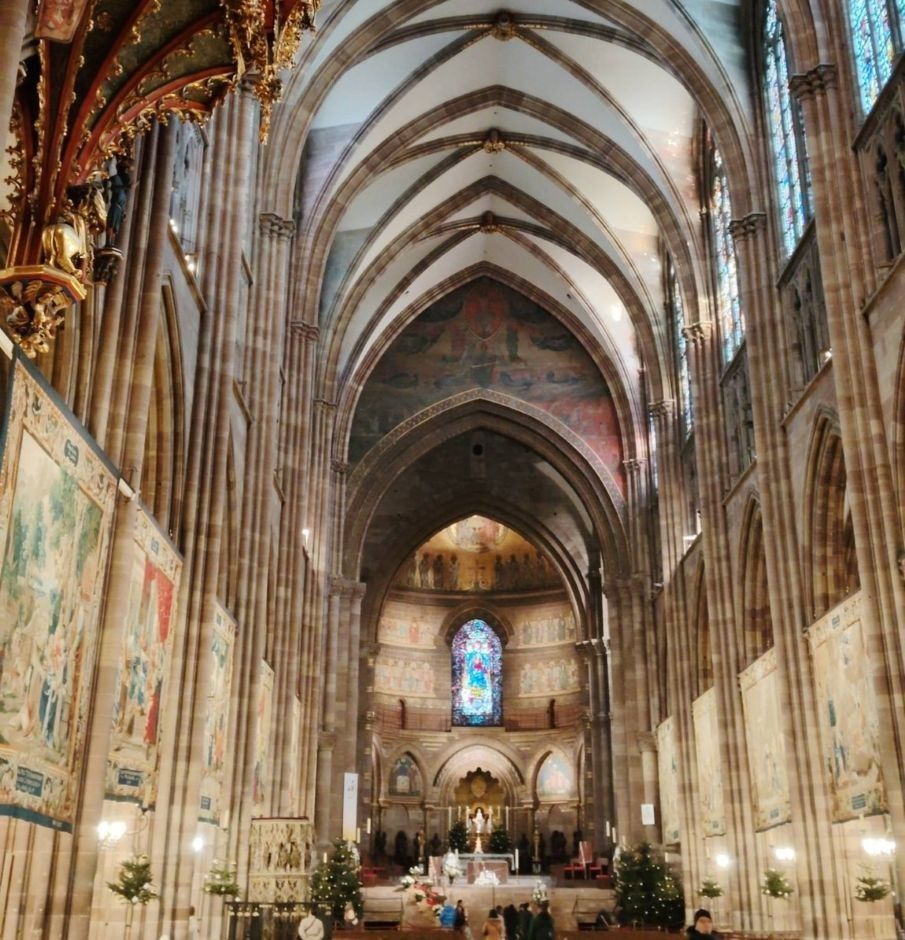
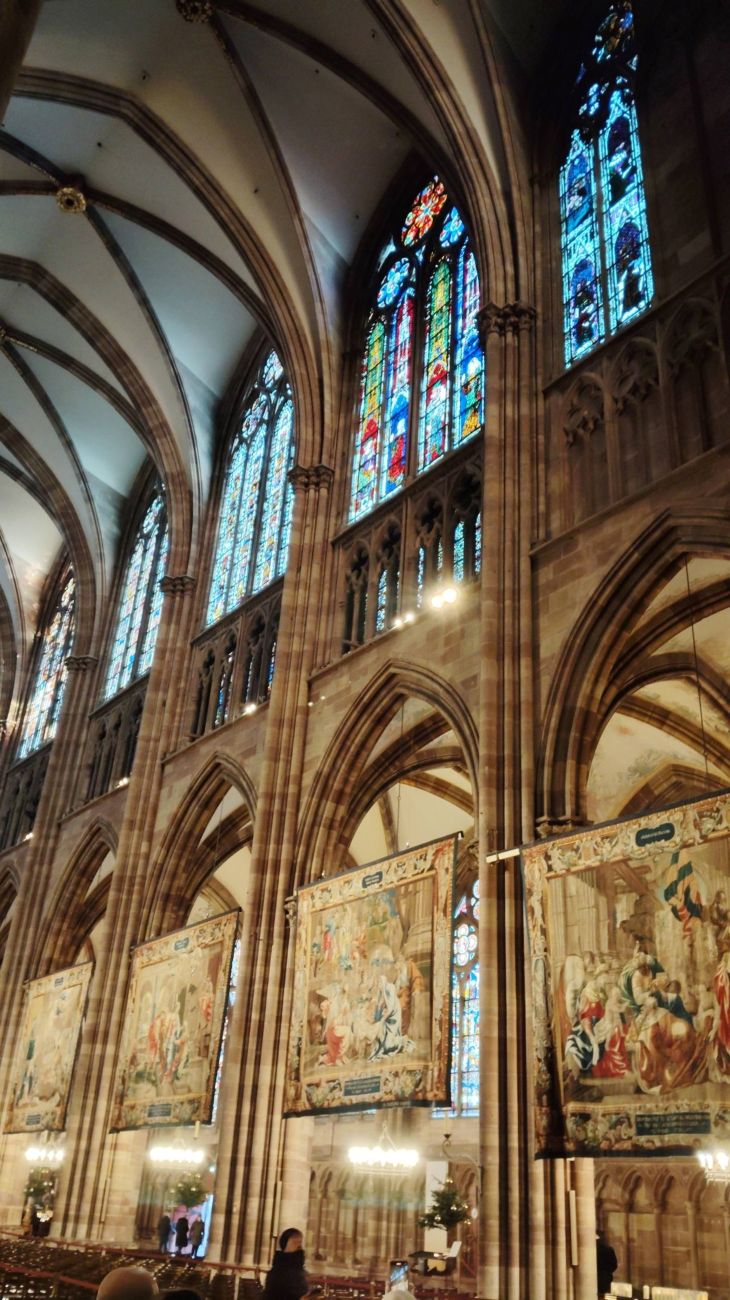
Contrary to popular belief, the cathedral’s nave, at 63 meters long, is among the longest in France. A new expression of French Rayonnant Gothic, the nave rises three stories and contains a rich collection of stained glass windows. In the north aisle, they depict the various emperors of the Holy Roman Empire and date from the 13C. In the south aisle, the 14C stained glass windows allow us to admire scenes from the lives of the Virgin Mary and Christ. The triforium windows represent Christ’s ancestors according to the genealogy given by Luke in his Gospel. To the south, the second figure in the first window of the fourth bay is Judah. The large rose window, however, is purely ornamental.
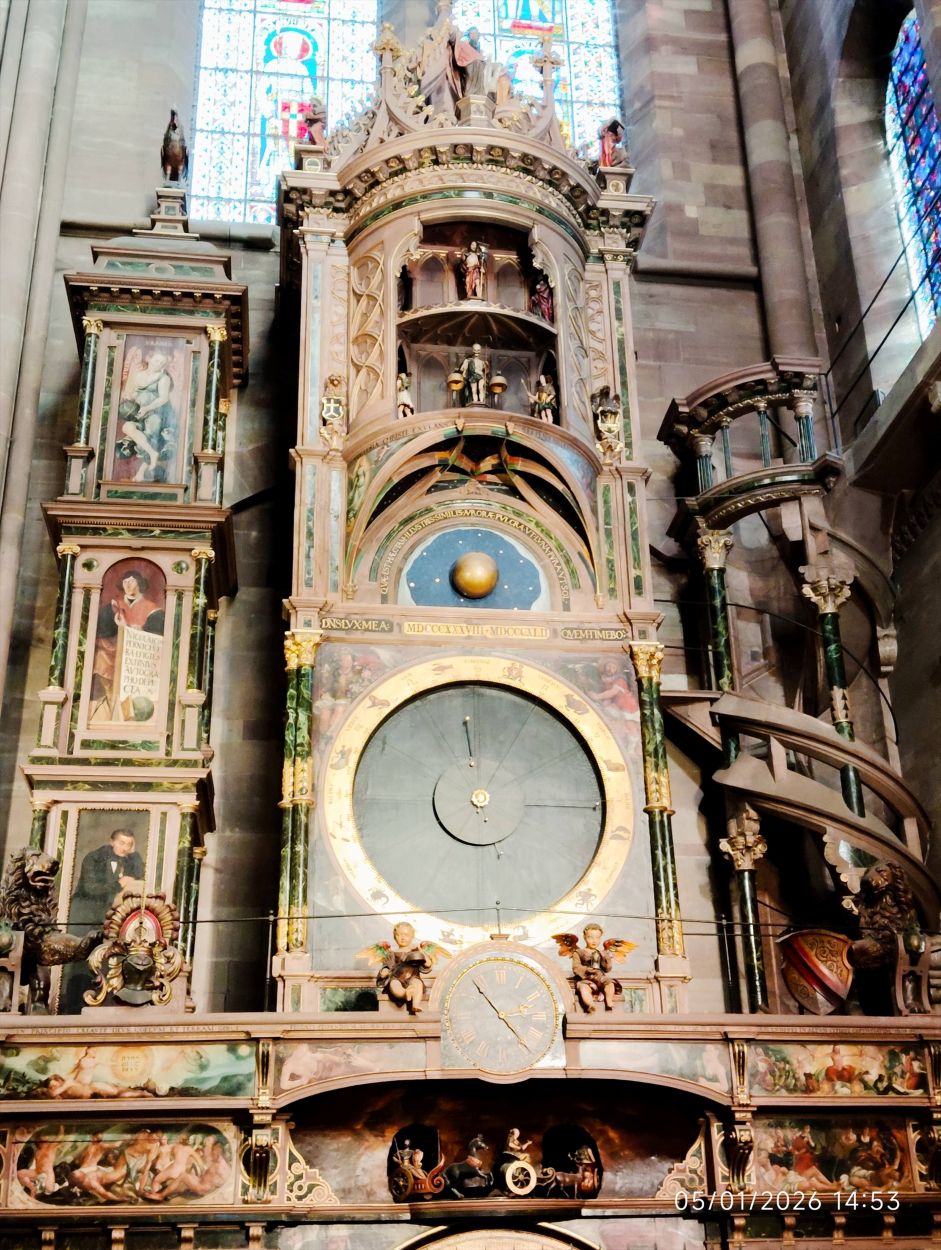
the astronomical clock built during the 16C, this Renaissance masterpiece was considered one of the Seven Wonders of Germany at the time. Automata are activated every day at 12h30. Every quarter hour, four ages of life are represented: the first quarter hour, the child completes a circuit of the clock; the second quarter hour, the young man; the third quarter hour, the mature man; and, in the final quarter hour, the old man announces his death and the arrival of the child. It is the product of a collaboration between artists, mathematicians, and technicians. Clockmakers, sculptors, painters, and automaton makers worked together. The current mechanism dates from 1842.The astronomical clock is presented every day ,except Sundays and holidays when a mass is celebrated at 11h.
The cathedral houses a set of fourteen tapestries depicting the life of the Virgin Mary, created between 1640 and 1657 from designs by Philippe de Champaigne and Charles Poerson for Notre-Dame Cathedral in Paris. No longer used in the Parisian cathedral from the beginning of the 18C, they were put up for sale in 1730 and purchased in 1739 by Armand de Rohan-Soubise for the Notre Dame Cathedral of Strasbourg. In addition, there were sixteen Aubusson verdure tapestries dating from the 18C, whose provenance is uncertain, but which may have originally been intended for the Palais Rohan.
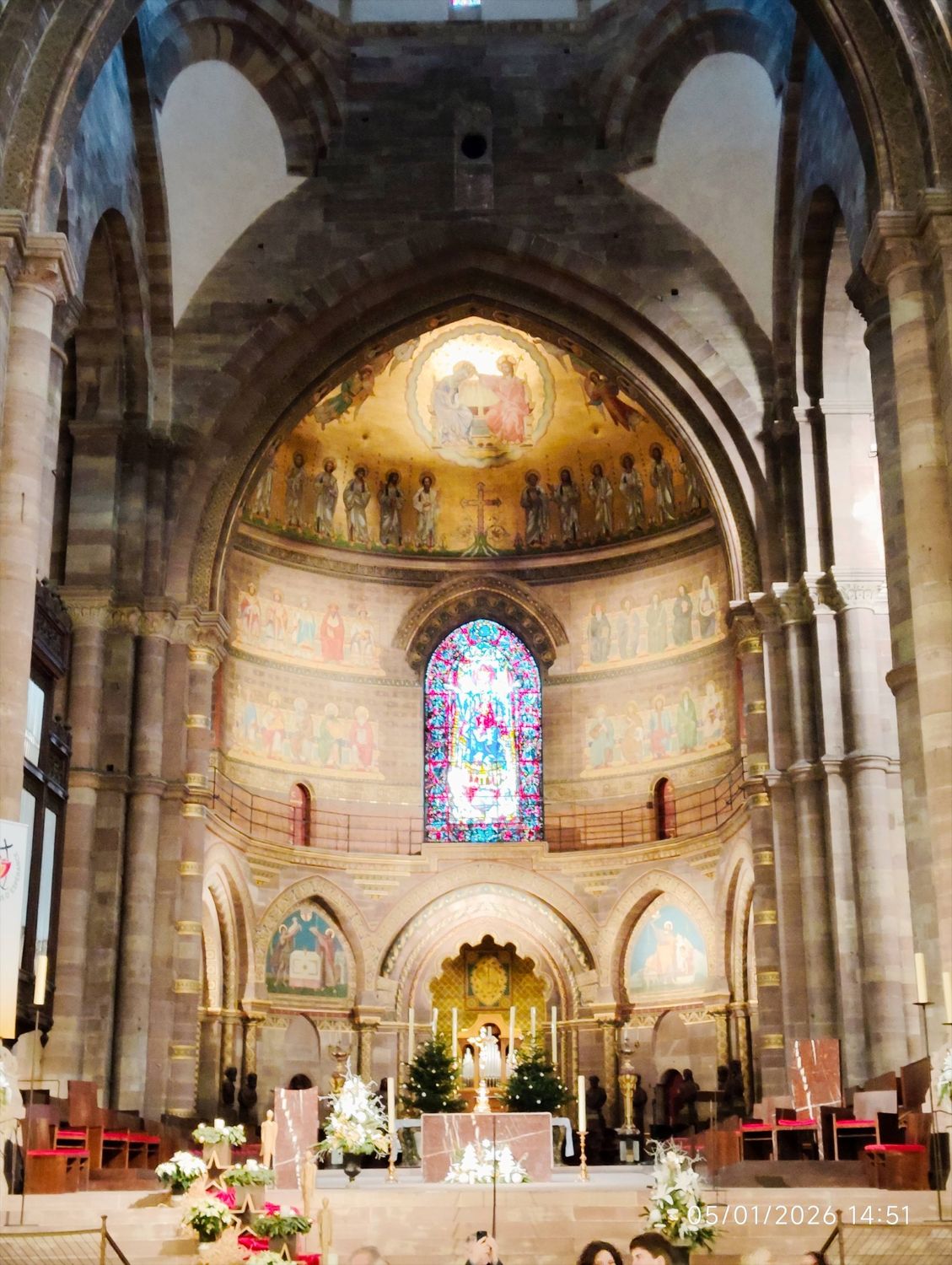
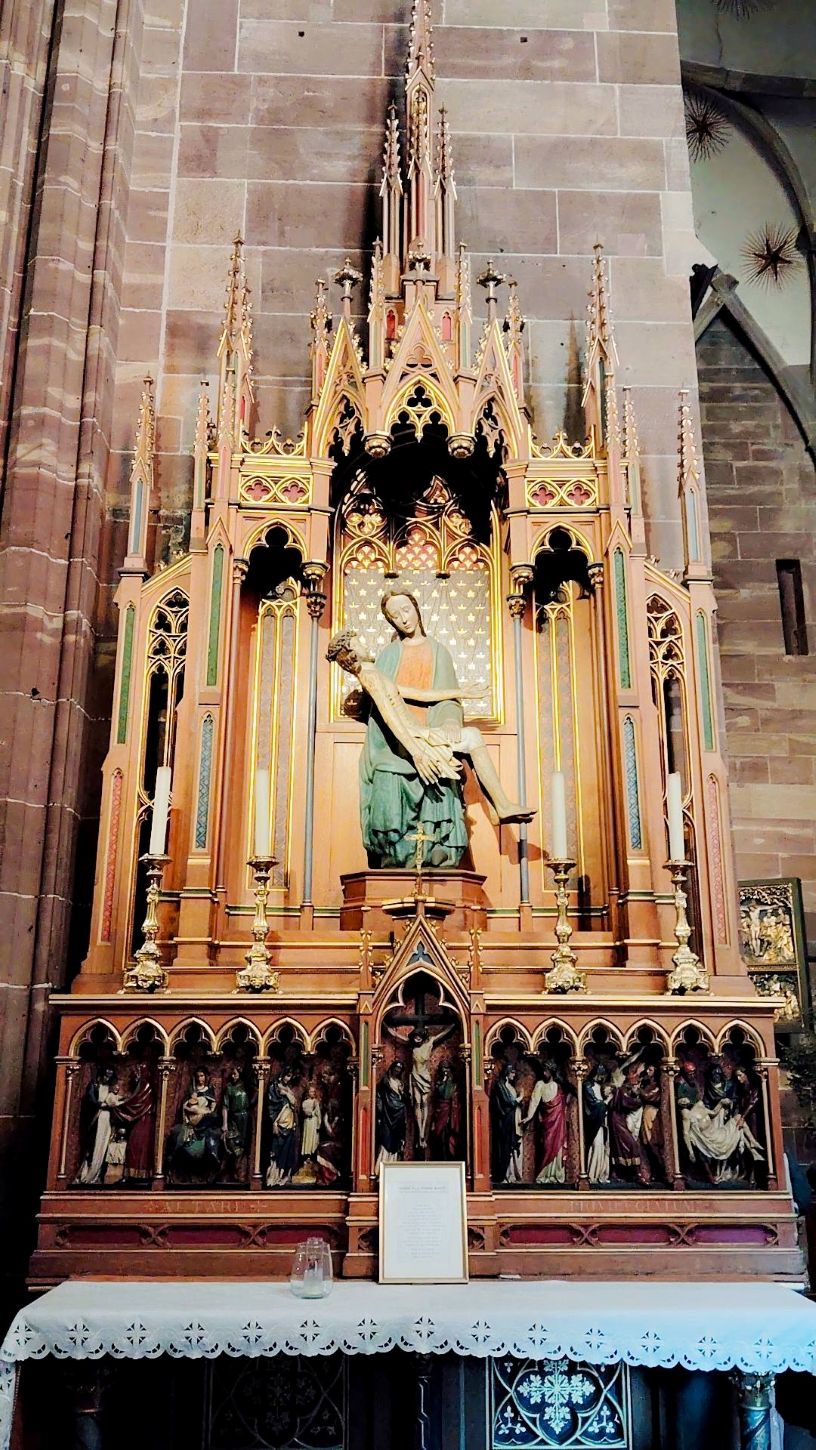
The Romanesque Choir, which houses the altar, is elevated, as it is situated above the crypt. It is decorated with 19th-century frescoes reminiscent of Byzantine art. Its center features a modern stained-glass window depicting the Virgin Mary, to whom the cathedral is dedicated. This stained-glass window, a gift from the Council of Europe, features the twelve stars of the European flag against a blue background, the color of the Virgin Mary. In the north transept, a beautiful sculpted and polychrome ensemble, dating from the early 16th century and in need of serious restoration, depicts the Mount of Olives. The choir is furnished with fifteen oak stalls dating from 1692.
The north transept arm is divided into four square bays by a central pillar. The central pillar of the north transept arm is cylindrical. The ribbed vaults, the oldest in the cathedral, are highly domed, making each of the four bays resemble a cupola. The height reaches twenty-six meters. On the left side of the east end, one can see the rather majestic former Romanesque niche of the Saint Lawrence altar. On the north side, the late Gothic Saint Lawrence portal, built between 1494 and 1505, features a large baldachin, formed by the superposition of three ogee arches terminating in finials. The upper register depicts a statue of Christ against a small column. The lower register is occupied by the martyrdom of Saint Lawrence.
The Saint Catherine Chapel (1332-1349) was created by Bishop Berthold II of Bucheck as his burial place. From east to west (from the chancel towards the facade), one finds: Saint Florent, a recent 19C statue; Saint John the Baptist (14C), wearing a medallion with the Paschal Lamb; Saint Catherine (14C), carrying a small wheel, a symbol of her martyrdom; Saint Andrew (14C), carrying a classically shaped cross; and Saint Elizabeth (14C). The Saint Lawrence Chapel (1495-1505) opens onto the north portal. It is reserved for prayer and the adoration of the Blessed Sacrament. Weddings and funeral masses for parishioners of the cathedral are also celebrated there.
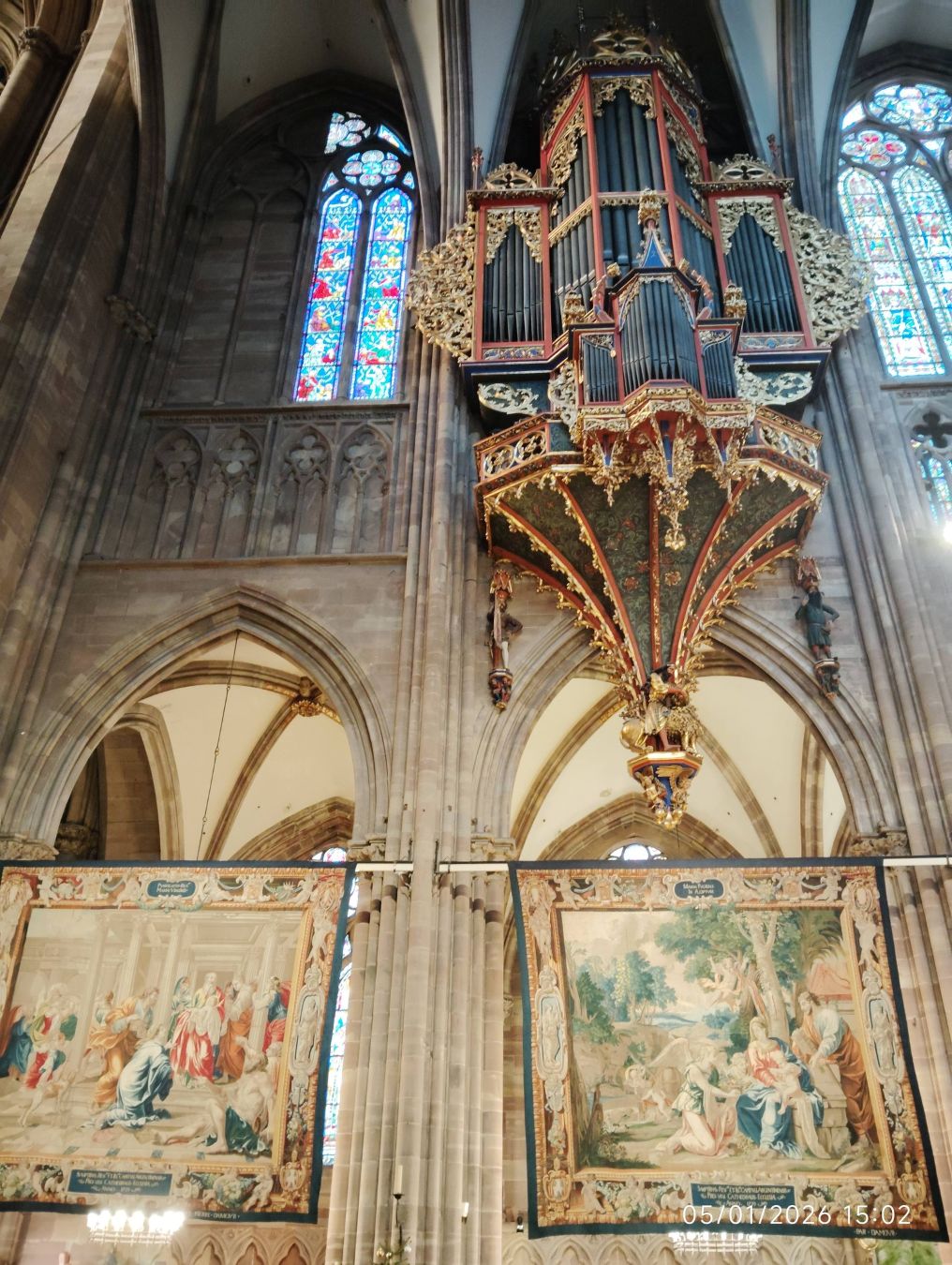
The first organ was installed in the cathedral in 1260. Destroyed by the fire of 1298, it was replaced in the 1320s. The great organ, although very The ornate organ is of modest size. Unlike most organs located in the gallery at the back of cathedrals, it is situated in the nave, in a swallow’s nest-like position, attached to an interior wall. After some modifications during the 19C and following war damage suffered by the cathedral in 1870, the organ was rebuilt in 1897. In 1935, the organ was rebuilt in a more French style. This organ remained until 1981, when it was rebuilt. The choir organ dates from 1878. The organ in the crypt was inaugurated on April 5, 1998.
The Pillar of Angels, built around 1230, is the central pillar of the hall and bears twelve exquisite sculptures: the first row depicts the four Evangelists, surmounted by angels playing trumpets. The upper group includes Christ, seated, surrounded by angels bearing the instruments of the Passion. The bell tower, which houses ten of the sixteen bells, is located above the Gallery of the Apostles, between the two towers of the facade.
The crypt is one of the few remaining above-ground structures, although the vast majority of the preserved elements do not date back to the original early 11th-century building, but to later reconstructions that took place in the first half of the 12th century. The Chapel of Saint Andrew occupies the angle between the south transept and the apse. The Chapel of Saint John the Baptist contains the recumbent effigy of Conrad of Lichtenberg, Bishop of Strasbourg from 1273 to 1299, the burial vault of the Bishops of Strasbourg, and the funerary monument of Conrad of Bussnang.
A bit of history tell us that at the end of Antiquity, Strasbourg, then called Argentoratum, was an important fortified camp of the Roman army. The site of the present cathedral is located in the center of this camp, where the houses of the tribunes and various pagan places of worship were probably situated. The area was destroyed and rebuilt several times between the 1C and 4C; from this date onward, it appears to have been occupied only by huts, at least until the 5C. The first wooden cathedral was built under Clovis in 510. More concrete evidence of the existence of a cathedral appears from the 8C onward. The exact date of the start of construction on this new cathedral is unknown, but a passage from the Annals of Marbach, written around 1190, indicates that in 1015 “the monastery of St. Mary rose for the first time above its foundations.” Similarly, no text indicates the date of the completion of construction, but it was probably finished by 1140 at the latest. Construction began with the choir and the apse. While the nave and western sections of the old cathedral were preserved for a time, the master builder was already preparing the construction of the Romanesque nave by laying the foundations and planning the connections at the level of the crossing piers. These works, which also included the restoration of the Saint Andrew Chapel, appear to have been largely completed before 1188, the choir already being operational by that date. The north transept arm was finished around 1200-1210, and work then continued on the south arm. The master builder of the north arm had time to erect most of the west wall of the north bay, as well as the portal, but seems to have left the site between 1210 and 1220. This same team also built the Saint John Chapel, then between 1230 and 1235 constructed the exterior wall of the aisle of the first two bays of the nave. However, work came to an abrupt halt around 1255, probably due to the growing animosity between the bishop and the burghers of Strasbourg. Later, the the first story of the north tower, and then, around 1330, assembled the great western rose window, as well as the gallery above it. They were probably also the one who completed the south tower. Between 1340 and 1347, was built the Chapel of Saint Catherine, then completed the second story of the north tower, giving the façade an appearance similar to that of Notre-Dame de Paris. However, between 1340 and 1360, when the construction of the north tower was almost finished, a large octagonal tower surrounded by four independent stair turrets and topped with a tall spire with a central staircase was modified: instead of a central staircase, the octagonal spire would have eight staircases running along its outer edges. The structure, completed in 1439, reaches a height of 142.11 meters and thus becomes the tallest tower in Christendom. It also improves circulation, equips the cathedral with monumental furnishings, and constructs additional structures, such as the small treasury building in 1488, the Saint Lawrence portal in 1505, and the Saint Lawrence Chapel in 1521.
In the 1520s, Protestantism gradually entered the cathedral: from 1521, the parish priest of Saint-Laurent promoted Lutheran ideas in his sermons, and then, in January 1524, the parish organized the first Mass in German. In 1527, the cathedral was officially dedicated to Protestant worship, with the exception of the choir, which remained under the jurisdiction of the Catholic canons. The cathedral also undertook the reconstruction of the vault of the Chapel of Saint Catherine, damaged by a storm in 1542, and financed the astronomical clock, completed in 1574. On September 30, 1681, Strasbourg was annexed to the Kingdom of France by Louis XIV. Among the first decisions made by the new sovereign was the restoration of the cathedral to Catholic worship. The 18C saw a resumption of construction within the cathedral complex, beginning with a new sacristy attached to the north transept and the choir school attached to the south transept. During the French revolution, in October-November 1789, on Talleyrand’s proposal, the Constituent Assembly voted to requisition the property of the Catholic clergy, including cathedrals. Mirabeau supported this proposal, invoking the simplicity of early Christianity. It is said that Cardinal de Rohan, Bishop of Strasbourg, in June 1790, refused the Civil Constitution of the Clergy and retired to Ettenheim, in the Baden region of his diocese. After the fall of Robespierre, the refractory clergy loyal to Cardinal de Rohan regained possession of their parishes: they celebrated a service in the cathedral on August 30, 1795. But, from December 1795, worship was again interrupted because the priests refused to swear allegiance to the French Republic. The cathedral was returned to Catholic worship in 1801 and the repair of the damage began in 1806. The bombing on August 11, 1944, when American aircraft targeted the city center of Strasbourg: the bombs that hit the cathedral notably caused the destruction of part of the dome and the vault of the north aisle. Three months later, on November 23, 1944, General Leclerc’s Spahis, having just liberated the city, raised the French tricolor flag atop the spire, thus fulfilling the Koufra Oath (a pledge made during the battle in Libya from January 31, 1941, to March 2, 1941) , a promise not to lay down arms until after the liberation of Strasbourg.
The official Cathédrale Notre Dame of Strasbourg:https://www.cathedrale-strasbourg.fr/
The City of Strasbourg on the Cathedral: https://int.strasbourg.eu/web/strasbourg-int/cathedral
The Strasbourg tourist office on the Cathedral: https://www.visitstrasbourg.fr/en/discover/must-see-attractions/the-cathedral/
The Alsace European Community tourist office on the Notre Dame Cathedral of Strasbourg: https://www.visit.alsace/en/223007269-the-cathedral-of-notre-dame/
There you go folks, a dandy area to explore and enjoy with the family, Memorable moments in my belle France, driving all over in my road warrior trails brings out sublime awesome spots with nice memorable family visits of yesteryear always remember and always looking forward to be back, eventually. Again hope you enjoy the post on the Cathédrale Notre Dame of Strasbourg !!! as I.
And remember, happy travels, good health, and many cheers to all !!!


