
I am taking you back to my dear Spain again !! love it !! We came by car always except once by plane, and took time to see this wonderful City of Burgos located in the province of Burgos in the autonomous community of Castilla y Léón in the kingdom of Spain , It really needs more time but on my road warrior trails we will be back eventually, I am glad found me a new picture in my cd rom vault to write this post for you and me, Mind you I condense the text and mostly from wikipedia, Therefore, here is my take on the Catedral Santa Maria of Burgos !!! Hope you enjoy the post as I.
The Gothic Cathedral of Santa Maria was begun in 1221, its construction took over three centuries. The third largest cathedral in Spain with 84 meters long and 60 meters wide, it is a UNESCO World Heritage Site. The cathedral is not only famous for its architecture, but also for its extraordinary art, with treasures you can’t miss: the lantern tower ; the Renaissance Golden Staircase by Diego de Siloé; and the Chapel of the Constables, considered a cathedral within the cathedral. Let yourself be captivated by the beauty of the chapels, masterpieces that tell their own stories, or immerse yourself in a journey of light and color through the cathedral’s stained-glass windows. Looking up, you can also spot the Papamoscas, one of the most popular and endearing figures in our city. Beyond its majestic architecture, the cathedral is intrinsically linked to the figure of El Cid Campeador. This medieval leader, buried in the cathedral in 1921 alongside his wife, Doña Jimena, remains an enduring symbol of the city. Their tombs, in the transept of the cathedral, invite visitors to immerse themselves in the rich history of Burgos.
Descending the steps to the Plaza Santa María Square, one can admire the western façade of the cathedral, inspired by those of the cathedrals of Paris and Reims. The lower section features the Portal of Santa María, composed of three pointed, splayed arches: the central one sheltering the Puerta Real, o del Perdón, (royal gate or gate of Forgiveness) ,and the side ones Puerta de la Asunción y Puerta de la Inmaculada,(Gates of the Assumption and the Immaculate Conception) . This portal, dating from the 13C, with its iconography dedicated to the Virgin Mary, was considered the most important example of Gothic sculpture in Castilla (Castile). However, its severe deterioration necessitated the austere reconstruction of the side doors in 1663 and the central door in 1790, in a Neoclassical style with a lintel and triangular pediment. Reliefs of the Immaculate Conception and the Coronation were placed in the tympana of the side doors, and two double arches flanking the spandrels, each containing a small statuette. The second section of the central bay of the façade dates from the 13C and features a Cistercian-style rose window with six-pointed star tracery, or the Seal of Solomon. The third section of the same bay opens onto an elegant gallery, punctuated by spires and several pinnacles, and formed by two large windows with mullions and tracery of three quatrefoil oculi. Beneath the eight small arches formed by the mullions of both arches are placed the statues of the first eight kings of Castile, from Ferdinand I to Ferdinand III. A fine balustrade-crest of pointed arches crowns the bay, above which stands a statue of the Virgin and Child, accompanied by the inscription, alluding to the Mother of Christ, “Pulchra es et decora” (She is beautiful and adorns). This crowning element was added in the mid-15C. Above the side doors of the first level rise two almost identical 13C towers, each with three sections. Above these towers, in the mid-15C, two pyramidal spires or pinnacles with octagonal bases and fine openwork were added, definitively shaping the silhouette of the cathedral. Two polygonal turrets, decorated with lobed arches, pinnacles, and statues, and topped with pyramidal spires that rise to the base of the towers’ spires, flank the façade. Inside, they house spiral staircases leading up to the triforium and the cathedral’s vaults.
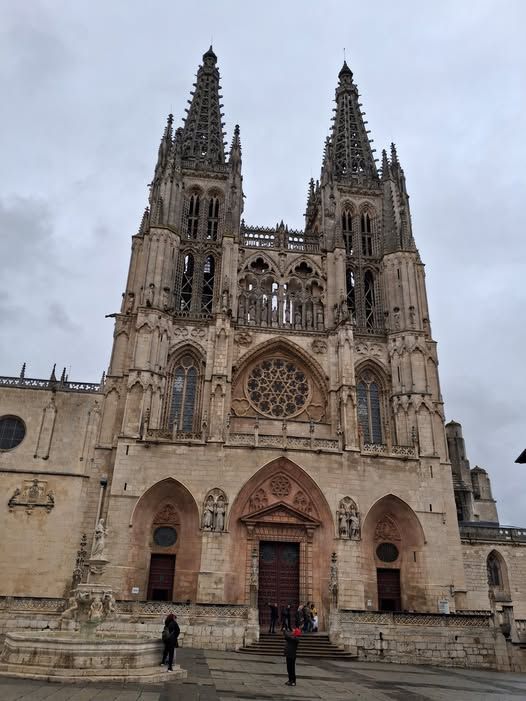
The Saint Mary’s Cathedral boasts numerous architectural, sculptural, and pictorial treasures. Among them are: The dome, first erected by Juan de Colonia in the 15C, which collapsed in 1539 due to its excessive weight and was rebuilt in the Gothic-Plateresque style by Juan de Vallejo in the 16C, following plans by Juan de Langres. The Constable’s Chapel, in the Isabelline Gothic style, on which the Colonia family, Diego de Siloé, and Felipe Vigarny worked. The Hispano-Flemish Gothic altarpiece by Gil de Siloé for the Chapel of Saint Anne. The large panel painting, The Holy Family, by Sebastiano del Piombo. The choir stalls. The late Gothic reliefs in the ambulatory, by Vigarny. The numerous Gothic and Renaissance tombs. The Renaissance Golden Staircase by Diego de Siloé. The Holy Christ of Burgos, an image of great devotional tradition. The tomb of El Cid Campeador and his wife Doña Jimena, their marriage contract, and their chest. And the Papamoscas, an articulated statue that opens its mouth when the clock strikes the hours. The last important works in the sacristy or the chapel of Santa Tecla belong to the 18C, the century in which the Gothic portals of the main facade were also modified. The decorative elements and liturgical furniture of the interior belong to various artistic styles, from Gothic itself, the Renaissance or the Baroque.
A bit of condense history I like tell us that Burgos was made an episcopal see in 1075 by King Alfonso VI and the authority of Pope Gregory VII, who thus gave canonical continuity to the episcopal tradition of the old diocese of Oca, whose prelate appears as a signatory of the Third Council of Toledo in 589, during the Visigothic period. The monarch promoted the construction of a cathedral dedicated to the Virgin Mary, the design of which is unknown, but which is assumed to be Romanesque. There is documentary evidence that the monarch donated for this grand project the site occupied by a royal palace that had belonged to his father, Ferdinand I, and a small church dedicated to Saint Mary, which was under construction. By 1096, the construction of this cathedral was already finished, but it soon proved too small for the needs of a city that was the symbolic capital of the kingdom. The decision to build a new cathedral was finally made at the beginning of the 13C. As was common at the time, the Romanesque building was destroyed, leaving only some sculptural fragments, and on its site, enlarged by the demolition of some adjacent houses donated by Bishop Marino, the new Gothic cathedral was erected. The first stone of the new cathedral was laid on July 20, 1221, in the presence of the temple’s promoters: King Fernando (Ferdinand) III of Castile and Bishop Mauricio, prelate of the Burgos diocese since 1213. The consecration of the temple took place in 1260, although records show that divine services were celebrated there as early as 1230. Between the second half of the 13C and the beginning of the 14C chapels of the side aisles were completed, and a new cloister was built. In the 18C, the Chapel of Saint Tecla, the Chapel of the Relics, and the Sacristy were added. The Saint Mary’s Cathedral owes its large number of works of art from the 13C to the 18C mainly to the fact that no decisive restoration was undertaken during the 19-20C.
The official Cathedral of Santa Maria (St Mary) of Burgos : https://catedraldeburgos.es/
The Burgos tourist office on the cathedral : https://visitaburgosciudad.es/en/web/guest/que-ver/catedral
The City of Burgos on its history : https://www.aytoburgos.es/historia-de-la-ciudad
The Castilla y Léon regional tourist office on the Catedral Santa Maria: https://www.turismocastillayleon.com/en/heritage-culture/burgos-cathedral
There you go folks , another wonderful nostalgic, sentimental trip to my dear Spain, Burgos is nice, awesome will say, and love it ! We will be back, eventually, Very convenient on my road warrior trails between France and Spain, Again, hope you enjoy this post on the Catédral Santa Maria of Burgos !!! as I
And remember, happy travels, good health, and many cheers to all !!!


