
I bring you back to the wonderful town of Huesca . I have been by here several times and did came in with my usual road warrior trails going elsewhere. This is a wonderful monument, a must to see, me think, The town of Huesca is the capital of the province of the same name and of the Hoya de Huesca area, located in the autonomous community of Aragon of my dear Kingdom of Spain, Therefore, let me tell you a bit on the monasterio de San Pedro el Viejo of Huesca !!! Hope you enjoy this post as I.
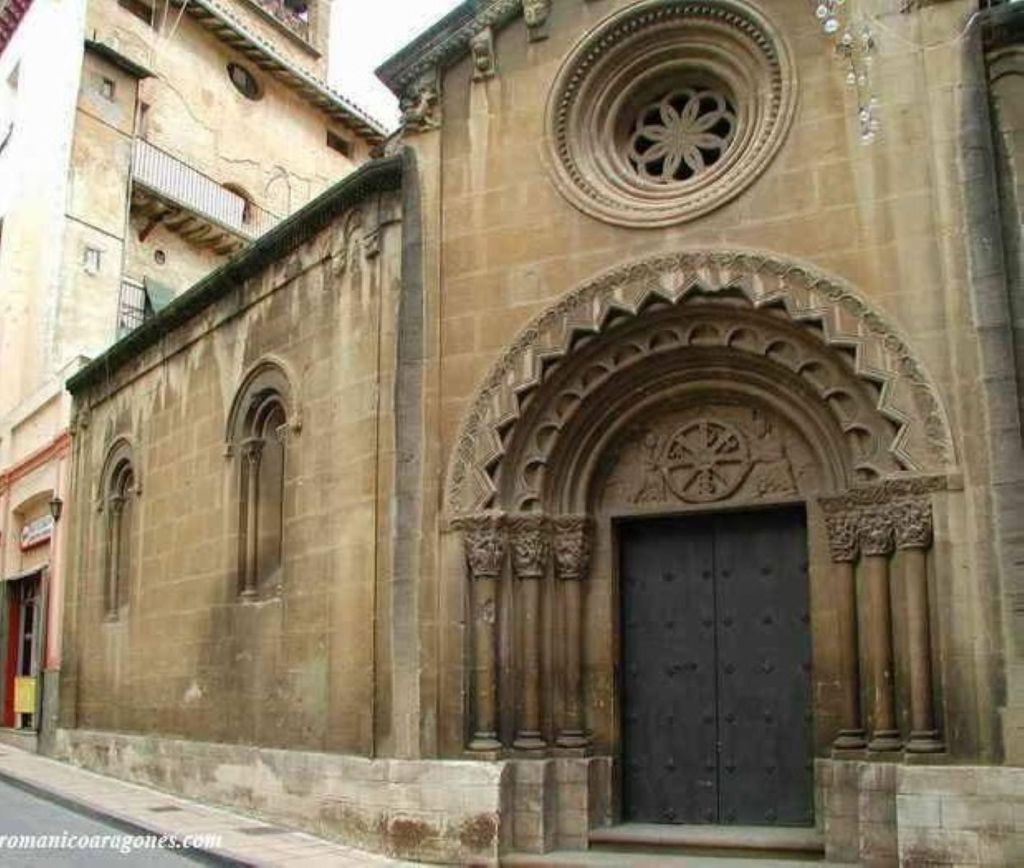
The Monasterio de San Pedro el Viejo, aka the Church of San Pedro el Viejo, is a 12C Romanesque church located in the old town of Huesca. From the outside, one can see the dilapidated apse with its semicircular arches. Perhaps the most valuable feature of the Church of San Pedro el Viejo is the tympanum of the north portal. It displays a magnificent Trinitarian chrismon held by two beautifully crafted angels. The ensemble is completed by a small reclining human figure at the top, representing Saint Vincent. It consists of three naves with barrel vaults and their respective semicircular apses with hemispherical domes, which were built in the first half of the 12C in the Romanesque style. Culminating in an apse with three staggered, semicircular chapels. The dome was added around 1240, in the Gothic style. At the foot of the central nave, on the north wall, Gothic murals dating from the 13C are preserved, depicting the themes of David and his battle with Goliath and Moses and the burning bush.
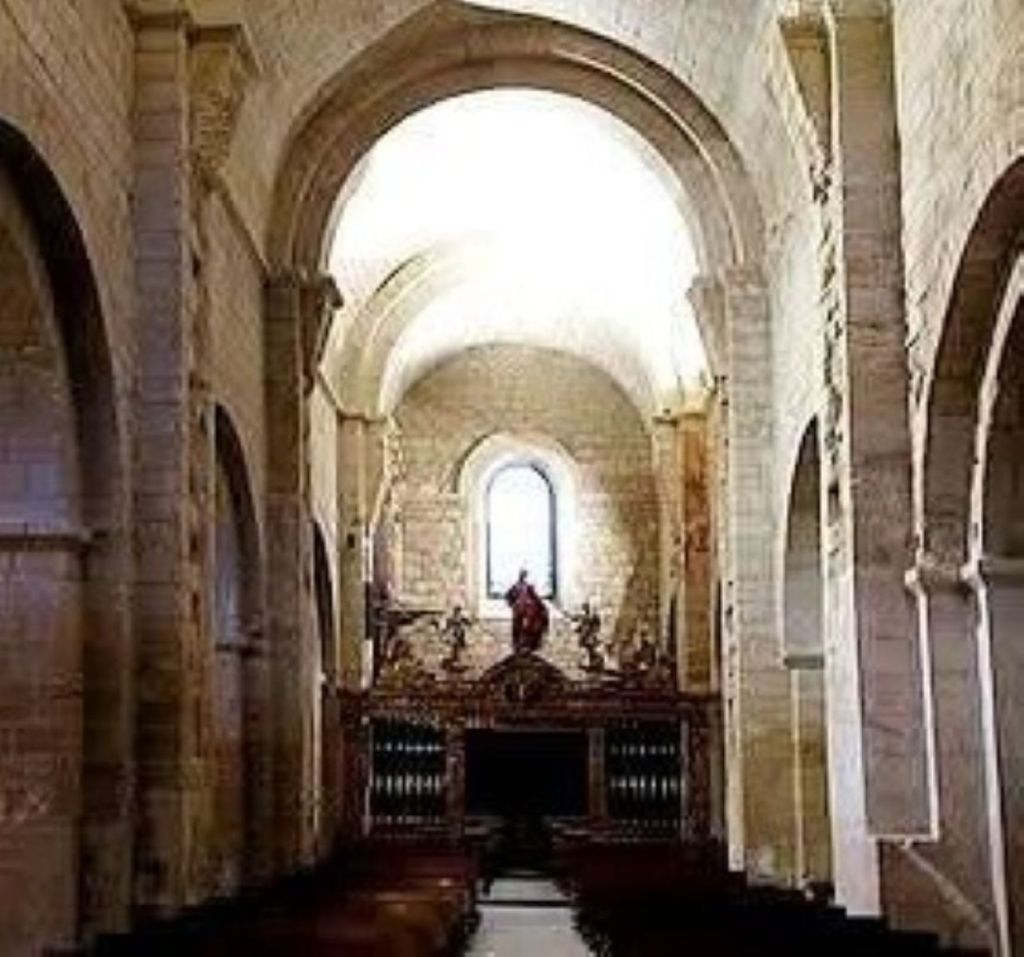
The main altarpiece is made of polychrome wood and features the church’s patron saint, Saint Peter, (San Pedro) wearing the triple papal tiara. It is dated 1602. At the foot of the nave is the choir; the choir stalls are dated 1506. It is protected by a Baroque screen. The side chapels display interesting works of art: the Altarpiece of Our Lady of Hope (16C), Renaissance style; the Altarpiece of Saints Justus and Pastor (17C), Baroque style; and the Altarpiece of the Annunciation (15-16C), Gothic style.
The Choir, initially located in the section corresponding to the main entrance of the nave, was moved to its current location in the late 17C or early 18C, The stalls dated 1506, following Gothic models. Made of walnut and marquetry. The Choir screen is a Baroque work from the mid-18C. It consists of three sections, with the two leaves of the entrance door in the central section, while the sides feature a stone parapet upon which the bars are placed. Four gilded wooden pillars with vegetal decoration separate the sections and support an entablature featuring sculptures of Saint Vincent, flanked by Saints Justus and Pastor, and Rococo cartouches simulating mirrors.
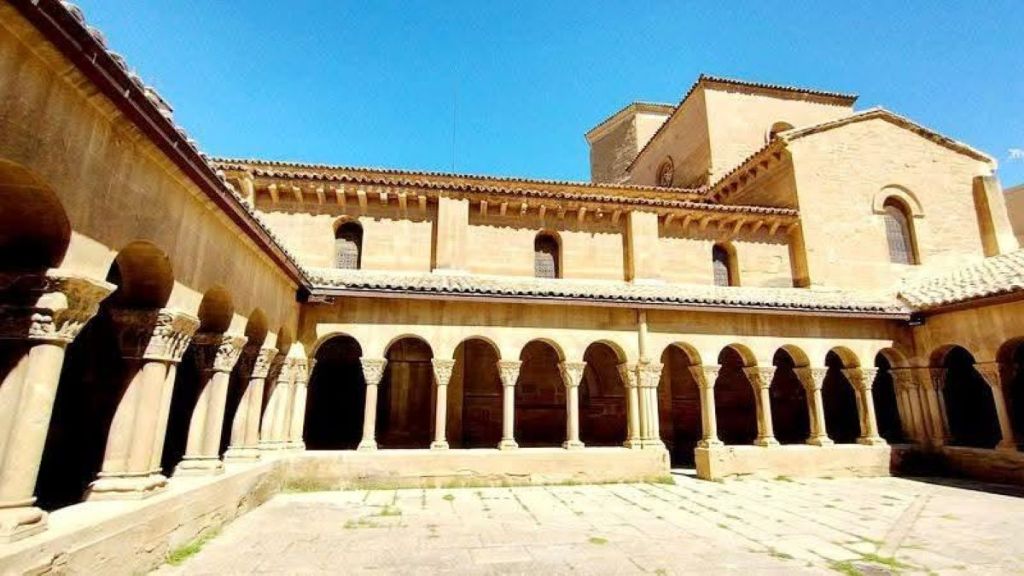
The most outstanding feature of the Church Saint Peter the Elder is its magnificent cloister, composed of four arcades forming a rectangle opening onto the central courtyard through semicircular arches supported by paired double columns. The cloister was built in the 12C, during the late Romanesque period. It has a moderately irregular rectangular floor plan with semicircular arches, topped by 38 capitals supported by paired shafts. Due to their deterioration, it was decided to replace twenty capitals with new ones of Romanesque inspiration. The removed capitals are kept in the storage of the Huesca Museum. The former monks’ quarters, located in the western part of the cloister, house important pieces of sculpture and goldsmithing from the old monastery.
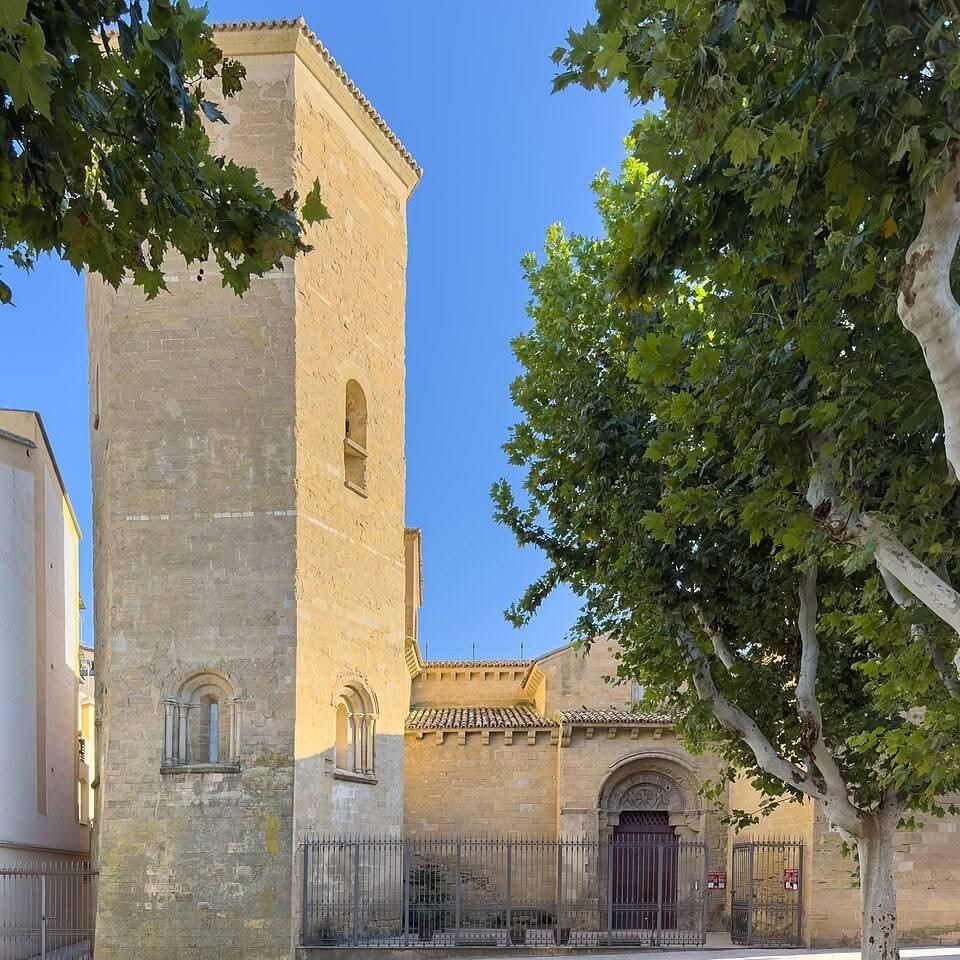
The tower is a hexagonal structure attached to the north wall of the transept and connected to the interior of the church by a doorway with chamfered archivolts and columns with plain capitals. The interior space, known as the Chapel of San Ponce de Tomières or Saint Pont de Tomières, has been converted into a small museum. Its elevation consists of two sections plus the upper ribbed vault. The second section has windows for illumination.
The following chapels are located in the East Gallery: the Chapel of Saint Bartholomew, Romanesque with a barrel vault, which was the chapter house of the monastery. What was once its chapter house now serves as a royal pantheon, containing the tombs of two kings of Aragon: Alfonso I the Battler and his brother and successor, Ramiro II the Monk. in a 2C Roman sarcophagus. The Chapel of Saint Joachim and Saint Anne (13C) is currently closed. The Chapel of Saint Benedict (13C) and the Chapel of Saint Agnes are also located here.
The Romanesque Monastery of Saint Peter the Elder stands on the site where archaeological evidence from this site suggests the existence of a Roman temple or necropolis. Later, a Visigothic church was built, where, after the Muslim conquest of the city in 719, the Mozarabic population was able to practice Christian worship under the patronage of Saint Peter, as mentioned in the bull of May 25, 1107, issued by Paschal II of the Mozarabic temple that served the Christian community during the long centuries of Muslim rule. After the conquest of Huesca in 1096, the temple was donated by the Aragonese King Pedro I to a French Benedictine monastery. Consequently, most of the pre-Romanesque structure, adapted to the Hispanic liturgy, was soon demolished to accommodate the Roman and Cluniac practices. This is the moment of the erection of the 12C Romanesque monastic complex, which consists of: a three-aisled church; a cloister attached to the southern side, with an excellent collection of capitals; the construction of a dome in the 13C; and the addition of a tower on the north side, next to the apse.
Archaeological evidence from this site suggests the existence of a Roman temple or necropolis. Later, a Visigothic church was built, where, after the Muslim conquest of the city in 719, the Mozarabic population was able to practice Christian worship under the patronage of Saint Peter, as mentioned in the bull of May 25, 1107, issued by Paschal II. When Huesca was reconquered in 1096, the Aragonese monarch Peter I ceded the old church of Saint Peter to the then-prosperous Benedictine monastery of Saint-Pons-de-Thomières, located in Languedoc (France). In 1117, the monastery began construction of the church, cloister, and other monastic buildings. The entire community was secularized by order of Ferdinand II of Aragon, ceasing to be dependent on the French abbey of Thomières.
The official Monastery site by the Obreros de San Pedro el Viejo : https://www.sanpedroelviejo.com/
The town of Huesca on the monastery: https://www.huesca.es/areas/fiestassanlorenzo/w/que-visitar/iglesia-y-claustro-de-san-pedro-el-viejo
The Huesca tourist office on the monastery: https://www.huescaturismo.com/en/monumental-detalle/8/the-church-and-cloister-of-san-pedro-el-viejo
The Aragon region tourist office on the monastery San Pedro el Viejo ( St Peter the Elder): https://www.turismodearagon.com/ficha/iglesia-y-claustro-del-monasterio-de-san-pedro-el-viejo-huesca/
There you go folks, a wonderful, terrific, glad had stop by to architecturally and historically stunning Huesca of my dear Spain, A good spot to enjoy the gorgeous Pyrénées and winter sports, Again, hope you enjoy the post on the Monasterio de San Pedro el Viejo of Huesca !!! as I.
And remember, happy travels, good health,and many cheers to all !!!


