
I bring you to the wonderful town of Huesca in marvelous Aragon of my beloved Spain. I have been by here several times and did came in with my usual road warrior trails going elsewhere. This will be an introduction to this wonderful mountain town, Therefore, let me tell you a bit on this is Huesca !!! Hope you enjoy it as I.
The City of Huesca is the capital of the province of the same name and of the Hoya de Huesca area, located in the autonomous community of Aragon of my dear Kingdom of Spain. It is located on the edge of the outer mountain ranges of the Pyrenees. The Isuela river runs through it, and also, in its surroundings, the Flumen river. The city, from which you can see the Guara mountain range, is sometimes referred to as “the gateway to the Pyrenees”. The demonym of the inhabitants of Huesca is “oscense” due to the ancient Roman name, “Osca”, which has lasted for centuries.
Huesca is connected to the other two provincial capitals of Aragon, Zaragoza and Teruel, via the Autovia Mudéjar A23 many times taken and glorious driving of much memories forever, It also connects to the provincial capitals that border it, Pamplona via the N-240 and Lleida via the A-22. It is also connected to France via the N-330, where the border is crossed at the Somport tunnel (see my posts).
In my road warrior trails passing City center of Huesca took a peek of the Catedral Santa Maria (see post) in the Gothic style, built in the 13C and completed in the 16C. It stands on a possible Roman temple and on the old mosque, of which only a horseshoe arch remains in the cloister area. During the 17C, the cathedral continued to be renovated, replacing medieval altarpieces, chapels and tombs with others in the Gothic and Baroque styles. In 1936, during the Spanish Civil War, the Republican siege of the city, the spire that raised the tower by a third more and gave it a more Gothic appearance was destroyed. It is the seat of the bishopric of Huesca and the Diocesan Museum of Huesca.
This is a City that needs more time and will be back, eventually, For now other things to see here are walking by the El Coso one of the main streets of the city, located in the San Lorenzo neighborhood, it surrounded the old wall of Huesca, except in its northeastern part, where it still stands. Most of its buildings follow the architectural style of the early 20C. El Coso has several buildings of interest, such as the Olimpia Theater, the courts, the Post Office building, the Church of San Vicente el Real, the Church of Santo Domingo and Church San Martín and the bullring. The Plaza Luis López Allué square is located within the city’s historic center. It is more popularly known as the Plaza del Mercado or Market Square, as it was the site of Huesca’s main market until 1976. The square is bordered by buildings that are four stories high on the exterior, with the ground floor being particularly tall and open to high arcades topped with semicircular arches resting on thick, rectangular pilasters. The Pedagogical Museum of Aragon and the city’s tourist office are located in this square. It also houses La Confianza, the oldest grocery store in Spain. A great instroduction to the City !
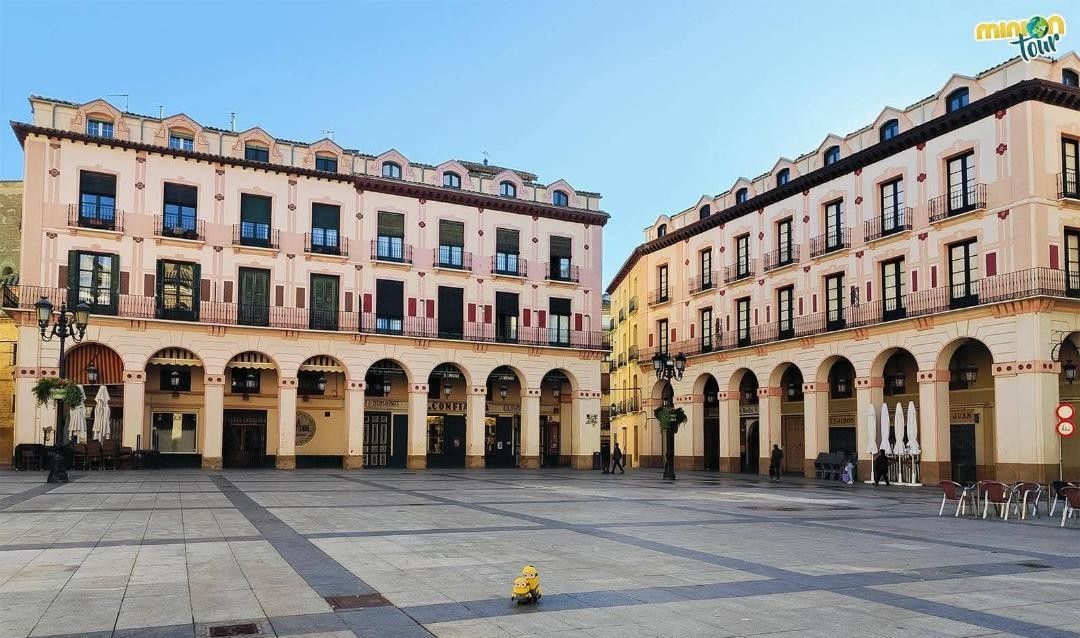
The things to see here are the Catedral Santa Maria in the Gothic style, built in the 13C and completed in the 16C . The Monastery Church of San Pedro el Viejo Romanesque monastery from the 12C, which includes a cloister and royal pantheon of the kings of Aragon (Alfonso I the Battler and Ramiro II the Monk). The tower has a hexagonal plan from the late 13C. It houses inside the mural paintings from the 13C, the choir stalls from the 16C and the Main Altarpiece from the early 17C. Currently, the only walls ramparts left standing are those from Calle Joaquín Costa to the bullring. The wall had 7 gates and 100 towers, but only the northern one remains, remodeled in the Gothic style. It has Roman and Mudejar characteristics and later modifications. Convent of San Miguel is a late Romanesque complex. It was founded by Alfonso I in 1110. The convent was an important hospital, leper colony and meeting place until the end of the 15C. Numerous Baroque-style altarpieces and the choir organ, dating from 1852, have been preserved. It is popularly known as “Las Miguelas” after the nuns of the Carmelite order who occupy it. Sanctuary of Our Lady of Salas is located approximately 1 km from the city and is accessed via a Stations of the Cross. It was rebuilt around 1200 on the initiative of Sancha de Castilla, widow of Alfonso II of Aragon. Church of Santa María in Foris was built in the 13C and has a single nave, with a polygonal apse. In the 16C the Augustinians took charge of it, founding a convent, so it was renamed San Agustín The City/Town Hall is a clear example of an Aragonese City/town hall of the Aragonese Renaissance. The building was built in the 16C on the site that previously occupied the seat of the council, opposite the cathedral. It houses the famous painting of the Bell of Huesca, Basilica of San Lorenzo was built on an old Romanesque temple, which was later enlarged in the 14C in Gothic style during the reign of James II of Aragon. The silver bust of San Lorenzo from the late 16C is kept in the sacristy. Fountain of the Muses dating from 1885, located in the Plaza Navarra , The Puente San Miguel bridge built in 1912 ; despite its small size, it is an engineering work that stands out for being one of the first constructions in reinforced concrete in Spain. Provincial Archaeological Museum of Huesca. This building is of great interest because it occupies part of the former palace of the Kings of Aragon, with a chapel (Room of Doña Petronilla), and the room where the Huesca bell would have taken place. It has an important archaeological section, medieval painting collections and the fine arts section with the Carderera legacy, with Goya prints and other canvases. The Monasterio de Boltaña Hotel & Spa 5*, It is located at Calle Latorrecilla, 2,Boltaña, province of Huesca, 95 km from Huesca.
The City of Huesca has a rich long history , I will condense on the history I like that tell us that in 476, with the disappearance of the Western Roman Empire, Osca became part of the Visigothic kingdom, and in 598 a Council of the bishops of the province of Tarraconensis was held. Under the Visigoths, the city was erected as a bishopric, suffragan of the archdiocese of Tarragona. In 673, the Visigothic king Wamba stayed in Osca to suppress the revolt of Duke Paulo. The city was conquered by the Arabs in 719 under a pact or capitulation and was one of the northernmost cities of Al-Andalus. The name changed from Osca in Latin to Wasqa in Arabic, and during the centuries that the Arabs were there, the society became Islamized, and Arabic became the language of power. In 797, a first attempt to reconquer the city failed, led by Louis, the son of Charlemagne and his future successor as Louis the Pious. In 799, according to the Annals of the Kingdom of the Franks, the governor of Wasqa gave Charlemagne the keys to the city as a sign of his submission. Frankish rule, however, did not become effective, and in 801, 811, and 812, new Carolingian attempts to reconquer the city failed. Sancho Ramírez, the second king of Aragon, built Montearagón, a large castle a few kilometers from Wasqa, in preparation for its reconquest. The construction of the fortress was full of symbolism: it was erected on lands that were still Muslim. In 1094, King Sancho Ramírez died before the walls of Huesca in an attempt to reconquer the city, after being shot by an arrow. Huesca was finally taken by his son, Pedro I of Aragon, in 1096, who defeated Al-Musta’in II of Zaragoza at the Battle of Alcoraz. On 7 September 1134, Alfonso I the Battler died from wounds received during the battle in the village of Poleñino and was buried in the Abbey of Montearagón. On 29 June 1136, Petronila of Aragon was born, daughter of Ramiro II and Agnes of Poitou, future Queen of Aragon and Countess of Barcelona. In 1155, King Louis VII of France passed through Huesca on his pilgrimage to Santiago de Compostela, also to visit King Alfonso VII of León, whose daughter he had married after the nullity of his marriage to Eleanor of Aquitaine had been proven.
During the 16C and 17C, the city began to experience a cultural and demographic revival. The University of Huesca was finally established in a permanent location. An agreement was reached in 1513 for the University to be housed in the former royal palace. The first colleges were also founded, most notably those of Santiago and San Vicente. The 17C saw its greatest cultural brilliance; some of the city’s main monuments were built, such as the Churches of San Lorenzo and Santo Domingo, the octagonal University building, and the Arguis Dam. The 18C began with the War of the Spanish Succession. Felipe (Philip) V abolished the old Huesca council, born in the Middle Ages, which was presided over by the justice of Huesca and the prior of juries and replaced it with a town council similar to the Castilian ones, headed by a corregidor, usually a military man, and twelve Huesca councilors loyal to the Bourbons.
The Spanish Peninsular War (independance of Napoléon Ier) in Huesca began with the assassination of Colonel Antonio Clavería, the mayor, in June 1808. During the Sieges, forces from Huesca participated in the defense of Zaragoza. French rule in the city lasted from 1809 to 1813. During the First Carlist War, a battle took place in front of the city between the Isabelline troops and the Carlist troops of the Royal Expedition that went from Navarre to Catalonia and ended up occupying the city. In 1845, the University of Huesca disappeared, five centuries after its foundation, and the current Huesca Museum was created in the same building. In the first third of the 20C, the main monuments were built, such as the casino, one of the main works of Huesca modernism, the bullring, in the same place where it had been since the Middle Ages, the Campo del Toro, a large rectangular building also dedicated to bullfighting shows, or the creation of the Miguel Servet municipal park, the lung of the city, During the Spanish Civil War, the city of Huesca rose up in 1936 against the Republic and was besieged by the Republican army, while the front stabilized on the Gállego river and the Huesca offensive. In March 1938 the Aragonese front collapsed and the city was liberated from the siege to which it was being subjected. In 1979 the first democratic elections were held and the first democratic city council was the Union of the Democratic Centre (UCD) founded by Adolfo Suàrez.
The City of Huesca on its heritage : https://www.huesca.es/la-ciudad/historia-y-patrimonio
The Huesca tourist office on its heritage : https://www.huescaturismo.com/en/monumental
The Aragon regional tourist office on Huesca : https://www.turismodearagon.com/en/ficha/huesca/
There you go folks, a wonderful, terrific, glad had stop by to architecturally and historically stunning Huesca of my dear Spain, A good spot to enjoy the gorgeous Pyrénées and winter sports, Again, hope you enjoy the post on this is Huesca !!! as I.
And remember, happy travels, good health,and many cheers to all !!!


On my bucket list
LikeLiked by 1 person
Do go beautiful scenery and great monuments Huesca needs to be seen! Thanks for stopping by Cheers
LikeLiked by 1 person