
And I am going back to a wonderful far away land in my beloved Spain. The City of Mérida is located in the province of Badajoz, capital of the autonomous community of Extremadura, and in the kingdom of Spain, It is 62 km from Badajoz, 75 km from Càceres, 83 km from Trujillo, 126 km from Guadalupe, and 342 km from Madrid,See my other post on the City as I came here in my road warrior mode from Guadalupe, I have found me again pictures in my cd rom vault that made me do this post for you and me. Therefore, here is my take on the Puente Romano of Mérida !!! Hope you enjoy it as I.
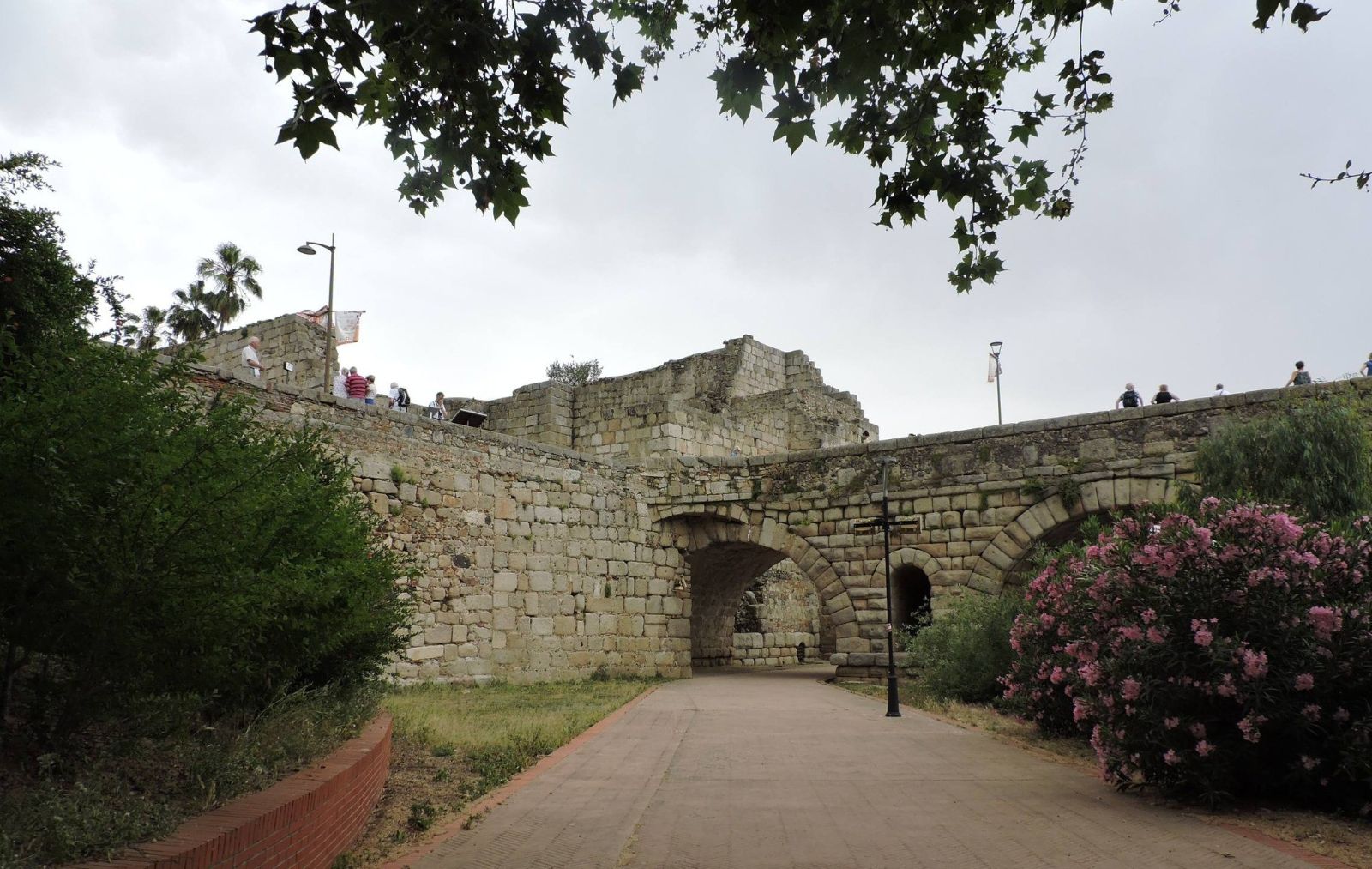
The City of Mérida has a huge amount of monuments that should had more time and i will eventually as said so much to see and little time in my road warrior trails, The Puente Romano or Roman bridge is a civil engineering work that spans the Guadiana river. Built by the Roman Empire ; today, the bridge is 790 meters long and rests on 60 arches, 12 meters high, three of which remained hidden until the late 1990s, when riverbank regeneration works uncovered them. The bridge over the Guadiana river is one of the longest Roman bridges in the world. The bridge carried vehicular traffic for almost its entire history, but became exclusively pedestrian on December 10, 1991.
From the meticulous analysis of the bridge, it has been concluded that it consists of three distinct sections. The first, from the city to the first upstream landing, called Humilladero; the second to the San Antonio landing, which is located in the same way; and the third to the end of the bridge. The first section corresponds to the initial ten arches and has undergone the fewest alterations, thus preserving the greatest originality. The second section, encompassing the center of the riverbed, has been the most exposed to the river’s natural erosion and human destruction. Subsequent reconstructions were carried out in the 13c, 15C, and 19C. While it is not known which parts were affected in all of these reconstructions, almost all of the documented ones were carried out on the central section. Thus, in this section, we recognize the work from the early 17C, completed in 1611, which harmoniously blends the Romanesque style with the austere architecture of the Habsburgs. It consists of five semicircular arches with larger spans than those of the first section, resting on rectangular piers with a sharp, pyramidal cutwater on the upstream side and a buttress on the opposite slope. It is in this section that the Humilladero descent begins, connecting the bridge and the island. The third section, although partially renovated, retains much of the original structure. It is an area that rises above a bank that is almost never flooded due to the Guadiana’s typically low flow, thus eliminating the need for spillways. This final section begins at the 17C San Antonio ramp, and towards its end, the remains of a Roman concrete platform can be seen. This platform may have once supported a now-lost Roman structure, such as a ramp or a triumphal arch, which would have embellished the bare structure we see today.
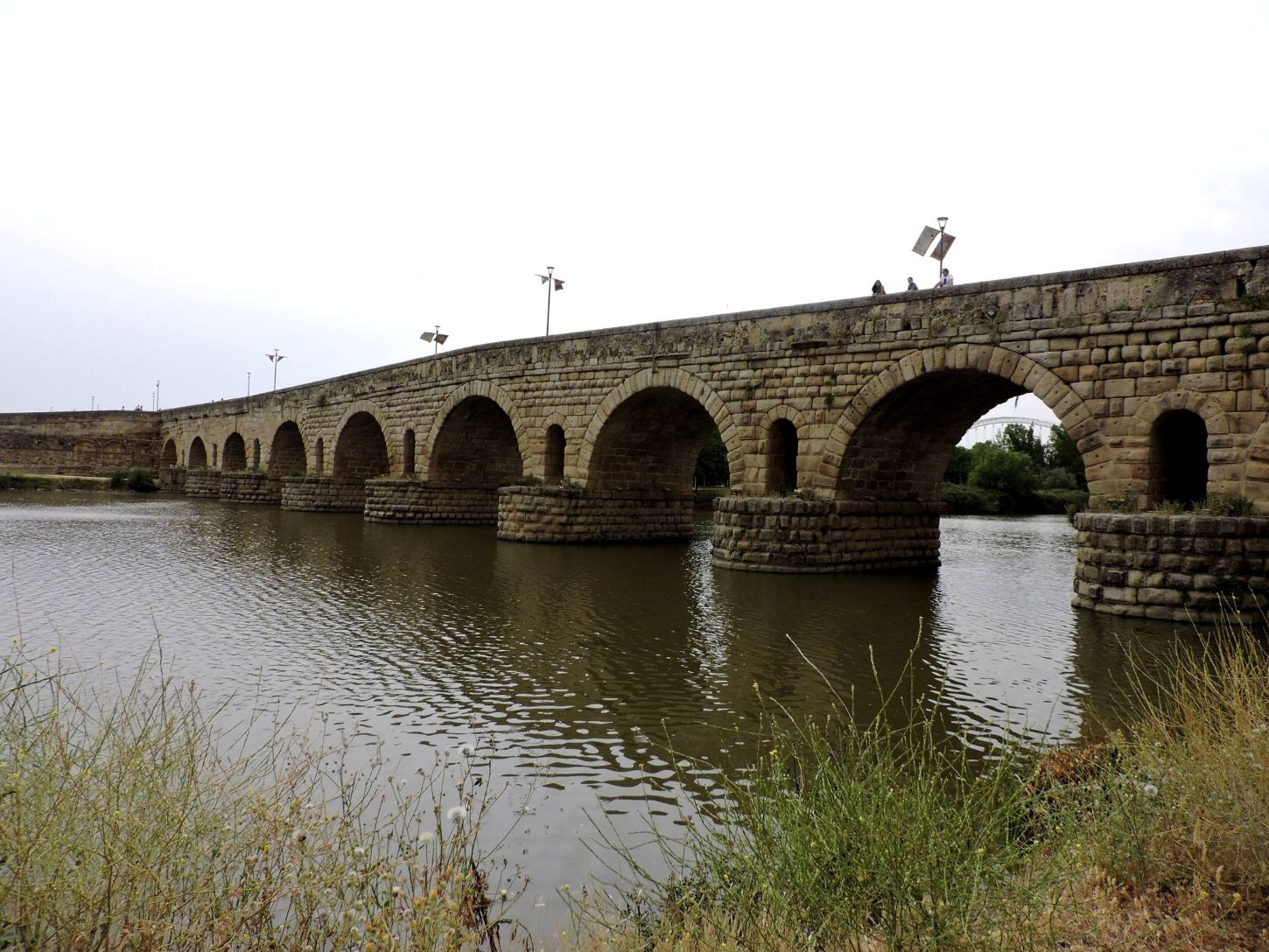
Since the founding of the colony of Augusta Emerita (today Mérida) in 25 BC, the city became the most important center in the communications network of the western Iberian Peninsula, both because of its status as the capital of the province of Lusitania (It spanned the largest part of present-day Portugal south of the Douro river and parts of León and Extremadura in Spain), and because of the ease of crossing the Guadiana river afforded by its enormous stone bridge. Thus, the important Via de la Plata or Silver Route , which crossed Hispania ( Named by the Romans to the Iberian Peninsula) from north to south along its western edge, and the roads leading to Olissipo (Lisbon), Corduba,(Cordoba), Toletum (Toledo), and Caesaraugusta (Zaragoza), all converged in Mérida and had to cross its bridge. The bridge was built at the same time as the founding of the colony, in the last decades of the 1C BC, and it is the structure that determined the city’s location.
The City of Merida on its history: https://merida.es/la-ciudad/breve-historia/
The Merida tourist office on the Roman bridge: https://turismomerida.org/what-to-see/roman-bridge/
The Province of Badajoz tourist office on the Puente Romano of Merida : https://www.turismobadajoz.es/que-ver-en-merida/#Puente_Romano_de_Merida
The Spain National Tourist Office on the Roman bridge: https://www.spain.info/en/places-of-interest/roman-bridge-rio-guadiana/
The Consorcio Monumental de Merida cultural site on the Puente Romano: https://www.consorciomerida.org/conjunto/monumentos/puenteromanoGuadiana
The official Extremadura tourist office on the Roman sites of Merida : https://www.turismoextremadura.com/es/explora/Conjunto-romano-de-Merida-y-Termas-de-Alange/
There you go, another dandy in my beloved Spain, and the needs as usual to come back to these beautiful places, eventually, Mérida is worth the detour indeed. Again, hope you enjoy the post on the Puente Romano of Mérida !!! as I
And remember, happy travels, good health, and many cheers to all !!!


