
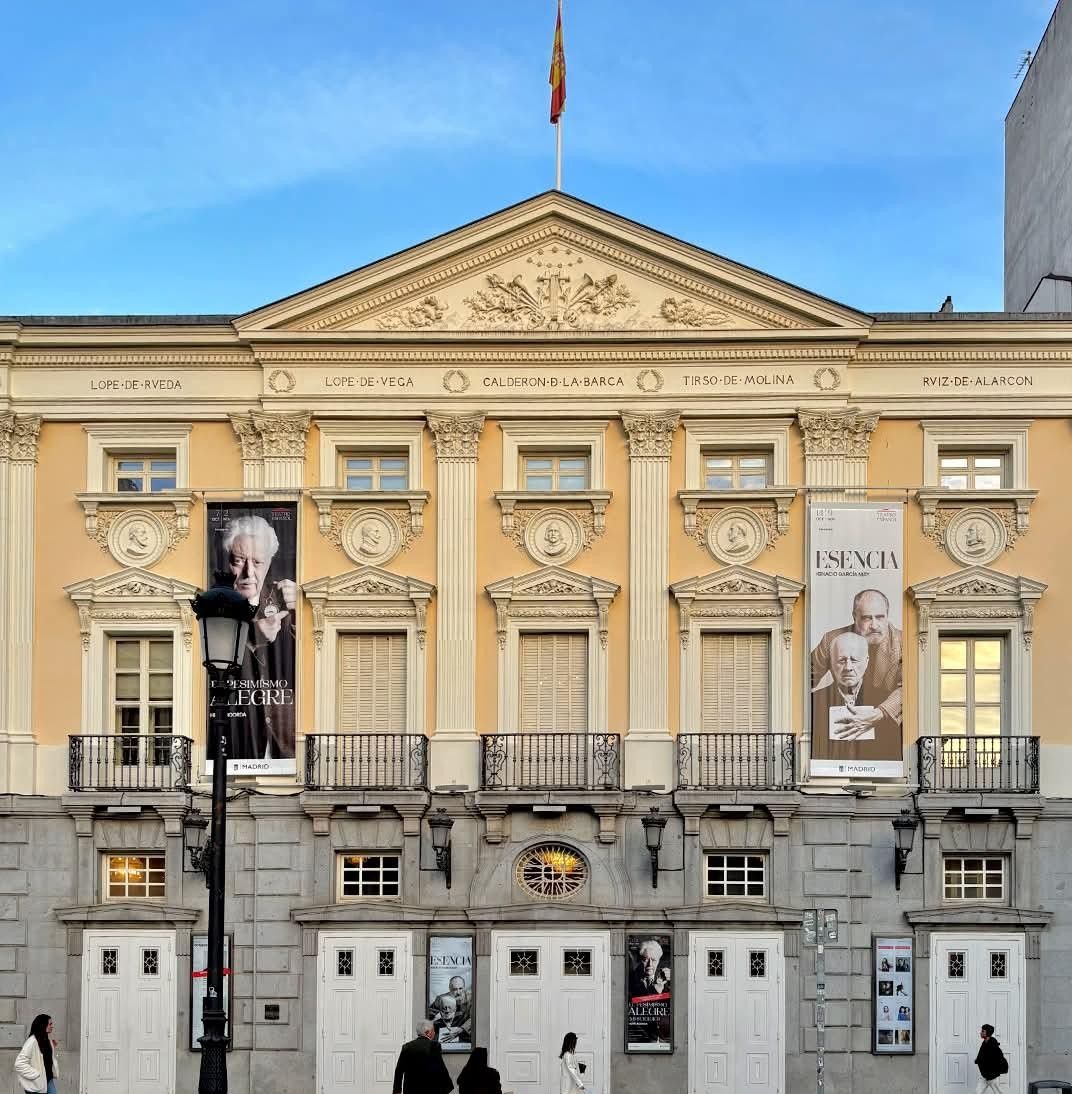
The city that I lived as a teenager and came back so many times over the years, it has become like my second home. Walked it, trained it, bused it, planed it , biked it, you name it I have done it all there . And now ,glad to find me this recent jewel of a picture a bit forgotten in my cd rom vault to share it in my blog for you and me. Therefore, here is my take on the Teatro Español of Madrid !!! Hope you enjoy the post as I.
The Teatro Español, built in 1735 and called the Teatro del Príncipe until 1849, is the oldest theater in Madrid and the most emblematic in the Plaza de Santa Ana (see post). It has hosted plays by the greatest playwrights in the country. By Royal Decree of 1849, the Teatro del Príncipe changed its name to its current one, Teatro Español. The Plaza de Santa Ana! Is located in the heart of the so-called Barrio de las Letras, (see post) its space is delimited by the Calle Principe, Calle del Prado, giving only street numbers to its west and north flanks, where the Plaza del Ángel and the Calle Núñez de Arce ends.
The Sala Principal or main auditorium, with 735 seats offering perfect visibility, is arranged on three levels and boasts superb acoustics. On its stage, the works of Cervantes, Lope de Vega, Tirso de Molina, Calderón, the Duke of Rivas, Zorrilla, Pérez Galdós, Unamuno, Valle-Inclán, Benavente, the Machado brothers, García Lorca, Mihura, and Buero Vallejo, among others, were first performed. The Palco del Rey or King’s Box is located to the right of the audience at the front of the stage, accessible by the royal elevator, dating from the early 20C, and in perfect working order. The Palco del Alcalde or Mayor’s Box, for its part, is located to the left of the audience, at the front of the stage. The Sala pequeña or Small Hall, located in the former Café del Príncipe, was converted in 2006 into a theater with approximately 110 seats, which vary depending on the seating arrangement, allowing for different configurations: one, two, three, or even four-sided seating. Other charming spaces in the Teatro Español include: The Salón de Té or Tea Room, which features an early 20C clock-elevator and is used for official events. The Salon Tirso de Molina Room, which was originally the private parlor where leading actors and actresses received their friends and is now used, due to its beauty, for interviews and photographs of artists. The Parnasillo, a space especially remembered because it was where playwrights met with the company for the first reading of their plays. This last space was decorated in 1929 with a valuable collection of portraits of artists and writers, unique of its kind. Finally, the Salón de los balcones or Balcony Hall, located above the Small Hall, is a versatile space, currently used for the performance of small-scale theatrical productions.
The origins of the present-day Teatro Español can be traced back to the 16C, to the authorization granted by Felipe (Philip) II in 1565 to establish a permanent confraternity in Madrid called the Confraternity of the Holy Passion, which would have a space for the performance of comedies. The Confraternity acquired the space located, on Calle del Príncipe, in 1582, and it was inaugurated on September 21 of the following year. Thirty-two years later, the Confraternity sold the theater to the City Council. The theater, shaping what exists today. It reopened its doors on January 12, 1895, with the play “El desdén, con el desdén” (Disdain, with Disdain), and the business management was assumed via concession by the city council, first by Mr Guerrero, and then by his daughter, the actress María Guerrero, who had financed the works. The actress premiered on this stage works by Benito Pérez Galdós and the Nobel Prize winners for Literature, Jacinto Benavente and José de Echegaray. Guerrero retained management of the theater until 1909. During the following two decades, the Teatro Español was occupied by successive tenants under a concession agreement, among them Jacinto Benavente himself, along with the actor Ricardo Calvo, in 1919. During much of the Spanish Civil War, the concession for the theater belonged to the actor Manuel González, who was performing El alcalde de Zalamea on the date that Francisco Franco’s troops took Madrid on March 28, 1939. During the years of the dictatorship, literary milestones included the premiere of Historia de una escalera and the introduction of works by contemporary foreign authors, such as J.B. Priestley or Jean Anouilh. With the necessary reconstruction, it did not reopen its doors until April 16, 1980, with the performance of Calderón de la Barca’s La dama de Alejandría or The Lady of Alexandria. The theater passed back into exclusively municipal hands from October 16, 1981.
The official Teatro Español : https://www.teatroespanol.es/
The Madrid tourist office on the Teatro Español : https://www.esmadrid.com/en/tourist-information/teatro-espanol
The Madrid tourist office on the Barrio de las Letras: https://www.esmadrid.com/en/madrid-neighbourhoods/barrio-letras
There you go folks, I always have and looking forward to another splendid vacation. The memories of this wonderful dear City of Madrid will linger forever ! I have been by this square of Plaza de Santa Ana a lot ,the quintessential spot of my Madrid ,and the theater is tops, a must to see. Again, hope you enjoy this post on the Teatro Español of Madrid !!! as I
And remember, happy travels, good health, and many cheers to all !!!


