
The city that I lived as a teenager and came back so many times over the years, it has become like my second home. Walked it, trained it, bused it, planed it , biked it, you name it I have done it all there . And now ,glad to find me this jewel of a picture in my cd rom vault to share it in my blog for you and me. Therefore, here is my take on the Ateneo of Madrid !!! Hope you enjoy the post as I.
The Ateneo de Madrid is a private cultural institution located in Madrid, founded in 1835 as the Scientific and Literary Athenaeum. Six Prime Ministers and almost all Spanish Nobel laureates have been associated with the Ateneo, as well as many politicians from the Second Republic and various members of the Generation of ’98, the Generation of ’14, and the Generation of ’27. The Ateneo has two exhibition halls. It is located in the Barrio de las Letras neighborhood, (see post) its space is delimited by the Calle Principe,Calle del Prado, giving only street numbers to its west and north flanks, where the Plaza del Ángel and the Calle Núñez de Arce ends. You can make it here by Metro line 1: Antón Martín station, line 2Sevilla station, lines 1,2, and 3 Sol station. Also, Cercanías Renfe trains on lines C3, C4, C4a, C4b and Regional at Sol station.
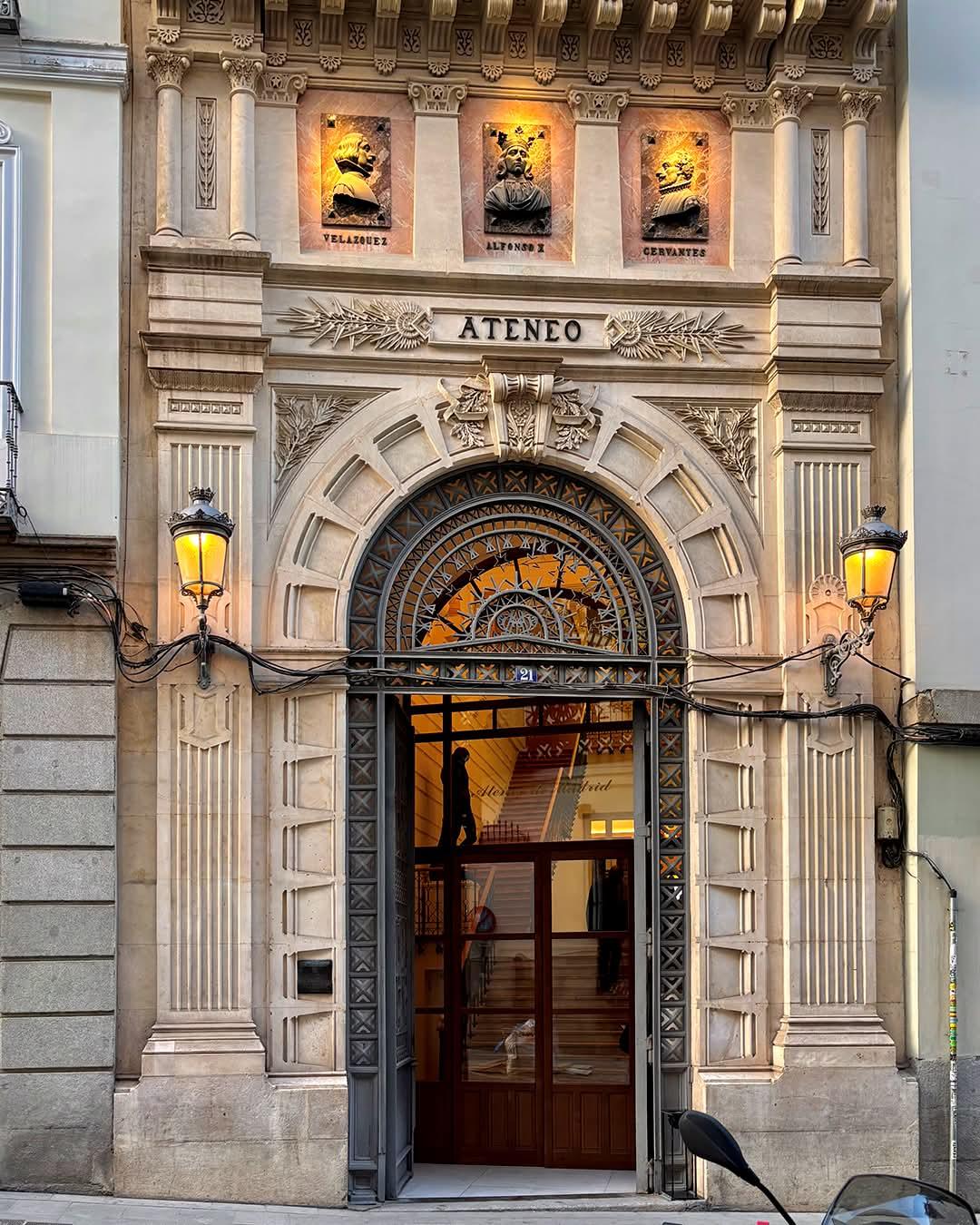
The exterior is notable for its ashlar stone façade, which displays three medallions with reliefs of Alfonso X the Wise, Cervantes, and Velázquez. This small façade doesn’t fully reflect the spaciousness of the building’s interior, and its facilities constitute a complete iconographic ensemble of the political and cultural life of Madrid in the 19C and early 20C. Among the most outstanding spaces are: the wooden Biblioteca or library beneath a skylight; the Neo-Greek style Salón de Actos or Assembly Hall; the Galería de Retratos or Portrait Gallery with works by great 19C Spanish painters; Despacho de Azaña or Azaña’s Office with its Art Deco decoration; and the open-plan Cacharrería,or Pottery room, an emblematic space for political and social gatherings of the time. It also features reading rooms, new multipurpose rooms such as the Sala Nueva Estafeta, and two exhibition halls: Sala Prado 19 and Espacio Prado.
The origins of the Ateneo lie with the Enlightenment thinkers and liberals of the early 19C. The return of exiles during the liberal government in 1820 spurred, among many other initiatives, the creation of the Ateneo Español, directed by Juan Manuel de los Ríos. In 1823, with the return to absolutism under King Fernando VII, the institution temporarily disappeared and had to relocate to London. With the death of Fernando VII and the liberals’ support for Isabel II against the pretender Don Carlos, a certain atmosphere of tolerance was restored during the regency of Maria Cristina. In 1835, the former Ateneo Español, promoted by the Madrid Economic Society, changed its name to the Scientific and Literary Ateneo. The corporation was thus comprised of four sections: I. Moral and Political Sciences, II. Natural Sciences, III. Mathematical and Physical Sciences and IV. Literature and Fine Arts. It prioritized the practical sciences and ignored music in its lectures. On December 31, 1860, it was renamed the Scientific, Literary, and Artistic Athenaeum. According to the 1876 Regulations, the number of sections was reduced to three: I. Moral and Political Sciences, II. Natural, Physical, and Mathematical Sciences, and III. Literature and Fine Arts. Finally, with the inauguration of the new building in January 1884, the Literature and Fine Arts Section was subdivided, including a Music section within the latter. It was then that it abandoned its old building on Calle Montera, and inaugurated, under the presidency of Cánovas del Castillo, a new space at Calle del Prado, 21 (see pic). The dictatorship of Primo de Rivera (1923-1930) suspended the activities of the Athenaeum. During the Spanish Civil War it remained open and it was providential to preserve the integrity of its facilities, especially its Library. The return to democracy has allowed the Ateneo de Madrid to continue being an important center of cultural reference.
The Calle del Prado is located within the Barrio de las Letras or Literary Quarter. It runs downhill from Calle del Príncipe to the Cortes. Along its length, it intersects Echegaray, Ventura de la Vega, León, and Santa Catalina Streets. It is very likely that its name originated with Francisco de Prado, a theater commissioner who lived on this street at the end of the 16C, when it had been a road until very recently. Popular tradition associates it with its proximity to the old meadow of San Jerónimo, later known as Paseo del Prado. The Ateneo de Madrid building stands at no. 21 (see photo above).
The official Ateneo de Madrid : https://ateneodemadrid.com/
The Madrid tourist office on the Athenaeum of Madrid : https://www.esmadrid.com/en/tourist-information/ateneo-cientifico-literario-y-artistico-de-madrid
The Madrid tourist office on the Barrio de las Letras: https://www.esmadrid.com/en/madrid-neighbourhoods/barrio-letras
There you go folks, I always have and looking forward to another splendid vacation. The memories of this wonderful dear City of Madrid will linger forever ! I have been many times in the neighborhood and even stayed lodge at the Barrio de Las Letras neighborhood, a quintessential spot of my Madrid is tops, worth the detour, me think. Again, hope you enjoy this post on the Ateneo de Madrid !!! as I
And remember, happy travels, good health, and many cheers to all !!!


