
Never amazed me in my travels the beauty of my dear Spain. This is deep roots, in fact when visitors comes to Spain or hear about it, what they really see / hear is Andalucia. You heard of this City Sevilla, in the province of Sevilla, and I am lucky enough to find me some paper old pictures that can put in my blog for the memories of always. As we say Spain is everything under the sun !!! I came to it long time ago, and really needs a return, eventually , Therefore, let me tell you a bit on this is Sevilla !!! Hope you enjoy it as I.
Sevilla (Seville) is the most populated city in Andalusia and the fourth in Spain according to official INE data. With its Royal Alcázar, is one of the four cities where the Spanish royal family has an official residence. Its old town, with 4.23 km², is the largest in Spain and the fifth largest in Europe. It is one of the cities with the most listed monuments in Europe. It is the only inland city in Spain with a port, located about 90 km from the Atlantic Ocean, as the Guadalquivir River is navigable from its mouth in Sanlúcar de Barrameda to the city of Seville. However, the size of the ships that enter is limited by a lock with a maximum draft of 8.5 meters, and the Centenario ring road bridge limits the air draft to 42 meters. Seville is among the top 100 world destinations for conferences, thanks in part to the modern and cutting-edge expansion of the Conference and Exhibition Centre (FIBES).
Sevilla enjoys good connections with the network of roads, highways, and motorways that link it to the other Andalusian capitals and major cities in Spain and Portugal. The ones I know are the A-4 Autovia del Sur or Southern Highway from Madrid – Ocaña – Bailén – Córdoba – Sevilla – Dos Hermanas – Jerez – El Puerto de Santa María – Cádiz, The A-66 Autovia Ruta de la Plata or Silver Route Highway from Gijón – Salamanca Plasencia – Cáceres – Mérida – Sevilla. The A92 highway from Sevilla to Almería via Granada: Seville – Antequera – Granada – Guadix – Almería. The N-4 national highway from Madrid – Ocaña – Bailén – Córdoba – Sevilla – Dos Hermanas – Jerez – El Puerto de Santa María – Cádiz. I came here several years back on a road warrior tour meeting friends of péñas or supporting groups of my Real Madrid CF, I came from Màlaga on the A45 highway or Autovia de Màlaga to exit/salida 98 bearing left to connect with the A92 passing by Mollina and continue ,Fuente de Piedra and continue go around Estepa and continue going around Osuana and continue on the A92 highway going around Arahal and continue go around Alcalà de Guadaira and continue into Seville on Avenida de Andalucia bear left on Calle Luis de Morales , then right on Avenida Eduardo Dato then left on Avenida de la Buhaira ,then right on CL Enramadilla ,then left on Avenida de la Borbolla ,right on Avenida Portugal , and left on Calle Nicolas Alpériz where you will find parking Gorillas and walk to Plaza de España, Sevilla !
The Parque Maria Luisa Park is the most famous park in Seville, and between 1914 and 1973 it was the city’s quintessential park. This park originally formed part of the gardens of the San Telmo Palace, belonging to the Dukes of Montpensier, and was donated to the city in 1893 by Duchess Maria Luisa Fernanda of Orléans. It was redesigned by the French engineer Jean-Claude Nicolas Forestier and the architect Aníbal González, and opened to the public on April 18, 1914. Later, the Plaza de España (see below) ,and Plaza de América were opened within the park, which are among its main attractions. The Parque Maria Luisa park, one of the largest and most beautiful parks in Sevilla, surrounded by a channel and it is possible to rent boats to walk and enjoy the view from the water.
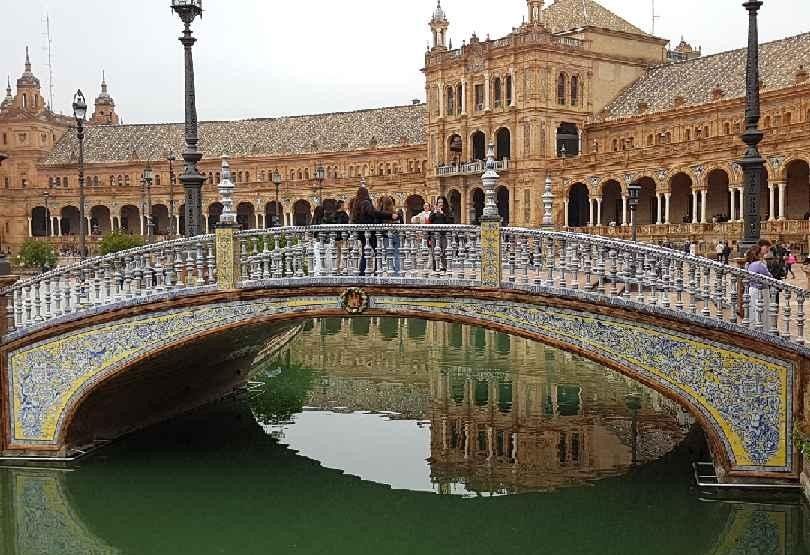
The Plaza de España is located in the historic and artistic center of the village and its construction dates from the 16C. It is a rectangular place which recalls the shape of a Roman circus. Its construction aimed to give more importance and beauty to the entrance to the Palais des Lords de Fuentes, located in the castle of Hierro. There is abundant vegetation, brick benches and four lampposts, on each of which are the coat of arms of Fuentes de Andalucía, Seville, Andalusia and Spain. The Plaza de España is an impressive and unique square of Europe in terms of architecture and design. Built in tribute to Hispanity, the square is a breathtaking size and beauty. It is a wonder that symbolizes the richness of the history and culture of Spain. It represents an important part of the cultural heritage of the city of Sevilla. One of the most beautiful squares in Spain its construction began in 1914 on the occasion of the Ibero-American exhibition in 1929, with the aim of showing the greatness and the cultural richness of Spain and its former colonies . The design of the square merged the architectural styles of the Renaissance and the baroque with the Mudejar architecture, so typical of Andalusia. It has an area of 50,000 square meters, surrounded by a channel which crosses the square by means of four bridges representing the four ancient kingdoms of Spain. In the center is a large fountain symbolizing the Guadalquivir river, which crosses the City of Sevilla. Today, the Plaza de España is one of the most visited places in Sevilla. The Museum of popular arts and customs of Seville: located in the building in the square, The Plaza de España was used as a decor in several films, notably in the Star Wars saga, episode II, the attack on the clones, the square served as a decor in the galactic city of Theed, on the planet Naboo. Also, Lawrence of Arabia, and the Dictator.
Other things to see here ,too many need to return eventually are the city’s historic gardens showcase a wide array of styles and sizes, featuring exotic species, such as those found in the gardens of the Alcázar, the María Luisa Park, and the Delicias Park. Nearby, next to Isla Mágica, is the American Garden, with over 400 plants of American origin. The Alamillo Park covers 48 hectares in the island of La Cartuja. The Cathedral of Sevilla ,the largest Gothic cathedral in the world and the third largest religious center globally. It was declared a UNESCO World Heritage Site in 1987. Its construction began in 1433 on the site left after the demolition of the old Great Mosque of Seville.The cathedral, primarily built in the late Gothic style, was constructed relatively quickly, although additions and decorations were added over several centuries, resulting in a blend of architectural styles: Gothic (1433-1528), Renaissance (1528-1593), Baroque (1618-1758), Academic (1758-1823), and Neo-Gothic (1825-1928). The cathedral complex is further enhanced by the Giralda, the bell tower of Seville Cathedral and the city’s most iconic tower. It measures 94.69 meters in height, and was begun in the 12C as the Almohad minaret of the Great Mosque, the Patio de los Naranjos (Courtyard of the Orange Trees), and the Royal Chapel. The Royal Chapel of Seville Cathedral serves as the cathedral’s apse. King Fernando III aka Saint Fernando, Alfonso X (the Wise), and Peter I (the Cruel), among other members of the Castilian-Leonese royalty, are buried in this chapel. The Royal Chapel houses the Gothic image of the Virgin de los Reyes or Kings, Patron Saint of Seville. Also noteworthy are the treasures of the cathedral and a large number of paintings by Murillo, such as the portraits of Isidore of Seville and Leander of Seville; paintings such as Saint Teresa by Zurbarán; and the sculpted head of John the Baptist. The tomb of Christopher Columbus, a mausoleum is located in the right transept of the cathedral. In 2006, a research team from the Genetic Identification Laboratory of the University of Granada confirmed that the remains of Christopher Columbus are in Seville Cathedral. The Alcázar of Seville is the oldest functioning royal palace in Europe, It began to take its current form after the conquest of Seville by the Arabs in 713, who used the alcázar as a residence for their leaders from 720. After the Reconquista in 1248, it was the lodging of King Fernando III of Castile, and it became customary for it to be the accommodation of successive monarchs.
The General Archive of the Indies was created in 1785 during the reign of Carlos III with the aim of centralizing in one place the documentation relating to the Spanish colonies, which until then had been scattered in various archives. The Torre del Oro (Tower of Gold) is a watchtower located on the left bank of the Guadalquivir river, next to the Real Maestranza bullring. Its name in Arabic was possibly Bury al-dahab, referring to its golden sheen reflected on the river. The Palacio de las Dueñas Palace has belonged to the House of Alba since 1612. It was built between the 15c and 16C, transitioning from Gothic-Mudéjar to Renaissance styles, and is one of the city’s most important buildings. The Museum of Fine Arts of Seville, a building constructed in 1662 and established in September 1835, was officially inaugurated in 1841 and is located in the Plaza del Museo (Museum Square). The Seville City Hall, renowned for its collection of 17C Spanish and Sevillian paintings, is one of the most remarkable examples of Plateresque architecture. Construction began in the 15C, featuring a new Neoclassical main façade facing Plaza Nueva. The Casa de Pilatos is a palace that blends Italian Renaissance and Spanish Mudéjar styles. Construction began in 1483. Considered the quintessential Andalusian palace, it has served as a filming location for several movies, including four Hollywood blockbusters: Lawrence of Arabia; 1492: Conquest of Paradise and Kingdom of Heaven, both directed by Ridley Scott; and Knight and Day, starring Cameron Diaz and Tom Cruise. The former Royal Tobacco Factory building, a prime example of 18C industrial architecture, now houses the Rectorate of the University of Seville and some of its faculties. The Santa Cruz neighborhood, the former medieval Jewish quarter located in the historic center of Seville, is one of the city’s most emblematic and picturesque areas. Within the neighborhood are the Convent of the Teresas, founded by Saint Teresa of Jesus in 1575; the Museum of Fine Arts; the Naval Museum; the Military History Museum of Seville; the Flamenco Dance Museum; the Bullfighting Museum and the Royal Cavalry Bullring; the Carriage Museum; and the Murillo House Museum.
A bit of history tell us that currently, there is controversy among historians as to whether the site was founded by the Phoenicians or the Tartessians. Roman troops entered in 206 BC, during the Second Punic War, under the command of General Scipio Africanus, and defeated the Carthaginians who inhabited and defended the region. Christianity arrived in the city early, and in the 3C, the sisters Saints Justa and Rufina which are among the current patron saints of the city were martyred, according to legend, for refusing to worship Astarte. During the Visigothic kingdom, it occasionally housed the court. In al-Andalus, after the Muslim invasion, Seville was first the seat of a cora (district) and later the capital of a taifa kingdom, eventually becoming the capital of Almohad al-Andalus. In 844, it was sacked by Vikings who sailed up the Guadalquivir river. In 1248, it was incorporated into the Christian Crown of Castile, having been reconquered during the reign of Fernando III, who was the first monarch to be buried in Seville Cathedral in 1252. After the discovery of America in 1492, Seville became the economic center of the Spanish Empire. The Catholic Monarchs founded the Casa de Contratación (House of Trade), from where voyages were directed and contracted, the wealth entering from America was controlled, and, together with the University of Merchants, relations with the New World were regulated. Seville began a golden age of development, thanks to its status as the only port with a royal monopoly on trade with Spanish America and the influx of wealth from that region. Since only sailing ships departing from and returning to Seville’s inner harbor could trade with Latin America, merchants from Europe and other trading centers needed to be in Seville to acquire goods from the New World. During the 20C, in addition to suffering through the Spanish Civil War for only three days, while in the rest of Spain it lasted from 1936 to 1939, as it sided with the Nationalist faction under General Queipo de Llano and the subsequent military dictatorship of Francisco Franco, it witnessed, years earlier, decisive milestones such as the Ibero-American Exposition of 1929 and later, in the democratic era, the Universal Exposition of 1992 and its selection as the capital of the Andalusian Autonomous Community.
The City of Sevilla on its heritage: https://www.sevilla.org/ciudad-de-sevilla/museos-patrimonio-monumental-y-cultural
The Sevilla tourist office on the Plaza de España: https://visitasevilla.es/en/plaza-de-espana/
The province of Sevilla tourist office on getting there : https://www.turismosevilla.org/en/how-get-there-and-move-around
The Andalucia regional tourist office on Sevilla: https://en.andalucia.org/places-to-visit/seville/seville/
There you go folks, one of the best of my Spain, and plenty to see in architecture, history, personalities, and gastronomy/wines you should be there and we will be back! Again,hope you enjoy this post on this is Sevilla !!! as I
And remember, happy travels, good health, and many cheers to all !!!


A fabulous city
LikeLiked by 1 person
Oh like so many in my Spain hehehehe! Thanks for stopping by Cheers
LikeLike
Absolutely
LikeLiked by 1 person
Plaza de España is such a beautiful gem in Seville. In fact, the city itself is gorgeous! I went almost a decade ago, and I’d happily return to explore more 🙂
LikeLiked by 1 person
Glad you enjoyed with nice memories of it. Thanks for stopping by Cheers
LikeLiked by 1 person