
This is a memorable road warrior trip a while back and only had glimpses of it mix in other posts. I decided to do one for them deservingly so for Lugo in the Lugo province of the autonomous community of Galicia in the kingdom of Spain. I took a car trip to Lugo, not much time there just passing city center for a quick look, One of my road warrior trips ,and always looking to be back. Lugo is located about 100 km from the Costa Verde on the Bay of Biscay. The City is 495 km from Madrid, 210 km from Oviedo, and 94 km from Coruña from where I came along the AC10 continue on the N550 ,and the Ac211 roads continue to the AC214 road dir Balomir where change to the N VI (6) road continue dir Betanzos continue dir Colantres continue making sharp tight turns in the mountains continue on same N VI road parallel to the A6 autovia del Noroeste continue dir Guitiriz, continue dir Begontes continue same road dir Lugo entering City on Avenida da Coruña passing by the ramparts wall continue on Rua Nova to the Catedral of Lugo (see post),
The main communication line of Lugo throughout its contemporary history has been the N-VI (6) highway from Madrid to La Coruña, with exits/salidas at 494 and 498, The LU 11 Lugo-Nadela highway, and as an urban double carriageway between km points 504 and 507. the A6 autovia del Noroeste highway from Arteijo-Madrid with exits/Salidas at 488 Lugo Sur Nadela, 493 Lugo center -Hospital Universitario, 497 Lugo Centro, 500 Lugo Norte-Poligono industrial de O Ceao, The A54 Autovía Santiago-Lugo, The A8 Autovía del Cantábrico with exit/salida 522A in Baamonde – Villalba, and the local AG64- Ribadeo – Gijón – Bilbao – Irún – French Border, taken on the northern traject to France,
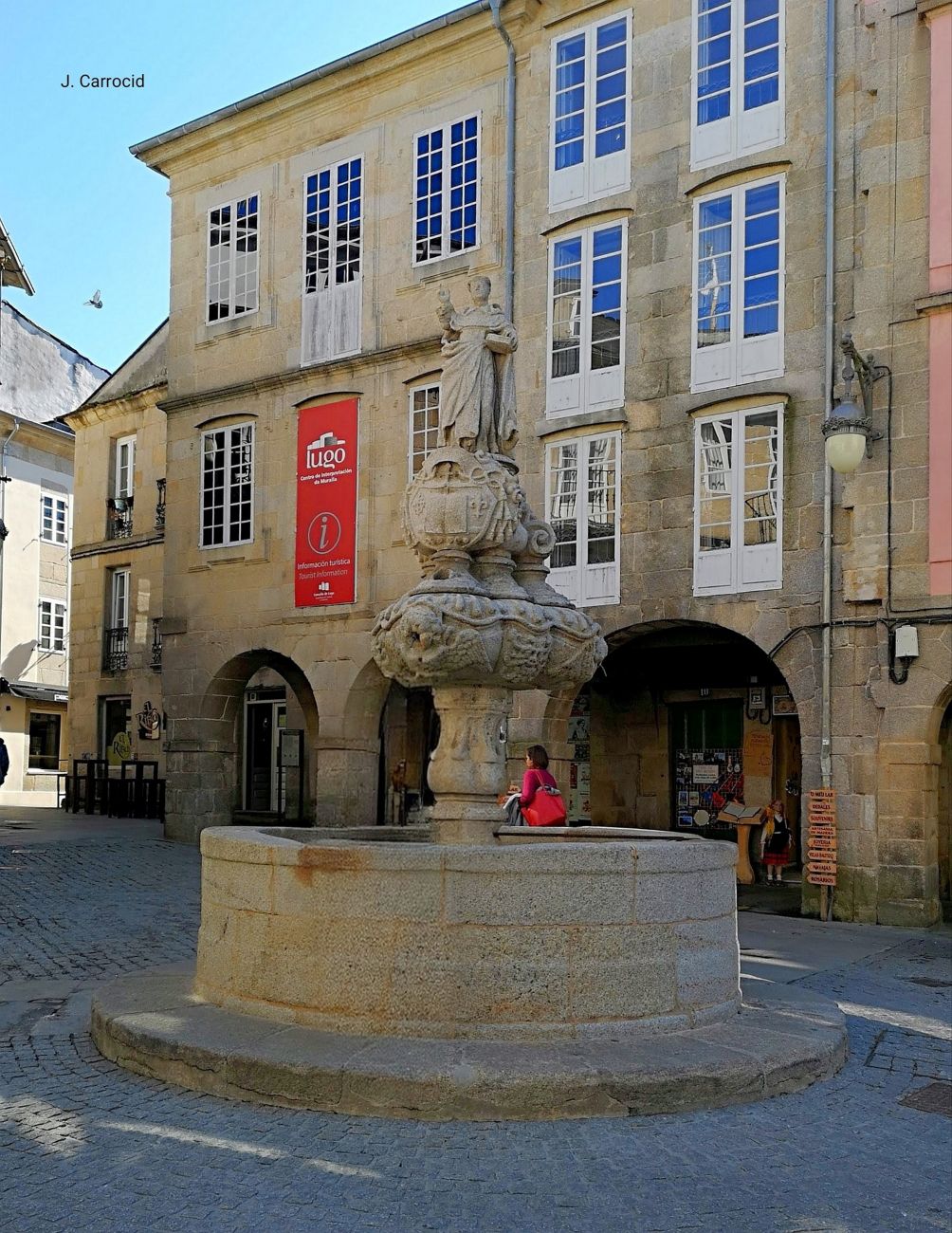
The Plaza del Campo was one of those corners that I came walking out of whims, without quite knowing why. A triangular square, with an irresistible charm, is a Baroque work from 1754, erected by order of Bishop Izquierdo to alleviate the area’s drinking water needs. Plaza del Campo is located in the historic center of Lugo. It is believed to have been the site of the Roman Forum of ancient Lucus Augusti. This small, triangular square is located near the cathedral (see post), and is possibly the oldest surviving square in the city. In the late Middle Ages, it was the commercial center of the city. Its current appearance is a product of the original medieval layout, strongly influenced by the Baroque style dominant in the houses surrounding it, which were built by the wealthiest merchants in the area during the second half of the 18C. In the center of the square is a fountain presided over by a statue dedicated to Saint Vincent Ferrer (see pic). This fountain received water to supply the city through an ancient aqueduct that no longer exists. It was completed in 1754, during the reign of Bishop Esquerdo, whose coat of arms is sculpted at the base of the statue. The Baroque houses in the square support their stone facades on arches that form arcades. In the lower part of the square, several medieval houses supported by columns remain, some of which are of Roman origin and were reused by the builders. Rúa Nova, also of medieval origin, converges at this square. It was the city’s busiest street until it began to expand beyond the city walls. This area is popularly known as “Wine Street.” The square also features the Muralla Interpretation Center, (see pic) as well as several terraces where you can relax with a drink.
Other things to see here, me think out of many are the Roman wall ,the city’s main monument. It is the only wall built by the Romans that preserves its entire original perimeter. It is more than 2 km long and was declared a World Heritage Site by UNESCO on November 30, 2000. Lugo has Roman baths and a Roman bridge. The Church of San Pedro was formerly part of the Convent of San Francisco. With its dome and the wooden ceiling of the main nave, it is one of the rare, if not the only, example of Mudejar art in Galicia. The Church of Santo Domingo is located in the square of the same name. In the last quarter of the 13C there is evidence of the arrival of the mendicant orders in the city, and a community of Dominican monks has been documented since at least 1274. The convent and the current church were built in different stages throughout the 14C. From the Gothic period, the access door to the temple, the head, part of the transept, and the door that connects the temple with the cloister have been preserved. The Cathedral of Santa María, (see post) construction began in 1129, in the Romanesque style, with additions in later centuries such as the portico of the north door, the clock tower, the cloister, and the façade that it has today, in the neoclassical style. It was declared a World Heritage Site in 2015. The façade of the City/town hall, from the early 18C, stands out for being an archetypal example of Galician Baroque. The Provincial Museum stands out for its collection of Celtic goldsmithing, its Roman mosaics and interesting collections by Galician artists such as Castelao, Julia Minguillón, Castro Gil and Asorey. The Plaza de Santa María is located next to the portico, the Old Tower, and the head of the Cathedral. It has a triangular floor plan, and is delimited by three large buildings: the aforementioned cathedral temple, the episcopal palace, and the rear of the Caixa Galicia Foundation, communicating on this side with the Plaza Mayor by means of the Luis Pimentel staircase.
A bit of history I like tell us that the City of Lugo is of Roman origin, it was founded in 25 BC by Paulo Fabio Maximus and is the oldest in Galicia. Built near a fort, in Roman times it was named Lucas Augusti. Numerous Roman remains, many of them preserved in the Provincial Museum, are testimony to its early history, especially its Roman wall, unique in the world, which preserves its entire perimeter, and which was declared a World Heritage Site in 2000. After the arrival and capture of the city by the Suebi in 460, the Council of Lugo took place, in which the church was elevated to metropolitan see. In Visigothic Hispania it was the episcopal see of the Catholic Church. In 714 the Muslims arrived in Lugo, and in 741 Alfonso I occupied the city without resistance. In 842 a large Galician army gathered in the city to conquer Oviedo and raise Ramiro I to the throne. Alfonso VI granted the bishopric the lordship of the city in 1088. In the 8C the city was a place of passage for pilgrimages to Santiago de Compostela and was a stage head of the so-called “Primitive Route” of the Way of St. James, and during the Middle Ages it was also a center of pilgrimage, since the cathedral had the special privilege, which it still retains today, of displaying a consecrated host to the public twenty-four hours a day; in 1669 the Offering of the Kingdom of Galicia to the Sacrament was established, still celebrated today It was not until the division of the Spanish state into provinces in 1833 and the creation of the councils when the town was designated as the provincial capital, a decision motivated above all by the central location of the walled city, and it became the most important of those that today form part of the province of Lugo, which meant a constant growth in population and extension.
The City council of Lugo on its heritage : https://concellodelugo.gal/es/lugo-destino-turistico-1
The Lugo province tourist office on Lugo: https://www.terrasdelugo.info/lugo.html
The Galicia region tourist office on Lugo : https://www.turismo.gal/que-visitar/cidades/lugo?langId=en_US
There you go folks, a wonderful road ride into beautiful Galicia and on this time, the pretty Lugo. Always looking forward to be back, eventually. Again, hope you enjoy the quick ride on this is Lugo !!! as I,
And remember, happy travels, good health, and many cheers to all !!!


