
Oh yes another wonderful old little town of my dear Spain; this is deep country and our road warrior trips at its best. There are so many towns that will take you a life time to see them all, and each is unique. This is one of them Olite in Navarra, I found me ,again, pictures in my cd rom vault that should be in my blog for you and me, Therefore, here is my take on this is Olite !!! Hope you enjoy it as I.
The Plaza Carlos III El Noble square is the main square of Olite. There you’ll find the entrance to the Royal Palace, bars, restaurants, the tourist office, and some of the city’s historic buildings. At the opposite end from the Royal Palace, you’ll see Olite’s Town Hall, and right in the center are the Galleries .These galleries, where you could ride two abreast on horseback, are steeped in legend, associated with secret passageways, exits from the Royal Palace, or perhaps part of Charles III the Noble’s dream project to connect the palaces of Olite and Tafalla with underground galleries.
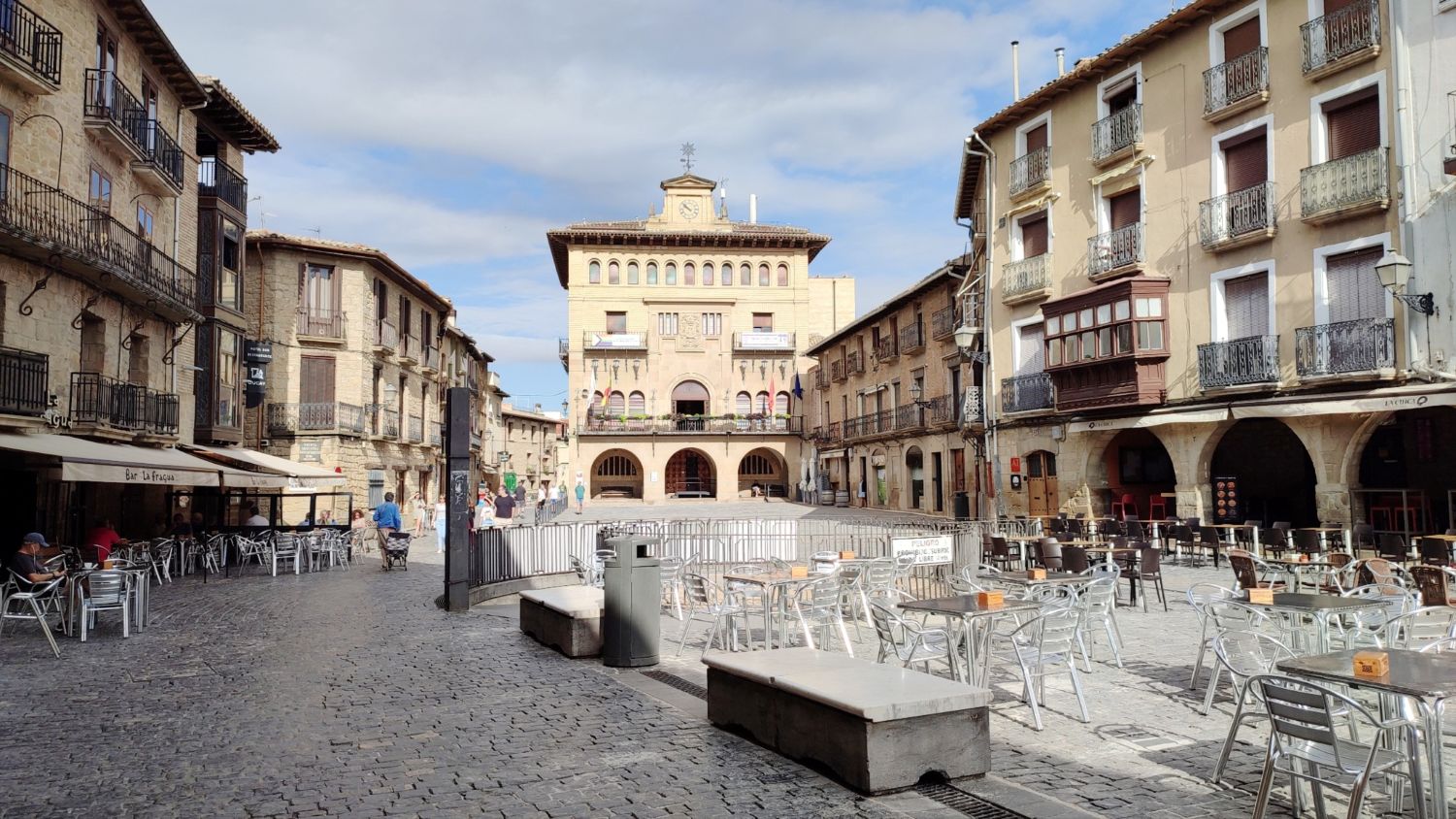
The town of Olite or Erriberri in Basque is located in the foral community of Navarra, and in the kingdom of Spain, It is located in the mixed linguistic zone of the province (local,basque and castilian), It is 43 km from Pamplona, 52 km from Tudela,84 km from Logroño, 357 km from Madrid, and 143 km from Saint-Jean-Pied-de-Port (France) from where we were coming down by Soria and then Madrid, The carretera NA-8602, which corresponds to the old traject of the N-121 before the construction of the variant of Olite goes into the City from both ends,and communicates between Pamplona, northern Navarra and San Sebastián in one direction and Tudela, Navarra, Madrid and Zaragoza in the other direction. This traject can also be carried out in other directions by the AP15 or Autopista de Navarra from where there is a connection on the N-121. We went out of SJPP on the French D933 road bearing left onto Spain with the N135 highway dir Luzaide continue on mountaneous curvy road past Roncevaux continue to Espinal bearing right continue on the N135 road carretera Pamplona-Roncesvalles continue to Erro and the Carretera de Francia bearing left onto the NA2330 road or Carretera de Erro dir Urroz Villa continue and here take the NA234 road or Carretera de Elorz continue to connect at exit/salida 16 with the A21 highway dir Noaîn where get on the loop road to connect with the AP15 highway or Autopista de Navarra to exit/salida 50 to connect with the N121 road into Olite bear left onto the NA6620 road into City center Plaza Carlos III El Noble,(see above pic).
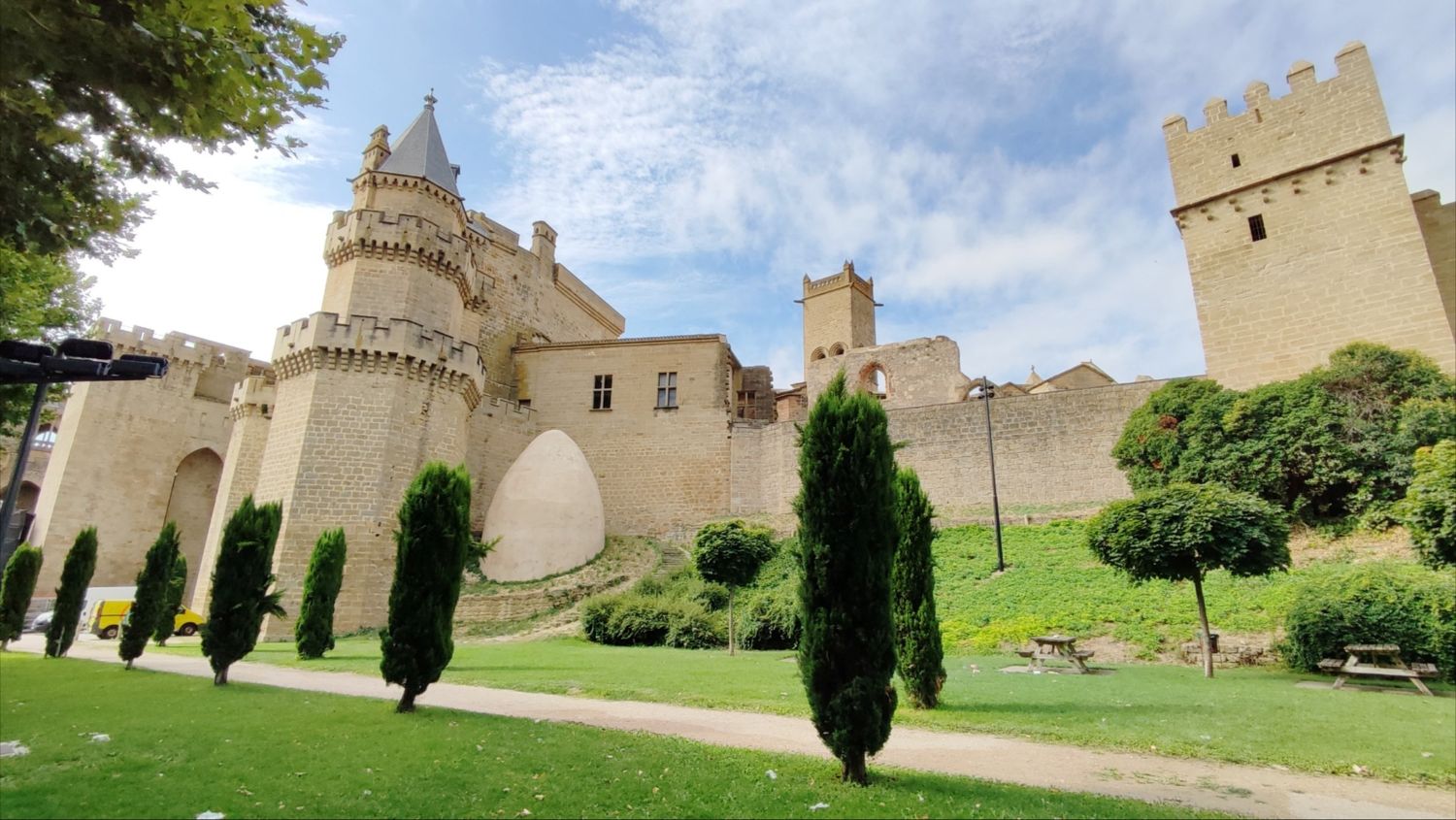
The Palacio de los Reyes de Navarra ; it was Carlos III “el Noble”, who in the 14C began the amplification of the previous when he was at the Palace, the king of Navarra, Carlos III “the Noble”, decided to convert the existing palace into a permanent domain and endow it with all the ornaments owned by it. The set formed by our homes, gardens and wells, surrounded by the high murals and ramanents by the numerosas towers, entrusts it with a spectacular and magical silhouette , After the invation of Navarra at the beginning of the 16C by Castilla, the state of disrepair of the palace will gradually deteriorate. This process culminated with the fire ordered by the guerrilla Espoz y Mina during the war of Spanish independence (1813), before the time of which the French troops of Napoleon were fortified. The current state of the palace is before a restoration, to be completed without conclusion, initiated by the beginning of the 20C,
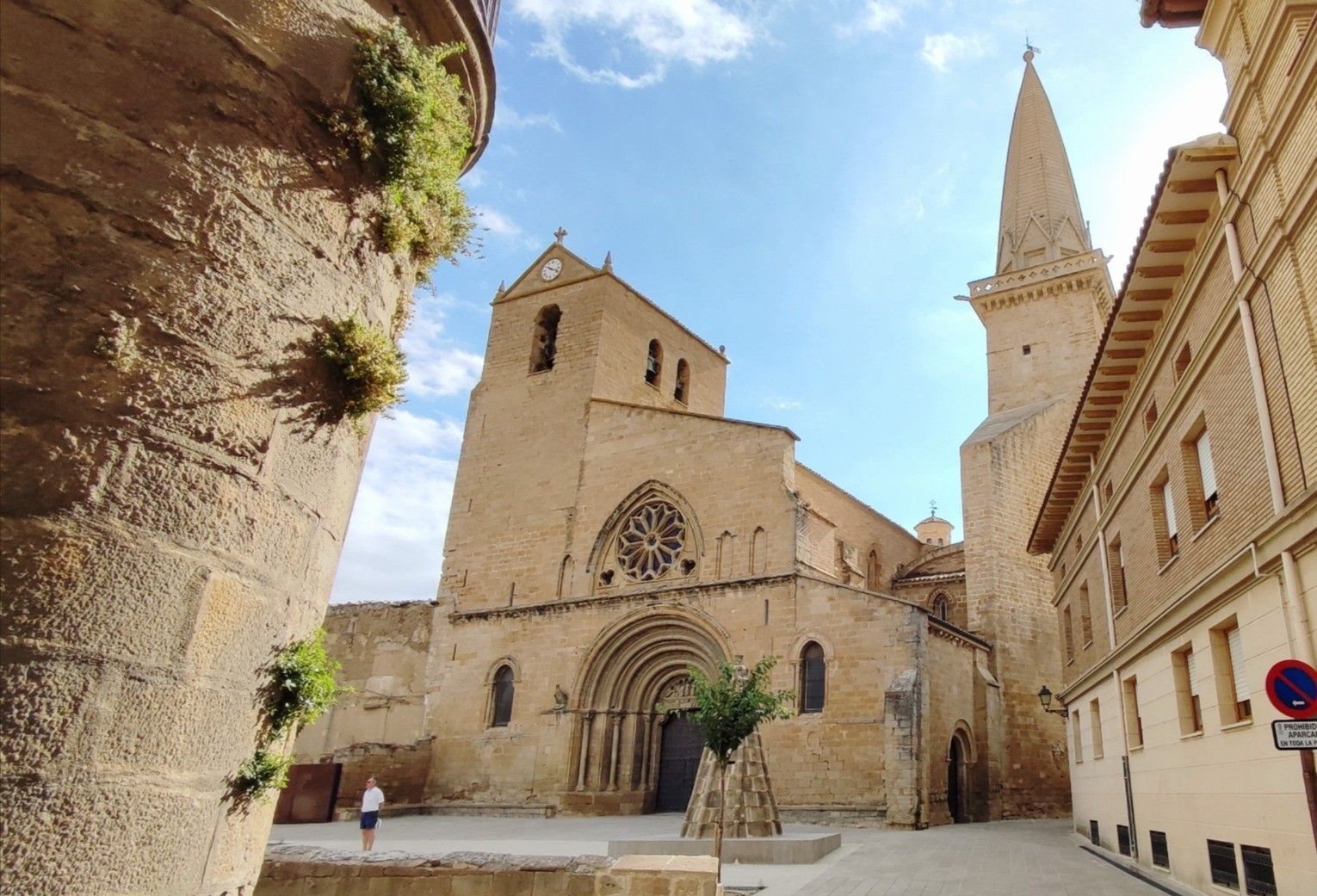
The Church San Pedro or St Peter is the most ancient church of Olite currently preserved. It was initiated in a Romanesque style, passed into a Christian Gothic and later expanded into the Barroque era. See the portal and the romantic cloister. The Gothic Pervives in the Tower of Aguja of 54 meters high, crowned by a graceful spire 14C, and also called the High Tower, in the Bell Tower and in the choir 14C, and in the Chapel of Christ 16C, crowned by an airy arrow 16C,
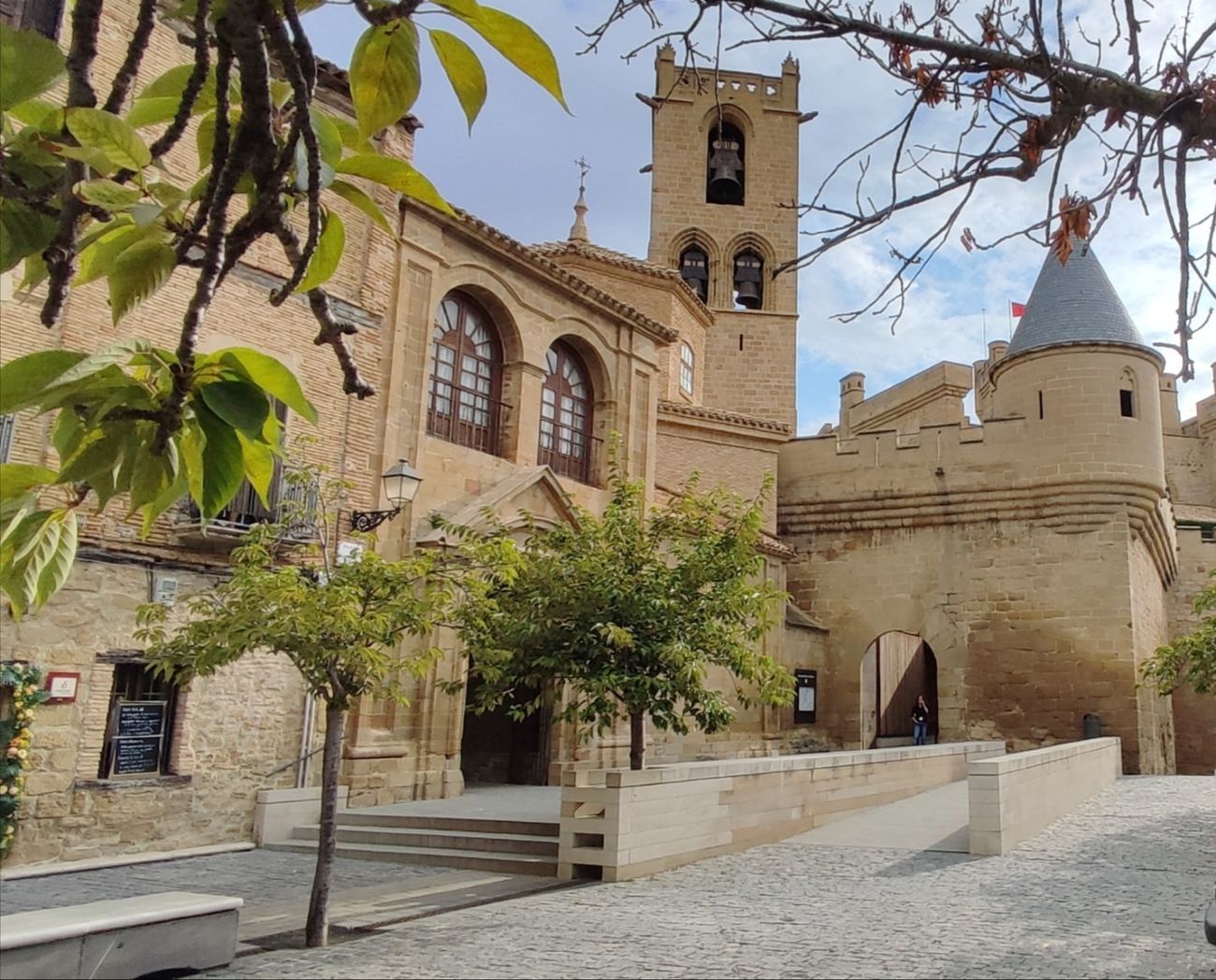
The Church of Santa María la Real is a Gothic church begun during the first third of the 13C with Cistercian influences, advancing towards the façade that was finished around the year 1300 already in full Gothic, in which its façade, its doorway and its Renaissance altarpiece stand out. The atrium was added around 1432. In 1767-1773 the church was extended with the Chapel of Cristo. The sacristy became part of the courtyard of the Palace and the Chapel of Cristo was accommodated as a sacristy. The tower uses a first body of a Roman tower of large cushioned ashlars; the finish is modern from 1918. The stained glass window of the rose window is from 1998.
Other things to see here are the Monastery of Santa Engracia was a 13C foundation practically rebuilt between 1607 and 1612 Since October 2, 1804 the building houses the Poor Clares who left the Monastery of Santa Engracia in Pamplona on October 17, 1794, The Convent of San Francisco ; was the first home of the Franciscan friars ,a modest building; in the 13C they received financial support from Theobaldo II for the works and in the times of Juana II and Carlos II the construction of the convent was completed. Already in the time of Carlos III and his daughter Doña Blanca 15C corresponds to the current Gothic façade and tombs. Old Palace or of the Theobalds ,from a Roman construction, a first defensive castle was built in the time of King Sancho VII, the Strong (12-13C). Being improved by his successors Theobald I and Theobald II. Since 1966, when it was ceded to the Spanish government, who undertook its restoration, it has been home to the Parador de Turismo Príncipe de Viana. The Medieval galleries with the main one is located in Plaza Carlos III and has been accessible to the public since 1987. There are others, such as the oldest one, next to the San Francisco portal, which served as a cellar for aging wine during the last century. The Torre del Chapitel Portal of the Roman and medieval walled enclosure, cambra del Concejo or council chamber, market house , clock tower and de la queda or curfew all these activities come togeth,er in the history of the Spire Tower. The torre del Chapitel or Spire Tower is, after the Royal Palace, the most emblematic civil architecture building in Olite. Olite preserves sections of the walled enclosure from the Roman period, attached to houses.
The history of wine in Navarra has always run parallel to that of Olite, Pitillas, and Ujué, towns located in the Ribera Alta region. Nine centuries have passed since Theobald I, Count of Champagne, planted his first vines after discovering the richness of its land and favorable climatic conditions, paving the way for the town’s winegrowers to this day. Later, Carlos III the Noble, by establishing his court in Olite, further strengthened its winemaking culture, multiplying the plantations that would eventually supply his entire kingdom with wine. Olite is home to the Regulatory Council of the Navarra Designation of Origin, the Navarra Viticulture and Oenology Station (EVENA), and the Wine Museum, making this town the economic, scientific, and cultural epicenter of wine in Navarra. One of my all time finds was/is the Bodegas Ochoa at Calle Miranda de Arga 35, a family-run winery with a tradition of producing wines using traditional practices combined with new production techniques, always using grapes from its own vines, planted, pruned, and harvested by the winery itself, The official Bodegas Ochoa : https://bodegasochoa.com/en/family/
A bit of history I like tell us that archaeological remains show that during the Roman Imperial period 1C AD, a strong walled belt defended a small hillock on which the medieval town would later be founded. The Visigoth king Suintila founded the city of Oligicus or Ologite in 621 and refortified it to confront the Basques. From the 15C, King Carlos (Charles) III “the Noble” and his wife Eleanor of Trastámara began the construction of the Royal Palace of Navarra in Olite, a reflection of its times. More than a century after the Castilian occupation in 1512, Felipe IV of Castilla granted it the title of city in 1630.
The City of Olite on its other heritage : https://www.olite.es/turismo/monumentos-y-edificios-de-interes/
The City of Olite on the Palacio Real : https://www.olite.es/turismo/palacio-de-olite/
The Olite tourist office on its heritage : https://www.olite.com.es/TURISMO/INFORMACION/Monumentos.php
The Navarra floral community tourist office on Olite : https://www.visitnavarra.es/en/olite
There you go folks, another dandy in the wonderful country of Spain from its foundations. Enjoy Olite in Navarra, the quant town and nice monuments worth the detour, me think. Again, hope you enjoy this post on this is Olite !!! as I
And remember, happy travels, good health, and many cheers to all !!!


I’ve been here during (cycling) Tour of the Basque Country a few years ago.
LikeLiked by 1 person
Yes indeed Navarrese are good cyclists.. thanks for stopping by. Cheers
LikeLiked by 1 person
Miguel Indurain comes from Navarre
LikeLiked by 1 person
Yes indeed from Villalba near Pamplona! Cheers
LikeLiked by 1 person
Thanks for the precision
LikeLiked by 1 person
You are welcome
LikeLiked by 1 person