
In my nostalgic saga of my family visits to wonderful places in my belle France, we found one quant historical Eu on the off the beaten path road warrior trails of yours truly. I have found some pictures in my cd rom vault that should be in my blog for you and me, Therefore, here is my take on this is Eu !!! Hope you enjoy the post as I
The town of Eu is located in the Seine-Maritime department no, 76 in the Normandie region of my belle France. Along with Le Tréport and Mers-les-Bains, it is one of the three main towns in the Eu urban area, which is entirely part of the inter-municipal community known as the Villes Sœurs or Sister Towns. It is 4 km from Le Tréport, 5 km from Mers-les-Bains, 24 km from Saint-Valery-sur-Somme, 38 km from Abbeville, 32 km from Dieppe, 94 km from Rouen, 214 km from Versailles, and 526 km from my current home. We came here from Versailles going out dir Saint Germain en Laye to connect with the A13 autoroute de Normandie dir Rouen, then go in at exit/sortie 22 Oissel onto the D18E road passing by Saint-Étienne-du-Rouvray continue and bear right on the Pont Mathilde over the Seine river connecting with the N28 highway passing on the Île Lacroix continue around Rouen continue same road becomes the A28 or Route des Estuaires dir Neufchatêl en Bray continue to exit/sortie 6 to get into the D920 road dir Smermesnil bearing right here onto the D14 road which becomes the D59 road dir Saint-Pierre-des-Jonquières and continue passing center of Fresnoy-Folny where bearing right to connect with the D1314 road dir Eu get entrance of town bear right onto the D1915 or Rue Jean Duhornay and continue bearing left onto the Collegiale Notre Dame et Saint Laurent,with parking in front Place Isabelle d’Orléans,
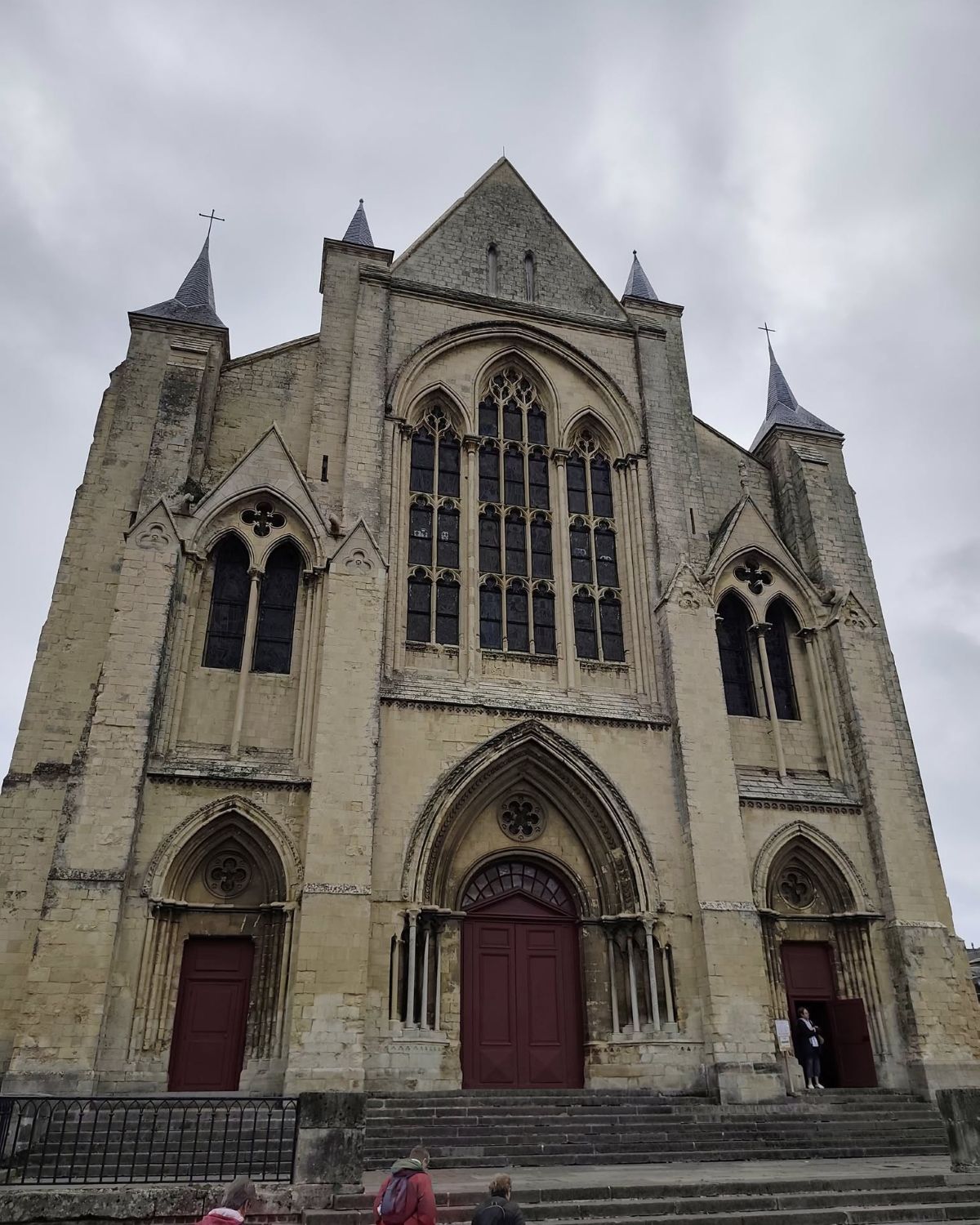
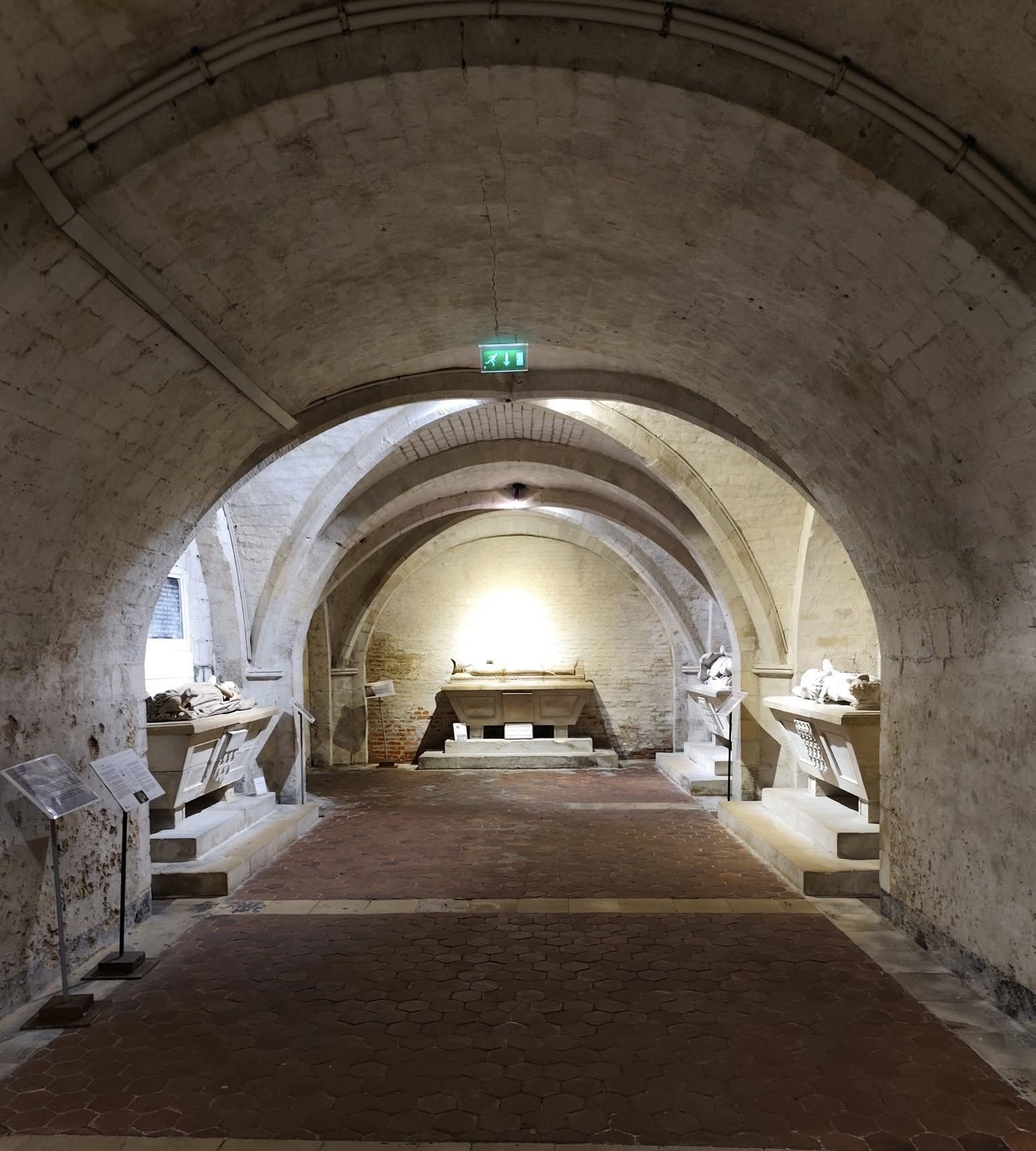
We had time in our road warrior trails to stop by the Collegiate Church Notre Dame et Saint Laurent, or the Collegiate Church of Our Lady and Saint Lawrence houses numerous works of sacred art in the fields of sculpture, painting, cabinetmaking, stained glass and organs. The collegiate church has two organs. The great organ, located on the western façade, dates from 1614 and was restored in the 19C by the prestigious Cavaillé Coll firm. A vast crypt houses the recumbent statue of the Patron Saint (12C) and the exceptional dynastic tombs of the Counts of Eu of the Artois family (14-15C). A 16C entombment is preserved in the original chapel of the Holy Sepulchre. 17-18C stalls, and pulpit of 1752,
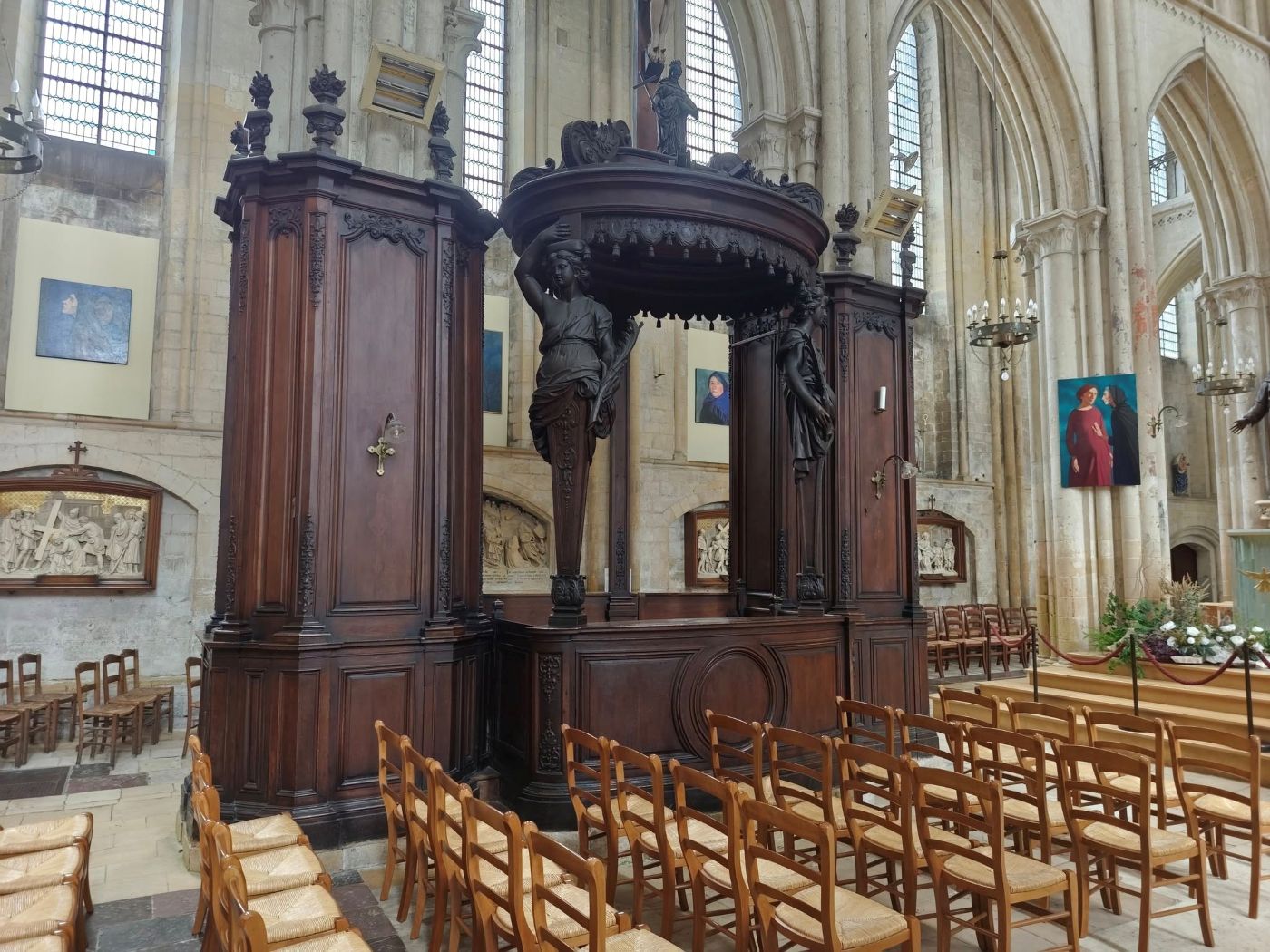
The Banc d’œuvre or workbench, a carpentry work dating from 1731, depicts an oval canopy supported by two caryatids and adorned with lambrequins whose ovals once featured carved fleurs-de-lis. This piece of furniture is surmounted by a statue of religion, beneath which cannons point, recalling one of the donors, Louis Auguste de Bourbon, Grand Master of Artillery, Duke of Maine, and Count of Eu from 1693 to 1736, who provided the wood needed for its construction.
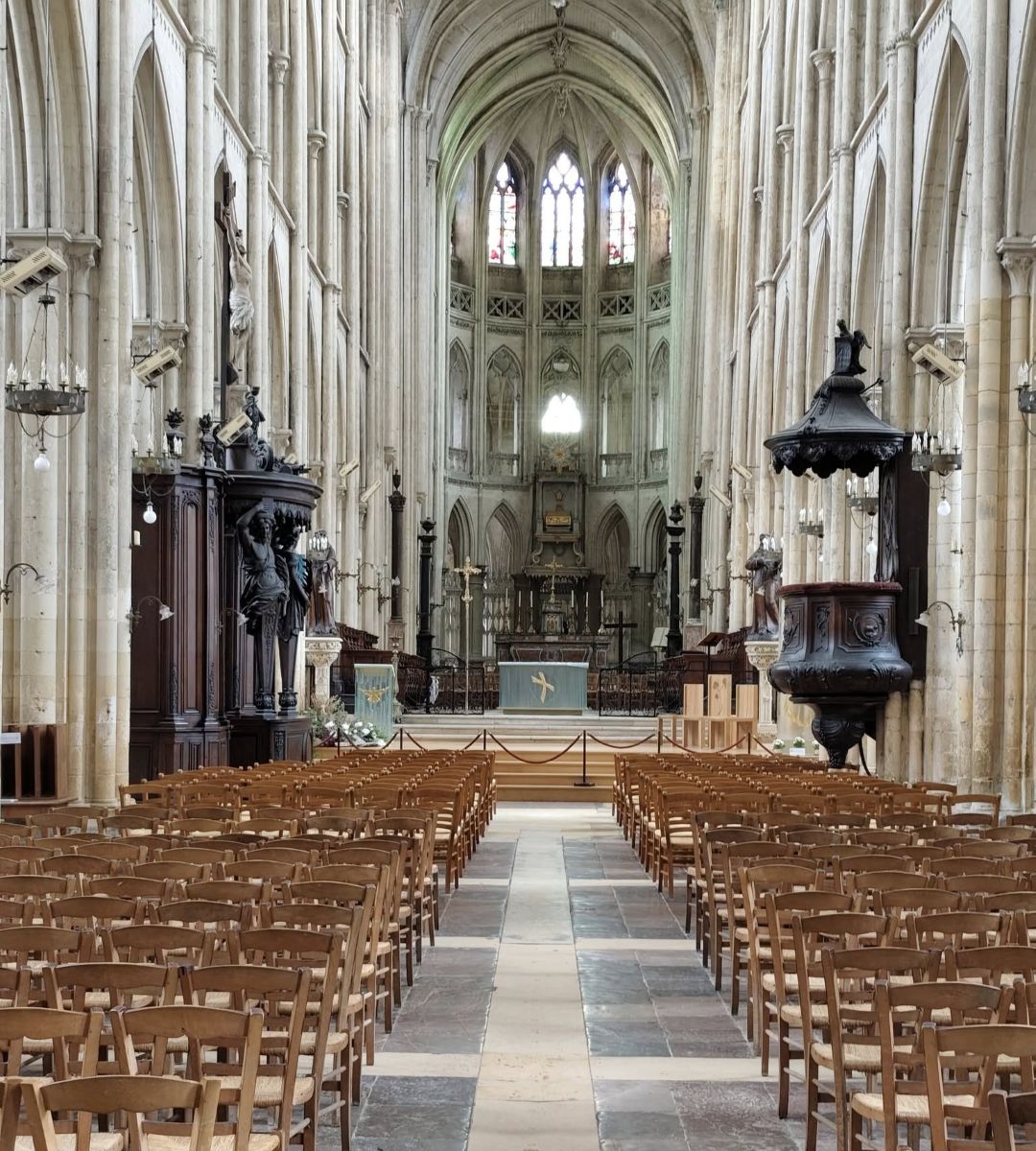
The Collegiate Church of Our Lady and Saint Lawrence is recognized as a high place of Norman religious architecture. It is part of the Abbeys of Normandy route. It is linked to the destiny of Lawrence O’Toole, Archbishop of Dublin at the end of the 12C. Charged by the Pope with a diplomatic mission to the King of England in Normandy, his journey took him to Eu, where, ill, he died. Buried in the small church of the Abbey of Saint Mary, the legate, known for his great kindness and his role as a peacemaker, was the object of a true cult of devotion. A large church, housing the college of canons, was built from 1186 to 1240, adjoining the abbey. It has a vast crypt to accommodate the tomb of the archbishop, canonized in 1225, and the many pilgrims. The simplicity and austerity of the 12C west portal contrasts with the 44-meter nave, in which the gaze is drawn by the verticality of the three elevation levels, expressed by the primitive and radiant Gothic styles. Illuminated by the large bays of the top level, the nave, bordered by the side aisles, opens onto the transept and the choir. In 1426, the fire in the lantern tower led to major restoration work on the transept and the chevet, which were rebuilt in the flamboyant Gothic style. During the French revolution, the abbey was destroyed, and revolutionary vengeance was exercised on the works of sacred art and the tombs of the Counts of Eu.
Other things to see here with more time are the Renaissance-style castle with a park, it houses the City/town hall and the museum. The castle was built at the end of the 16C on the orders of Catherine of Cleves and Henry of Lorraine (Duke of Guise). The Grande Mademoiselle had it enlarged. Louis-Philippe Museum created in 1973 in the Château d’Eu has become the Louis-Philippe Museum. The Association of Friends of the Louis-Philippe Museum of the Château d’Eu was created in 1985 by the Countess of Paris, born Isabelle d’Orléans and Braganza, to promote the enrichment of this building, labeled a Museum of France. Part of the former royal estate still belongs to the Orléans, heirs of Isabelle d’Orléans and Braganza.: decorations from the 17C and 19C, ceilings from the 17C, parquet floors from the Louis-Philippe period among the most beautiful in France and fittings by the architect Viollet-le-Duc under the Third Republic, collections of La Grande Mademoiselle, King Louis-Philippe, the Orléans family and the imperial family of Brazil, the princes of Orléans-Braganza. Chapel of the Jesuit College ,erected by Catherine de Clèves for the Jesuits, it is dedicated to Saint Ignatius of Loyola, and contains the tombs of Catherine de Clèves and Henri de Guise.
A bit of history I like tell us that as situated on the border between the Frankish and Norman possessions after the Treaty of Saint-Clair-sur-Epte (911), Eu played a strategic role in stabilizing the region. This treaty, signed between King Charles III the Simple and the Viking leader Rollon, established Normandy as a semi-autonomous territory under the latter’s authority. In 996, the County of Eu was created by Richard I of Normandy, Rollon’s grandson, to protect Normandy against enemy incursions. In 1002, William, Count of Hiémois, received the County of Eu from his brother, Richard II of Normandy. On this occasion, he founded a collegiate church in the town of Eu. In 1049, William the Bastard (later William the Conqueror) learned that the Count of Eu, Robert, had approached the King of France to contest his rights to the ducal crown of Normandy. William attacked the castle of Eu and took the town. In 1050 or 1051, William, having become Duke of Normandy, married Matilda of Flanders in the town of Eu. Matilda was the daughter of the powerful Count of Flanders, Baldwin V of Flanders, and this marriage marked an important political alliance. In 1091, William Rufus, King of England, landed at Eu to confront his brother Robert Curthose in a conflict for control of Normandy. In 1093, Henry of Eu became the 5th Count of Eu, endowed the town with the Norman hospital and improved the port by diverting the course of the Bresle river. In 1117, he converted the chapter of canons of the Collegiate Church of Saint Mary of Eu into an Augustinian monastery. In 1120, the construction of the abbey was completed. In 1180, Lawrence O’Toole, Archbishop of Dublin and papal legate, died at Eu, where he was taken in by the canons. He was beatified in 1186 and canonized in 1225. His relics are kept in the Collegiate Church of Our Lady and Saint Lawrence in Eu. In 1202, following the confiscation of John Lackland’s lands, Philip II Augustus took Eu and other strongholds in Normandy. In 1419, Eu capitulated to the English, marking an important stage in the Hundred Years’ War. In 1430, Joan of Arc, taken prisoner at Compiègne by the English, was taken to Rouen via Eu; she stayed there for one night. On Tuesday, July 10, 1475, King Louis XI ordered the burning of the town of Eu, fearing that its inhabitants would hand it over to the English. Only the religious buildings were spared. This event, known as “Mardi Piteux,” marked the beginning of the city’s decline, losing its strategic and local economic role to Dieppe and Abbeville.
In 1578, Henry the Scarred, Duke of Guise, husband of Catherine of Cleves, 26th Countess of Eu, had the current castle built and founded the Jesuit college (1580). But his assassination in Blois (see posts) on December 23, 1588, hampered the progress of the work. In 1660, Anne-Marie-Louise d’Orléans , known as the Great Mademoiselle, Duchess of Montpensier, first cousin of Louis XIV and the richest heiress in France, purchased the French-style garden from the County of Eu. She moved to the Château d’Eu in 1677, transformed it, fitted it out, had a small castle built in the park and provided the town with a hospital. In an attempt to obtain the release of her beloved (Monsieur de Lauzun), prisoner of Louis XIV in Pignerol, the Grande Mademoiselle donated the County of Eu to the Duke of Maine, the legitimate son of the King and Madame de Montespan. The sons of the Duke of Maine dying without issue, the county then returned in 1775 to Louis de Bourbon, Duke of Penthièvre, son of the Count of Toulouse (younger brother of the Duke of Maine). The future King Louis-Philippe I, then Duke of Orléans and grandson of the Duke of Penthièvre through his mother, inherited the château in 1821. Eu became a royal residence in 1830 and was delighted with the regular stays of the king and his family. On two occasions, in 1843 and 1845, Queen Victoria of the United Kingdom was received at the Château d’Eu, thus laying the foundations of the future Franco-British Entente Cordiale. From 1873, Eugène Viollet-le-Duc remodeled it for the Count of Paris, pretender to the throne. The former imperial family of Brazil (the Orléans-Braganza) owned it from 1905 to 1954. In 1914,beginning of the Great War or WWI ,a temporary hospital no. 20 was installed in the castle. Thanks to the ingenious and persevering work of Denis Sauzéat, pharmacist assistant major 1st class, and the valuable assistance he secured, notably with the help of Marie Curie and the use of the car-wagon of Prince Pierre of Orléans-Braganza, an X-ray station was installed in one of the rooms of the castle. It was in Eu on July 1, 1918, that the Belgian Autocannons military formation was dissolved, after its world tour returning from Russia via the United States.
The town of Eu on its heritage : https://www.ville-eu.fr/le-patrimoine-architectural
The abbeys of Normandy on the Collegiate Church Notre Dame et Saint Laurent of Eu: https://www.normandy-abbeys.com/abbaye/collegiate-church-of-notre-dame-and-saint-laurent-0toole-eu/
The Seine Maritime dept 76 tourist office on the Collegiate Church of Eu : https://www.seine-maritime-tourisme.com/en/offers/collegiale-notre-dame-et-saint-laurent-otoole-eu-en-5132801/
The Normandie region tourist office on the Collegiate Church of Eu : https://www.normandie-tourisme.fr/sites-lieux-de-visites/collegiale-notre-dame-et-saint-laurent-otoole/
There you go folks, a wonderful stay in quant historical nice Eu! Worth the detour, me think to this off the beaten path trail. The sights are endless in my belle France ! Again, hope you enjoy this post on this is Eu !!! as I.
And remember, happy travels, good health, and many cheers to all !!!

 Paris1972-Versailles2003