
And as my findings of older pictures in my cd rom vault continues ,these are a road warrior trail memorable trip from our home base that gladly posting in my blog for you and me, I went for curiosity’s sake to find this castle in Saelices, it was nice to see as love architecture and history so much, Therefore, here is my take on this is Saelices !!! Hope you enjoy it as I.
The Village of Saelices is in the province of Cuenca, in the autonomous community of Castilla-La Mancha, and in the kingdom of Spain. It has a population of 464 (INE 2024) It is located 72 km from Cuenca, 4 km from the Segóbriga Archaeological Park, 9 km from Uclés, 47 km from Belmonte, 131 km from Madrid, and 254 km from Valencia. (see posts). We came from Cuenca along the A40 or Autovia de la Meseta Sur or Madrid-Valencia, to the exit/salida 254 around Carrascosa del Campo.connecting on the CM310 road to the roundabout bear right onto Avenida Madrid-Valencia which takes you to City center to the church or to get to the castle bear left to the road before the panel to the A3 highway (which has it at km 102 )continue on this unmark road to bearing right into the castle parking area.
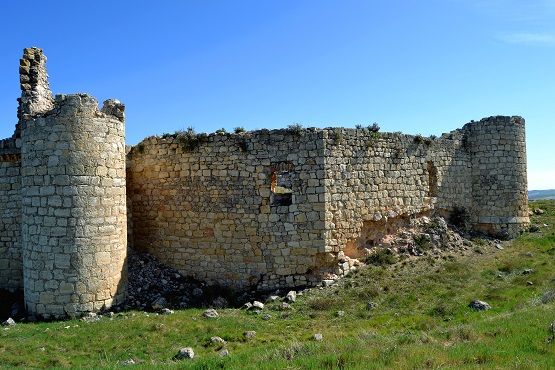
We basically took this road warrior trail trip to see the Castillejo or small Castle of Luján aka Saelices Castle, That was on our further trails to the ancient Roman city of Segóbriga (see post). The castle stands on a hill overlooking the Cigüela river. A neo-Gothic palace with an interior courtyard was built there, of which only a few remains still visible. The historical data available about this castle begins at the end of the 14C, during the final years of the reign of Henry II, when Ruy González Mejía, warden of Huélamo Castle, owned the towns of Castillejo, Saelices, and Villavieja. In the mid-15C, the castle was owned by different folks afterward even in 1499, was purchased by the Catholic Monarchs Fernando II and Isabel I, The changing hands continue. The last modification to the castle, consisting of the construction of a new palace on top of the ruined castle, must have taken place between 1833 and 1840, during the regency of María Cristina who, upon marrying Agustín Fernando Muñoz y Sánchez, Duke of Riánsares, the queen acquired through him an enormous estate which included the small castle. The remains that are preserved today correspond to the barrier or exterior wall that surrounded and protected the original castle, now disappeared. Of the large artificial moat that surrounds it, the existing space on its two parallel sides is preserved, since those corresponding to the two accesses to the interior are currently filled in. Almost completely modified this castle, as the four corner towers of the old castle were replaced by a wall.
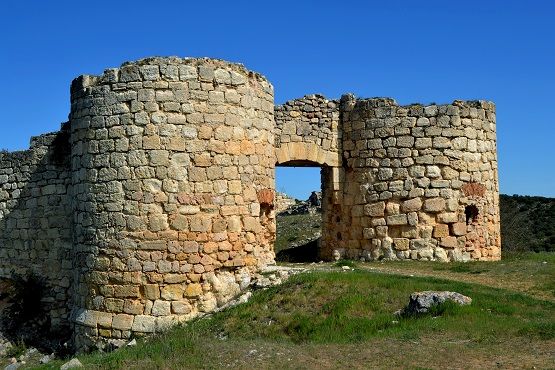
We do not know which was the first castle built on this site, located so close to the Roman Segóbriga and so close to a ford over the Cigüela river that it had a Roman bridge to cross it ,and still preserved , it is thought that a fortification could have been built on this property at the end of the 12C or beginning of the 13C, by the Order of Santiago to protect both the road or ravine that ran through said pass over the Cigüela river and to protect this pasture of great importance to the commandery of Uclés (see post). A later construction phase in the 16C involved the construction of the perimeter barrier adapted for artillery or the outer wall surrounding the castle to protect the original fortifications. This wall has a rectangular shape with four cubes located at each of its corners, extending in an irregular trapezoidal shape, resembling the projection of a pentagonal tower that existed within the enclosure. The smaller wall of the trapezoid is made up of two more cubes that defend the southern entrance gate. It should be noted that the aforementioned pentagonal tower no longer exists today.
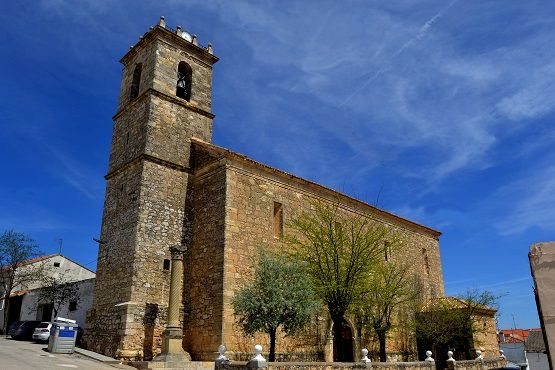
The Church San Pedro (Saint Peter) began in 1577 and nowadays preserves its impressive sizes. It has a cornice running around the whole perimeter, it has a polygonal three-sided apse, and a three-bodied tower at the foot of the church.
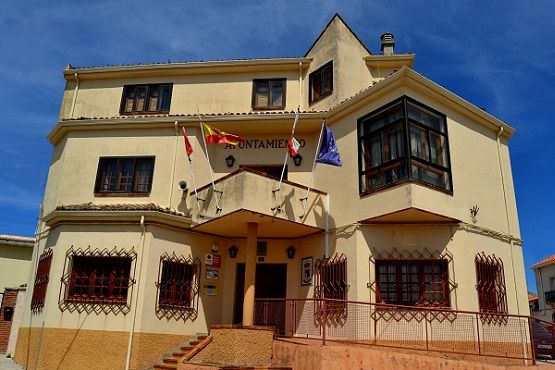
The Plaza Pùblica or Public Square, houses the City/Town Hall. There you can see a column, possibly taken from the ruins of Segóbriga. However, similar columns can be seen throughout the town center.
Other things to see here are the house-palace of Martínez Falero, with a rectangular floor plan, two stories, and interior patio. The beforementioned and post of the Segóbriga Archaeological Park, located on Cerro de Cabeza de Griego, very well preserved, despite being in ruins and can help you understand what life was like for the people who lived there. The hermitage of Nuestra Señora de la Fuensanta, right next to the house-museum of the painter José Mondéjar, is quite small, but still has a special charm. The hermitage of the Virgen de los Remedios or del Cerro is located next to Segóbriga, so you can take advantage of your visit to the ruins to enter. It is a hermitage attached to the walls of an ancient Visigothic church.
A bit of history I like which is difficult to find any as above most came from my brochures and books on the subjects which are my hobbies, There is no certain data on the foundation of Saelices that can be established in the repopulation after the Reconquista (1492), carried out by the Order of Santiago in the lands of the Priory of Uclés, to which it belonged in the Middle Ages. As you can imagine with size of this village it has no City web site,
The Castilla La Mancha region tourist office on Saelices : https://en.www.turismocastillalamancha.es/patrimonio/saelices-85331/descripcion/
There you go folks, another wonderful spot in my beloved Spain, and dream lands of Castilla la Mancha. This is wonderful country, and a nice spot to visit at Saelices. Again, hope you enjoy this post on this is Saelices !!! as I.
And remember, happy travels, good health, and many cheers to all !!!


