
I take you back to my dear Madrid !! love it !! I like to continue the saga of my dear Madrid with new pictures from my cd rom vault that should be in my blog for you and me, This is again my lost walking trails of wonderful sublime Madrid, Therefore, let me tell you about curiosities of Madrid, part IX !!! Hope you enjoy the post as I.
The Palacio de Maudes Palace is located at 17 Calle de Maudes in the Chamberi neighborhood, was originally created as a Day Laborers’ Hospital. Dolores Romero created the charitable foundation, for which she was decorated by King Alfonso XIII with the Grand Cross of the Civil Order of Beneficence with white distinction (1916) and with the Grand Cross of the Order of Military Merit (1924). In 1908, a request was made for the construction of the hospital. It was inaugurated on June 23, 1916, and administered by the Hospitaller Order of Saint John of God. The first admission took place on July 4. During the Spanish Civil War (1936-1939), it was taken over by the Popular Militia and was called the “Blood Hospital.” Most of the patients were soldiers wounded at the front. In the postwar period, it became a military emergency hospital, serving soldiers and their families, as well as civilian personnel serving the military administration and their families. From 1964 , the building was abandoned, empty, and exposed to predatory activities. It served as a refuge for vagrants, a scene of adventures for local children, and a treasure trove of scrap metal dealers where only vegetation grew. In fact, among local residents, it was known as “the cat house.”
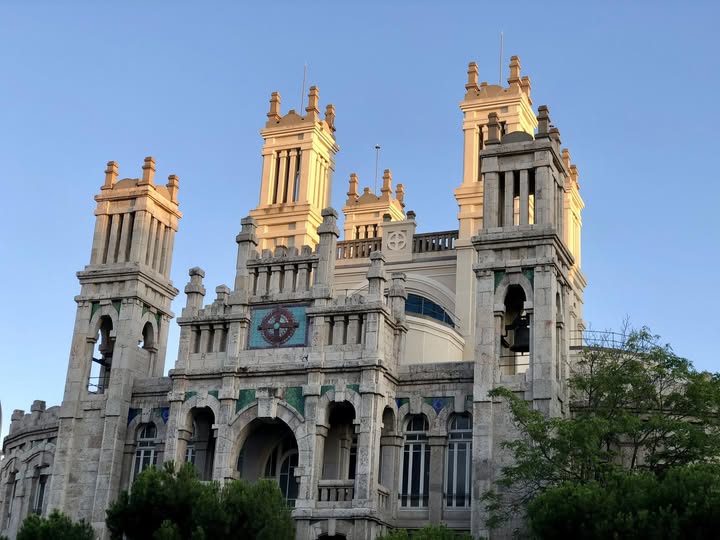
In 1984, the newly created Community of Madrid purchased the Maudes Hospital at a notary auction to use it as the headquarters of the Ministry of Land Use Planning, Environment, and Housing. It opened on September 23, 1986, after a major renovation. The Maudes Palace, formerly the Day Laborers’ Hospital, now houses the Ministry of Environment, Housing, and Agriculture. The Parish of Santa María del Silencio is located in the former chapel of the Day Laborers’ Hospital, now the Maudes Palace, with access from Calle Raimundo Fernández Villaverde. It was inaugurated in 1973 as the first parish for deaf and deaf-blind people. Two deaf priests from Madrid, along with a group of parishioners with the same disability, informed the diocesan delegate of Caritas about the difficulties they were having in participating in religious and pastoral activities. The former Hospital de Jornaleros de San Francisco de Paula aka Hospital de Maudes or Palacio de Maudes , takes up an entire block, with the radial layout centred around a central octagonal courtyard, divided into four sections, two occupied by the rectangular pavilions of the hospital wards, and the other two used to house the service buildings. The corridors and stairwells are open and spacious to facilitate good ventilation and lighting of the rooms. It can be reach by metro station Cuatro Caminos on lines 1,2,and 6 ; as well as by bus lines 3, 5, 37, 45, 64, and 66,as my known routes,
The Madrid tourist office on the Palacio de Maudes : https://www.esmadrid.com/en/tourist-information/maudes-palace
The Comunidad de Madrid region on the now Centro de Documentación de Medio Ambiente y Ordenación del Territorio (Palacio de Maudes) : https://www.comunidad.madrid/actividades/2025/visita-360o-centro-documentacion-medio-ambiente-ordenacion-territorio
The Fuente de la Fama spirals from its base, with four mythological dolphins, spouting water, stands on a basin in the shape of a four-leaf clover. These sculptures support a lavishly decorated pilaster, following the Churrigueresque fashion of the time. Among the ornamental motifs are niches with flower vases and statues of four children, each holding an inverted shell, which acts as a parapet above their heads. The pilaster narrows at the top, where, as a crown, there is a “Fame”, according to some, or winged Victory, blowing a trumpet to the top, evokes triumph by brandishing a trumpet. The fountain illustrates the Baroque preoccupation with the passage of time and refers to the famous precept of “Carpe diem, carpe hora” or enjoy the days, enjoy the hours. The angel was restored at the beginning of the 20C.
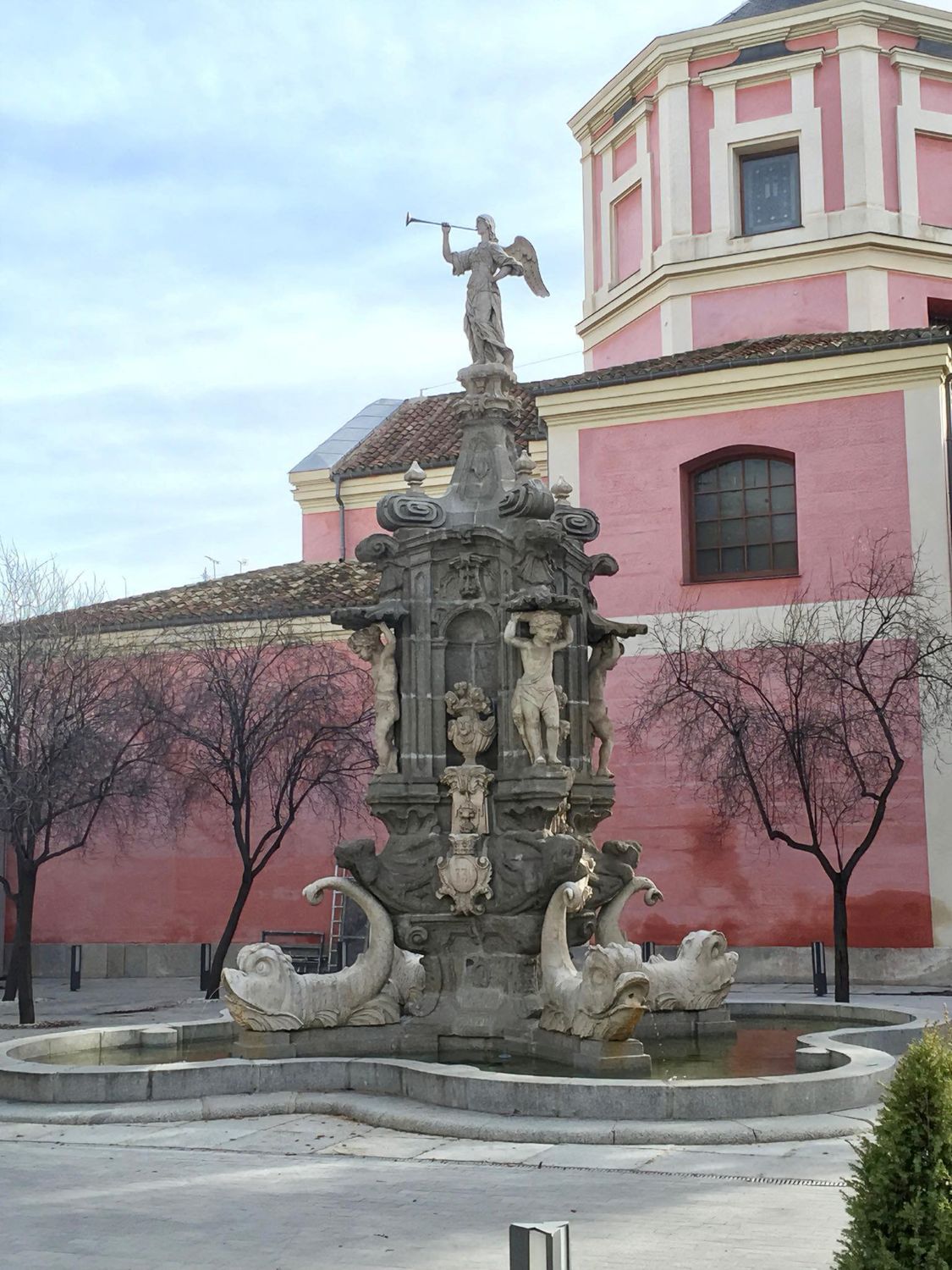
Built by order of Felipe (Philip) V of Bourbon to beautify the city and improve the water supply, the Fuente de La Fama or fame fountain underwent numerous renovations. The work, begun on June 14, 1731, was not completed until May 10 1732, in the Churrigueresque style. The project led to a tax increase, and on the day of its inauguration in 1732, the people of Madrid demonstrated their characteristic sense of humor with the inscription that meant “God willed it, the King suggested it, and the people paid for it. It was originally known as the Fuente de Antón Martín, fed by the flow of the Abroñiga stream. And named after the Plazuela de Antón Martín square where it was then located and where the popular revolt known as the Revolt against Esquilache or Motín de Esquilache took place. After a brief stay in the Parque del Oeste, in 1941, it was moved to its permanent location in the Jardines del Architecto Ribera or Plaza de Pedro de Ribera, between Calle Fuencarral and Calle Barceló near the former Hospicio de San Fernando today the seat of the History Museum of Madrid (see post). It is located in the Chueca neighborhood or barrio and access by metro Tribunal station on lines 1 and 10.
Talking about the fountain of fame, Miguel de Cervantes wrote « “Goodbye, I said to my humble hut; goodbye, Madrid; goodbye to your meadow and fountains, flowing with nectar «
The Madrid tourist office on the Fuente de la Fama : https://www.esmadrid.com/en/tourist-information/fuente-de-la-fama-o-fuente-de-anton-martin
The ME Reina Victoria Hotel is housed in an elegant 1923 building with a modernized interior, located on Plaza de Santa Ana, and the Plaza del Ángel side, surrounded by the capital’s best restaurants and vibrant nightlife, this urban hotel shines with its own unique light. Housed in a former 19C palace with an impressive Modernist façade, it offers a complete immersion in trends, design, and the music scene. The property features a trendy rooftop bar and a refined restaurant serving traditional and modern tapas. It also offers hydrotherapy treatments and parking (for a fee). My experiences here other than walking around the square all over was a business luncheon in 2015,
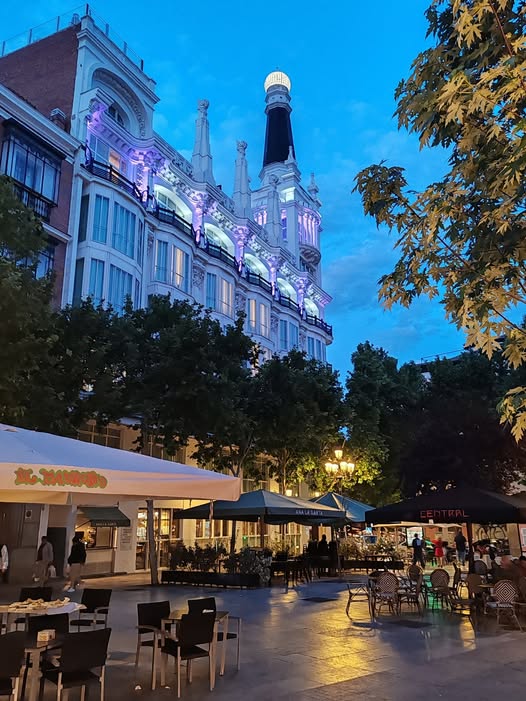
The former Reina Victoria Hotel has given way to Me Madrid, a hotel converted into a prototype of avant-garde design in a truly traditional setting. The ME Madrid Reina Victoria Hotel is closing its doors, and during the weekend of September 5-7, 2025 ECO-ONE is holding a sale open to the public of all its furniture. Opening hours are from 16h to 21h, and will continue over the weekend from 10h to 20h30. The event is taking place on the ground floor of the hotel. Visitors will find more than 10,000 pieces in perfect condition, ranging from 135 cm box-spring beds for €100, Barcelona-style armchairs for €60, lamps inspired by the Taraxacum model by Achille & Pier Castiglioni for €40, and a chaise longue reminiscent of the Eames Lounge Chair for €65. Also on sale are leather sofas, Ketall outdoor armchairs, televisions, tables, rugs, paintings, decorative objects, and sound equipment. The new hotel will be like well new nothing of the old remains inside,
The former Hotel Reina Victoria, also known as the Gran Hotel Reina Victoria, its white façade overlooks the Teatro Español (see post). It is a building with an eclectic style and modernist touches. The site housed the palace of the Counts of Montijo and Teba, built around 1811. After that, before the current hotel building was built, the palace became the premises of the Military Casino and was demolished in 1919 to build in its place the so-called Edificio Simeón. The building initially housed a popular market called Almacenes Simeón. For seven decades it combined the function of a warehouse with that of an inn. For a time it was popularly known as the “Hotel of the Bullfighters” due to the custom of bullfighters during the San Isidro fair of dressing in the hotel rooms before going to their “work” at the Monumental de Las Ventas (see posts). Some famous bullfighters such as Manolete reserved the same room in the hotel: room 220. When the warehouses closed in 1986, the ground floors were used as a hotel. In October 2006 the hotel was inaugurated under the protection of a new brand: ME Madrid Reina Victoria. Built on a trapezoidal site, it is characterized by its glass balconies, its white façade ,and its peculiar and immense pinnacle ;being a medieval reminder of a corner tower with a rounded top. The large windows overlooking the adjacent bullrings were once the shop windows of department stores. The building is organized around a covered octagonal courtyard.
The official Mélia hotels on the ME Reina Victoria: https://www.melia.com/en/hotels/spain/madrid/me-madrid-reina-victoria
The Madrid tourist office on the ME Reina Victoria: https://www.esmadrid.com/en/accommodation/me-madrid-reina-victoria
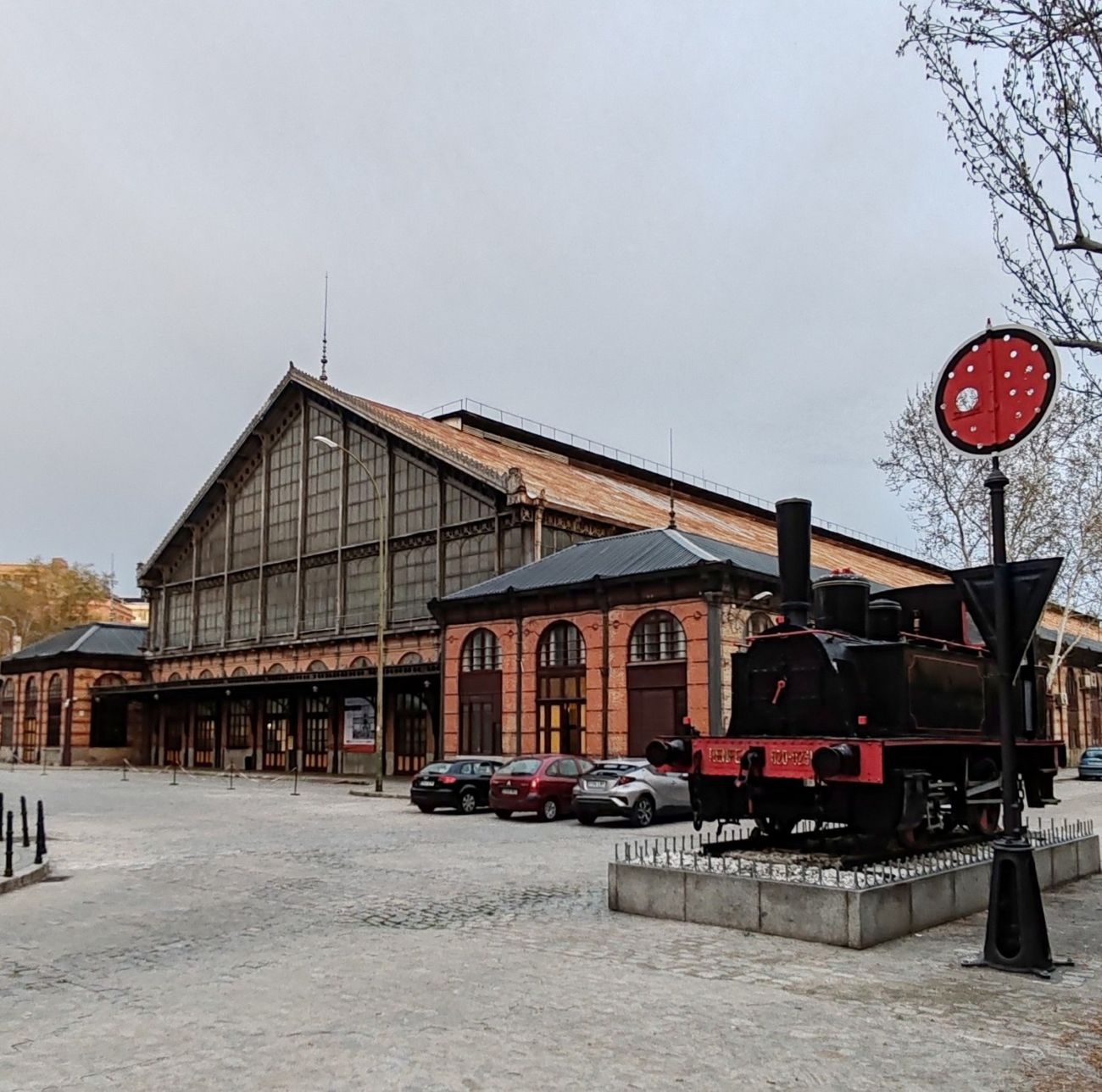
The old estacion de Delicias station, also known historically as Madrid-Delicias. The facilities are located on Paseo de las Delicias. Opened in 1880, it was the first monumental station built in Madrid. For many years, it served as the terminal for express trains to Portugal and the west of the country. After the Spanish Civil War, it became part of the new RENFE network. It was closed to passenger service in 1969 and was later used as a material depot. It no longer provides rail services, and its former facilities house the Museo del Ferrocarril or Railway Museum of the Spanish Railway Foundation. The new location of the Railway Museum was finally inaugurated on December 19, 1984, and the headquarters of the Museo Nacional de Ciencia y Tecnología or National Museum of Science and Technology was inaugurated in 1997. The station began to be built in 1879, following the project of the French engineer Émile Cachelièvre, who belonged to the school of Gustave Eiffel. Several films have been filmed at the station, for me the best being Doctor Zhivago,
The official Museo del Ferrocarril (Railway Museum): https://www.museodelferrocarril.org/
The Madrid tourist office on the Railway Museum: https://www.esmadrid.com/en/tourist-information/railway-museum
The Church San Manuel y San Benito (see post) is on the Calle de Alcalà, 83 but further where across from the Retiro park (see pic) before arriving at the Puerta de Alcalà ,And even if was further from home my mom Gladys, like it better and used to take me as a boy. It is still nostalgic to see it and remind me of my mother again, always in my mind even if already 18 years passing in France; never forget. The church was built between 1902 and 1911, and was intended as a residence and church for the Augustinians Fathers.
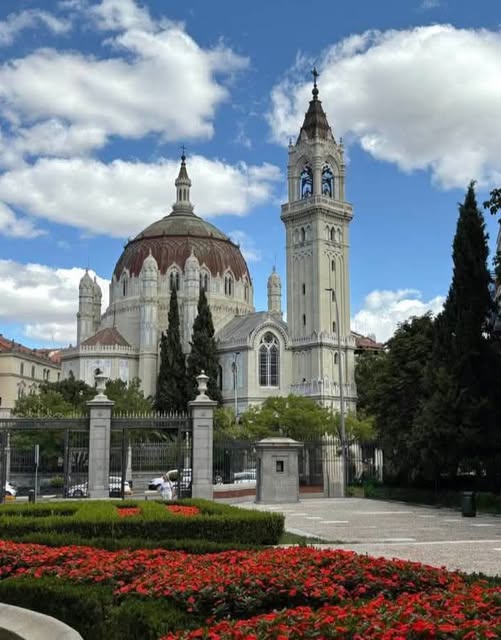
The official Church San Manuel y San Benito : https://samasabe.es/
The Madrid tourist office on the Church San Manuel y San Benito : https://www.esmadrid.com/en/tourist-information/iglesia-parroquial-de-san-manuel-y-san-benito
There you go folks , another wonderful nostalgic, sentimental trip to my dear Spain, A love affairs with my Madrid, as do not know when we will be back, we sure will have this trip in our hearts forever, Again, hope you enjoy this post on curiosities of Madrid, part IX !!! as I
And remember, happy travels, good health, and many cheers to all !!!


