
A wonderful memorable city we have passed rather quickly and merits more, Gladly found me again pictures in my cd rom vault that should be in my blog for you and me. I stop by on one of my road warrior trips way back ,and it remains a nostalgic spot in my life, Therefore, here is my take on this is Gijon !!! Hope you enjoy it as I.
The City of Gijón is located in the Estatuto de Autonomía del Principado de Asturias, and in the kingdom of Spain, It is well connected to the national highway network, providing easy access to other cities in Asturias and the rest of Spain. The A8 Cantabrian Highway going from Baamonde – Avilés – Gijón – Llanes – Torrelavega – Solares – Bilbao – San Sebastián and Irún (taken), The A66 Ruta de la Plata or Silver Route Highway going from Gijón – Oviedo – Mieres – Pola de Lena – León – Benavente – Zamora – Salamanca – Cáceres – Mérida – Seville, The local N632 road going from Canero – Cudillero – Muros del Nalón – Soto del Barco – Avilés – Gijón – Villaviciosa – Colunga – Caravia – Ribadesella, The City is 29 km from Avilés, 33 km from Oviedo, 174 km from Santander, 180 km from Xove , 361 km from San Sebastian, and 470 km from Madrid, I came initiallycoming from France to San Sebastian and continuing to Gijon to reach my final destination visiting friends in Xove, Galicia, All this along the A8 highway of Cantabria which later connected me with the N632 to my final destination,
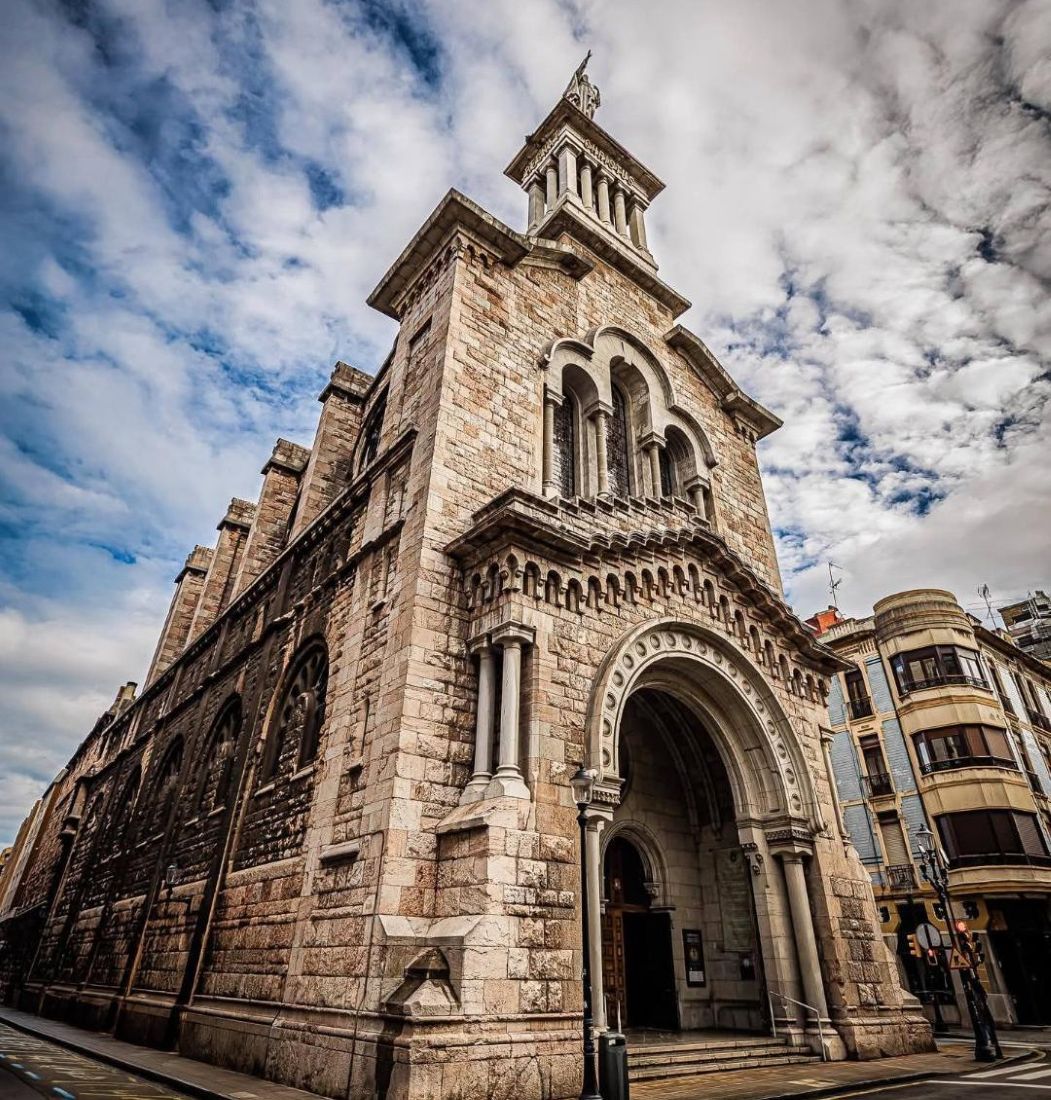
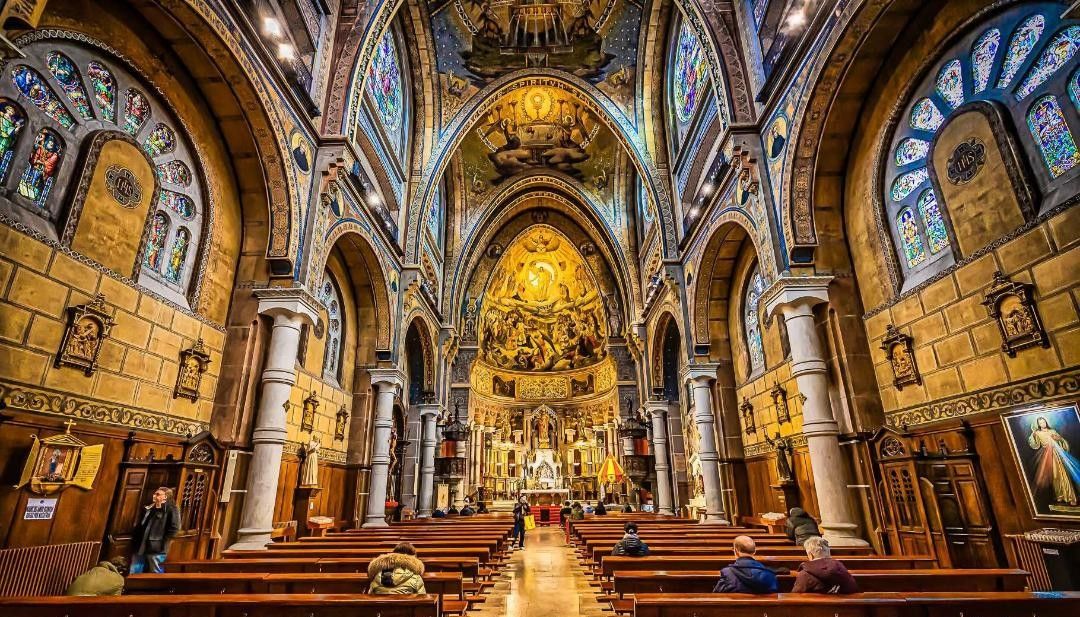
Passing in my road warrior mode by City center allow me to see some wonderful monument of which pictures were taken such as the basilica built in 1918 and nicknamed La Iglesiona or big church , The Basilica del Sagrado Corazon or of the Sacred Heart is at Calle Jovellanos, s/n. And was built between 1918 and 1922. It was done midway between the Gothic Revival and the Gaudi-influenced Modernism. This connection can be seen, first of all, in the interior. Designed for the Jesuit Fathers in 1911, the church’s interior layout uses solutions reminiscent of Gaudi’s work, specifically in the parabolic sections of the vault and the multi-lobed arches of the presbytery. The main façade, despite maintaining traditional elements such as the central rose window above the doorway, the gable, and the side towers, serves as a framework for a decorative design based on a marked contrast of light and shadow with an Expressionist tinge, visible especially in the towers. It was declared a Basilica in 2003.
Other things to see here time permitting are the Palacio Revillagigedo Palace, from the 18C, the City/town hall , 1865, the El Bibio bullring , 1888, the Bank of Gijón, 1902, the School of Commerce 1915, Solavieya 1918, La Gota Leche 1925, La Escalerona 1933, the Casa Rosada,1940, There are several churches, the three most important being the “historical”: San Pedro 1955, San José 1954 and San Lorenzo 1901, There is also, Nuestra Señora de Contruences1660, There are several museums about its own history such as the Roman Baths of Campo Valdés, the Roman Villa of Veranes, two about the history of Asturias: the Railway Museum of Asturias and the Museum of the People of Asturias, which includes the Museum of the Bagpipe. Also, the botanical garden and the Aquarium.
A bit of history I like tell us that since its foundation in Roman times, the development of the urban center has been linked to that of its port, which is currently a leader in the movement of solid bulk in Spain. The city is known par excellence as the “capital of the Costa Verde” or Green Coast. There is no evidence of permanent settlements in the City until the appearance of the castros. The best known of these fortified settlements is the one located in Campa Torres (Noega), with its origins in the 6C and 5C BC, populated by Astures of the Cilúrnigos gens and later Romanized as it was a perfect candidate to temporarily house military forces after the conquest. The castro of Noega was progressively abandoned as a result of the foundation in the 1C AD of a new Roman settlement at the foot of the Santa Catalina hill, in the current neighborhood of Cimadevilla. After Romanization there was a very dark period, which ran from the end of Roman control until the arrival of the Muslims. The domination lasted approximately from the year 713 until 718 or 722. During those years the victory of the Astur-Cantabri took place in the Battle of Covadonga, which began in 718 and was led by Pelayo, who would become king of the Kingdom of Asturias. In 1270 Alfonso X granted it a charter and a town. The 14C, a period in which the power of the nobility reached its maximum, was marked by a dynastic struggle after the death of Alfonso XI. This was a war between Pedro I the Cruel, a legitimate descendant, and the bastard Henry of Trastámara. It was not until the 15-16C that Gijón began to develop again. In the 17-18C, Gijón experienced great development that caused its urban center to expand. This was due to the Free Trade Regulation of 1778, which enabled the port for trade with the American colonies. During the second half of the 19C, holiday visits by the royal family began, staying at the Revillagigedo Palace. Isabel II inaugurated these stays in the summer of 1858, when she took wave baths on Pando beach, which occupied the site of the current Poniente beach before making way for port infrastructure. Later, several royal stays followed. Alfonso XII went to the same beach during the bathing season of 1877, while during his visit with his family in 1884, the San Lorenzo sandbank, the city’s main beach today, began to take center stage. Finally, his son Alfonso XIII visited Gijón with his family in August 1900. The city then became a summer destination. During the 1934 revolution, the National Confederation of Labor (CNT) called a hasty general strike on October 4 and eagerly awaited the arrival of weapons and dynamite from the Mining Basins, the epicenter of the revolution. However, the weapons never arrived, allowing the Civil Guard and the Assault Guard to take up positions in the city. The revolution was crushed and its leaders executed, arrested or exiled. With the outbreak of the Spanish Civil War in July 1936, the city was controlled by the Republican side due to the anticipation of the municipal government. Finally, the occupation of the city by Franco’s Nationalists troops took place on October 21, 1937.
The town of Gijon on Basilica Sagrado Corazon : https://www.gijon.es/es/directorio/basilica-sagrado-corazon-de-jesus
The Principado de Asturias tourist office on Gijon : https://www.turismoasturias.es/en/descubre/ciudades/gijon
There you go folks, another gem in my dear Spain, Gijon was a passing stop over easy ride by car in my road warrior trails between France and Spain, and looking forward to be back, eventually. Again, hope you enjoy this post on this is Gijon !!! as I.
And remember, happy travels, good health, and many cheers to all !!!


Really beautiful!
LikeLiked by 1 person
I agree …Thanks for stopping by Cheers
LikeLiked by 1 person
I visited it a lot of time ago ❣️❣️❣️
LikeLiked by 1 person
It happens, and yearns to be back always. Thanks again Cheers
LikeLiked by 1 person
🙏❣️🙏
LikeLiked by 1 person
Fab town
LikeLiked by 1 person
Yes i see them coming here in celtic festival. Thanks for stopping by Cheers
LikeLiked by 1 person