
A wonderful memorable city we have visited couple times over the years, Gladly found me again pictures in my cd rom vault that should be in my blog for you and me. I stop by on one of my road warrior trips way back ,and then came back years later and it remains a nostalgic spot in my life, Therefore, here is my take on the Santa Basílica Catedral Metropolitana de San Salvador of Oviedo !!! Hope you enjoy it as I.
The City of Oviedo is in the Principality of Asturias and in the kingdom of Spain. It is the geographical, university, religious, political and administrative center of Asturias, The city is protected from the north winds by Mount Naranco; To the south is the Sierra del Aramo, where the Angliru mountain pass is located, famous for its difficulty for cyclists and popularized for being the final stage of the Vuelta a España on several occasions. The main highways taken are the Autovia A63 Oviedo-La Espina highway, Autovia A64 Oviedo-Villaviciosa highway, The autovia A66 Ruta de la Plata highway going from Gijón – Oviedo – Mieres – Campomanes – León – Benavente – Zamora – Salamanca – Plasencia – Mérida – Seville , The national road N634 going to San Sebastián – Bilbao – Solares – Torrelavega – San Vicente de la Barquera – Unquera – Llanes – Oviedo – Luarca – Ribadeo – Baamonde – Santiago de Compostela , The local AS 381 going on the Oviedo-Gijón highway, The City is 31 km from Gijón, 33 km from Avilés, 191 km from Santander, 286 from La Coruña, 455 km from Madrid, 378 km from San Sebastian, and 184 km from Xove from where I was coming from on our way to France, along the N642 road and by San Cosme de Barreiros go around the trafic circle bearing right into the N634 road and on next trafic circle bear left into the autovia do Cantabrico or A8 highway stay on this road for a while until bearing right into the AS325 road by Espin continue quickly becomes the A66 highway or Autovia Ruta de la Plata right into Oviedo looking for Plaza de la Catedral.
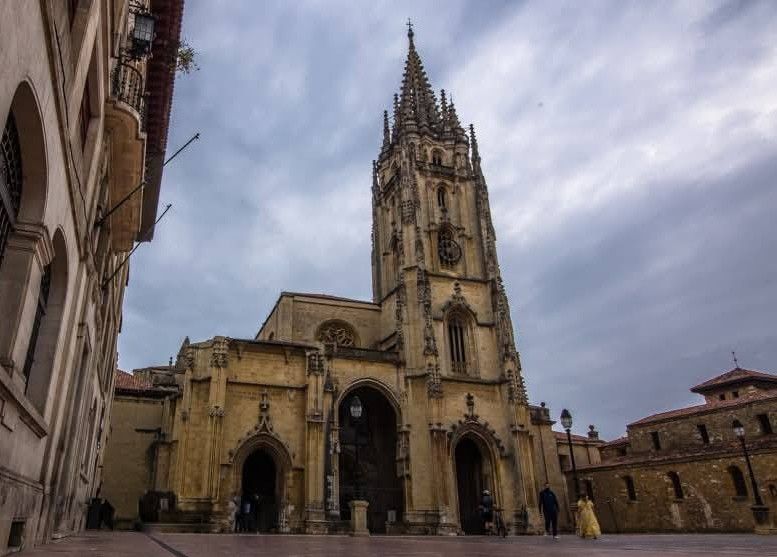
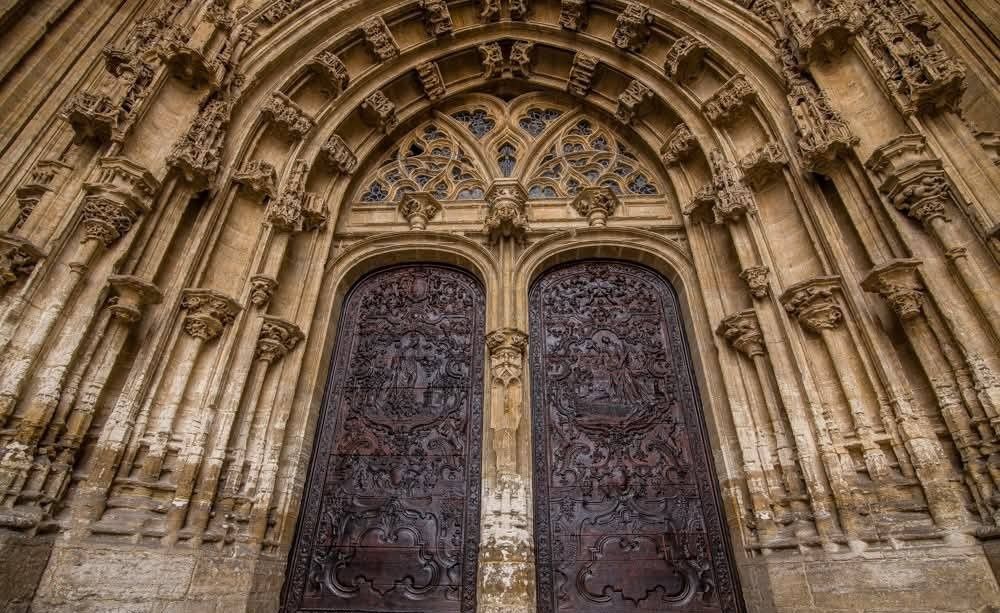
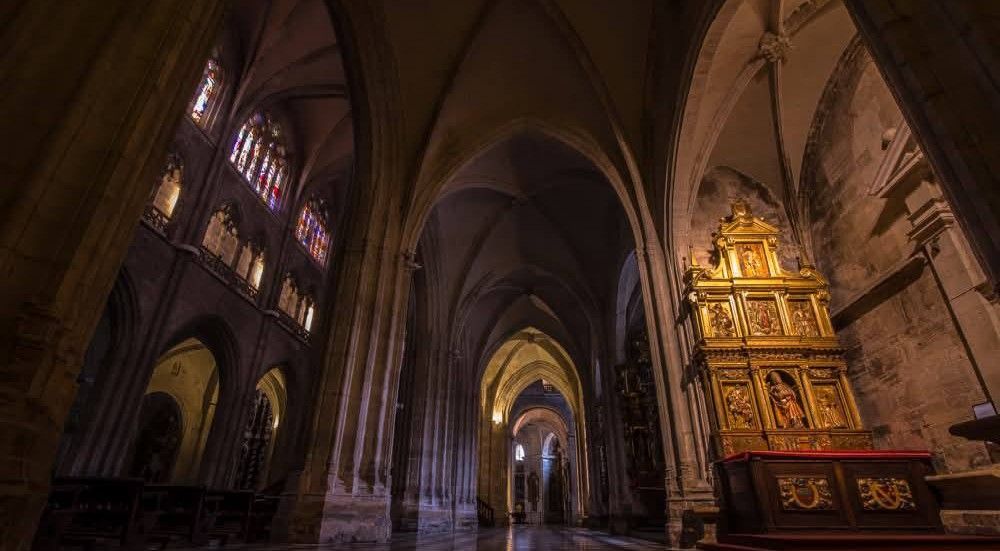
The Santa Basílica Catedral Metropolitana de San Salvador is a fundamentally Gothic work, built between the 14C and 16C ,although it has pre-Romanesque, Romanesque, Gothic, Renaissance and Baroque structures, with chapels and an ambulatory added later in the Baroque style. The Cathedral tower is open to visitors. It is an ascent of 184 steps that allows you to contemplate unique views of the city of Oviedo as well as to learn the intricacies of this outstanding element of the basilica. It was built over the basilica erected by order of Alfonso II “the Chaste”. The first altar to San Salvador was consecrated on October 13, 821. Although most of the basilica dates from the 15C, due to its numerous renovations, it combines a range of artistic styles, with a predominance of Flamboyant Gothic. The main altarpiece. It is one of the most beautiful works of the Spanish Gothic ,It is a gilded ensemble of 24 altars with five sections and five levels in which, excepting the central section, you can “read” the Gospel. The general project is from 1511 and 1518. The Chapel of the Chaste King. This is a place of prayer and meditation. Located at the end of the north transept , it houses the Pantheon of the Kings at the back. It is one of the most important historical sites in the Cathedral since it occupies the place where Alfonso II ordered the construction of a pre-Romanesque basilica to house his tomb and those of his predecessors and heirs in the first ever pantheon of Spanish kings. The basilica remained standing until 1705. The Chapel of the Chaste King features a magnificent interior doorway sculpted in the Gothic style that you will only be able to see on your way out. See, also, the Cloister. Time permitting which I did not had,,,,
The so-called Càmara Santa or Holy Chamber, now part of the Gothic structure of the cathedral alongside the well-known tower of San Miguel, is a palatine chapel most likely used as a martyr’s chapel, whose origins date back to the reign of Alfonso II the Chaste, at the beginning of the 9C. It consists of two main sections: a lower floor known as the “Crypt of Saint Leocadia,” where the remains of Saint Leocadia herself and Saint Eulogius, brought to Asturias from Córdoba by Alfonso III and the priest Dulcidio, are laid to rest and venerated; and a main floor, significantly renovated between the late 12C and early 13C, which also suffered serious damage in 1934 during the Asturian Revolution and was finally rebuilt between 1938 and 1942. The sculptural groups consist of Simon with Judas and Saint Thomas with Saint Bartholomew in the groups at the foot of the nave; Saint James the Lesser with Saint John, Saint Peter, and Saint Paul in the center of the nave, supporting the main transept; and Saint James the Lesser with Saint Philip, Saint Andrew, and Saint Matthew in the background, next to the triumphal arch leading to the chancel. The most precious treasure of the cathedral is housed in the chancel area of the Chapel of Saint Michael, or Holy Chamber. Among other pieces, the most notable are the Cross of Victory, the Cross of the Angels, the Agate Box, the Holy Ark, and the Book of Testaments.
Other things to see here and plenty of time would be needed are the Holy Chamber of Oviedo. Chapel located within the architectural complex of the cathedral. Of disputed chronology, stylistically it seems to be the work of the time of King Alfonso II “the Chaste”, first half of the 9C, although based on the existing documentation it seems more plausible that it was ordered to be built by King Alfonso III “the Great” in the last third of the 9C. San Julián de los Prados Church from the beginning of the 9C, ordered to be built by Alfonso II. Its interior is decorated with fresco paintings that are practically intact and constitute one of the most important examples of pre-Romanesque painting in Europe. Monastery of San Vicente, its foundation marked that of the city. Much modified and enlarged over time, its church, now the parish Church of Santa María la Real de la Corte, and cloister, now the Archaeological Museum, date from the 16C. Monastery of San Pelayo, founded by Alfonso II, the current building is in the Baroque style of the 17C. Church of San Isidoro, built by the Jesuits in the 17C as part of the now-defunct College of San Matías, whose site is now occupied by the Fontán Market. Casa de la Rúa, a palace-house from the late 15C, the only surviving civil building from the fire of 1521. University of Oviedo, founded at the end of the 16C by the Catholic archbishop Fernando Valdés Salas, Inquisitor General of Spain. Opened in 1608 Oviedo City/Town Hall, built in the 17C, is a three-story building and a porticoed ground floor with a central arch built over the Cimadevilla Gate and supported by the old city wall. Malleza-Toreno Palace, Baroque from the late 17C, today the headquarters of the Royal Institute of Asturian Studies and its Library. Velarde Palace, from the late 18C. It houses the Museum of Fine Arts of Asturias, the El Fontán Market, Oviedo’s first covered square, from 1885 Campo de San Francisco: popularly known as El Campo by the people of Oviedo, is a 90,000 m² park located in the center of Oviedo, next to Uría Street. This park with large trees was part of the San Francisco convent.
The official Basilica Catedral San Salvador of Oviedo : https://catedraldeoviedo.com/
The Principado de Asturias tourist office on the Cathedral : https://www.turismoasturias.es/en/descubre/cultura/patrimonio-religioso/catedral-de-el-salvador
The Oviedo tourist office on the Cathedral : https://www.visitoviedo.info/que-visitar/imprescindibles/catedral
The Principado de Asturias tourist office on Oviedo : https://www.turismoasturias.es/en/-/blogs/las-10-mejores-cosas-que-ver-y-hacer-en-oviedo
The Spain National Tourist office on Oviedo : https://www.spain.info/en/destination/oviedo/
There you go folks, another gem in my dear Spain, Soria, an easy ride by car all worth it for a pleasant rest stop or more on my road warrior trails between France and Spain. Again, hope you enjoy this post on the Santa Basílica Catedral Metropolitana de San Salvador of Oviedo !!! as I.
And remember, happy travels, good health, and many cheers to all !!!

 Paris1972-Versailles2003