
I am again to tell you about more streets of my eternal Paris. I have many many posts on Paris and several on the streets of the most beautiful city in the world. I have come up with pictures from cd rom vault that should be here for you and me. As always thank you for following my blog some since Nov 26, 2010. Therefore, here is my take on the streets of Paris, part XXXIV !!! Hope you enjoy it as I.
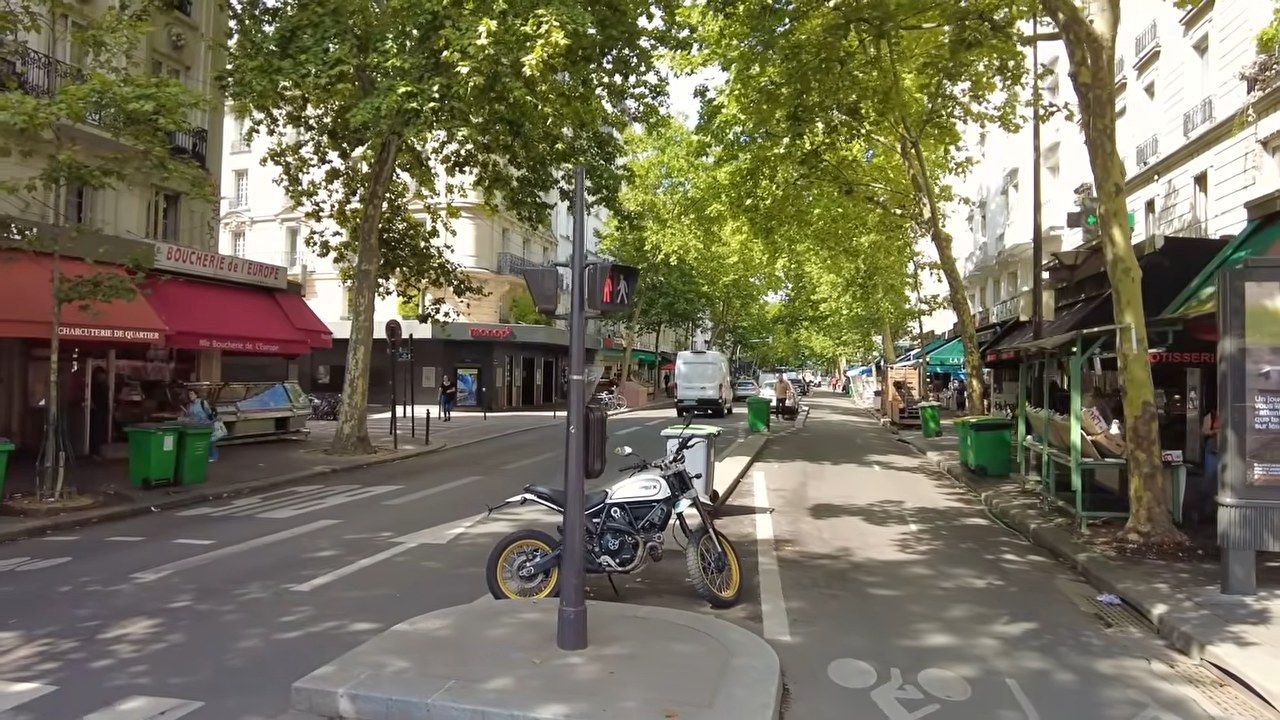
The Avenue de Saint-Ouen is located in the 17éme and 18éme arrondissements of Paris. The avenue begins at 62-66 Avenue de Clichy and ends at 1 Boulevard Bessières and 155 Boulevard Ney. The picture is from the corner of Rue de La Jonquiére and and Rue Collette, This street takes its name from the city of Saint-Ouen, to which it leads.
Three metro stations on line 13 have one or more access points on Avenue de Saint-Ouen: La Fourche, Guy Môquet, and Porte de Saint-Ouen, which share access with line 3b of the Île-de-France tramway. It originates from the road leading to Saint-Ouen, attested from the 7C. From 1803 to 1863, it was an integral part of the D13 road. It was classified as part of the Parisian road network and received its current name by a decree of May 23, 1863. The notable buildings here me think are at No. 25: Batignolles hamlet. No. 30: Pilleux estate. Former workers’ town from the end of the 19C. It housed workshops on the ground floor and accommodation upstairs, No. 37 and 37 bis: Marcelle Lesage ran the bookstore “Librairie, Papeterie, Abonnement de Lecture” there, renamed “Le Livre pour Tous”, from 1923 to 1926. It then moved to 37, quai de l’Horloge, No. 128: station on avenue de Saint-Ouen, on the old Petite Ceinture line. Once transformed into a bazaar store, it is now a cultural venue, Le Hasard Ludique, which has a bar, houses artistic practice workshops and programs concerts. No. 139: Lucien Raimbourg, actor, lived here. His son Claude Raimbourg, engraver, painter and writer, was born and lived there as well.
The Paris tourist office on the 17éme arrondissement de Paris : https://parisjetaime.com/eng/article/explore-paris-s-17th-arrondissement-a831
The Paris tourist office on the 18éme arrondissement de Paris :https://parisjetaime.com/eng/article/explore-paris-s-18th-arrondissement-a832
The Cité des Fleurs is a site served by a private road, closed to public traffic,and forbidden to dogs in the 17éme arrondissement of Paris. It is 320 meters long, lined with charming houses of different architectural styles, but harmonized by the presence of fences and pilasters in cut stone placed on either side of this central road. composed of houses very diverse in their architecture and particularly flowery. It bears this name because the road is bordered by gardens. It is located in the quartier or neighborhood Épinettes. The Cité des Fleurs links the rue Guy-Môquet and Avenue de Clichy to the rue de La Jonquière. Its entrance is located near the Brochant metro station, on line 13. Public access is possible from 7h to 19h Monday to Saturday and from 7h to 13h on Sundays and public holidays.
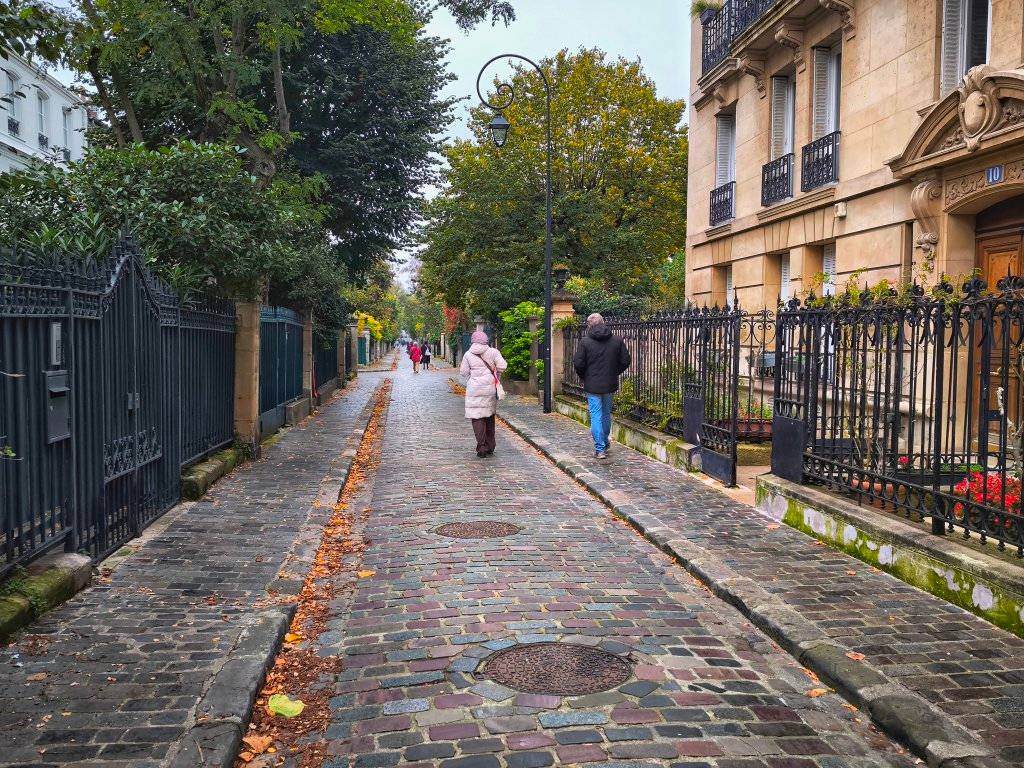
In 1846, Ernest Goüin founded the company, called Ernest Goüin et Cie. He specialized in the construction of locomotives and spinning machines. Thanks to this boom, the Cité des Fleurs was created in 1847 by Jean-Edmé Lhenry and Adolphe Bacqueville de La Vasserie by grouping their various possessions in the Épinettes neighborhood, then beyond the wall of the Farmers General and therefore outside Paris, but within the Thiers wall and belonging to the village of Batignolles-Monceau, the Cité des Fleurs is structured around a 320-meter central road lined with houses and private mansions and punctuated by three circular squares. In the 20C, the Valentin-Picard caramel factory and then the Gerb’s doll factory still existed. On March 19, 1909, the laying of the foundation stone of the Saint-Joseph-des-Épinettes Church had an impact on the life of the Cité des Fleurs due to the establishment of a presbytery, parish premises, and a religious congregation within it. It was consecrated on May 26, 1910. The notable buildings here me think are the fact that Catherine Deneuve and her sister Françoise Dorléac were born in 1943 and 1942 respectively in one of the two clinics in the Cité des Fleurs. At no. 21: a commemorative plaque pays tribute to the painter Simon Hantaï, who lived and worked there from 1949 to 1966. No. 25: during WWII, the house served as a relay for the Plutus network for the transmission of false papers for the Resistance by the National Liberation Movement (MLN), which had moved from Lyon. Arrested by the Gestapo on May 18, 1944, the main members of the service were deported. No. 27: Alfred Sisley, impressionist painter, lived there and painted his Vue de Montmartre or View of Montmartre, from the Cité des Fleurs at Batignolles in 1869 (painting preserved at the Grenoble Museum). No. 32: Lucien Fontanarosa and Annette Faive, French artists, set up their studio there from 1964. Nos. 52-54, the French Red Cross has a building there which houses a nursery, a training center for volunteer first-aiders in Paris and an annex of the Local Unit of the 17éme arrondissement of Paris. No. 56: the artists Gustave Nicolas Pinel and Norbert Gœneutte lived there. No. 59: the Church of Saint-Joseph-des-Épinettes.Need to see it !
The Paris tourist office on the Cité des Fleurs : https://parisjetaime.com/eng/culture/cite-des-fleurs-p1515
The Paris tourist office on the Church Saint Joseph des Epinettes : https://parisjetaime.com/eng/culture/eglise-saint-joseph-des-epinettes-p1264
The Paris tourist office on the 17éme arrondissement de Paris : https://parisjetaime.com/eng/article/explore-paris-s-17th-arrondissement-a831
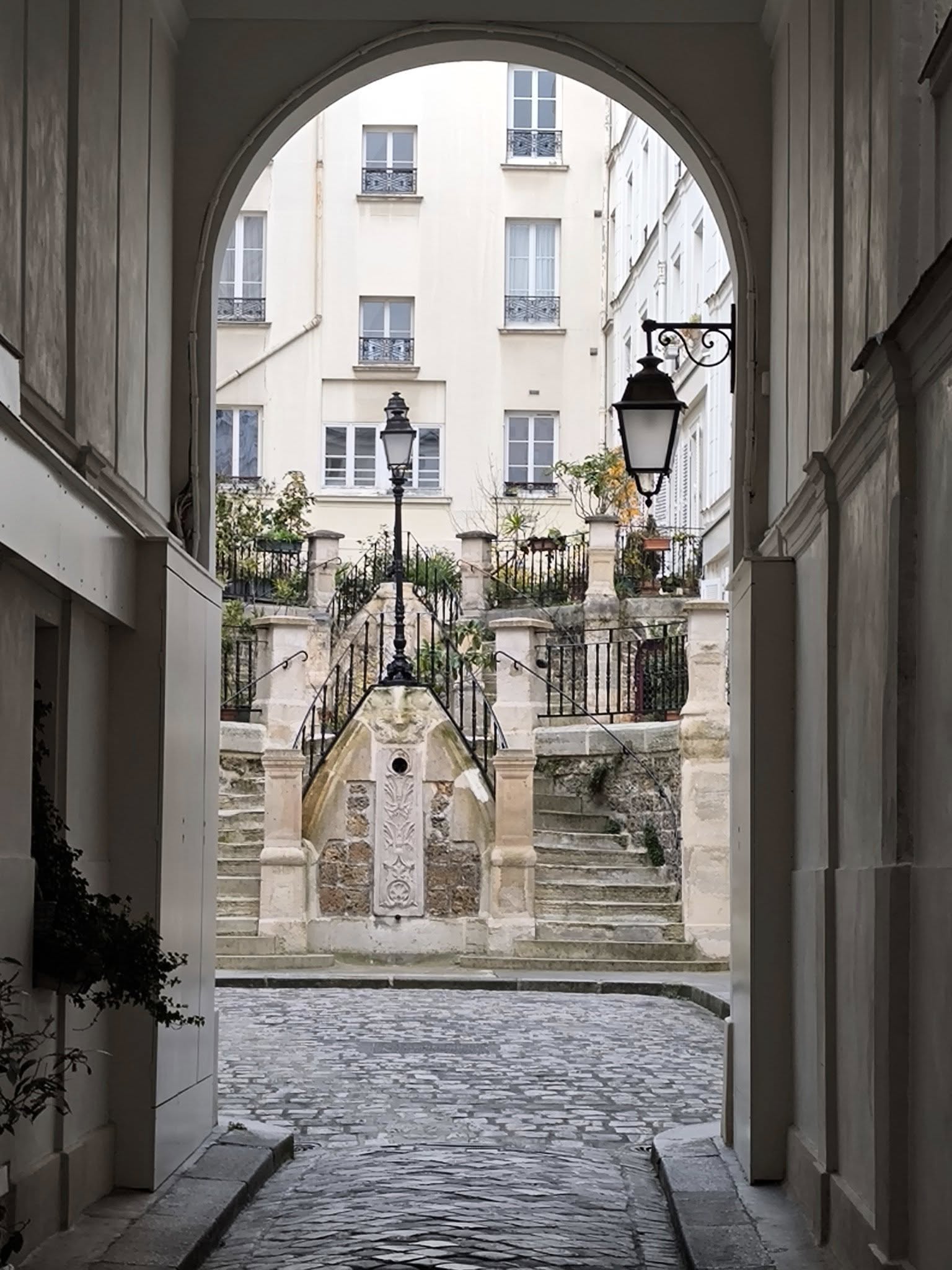
The Rue Durantin is located in the 18éme arrondissement of Paris ,and in the Montmartre quartier or neighborhood, bordering the Grandes-Carrières quartier. It is one of the few streets on the Butte Montmartre that does not go uphill. Its name comes from the former owner of the street, the historian and novelist Armand Durantin. Following two consecutive expropriations under the influence of Patrice de Mac Mahon, Armand Durantin paid for the entire construction of a wall on the street, and the city, therefore named this street “Rue Armand-Durantin”. First of all, we must differentiate between the old rue Durantin, which was created before 1672, and the current street, whose name dates back to 1881. The current Rue Durantin was formed by the union of the old rue Durantin (starting at rue Ravignan and ending at rue Garreau), rue Bastien (between rue Garreau and rue Tholozé), and the passage Masson (surplus extending to rue Lepic). Notable buildings here are the Spanish painter Ignacio Zuloaga lived on rue Durantin in 1890. In the same year, he resided at various times in rue Cortot and rue des Saules. At No 1, the painter Charles Maurin lived there. Stéphane Mallarmé settled here for a time upon returning from military service in December 1877. The poet Lautréamont lived at No 7. Henry-Eugène Delacroix had a studio there in 1907 at No 20. The painter Georges Delaw had his studio, topped with a large glass roof, until 1934. At No 40,(see pic) inside the buildings, lies a stunning two-level courtyard with a horseshoe staircase. The building offers a glimpse through a gate into one of the most astonishing courtyards in Montmartre. Due to the steep slope of the hill, the courtyard is arranged on two levels connected by picturesque double-spiral stone staircases, decorated with a fountain. It is decorated with flowers and retains its old, dented paving stones. During WWII, the inhabitants of this courtyard suffered a tragic fate. At the time, the Butte Montmartre was home to a number of Jewish families. The Jewish families living in this courtyard were rounded up and taken to the Vel’ d’hiv, before being deported and exterminated in the death camps. For this reason, the place is often called the “Jewish courtyard.” At No 43, the painter Fernand de Launay lived and died there in 1904. At No 48, the painter Émile Beaudoux lived there in 1898. The painter Pere Créixams owned the studio. At No 52, the painter Jean-Paul Riopelle had a studio there for three years.
The Paris tourist office on the 18éme arrondissement de Paris :https://parisjetaime.com/eng/article/explore-paris-s-18th-arrondissement-a832
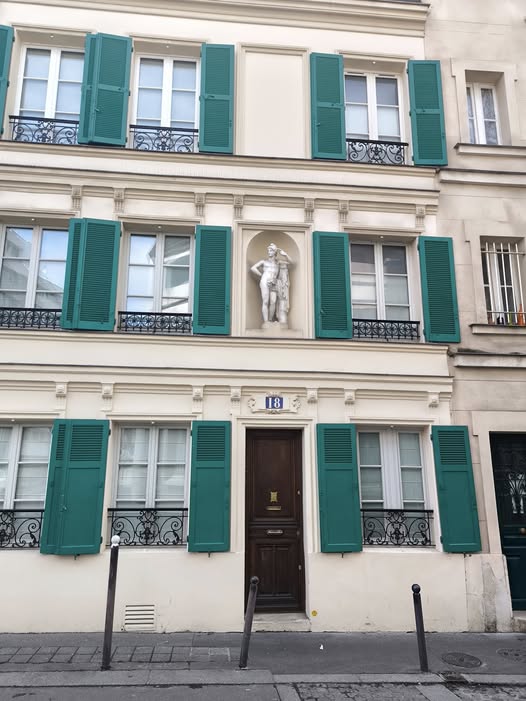
The rue des Solitaires is located in the 19éme arrondissement of Paris. It begins perpendicular to Rue de la Villette, and ends at the Place des Fêtes. Rue des Annelets and Rue Arthur-Rozier open onto its north side, and Rue de Palestine onto its south side. It was originally called “Rue des deux Solitaires” (the street of the two Solitaires) because it was home to two nuns belonging to the Congregation of Discalced Solitaires of the Order of Saint Clare, whose members lived in seclusion and silence, The street is a street in the former village of Belleville, annexed by Paris in 1860; its dating is from 1730. Notable buildings here are to see the several street artists that have created works on the facades of some buildings. At Nos 18-20, there are houses from the early 19C. Two statues of deities are installed in niches: Mercury and Ceres (see pic). At No 19, on the corner with Rue des Annelets: a house from the early 19C. The director Luc Bondy lived there. The houses at No 21 date from the early 19C. At No 24 at the end of the small garden, is the studio of the painter Marc Tanguy. Located on a former metalwork factory. At No 31, since 1994, the Hindu temple ,and before 1994, there was a travel agency , At No. 36 was until 1993, a craftsman ran a shop selling beautiful tiles and beautifully painted ceramics directly from Portugal. Then, a bookstore and newspaper store replaced it. A store selling electrical equipment then moved in. It’s currently an apartment. At Nos 36 and 38, access to the Palais Royal de Belleville. An unusual and picturesque square made up of pavilions and small buildings. Several backyards lead us to 151 Rue de Belleville. At No. 44: The Lecouteux Manhole, the former manhole of the Belleville aqueduct, is located in the building’s courtyard; At No 47, from 1931, there was the establishment of the convent of the mission center of the Franciscan friars of the order of the Discalced Friars Minor. This pretty convent was unfortunately destroyed. And in 1970, the Franciscans and their convent were relocated to a wing of the newly constructed buildings. Then the Trinitarian brothers moved in. Currently, at the bottom of the garden, with another entrance located at 5 rue de Crimée, for the past 3 years, there has been the convent of the Salesian Sisters of Mary Immaculate. At No 49 dates back to around 1860. It is decorated with a mural. Bear in the rue des Solitaires between rue des Fêtes and rue de la Palestine will be in work renovation until October 3, 2025,
The Paris tourist office on the 19éme arrondissement de Paris : https://parisjetaime.com/eng/article/explore-paris-s-19th-arrondissement-a833
There you go folks, another dandy beautiful set of glorious streets of my eternal Paris. I have criss cross them many and have many in my blog already, Again, hope you enjoy this post on the streets of Paris, part XXXIV !!! as I.
And remember happy travels, good health, and many cheers to all !!!

 Paris1972-Versailles2003