
We have driven and walked in my eternal Paris, and would like to have an imprint in my blog on the wonderful family times we had there, There is so much to see , doing my best, and glad found me these pictures in my cd rom vault ,which now transposing in my blog for you and me, This was my former worked city, so glad to post more memorable spots on it, I thank you for your readership over the years and to bear with my rants! After Paris is to rant, shout and yelled about, me think. Therefore, here is my take on curiosities of Paris, part XLVIII !!! Hope you enjoy the post as I.
The Gare de L’Est (see post) as I knew it or now rather call Paris-Est, and originally called Gare de Strasbourg, is one of six major terminus stations in the SNCF network in Paris. It is located in the Saint-Vincent-de-Paul quartier or neighborhood of the 10éme arrondissement or district of Paris. Its facade closes the perspective of the north-south axis pierced by Baron Haussmann and mainly constituted by the Boulevard de Strasbourg. My dear late wife Martine worked in the 10éme when we met and she took the train from her native Meaux to Gare de l’Est for work. Of course, sweet lady wanted to show me where she worked and the train she took so off we went. It is heavenly memories now for forever. Again, it brings lots of wonderful memories forever.
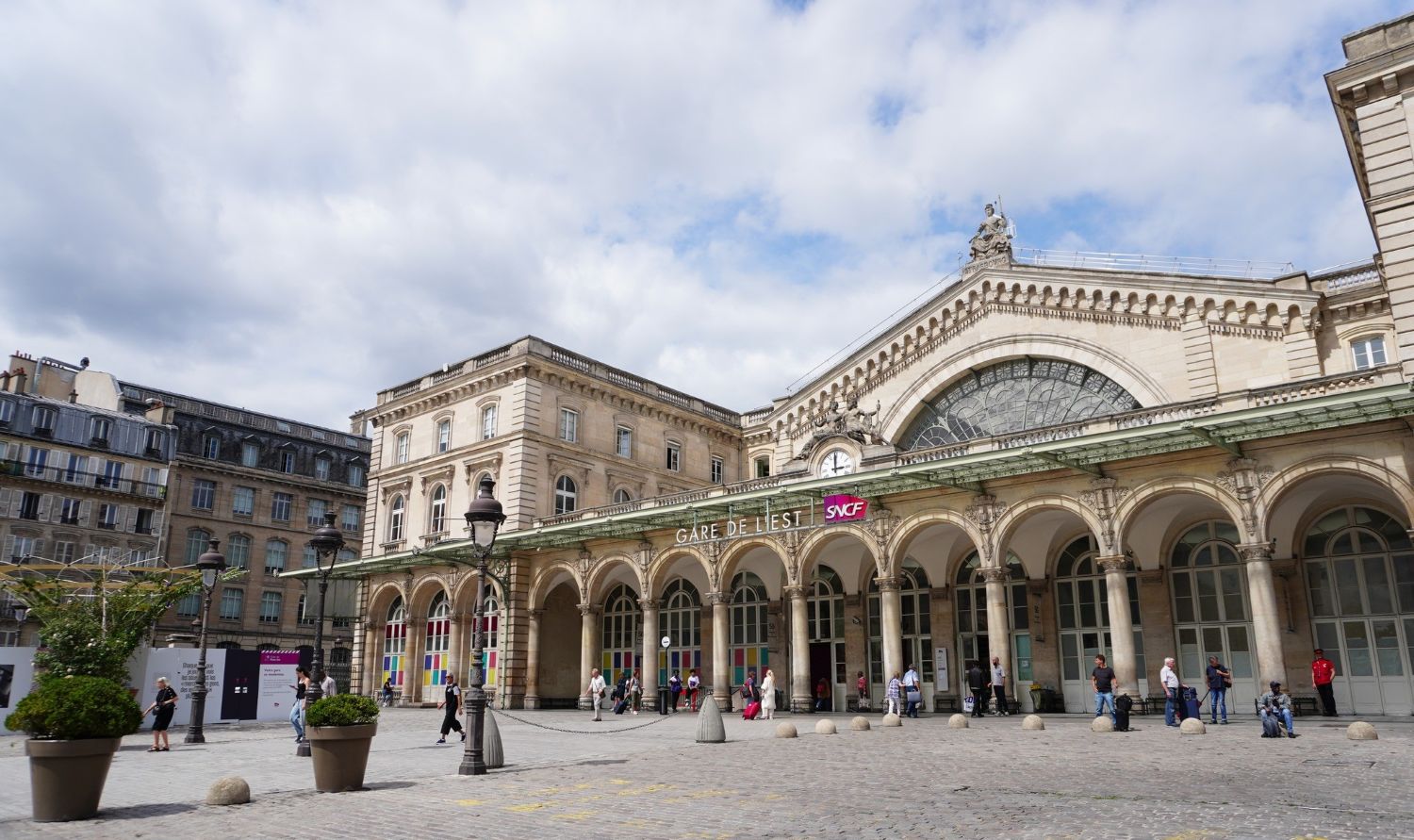
The Paris tourist office on the Gare de l’Est : https://parisjetaime.com/eng/transport/gare-de-l-est-p1936
The Paris tourist office on the 10éme arrondissement de Paris : https://parisjetaime.com/eng/article/explore-paris-s-10th-arrondissement-a843
The metro Monceau is a station on Line 2 , located in the 8éme arrondissement of Paris, on the edge of the 17éme arrondissement. The station is located under Boulevard de Courcelles at Place de la République-Dominicaine, on the edge of Parc Monceau. The station is also,served by bus line 30 of the RATP bus network. The station opened to the public on October 7, 1902, with the opening of the section between Étoile (now Charles de Gaulle – Étoile) and Anvers of Line 2 Nord. This became simply Line 2 on October 17, 1907, following the absorption of Line 2 Sud (corresponding to a large part of the current Line 6) by Line 5 on October 14. It owes its name to its proximity to Parc Monceau,(see posts) whose name refers to the former village of Monceau. The station has a single entrance called Place de la République-Dominicaine, opening onto the south sidewalk of Boulevard de Courcelles near the barrier of the Rotonde de Chartres, which marks the entrance to Parc Monceau on the said square. Consisting of a fixed staircase, it is decorated with a Guimard kiosk, it has two platforms separated by the metro tracks and the vault is elliptical.
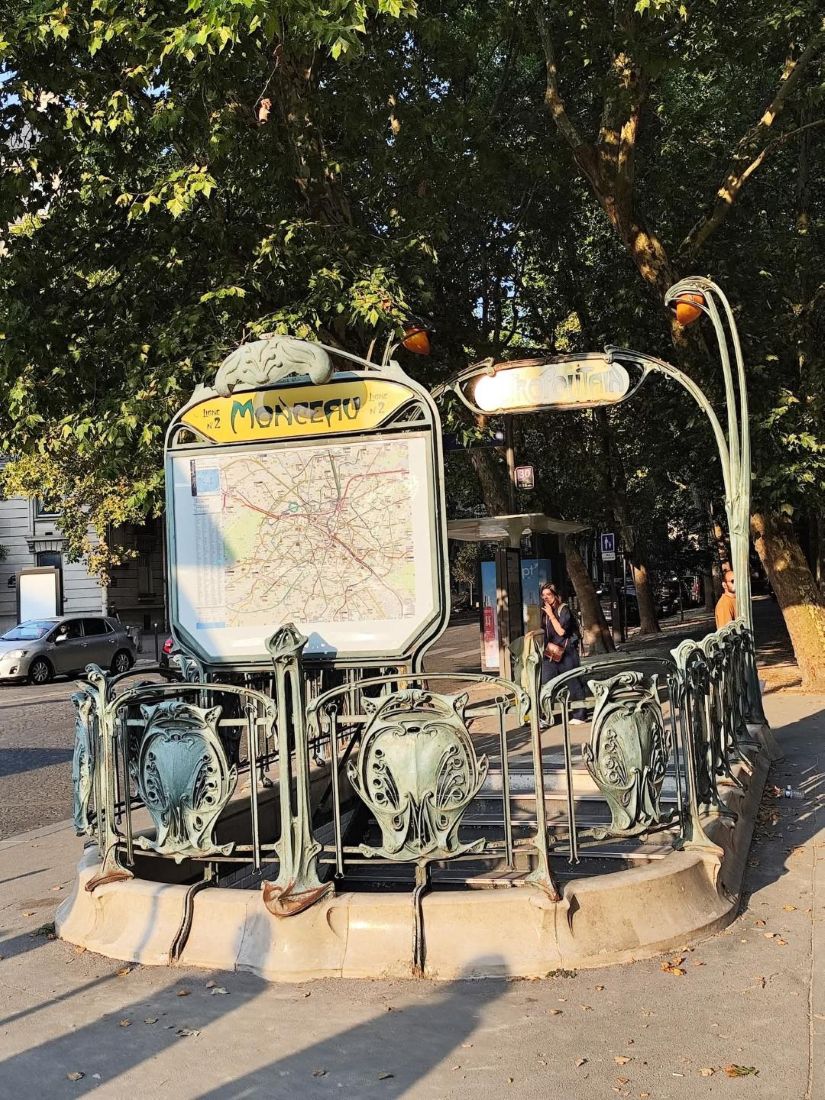
The official RATP transports on metro line 2 Monceau: https://www.ratp.fr/en/plans-lignes/metro/2
The Paris tourist office on walks from Opéra Garnier to Parc Monceau,sublime! : https://parisjetaime.com/eng/article/walk-from-palais-garnier-to-parc-monceau-a837
The Paris tourist office on the 8éme arrondissement de Paris: https://parisjetaime.com/eng/article/explore-paris-s-8th-arrondissement-a826
The metro Laumière is a station on line 5 , located in the 19éme arrondissement of Paris. The station is served by bus line 60 of the RATP bus network. The station is located in the La Villette quartier or neighborhood. It is located under Avenue Jean-Jaurès at the exit of Avenue de Laumière. The station opened on October 12, 1942, in the middle of WWII, with the commissioning of the penultimate extension of line 5 from Gare du Nord to Église de Pantin. The station owes its name to its proximity to Avenue de Laumière, which pays tribute to the French artillery general and polytechnician. Xavier Jean Marie Clément Vernhet de Laumière, He was on March 29, 1863, during the siége of Puebla (Mexico), he was wounded by a bullet to the head. This injury was not considered fatal, but on April 5 he became delirious and died the following night. The station has three entrances, including two main entrances and a secondary exit: entrance no. 1 “Avenue Jean Jaurès – Gymnasium”, consisting of a fixed staircase, opening directly opposite the Jean-Jaurès gymnasium at no. 87 of the aforementioned avenue; entrance no. 2 “Avenue de Laumière”, also consisting of a fixed staircase, located opposite no. 34 of this avenue; and entrance no. 3 “Rue de Meaux”, consisting of an ascending escalator allowing only the exit, located directly opposite nos. 41 and 43 of Avenue de Laumière. All the metro entrances are decorated with a Dervaux-type wrought iron balustrade and, for entrances 1 and 2, a candelabra in the same decorative style dating from the 1930s. It has two platforms, with a conventional length of 75 meters, separated by the metro tracks located in the center and the vault is elliptical.
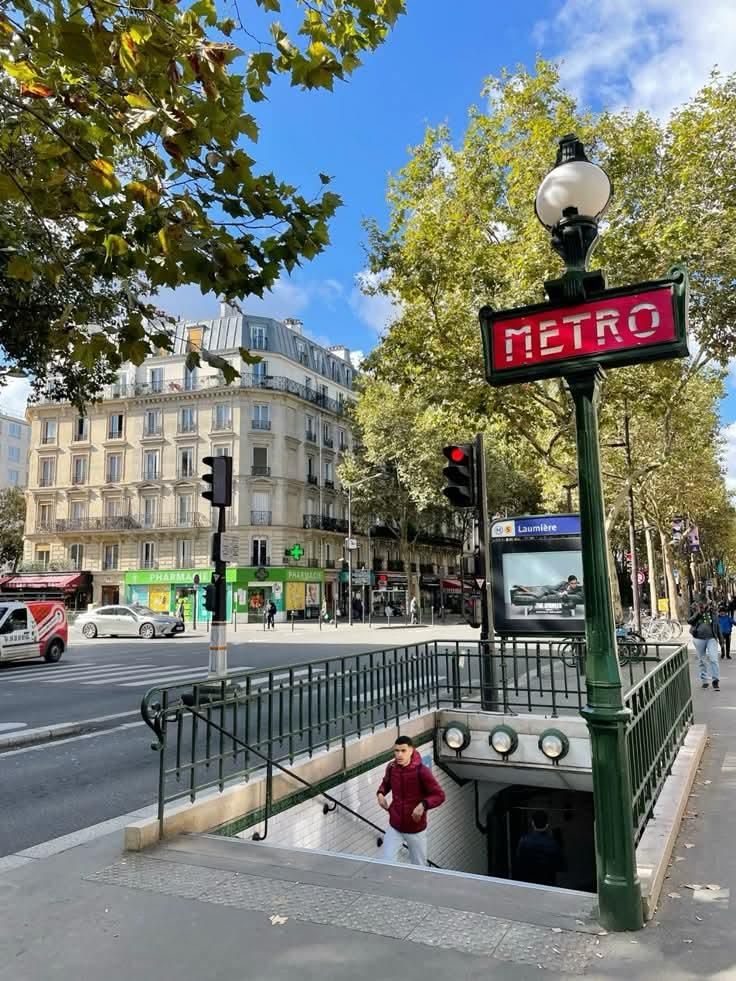
The official RATP transports on metro line 5 Laumière: https://www.ratp.fr/en/plans-lignes/metro/5
The Paris tourist office on the 19éme arrondissement de Paris: https://parisjetaime.com/eng/article/explore-paris-s-19th-arrondissement-a833
The Georges Pompidou National Center for Art and Culture (CNAC), commonly known as the Georges Pompidou Center, or Centre Pompidou or the Centre Beaubourg or simply the Beaubourg (see post) is a polycultural institution born from the will of the President. Georges Pompidou, a great lover of modern art, created in the heart of Paris an original cultural institution entirely devoted to modern and contemporary creation, where visual arts would be associated with books, design, music and cinema. It is located in the Saint-Merri neighborhood or quartier, in 4éme arrondissement or district of Paris. Within the National Museum of Modern Art / Center for Industrial Creation (MNAM / CCI), it has one of the world’s three largest collections of modern and contemporary art and the first in Europe. It also houses major galleries of temporary exhibitions, theaters and cinemas, and the BPI, the first public reading library in Europe. On either side of the square, two annexes house the IRCAM and the Brancusi workshop.
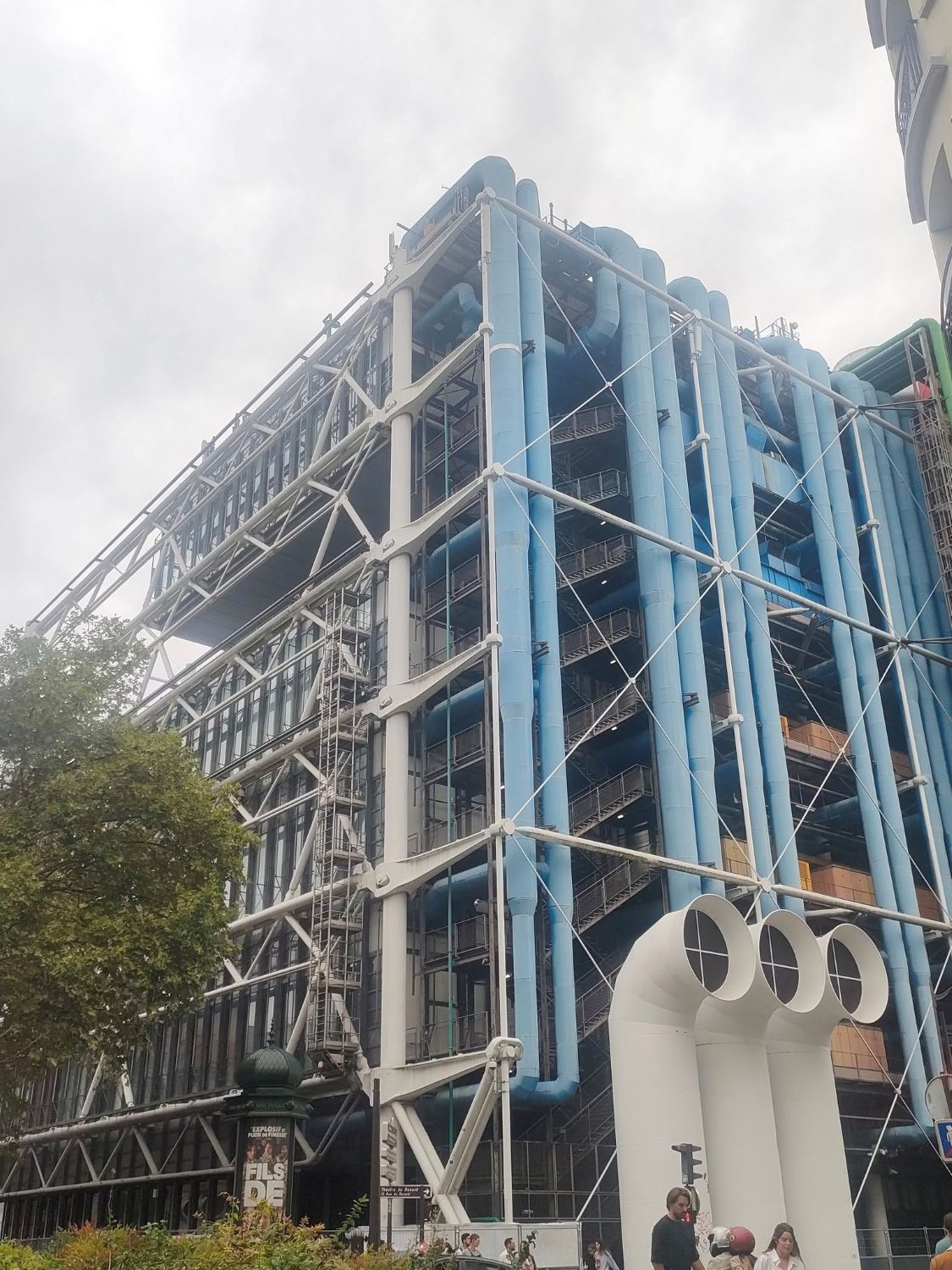
The Paris tourist office on Paris Centre (arrond 1-4) of Paris : https://parisjetaime.com/eng/article/explore-the-centre-of-paris-a846
The Paris tourist office on the Centre Pompidou : https://parisjetaime.com/eng/culture/centre-pompidou-p3593
The Pont Bir-Hakeim (see post) bridge, formerly the Passy viaduct, on two levels, with a length of 247 meters and a width of 25 meters, was built between 1903 and 1905. The bridge connects the Quai Branly and the Quai de Grenelle on the left bank to avenue du Président Kennedy on the right bank after crossing the northern tip of Île aux Cygnes. The upper level is reserved for the passage of metro line No. 6 (see post on the metro) Nation-Charles-de-Gaulle-Étoile, The metro line 6 is one of the most popular lines for tourists and Parisians, indeed love to take it and did to my office for several years. It offers unique views of several monuments such as the Eiffel Tower, the Butte Montmartre, the Maison de Radio France, the Île des Cygnes and the Beaugrenelle district. Near the Sèvres-Lecourbe station, you can see the perspective of Avenue de Breteuil on the Invalides before diving back underground. You can see the Ministry of Finance and the Palais Omnisports de Paris-Bercy during the aerial journey, as well as the François-Mitterrand library and, in the distance, the chevet of Notre-Dame Cathedral. Beyond the Montparnasse-Bienvenüe station, you see the Place Charles-de-Gaulle and the Arc de Triomphe; the Trocadéro; the Eiffel Tower and the Champ-de-Mars; the Montparnasse Tower, the editorial headquarters of Le Monde by Boulevard Auguste-Blanqui; Place d’Italie and the Butte-aux-Cailles district; the Ministry of Finance, the Palais Omnisports de Paris-Bercy and the Parc de Bercy and Place de la Nation. A rail tour of eternal Paris !
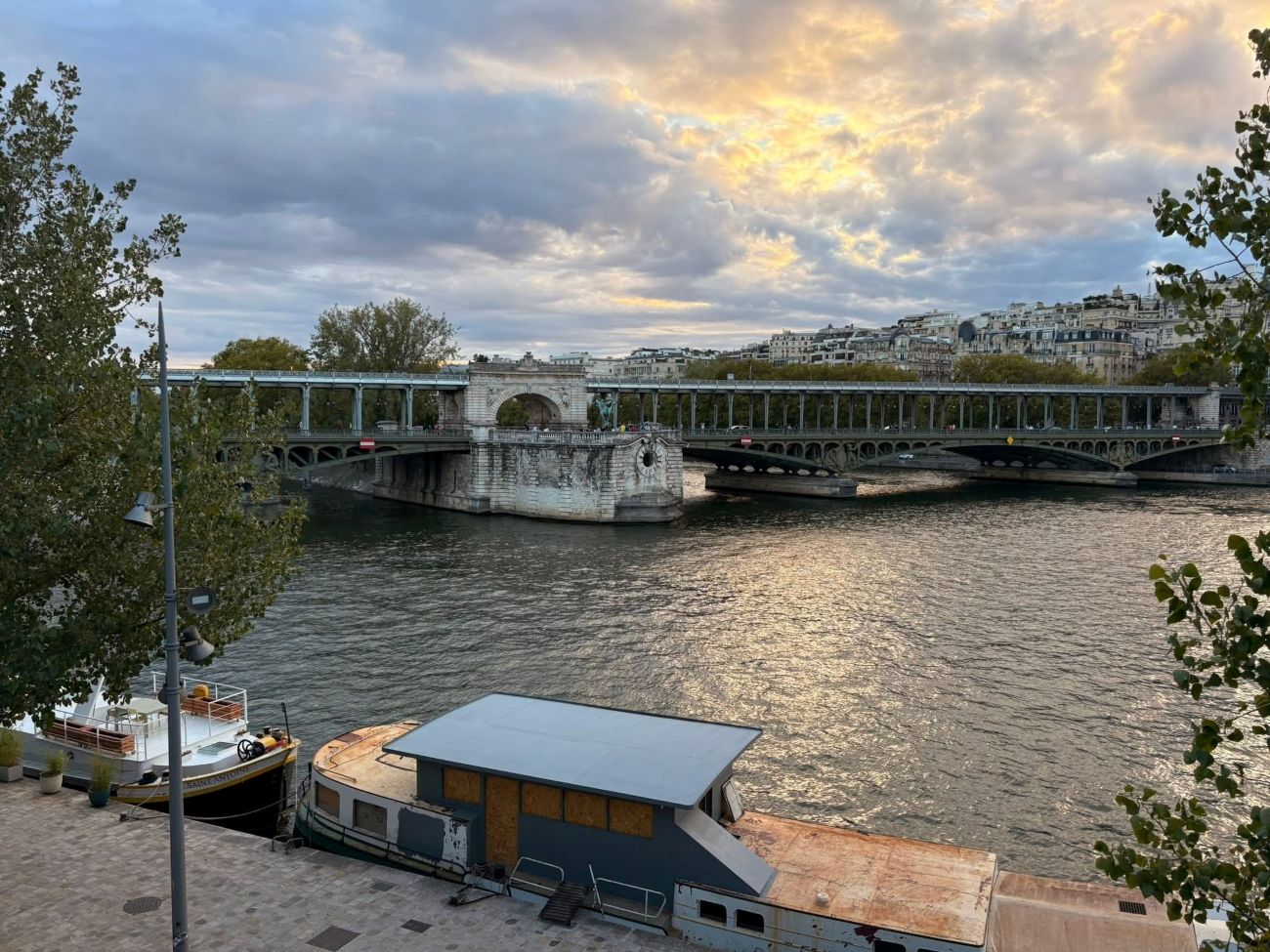
The Paris tourist office on the pont Bir Hakeim : https://parisjetaime.com/eng/transport/pont-de-bir-hakeim-p1880
The RATP public transports in Paris and suburbs on metro line 6 : https://www.ratp.fr/en/plans-lignes/metro/6
The Lariboisière Hospital, located at 2 Rue Ambroise Paré, in the 10éme arrondissement of Paris, You can come here by the metro Gare du Nord lines 4 and 5, metro Barbès-Rochechouart lines 2 and 4,as well as by the RER D Gare du Nord and RER E Magenta. The Lariboisière Hospital structure adopted is that of a pavilion hospital, where the buildings are arranged in a symmetrical “double comb” pattern. This double comb, with a long gallery forming the back, and the buildings forming the teeth of the comb, is arranged on either side of a vast central courtyard where the chapel is located. It consists of ten wings (five on each side), including six inpatient wings (three for women, three for men). These buildings are on three levels, completed by four service wings at the corners of the quadrilateral. The facade of the Chapel is decorated with three statues, representing the theological virtues: Faith, Charity, Hope (1855), The twelve stained glass windows representing the apostles and were created from 1856 to 1857. The murals are from 1858. The chapel houses the funerary monument of Countess Élisa de Lariboisière, with a sculpted group from 1853.
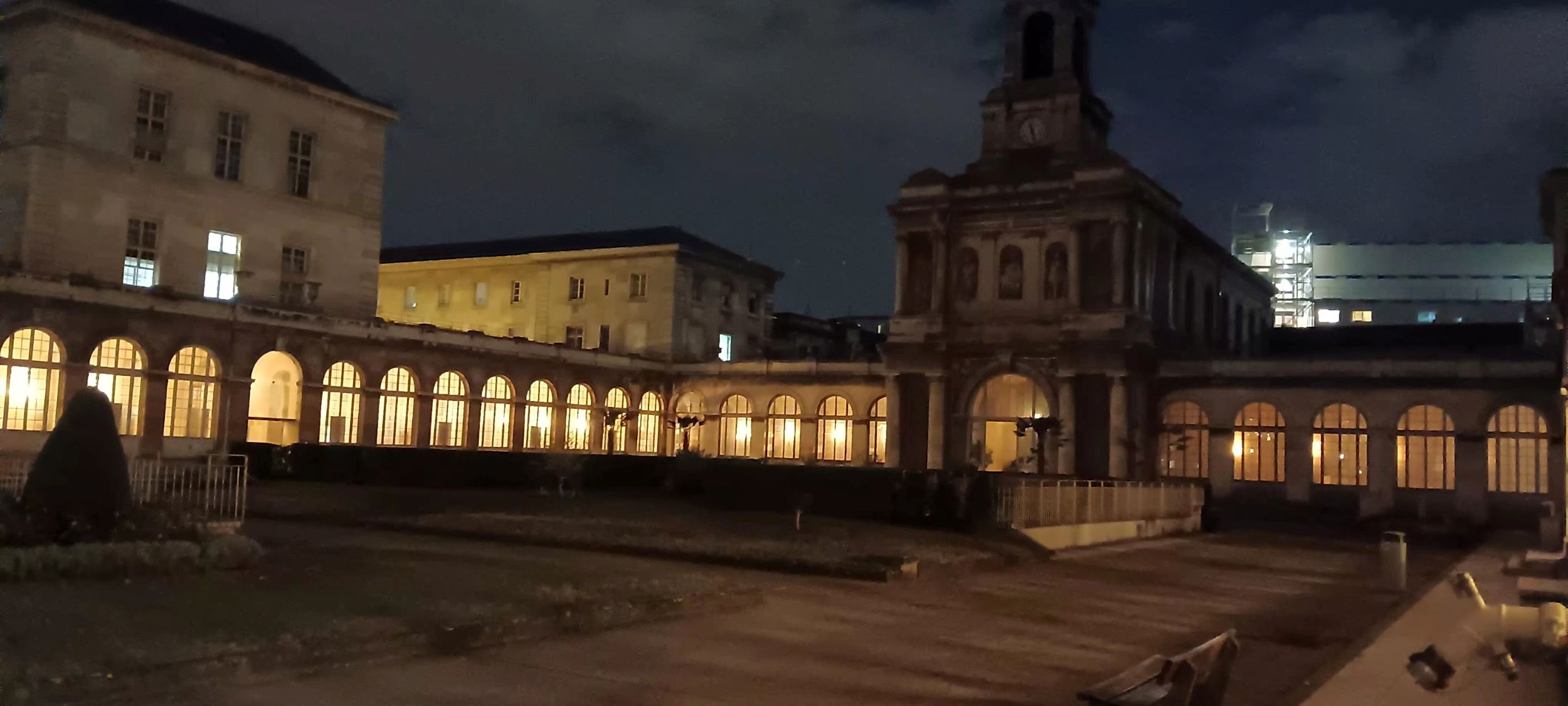
The Lariboisière Hospital was built in the 19C according to hygiene theories and in a pavilion style. It opened in 1854. It is now part of the Hospital Group (GH). The hospital is a partner of Université Paris-Cité. In 1846, work began on the deserted land of the former Saint-Lazare enclosure, located near the Poissonnière barrier. The hospital was successively called: 1839: Clos-Saint-Lazare Hospital or Northern Hospital, 1841: Louis-Philippe Hospital, 1848: Republic Hospital, and 1854: Lariboisière Hospital, The Countess Élisa de Lariboisière, daughter of Count Roy, Minister of Finance during the Restoration, and wife of Count de Lariboisière, son of the General of the Empire, who during her lifetime had distinguished herself for her charitable work, died without an heir on December 27, 1851. She left the greater part of her fortune in her will for the foundation of a hospital in Paris. This hospital, built in accordance with her last will and one of the most beautiful in Paris, received her name.
The official Hospital Lariboisiére: https://hopital-lariboisiere.aphp.fr/
The Paris tourist office on the Hospital Lariboisiére : https://parisjetaime.com/eng/pro/hopital-lariboisiere-et-fernand-widal-p2695
The Hôtel de Crillon, a Rosewood Hotel is located at 10 Place de la Concorde, in the 8éme arrondissement of Paris. Built in 1775 by the architect Louis-François Trouard, behind a façade built by the architect Ange-Jacques Gabriel in 1758, it was first the residence of the Duke of Aumont in 1776 and from 1788 it was the property of the Counts and then Dukes of Crillon. It was confiscated as national property during the French revolution, then returned to the family who reinstated it until 1906. It was transformed into a hotel establishment from 1909 by the architect Walter-André Destailleur to become “L’Hôtel des voyageurs”. Inaugurated on March 11, 1909, and opened to travelers on March 12, the Hôtel de Crillon quickly enjoyed worldwide renown and welcomed personalities from all over the world. In 1973, the prestigious hotels L’Hôtel de Crillon, Le Lutetia, Le Louvre in Paris and Le Martinez in Cannes were united within the Concorde Hotels & Resorts subsidiary of the Taittinger group (one of the hotel subsidiaries of the Groupe du Louvre majority-owned by the Taittinger family). On July 21, 2005, the financial group Starwood Capital Group (I was in transition with this group while working in Paris) bought the Taittinger family’s shares, shortly after the death of patriarch Jean Taittinger, and thus became the new owner of the Hôtel de Crillon. It was sold in 2010 to a member of the Saudi royal family. On March 31, 2013, the Hôtel de Crillon closed its doors for the largest restoration in its history. At the same time, it formalized its integration into the Rosewood Hotels & Resorts group. On September 19, 2018, it received the “palace” distinction, becoming the 25th palace in France. Its famous restaurants are the L’Écrin , a Michelin-starred gourmet restaurant led by Executive Chef Boris Campanella Nonos et Comestibles by Paul Pairet : Jardin d’hiver, a tea room led by pastry chef Matthieu Carlin, La Cave, a private dining room led by head sommelier Xavier Thuizat, and my favorite many times there ,the Bar Les Ambassadeurs led by Kevin Rigault, Some of the politicians guests here include Winston Churchill, US President Richard Nixon, Japanese Emperor Hirohito, Egyptian President Hosni Mubarak, Queen Noor of Jordan, King Hassan II of Morocco, Queen Sofia of Spain, and Nobel Prize winners Yasser Arafat and Shimon Peres, and Fidel Castro, The Hôtel de Crillon has also hosted military personnel, such as Marshal Joseph Joffre or General Leclerc, and sometimes heads of state such as Philippe Pétain. In 1998, the French football team presented the Football World Cup to the public from the upstairs terrace. A replica, built by Horace Trumbauer and Julian Abele, of the two buildings on the Place de la Concorde is located in Philadelphia PA USA. One of the buildings houses the Free Library of Philadelphia and is a replica of the Hôtel de Crillon.
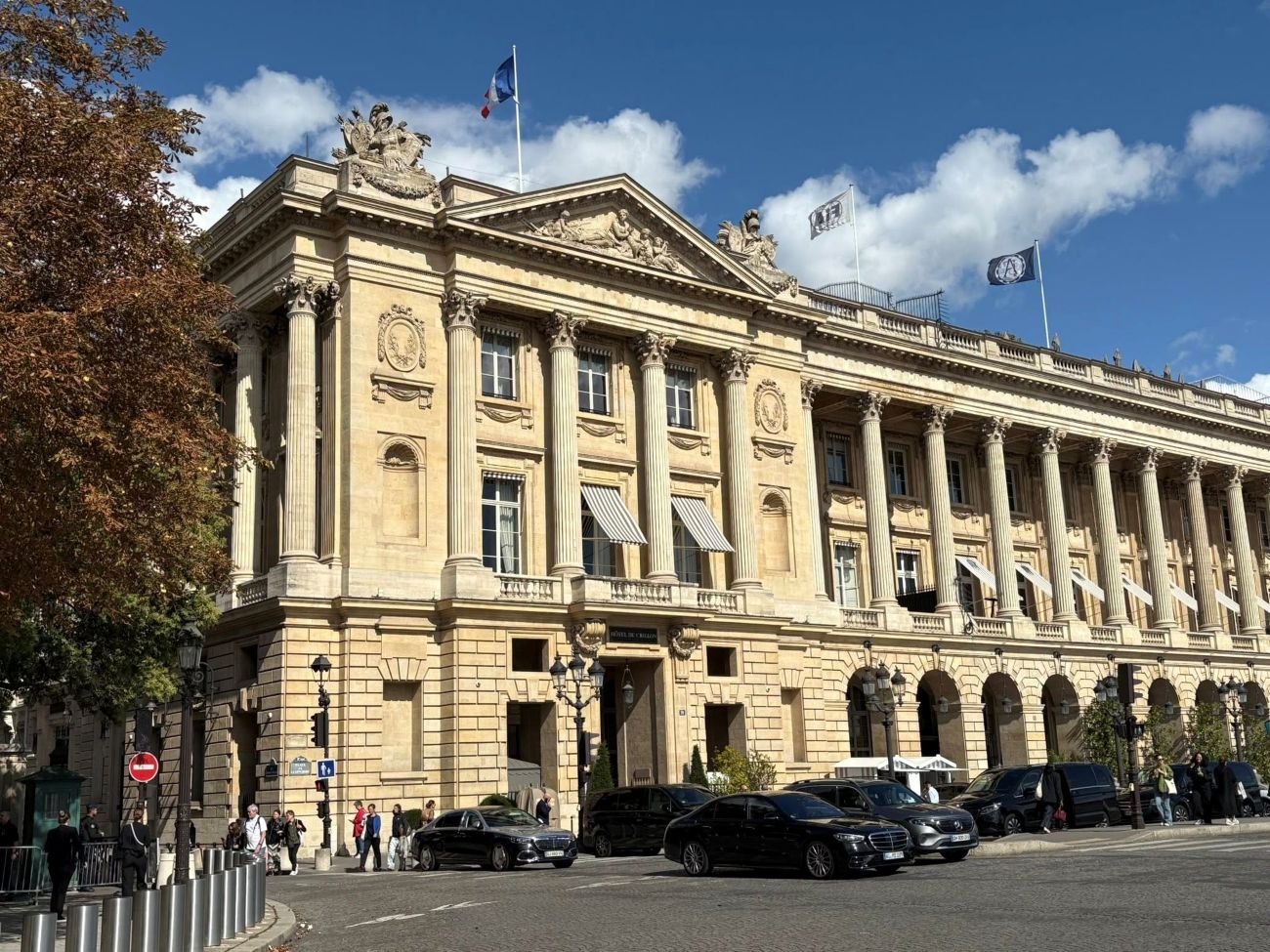
The Rosewood hotels on the Hôtel de Crillon : https://www.rosewoodhotels.com/en/hotel-de-crillon
The Paris tourist office on the Hôtel de Crillon : https://parisjetaime.com/eng/article/hotel-de-crillon-a-rosewood-hotel-a739
There you go folks, a dandy city to explore and enjoy with the family, Memorable moments in my eternal Paris, driving and walking all over in my road warrior trails brings out sublime awesome spots with nice memorable family visits of yesteryear always remember and always looking forward to be back, eventually. Again hope you enjoy the post on curiosities of Paris , part XLVIII !!! as I.
And remember, happy travels, good health, and many cheers to all !!!

 Paris1972-Versailles2003